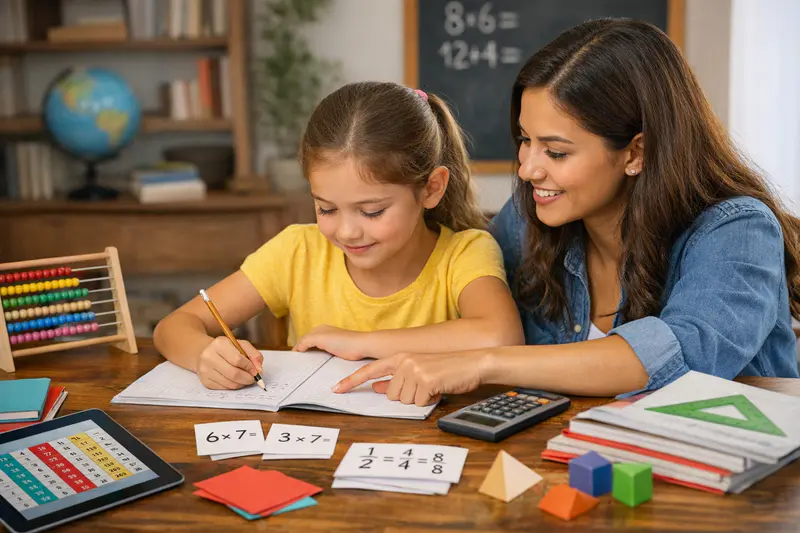
Maths for Kids: How to Build Strong Foundations at Home
Here is something most parents don't realise until it's already a problem: the maths concepts children learn between ages 6 and 11 determine how they experience maths for the rest of their education. Not just in primary school. Secondary school, university entrance, and career pathways all run through the foundation built in those early years.
A child who leaves primary school with genuinely solid maths for kids foundations, number sense, arithmetic fluency, early algebraic thinking, finds secondary maths accessible. One who reaches secondary school with gaps in those areas finds it progressively harder, because each new topic in maths builds on the ones before. The subject doesn't reset. It compounds.
This guide covers the complete picture of children's maths education from age 5 to 17: what matters at each stage, why children struggle, what parents can do at home, how Vedic and mental maths methods accelerate fluency, when to seek additional help, and how to find instruction that produces lasting results.
Key Takeaways
Mathematical foundations built between ages 6 and 11 determine a child's relationship with maths throughout secondary school and beyond.
The most common cause of maths difficulty is not low ability. it is a specific conceptual gap that was never properly addressed and compounded as the curriculum advanced.
Mental arithmetic fluency, including Vedic maths techniques, produces measurably faster and more confident calculation across all areas of school maths.
Live 1:1 maths instruction is the most effective format for identifying and fixing specific gaps, because it adapts to exactly where each child's understanding breaks down.
Codeyoung's maths programme has helped 45,000+ students across the USA, UK, Canada, and Australia build the foundations their school curriculum assumed they already had.
Maths by Age: What Children Should Know and When
Every country's school curriculum covers broadly the same mathematical ground in the same order. Understanding what's expected at each stage helps parents spot when a child is on track, when they're ahead, and, most usefully, when a specific concept hasn't fully landed before the class moved on.
Core Maths Concepts by Age Group
The warning signs in this table are worth reading carefully. They're not indicators of low mathematical ability. They are specific signals that a concept hasn't been fully internalised, often because it was introduced, tested, and moved past before it was truly fluent. Addressing the warning sign at the age it appears takes days or weeks. Addressing it three years later, after several dependent topics have also been partially understood, takes months.
Why Do Children Struggle With Maths?
The most common answer parents give to this question is "my child just isn't a maths person." It's almost always wrong. Genuine mathematical learning disability (dyscalculia) affects around 3 to 7% of children. The vast majority of children who struggle with maths do so for one of a small number of identifiable, fixable reasons.
Reason 1: A conceptual gap that was never addressed
The most common cause of maths difficulty is a specific foundational concept that didn't fully land. Times tables that were never truly fluent slow down fraction work. Fraction understanding that remained shaky makes ratio and percentage harder. Place value confusion produces errors in every multi-digit calculation. The child isn't bad at maths. They're struggling with today's topic because yesterday's concept wasn't complete.
For a parent guide on identifying and addressing these gaps, see How to Help a Child Who Is Struggling With Maths: A Parent Guide.
Reason 2: Maths anxiety
Maths anxiety is a specific, well-researched phenomenon distinct from general school anxiety. It produces measurable performance decrements: the brain's working memory is partially occupied by anxiety about maths, leaving less cognitive resource available for the mathematical task itself. Children with maths anxiety consistently underperform relative to their actual mathematical ability.
The most effective intervention for maths anxiety is positive experience of success at an appropriate level. This sounds circular but isn't: a child who experiences genuine mastery of a concept they found difficult stops being anxious about that concept. The anxiety is not a fixed trait. It's a learned response to repeated difficulty, and it can be unlearned through the right instruction. For more on this pattern, see Maths Anxiety in Kids: Signs, Causes, and How 1:1 Tutoring Helps.
Reason 3: Procedural learning without conceptual understanding
Many children learn to perform mathematical procedures correctly without understanding why they work. They can follow the algorithm for long division but can't explain what division means. They can apply the percentage formula but can't estimate whether their answer is reasonable. This works reasonably well up to age 10 or 11. After that, the curriculum demands conceptual flexibility, applying the same idea in different forms, transferring it to unfamiliar contexts, and procedure-only understanding breaks down.
Reason 4: Pace mismatch with the classroom
A class of 30 children moves at approximately the pace of the middle third. A child who needs more time on fractions before moving to percentages doesn't get it. A child who grasped fractions in two sessions and is ready for percentages also doesn't get the right pace. The classroom format is structurally unable to deliver pace-appropriate instruction to every child. This isn't a teacher failure, it's a systemic constraint that live 1:1 instruction is specifically designed to overcome.
Mental Maths and Vedic Techniques: Why They Matter More Than Parents Expect
Mental arithmetic fluency is not just a party trick. It has a specific, measurable effect on mathematical performance across every area of the curriculum. Children who can calculate quickly and accurately in their heads have more cognitive bandwidth available for the thinking part of a maths problem: the part that requires reasoning, not computation.
A child who spends 90% of their working memory on the calculation has almost nothing left for the strategy. A child who calculates fluently spends 10% on computation and 90% on thinking. The difference in problem-solving quality between these two children is enormous, and it's entirely attributable to arithmetic fluency rather than intelligence.
What are Vedic maths techniques?
Vedic mathematics is a system of calculation techniques derived from ancient Indian mathematics, systematised in the 20th century by Bharati Krishna Tirthaji. It provides faster computational methods for multiplication, division, squares, and more through pattern-based mental procedures. A child who learns the Vedic technique for multiplying numbers near 100, for example, can calculate 96 x 98 mentally in under 5 seconds. The same calculation using the standard algorithm takes 30 to 45 seconds on paper.
The value of Vedic techniques is not in replacing standard methods but in building the mental agility and numerical intuition that make all arithmetic faster. For a detailed look at specific techniques, see Vedic Maths for Kids: Ancient Techniques That Make Arithmetic Easy and Mental Maths Tricks for Kids: 9 Techniques That Actually Work.
Mental Maths Techniques by Age Group
Want to find your child's specific maths gaps and build the fluency their school curriculum assumed they already had? Codeyoung's maths instructors assess every new student and start from exactly where they are. Book a free trial class with no commitment required.
Book a Free Trial Maths Class →
What Can Parents Do at Home to Support Maths Learning?
Parents don't need to be mathematicians to meaningfully support their child's maths development. The most effective home support strategies require almost no content knowledge: they require consistency and the right framing.
Daily mental arithmetic practice, 5 minutes maximum. Short, daily practice builds fluency faster than occasional long sessions. Five minutes of times table practice every morning is more effective than 35 minutes once a week. The key is that it should be slightly challenging but mostly successful, frustration does not produce fluency.
Make calculation visible in everyday life. "How many do we need if each person has three?" "What's 20% off £45?" "How long will the journey take if we're averaging 60mph?" These are real maths problems that children see as relevant because they're embedded in situations they care about. The motivation to calculate correctly is higher when the answer means something.
Reframe "I'm not a maths person." Research by Carol Dweck and colleagues consistently shows that children who believe mathematical ability is fixed (you either have it or you don't) perform significantly worse than those who believe it develops through effort. When a child says "I'm bad at maths," the most useful response is not reassurance but reframe: "You haven't learned this yet. Let's figure it out."
Don't help by doing it for them. The most common well-intentioned mistake parents make is completing the difficult steps while the child watches. The child needs to experience the productive struggle. Offer to think through the problem together rather than providing the method. "What do we know? What are we trying to find? What have we tried?" These questions produce far more learning than a demonstration.
Connect maths to your child's interests. Sport statistics, music rhythm, cooking measurements, gaming points systems, every child has a context where numbers are meaningful to them. Maths encountered in that context is learned more durably than maths presented as an abstract school requirement.
For a detailed framework on supporting home maths practice, see How to Improve Your Child's Maths Skills at Home (Without the Tears).
When Does a Child Need More Than School Maths Can Provide?
Most children need supplementary maths instruction at some point. The question is when, and what form that instruction should take.
The clearest signal that school maths is insufficient is a widening gap between what a child understands and what the class is currently covering. This gap rarely closes by itself. School moves forward. A child who didn't fully grasp fractions when the class covered them will be behind when the class covers ratios, and further behind when it covers percentages, and significantly behind when it covers algebra. The appropriate time to act is the moment the gap becomes visible, not after it has compounded.
What are the signs a child needs extra maths help?
The most reliable signals include: consistent errors on a specific type of problem across multiple weeks; reluctance or avoidance of maths homework that isn't present in other subjects; a marked drop in maths confidence compared to a year earlier; maths test scores that are noticeably below the child's performance in other subjects; and the child's own statements that they "don't understand" a topic rather than just finding it hard. See Signs Your Child Needs a Maths Tutor: When to Get Extra Help for the full framework.
How Do You Choose the Right Maths Programme for Your Child?
Not all maths instruction is equivalent, and the differences in outcome between good and poor programmes are significant. These are the criteria that predict genuine results.
What to Look for in a Children's Maths Programme
How Codeyoung's Maths Programme Builds Foundations That Last
Codeyoung's maths programme is built around live 1:1 instruction that covers three interconnected areas: school curriculum support (ensuring the child understands what their class is currently working on), mental arithmetic fluency (including Vedic techniques appropriate to the child's age), and foundational gap-filling (identifying and properly addressing concepts that weren't fully learned earlier).
The programme serves children aged 6 to 17 across the USA, UK, Canada, and Australian curriculum frameworks. Every new student is assessed before the curriculum begins, and the starting point is determined by what the assessment reveals rather than by the child's year group. A Year 7 student with a solid fraction foundation and weak algebraic thinking starts differently from a Year 7 student who needs fraction work first.
The maths and coding programmes are designed to work together. Children who take both simultaneously develop faster mathematical reasoning than those who take either alone, because coding provides purposeful, concrete applications for the same concepts maths instruction introduces abstractly. For more on this connection, see Coding and Maths for Kids: How Learning Both Gives Children a STEM Edge.
Frequently Asked Questions About Maths for Kids
What age should children start structured maths instruction?
Children can begin structured maths instruction from age 5 or 6, starting with number recognition, counting, and basic addition. Most children receive this through school, but supplementary 1:1 instruction from age 6 upwards is appropriate for children who need more time on foundational concepts or who show strong early aptitude and would benefit from enrichment. The most impactful window for intervention is ages 7 to 11, when foundational gaps can be addressed before they compound.
Why does my child understand maths in class but fail tests?
This pattern almost always reflects procedural understanding without conceptual depth. The child can follow a demonstrated method when it is fresh in working memory but cannot retrieve and apply it independently under test conditions. The fix is not more practice of the same procedure but a different kind of instruction: one that builds understanding of why the method works, which makes it reconstructable rather than merely memorable. A child who understands why long division works can reconstruct the method if they forget a step. One who only memorised the steps cannot.
How do I know if my child is at the right maths level?
The most reliable check is whether your child can independently solve problems at their current year group level without looking up methods or needing hints. If they can follow a demonstrated method but cannot start a similar problem from scratch, the concept isn't fully internalised. If they can solve familiar problem types but freeze on slightly unfamiliar applications of the same concept, their understanding is procedural rather than conceptual. Both are worth addressing before the class moves to the next topic.
What is the difference between Vedic maths and standard maths?
Standard maths curricula teach methods that are reliable and generalisable but not necessarily the fastest. Vedic mathematics teaches pattern-based mental calculation techniques that are faster for specific problem types. They are not alternatives to standard methods but supplements that build numerical intuition and calculation speed. A child who learns both is more flexible and faster than one who knows only the standard approach. Vedic methods are particularly valuable for mental multiplication, squaring, and rapid percentage work.
My child says maths is boring. What can I do?
Boredom in maths almost always means one of two things: the work is too easy, or the work feels pointless. For the first, the solution is more challenging material. For the second, the solution is better context. Children who find maths boring in the abstract often find it engaging when it's applied to something they care about. Sport analytics, game scoring, cooking quantities, music beats, or budgeting for something they want to buy all provide real contexts where the same calculations feel purposeful. The maths hasn't changed. The motivation has.
Should children use calculators for maths practice?
For practice specifically aimed at building fluency and understanding, calculators should be minimised. Using a calculator for basic arithmetic during learning prevents the development of number sense and mental fluency. For complex multi-step problems where the arithmetic isn't the focus of the learning, calculators are appropriate. The distinction matters: when the goal is to understand a concept or build mental speed, the calculation should happen in the child's head. When the goal is to explore a complex problem and arithmetic would distract from the thinking, a calculator is a reasonable tool.
How much maths practice should children do at home per day?
For mental arithmetic fluency specifically, 5 to 10 minutes of daily practice is more effective than longer less frequent sessions. For broader maths learning and homework, the appropriate time varies by age: 10 to 15 minutes per day for ages 7 to 9, 20 to 30 minutes for ages 10 to 13, and up to 45 minutes for older secondary students. Quality matters more than duration. Focused practice with specific goals produces more progress than the same amount of time spent on familiar, comfortable problems.
What maths topics do most children find hardest?
The topics that produce the most persistent difficulty are fractions (where conceptual confusion is very common), algebra (particularly the transition from arithmetic to symbolic reasoning), and word problems (which require both mathematical and reading comprehension). These aren't harder topics in an absolute sense. They're topics where procedural instruction is especially likely to produce superficial understanding, and where conceptual grounding is especially important for long-term success.
Can maths anxiety be overcome?
Yes. Maths anxiety is a learned response and can be unlearned through positive experience of mathematical success. The most effective approach is structured exposure to maths problems at a level the child can succeed at, with gradual increase in challenge as confidence builds. This is best done in a low-stakes environment with a patient instructor who can identify exactly where anxiety is linked to specific gaps rather than to maths generally. Most children with significant maths anxiety show meaningful improvement within 6 to 10 sessions of appropriate 1:1 instruction.
How does Codeyoung's maths programme work?
Codeyoung's maths programme is delivered through live 1:1 sessions with a qualified instructor. Every new student begins with an assessment that identifies their current level, specific gaps, and areas of strength. The curriculum combines school curriculum support (covering what the child's class is working on), mental arithmetic and Vedic techniques, and foundational gap-filling. Sessions are available for children aged 6 to 17, and the first session is free with no commitment required.
Strong Maths Foundations Change Everything That Follows
The children who find secondary maths accessible are not, in the main, more gifted than the children who find it hard. They are children who arrived with solid foundations: times tables that never required effort, fraction concepts that were genuinely understood rather than procedurally memorised, and early algebra that felt like a natural extension of arithmetic rather than an alien system.
Those foundations are built between ages 6 and 11, reinforced through consistent practice, and strengthened by the kind of responsive, adaptive instruction that only 1:1 teaching can deliver. The investment of time in this window pays dividends across a decade of subsequent learning.
Explore Codeyoung's maths programme for children aged 6 to 17, or book a free trial session and let our instructors identify exactly where your child's foundations need strengthening.
Build the maths foundations your child's future depends on.
Codeyoung offers personalised 1:1 live maths classes for children aged 6 to 17, covering school curriculum, mental arithmetic, and Vedic techniques. Expert instructors, flexible scheduling, and a completely free first class.