Math Anxiety in Kids: Signs, Causes, and How 1:1 Tutoring Helps
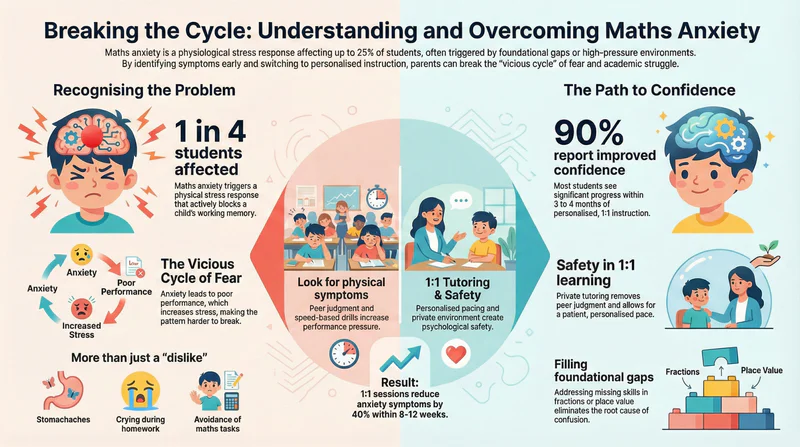
Math anxiety in kids is a genuine psychological response that causes stress, fear, and mental blocks when facing math tasks. It affects an estimated 20% to 25% of students and can significantly impact academic performance. The good news is that math anxiety is highly treatable, especially with patient, personalized instruction that rebuilds confidence one small win at a time.
If your child freezes up during math tests, complains of stomachaches before math class, or insists they're "just not a math person," you're likely dealing with more than a simple dislike of the subject. Math anxiety is real, it's common, and it creates a vicious cycle that makes math harder than it needs to be.
Let's look at what's actually happening, how to recognize it, and what you can do to help your child break free from math fear.
Key Takeaways:
Math anxiety affects 20-25% of students and triggers real physiological stress responses increased heart rate, sweating, and reduced working memory that block mathematical thinking.
At Codeyoung, 90% of students who previously showed math anxiety symptoms report improved confidence within 3-4 months of 1:1 personalized instruction focused on rebuilding foundational skills.
Watch for physical symptoms (stomachaches before math class), emotional responses (crying during homework), avoidance behaviors, and negative self-talk ("I'm not a math person").
Math anxiety creates a vicious cycle: anxiety reduces performance, poor performance increases anxiety, making intervention essential before the pattern becomes deeply ingrained.
One-on-one tutoring breaks the anxiety cycle by removing peer judgment, allowing patient pacing, filling foundational gaps, and creating small wins that rebuild positive math associations.
What Math Anxiety Actually Is
Math anxiety is a genuine emotional and physiological stress response increased heart rate, sweating, reduced working memory that occurs when a child faces math-related situations. It's not laziness or lack of intelligence; it's the brain perceiving math as a threat and triggering the same stress response as physical danger.
When a child with math anxiety faces a math problem, their brain perceives it as a threat. This triggers the same stress response they'd have if facing physical danger. Their heart rate increases, their palms sweat, and their working memory gets hijacked by worry. The mental resources they need to actually solve the problem get consumed by anxiety instead.
Research published in the journal Current Directions in Psychological Science found that math anxiety reduces working memory capacity, which directly impairs the ability to solve math problems. In other words, anxious kids aren't performing poorly because they don't understand math. They're performing poorly because anxiety is literally blocking their thinking.You can read the research here.
This creates a painful cycle. Anxiety leads to poor performance, which leads to more negative math experiences, which increases anxiety further. Without intervention, the cycle tends to get worse over time.
Recognizing Math Anxiety Symptoms
The five main signs of math anxiety are: physical symptoms (stomachaches, headaches before math), emotional responses (crying, shutting down), avoidance behaviors (forgetting assignments), negative self-talk ("I'm not a math person"), and test performance that's significantly worse than homework. Here's how to recognize each:
Physical symptoms often appear before or during math activities. Your child might complain of headaches, stomachaches, or nausea specifically around math time. These aren't excuses. Anxiety genuinely causes physical discomfort.
Emotional responses can include crying, anger, or shutting down completely when faced with math homework. You might notice your child becoming unusually irritable or upset during homework sessions, even when they were fine moments before.
Avoidance behaviors are common. Your child might "forget" to bring home math assignments, rush through math work just to be done with it, or procrastinate on anything math-related while happily doing other homework.
Negative self-talk is a major red flag. Phrases like "I'm stupid at math," "I'll never understand this," or "I'm not a math person" suggest your child has internalized their struggles as a fixed identity rather than a temporary challenge.
Test performance that doesn't match homework performance often indicates anxiety. If your child seems to understand concepts at home but bombs tests, anxiety is likely interfering with their ability to demonstrate what they know.
What Causes Math Anxiety
The primary causes of math anxiety are: early negative experiences (harsh teacher comments, classroom embarrassment), parental attitudes ("I was never good at math either"), teaching methods emphasizing speed over understanding (timed drills), foundational knowledge gaps creating ongoing confusion, and performance pressure from grades or tests. Math anxiety rarely appears out of nowhere it develops from specific experiences that taught your child to fear math.
Early negative experiences plant the seeds. A harsh comment from a teacher, embarrassment from getting an answer wrong in front of classmates, or consistently struggling with timed tests can create lasting associations between math and shame.
Parental attitudes matter more than most people realize. If you've said things like "I was never good at math either" or visibly shown frustration when helping with homework, your child may have absorbed the message that math is inherently difficult and scary.
Teaching methods that emphasize speed over understanding can trigger anxiety. Timed multiplication drills, for example, teach many kids that math is about being fast rather than thinking carefully. Kids who need more processing time learn that they're "slow" and start dreading math situations.
Foundational knowledge gaps create ongoing math anxiety because each new lesson builds on concepts the child never fully mastered. When a student doesn't understand fractions from 3rd grade, later work with decimals, percentages, and ratios feels impossible. They're constantly trying to build on a shaky foundation, which keeps them in a perpetual state of confusion and stress that manifests as anxiety.
The pressure to perform, whether from grades, standardized tests, or parental expectations, can transform normal challenge into paralyzing anxiety for some kids.
Why Traditional Approaches Often Fail
The typical response to a struggling math student is more practice problems. But for an anxious child, this can actually make things worse.
Imagine you're terrified of dogs, and someone's solution is to put you in a room with more dogs. That's essentially what we do when we give anxious kids more math drills. We increase exposure to the thing that scares them without addressing the underlying fear.
Group tutoring settings intensify math anxiety because children fear looking stupid in front of peers. Anxious students in group classes stay silent rather than asking clarifying questions, pretend to understand concepts they don't, and experience constant performance pressure from comparing themselves to classmates. This classroom environment keeps their anxiety response activated rather than creating the psychological safety needed for learning.
Impatience, whether from parents or teachers, reinforces the belief that they should "get it" faster. When adults show frustration, anxious kids internalize that frustration as confirmation that something is wrong with them.
How 1:1 Tutoring Addresses Math Anxiety
One-on-one tutoring reduces math anxiety by: removing peer judgment (private learning environment), allowing patient pacing (no rushing), building trust through consistent relationships, filling foundational gaps that fuel confusion, and creating small wins that rebuild confidence. Personalized instruction directly counters each major cause of math anxiety.
A private learning environment removes the fear of judgment. There's no classroom of peers watching, no pressure to keep pace with others, and no embarrassment about asking "basic" questions. Your child can admit confusion freely without social consequences.
Patient pacing allows your child to slow down. They can spend as much time as needed on a concept without feeling rushed or stupid. This alone can dramatically reduce anxiety, because much of math fear comes from feeling perpetually behind.
A consistent relationship with one tutor builds trust over time. Your child learns that this person won't judge them, won't lose patience, and will keep explaining until things make sense. That safety transforms the learning experience.
Starting from solid ground matters. A good1:1 math tutor will identify where your child's understanding breaks down and rebuild from there. Filling foundational gaps eliminates the constant confusion that fuels ongoing anxiety.
Small wins accumulate into confidence. When your child successfully solves problems at their level, they start building positive math experiences. Over time, these experiences overwrite the negative associations driving their anxiety.
Among Codeyoung's 50,000+ students, those who began with significant math anxiety showed a 40% reduction in anxiety symptoms within their first 8-12 1:1 sessions measured through self-reported stress levels, homework completion rates, and willingness to attempt challenging problems. The key factor was personalized pacing that prevented re-triggering anxiety while systematically building competence.
What Parents Can Do at Home
While professional support often helps, there's plenty you can do to reduce math anxiety at home.
Watch your own language around math. Even casual comments like "math is hard" or "I hated math as a kid" can reinforce your child's belief that math is something to fear. Instead, emphasize that math is learnable with practice. Research from the University of Chicago found that parents' own math anxiety directly predicts their children's math anxiety levels but only when parents are heavily involved in homework, suggesting that anxious parents inadvertently transmit their fears through frustrated helping attempts.
Separate your child's worth from their math performance. Make sure they know you love them regardless of grades. When math struggles don't threaten their sense of being loved and accepted, the stakes feel lower.
Normalize mistakes as part of learning. Talk about times you've struggled with things and eventually improved. Help them see that confusion is temporary, not a permanent state.
Avoid timed activities until anxiety is under control. Speed pressure is one of the biggest anxiety triggers. Focus on accuracy and understanding first.
Create positive math experiences outside of homework. Cooking together, playing strategy games, or discussing math in sports can help your child see math as useful and even fun rather than purely stressful.
Taking the Next Step
Math anxiety doesn't have to define your child's relationship with math. With the right support, kids who once cried over homework can become confident problem-solvers.
If your child shows signs of math anxiety, early intervention matters. The longer anxiety goes unaddressed, the more deeply ingrained it becomes.
Consider afree trial session with a tutor who specializes in working with anxious learners. A single session can help you understand what your child is experiencing and whether personalized support might help them break the anxiety cycle.
Your child isn't bad at math. They're scared of math. And fear is something they can absolutely overcome.
Frequently Asked Questions
How can I tell if my child has math anxiety or just dislikes math?
Dislike is a preference ("math is boring"). Anxiety is a fear response with physical symptoms stomachaches before math class, avoidance behaviors, panic during tests, or shutting down when faced with math problems. If your child shows physical stress responses, negative self-talk ("I'm stupid at math"), or performs significantly worse on tests than homework, you're likely dealing with anxiety rather than simple dislike.
At what age does math anxiety typically develop?
Math anxiety can emerge as early as 1st or 2nd grade but most commonly develops between 3rd and 6th grade when abstract concepts (fractions, decimals, early algebra) are introduced. Research shows the critical period is ages 8-12, when foundational gaps combine with increased performance pressure to create anxiety patterns that can persist into adulthood if unaddressed.
Can math anxiety be completely cured, or will my child always struggle?
Math anxiety is highly treatable it's not a permanent condition. With proper intervention (personalized instruction, foundational gap-filling, and positive experience rebuilding), most children show significant anxiety reduction within 3-6 months.
Is 1:1 tutoring really better than group classes for anxious kids?
Yes, significantly. Group settings maintain the peer judgment and pacing pressure that trigger anxiety. In 1:1 sessions, anxious students can ask "basic" questions without embarrassment, work at their own pace, and take breaks when overwhelmed none of which is possible in group classes.
What if my child's math anxiety is so severe they refuse to even try?
Severe math anxiety (complete refusal, meltdowns, school avoidance) requires professional intervention. Start by removing all math pressure at home no forced homework battles. Consider working with a tutor who specializes in anxiety (not just subject expertise) and potentially consult your pediatrician about whether short-term counseling could help. The goal is to first establish emotional safety around math, then very gradually rebuild positive experiences starting from concepts your child CAN do successfully.
How long does it take to reduce math anxiety with 1:1 tutoring?
Most students show measurable improvement within 6-12 weeks (8-12 sessions) of consistent 1:1 tutoring demonstrated through increased willingness to attempt problems, fewer physical symptoms, and improved test performance. Full anxiety resolution (where math feels neutral or positive) typically takes 4-6 months of regular sessions. Timeline depends on anxiety severity, age, and how long the anxiety has been present. Early intervention produces faster results.