Ask most children to multiply 48 by 5 in their head and watch what happens. Some reach for a pencil. Others freeze. A few say "can I use a calculator?" But a child who knows one specific mental math trick will have the answer 240 before anyone else has written the first digit.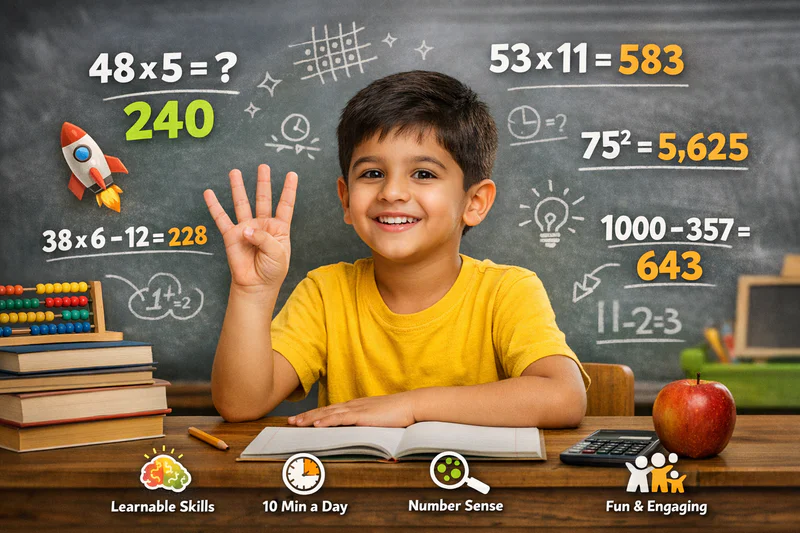
Mental math tricks for kids aren't about being a prodigy. They're about learning to see numbers the way confident mathematicians do: as flexible, pattern-rich things that can be rearranged, rounded, and restructured. That shift changes everything not just speed, but how a child feels about maths.
This guide covers 9 techniques that genuinely work, explains the logic behind each one, and shows how parents can help build the kind of daily practice that makes these tricks stick.
Key Takeaways
Mental math is a learnable skill, not a natural talent the right techniques make a measurable difference.
Children who practise mental arithmetic for 10 minutes a day show faster calculation speed within 3 to 4 weeks.
Understanding why a trick works builds lasting number sense; memorising it without context fades quickly.
Vedic maths techniques, taught at Codeyoung to 45,000+ students, extend mental calculation well beyond basic tables.
The best time to introduce structured mental math is ages 7 to 10, before calculation habits become fixed.
Why Mental Math Skills Matter More Than Parents Realise
There's a widely held assumption that calculators have made mental arithmetic irrelevant. The research says otherwise. A 2019 study published in the Journal of Educational Psychology found that students with strong mental arithmetic foundations performed significantly better on standardised maths tests not because they calculated faster, but because they had cognitive capacity left over to focus on problem structure rather than basic computation.
Think of it this way. When a child has to laboriously work out 7 × 8 by counting, that process consumes working memory. A child who knows it instantly can use that same mental energy to understand what the problem is actually asking. The trick isn't the point. The freed-up thinking is.
Beyond academics, quick mental calculations are useful every day: comparing prices, calculating discounts, splitting a bill, estimating travel time. These are life skills. The maths classroom is just where they get built.
What Makes a Good Mental Math Trick for Kids?
Not all shortcuts are created equal. Some tricks produce the right answer but leave children with no understanding of why. Those are the ones that fade after a week. The best mental math strategies share three qualities.
They reveal a real mathematical pattern: not just a mnemonic, but something that reflects how numbers actually work
They generalise beyond the example: a good trick works on a whole category of problems, not just the one you learned it with
They can be explained, not just performed: if a child can tell you why the trick works, they own it; if they can only do it, it'll disappear
With that framing, here are 9 techniques that meet all three criteria.
The 9 Mental Math Tricks Every Child Should Know
1. The Double-and-Halve Method for Multiplication
This works on any multiplication where one number is even. Halve that number, double the other. Repeat until the problem becomes easy.
Try it with 16 × 25. Halve 16, double 25: 8 × 50. Halve again: 4 × 100. Answer: 400. Three steps, no paper.
Why it works: halving and doubling preserves the product because you're multiplying by 2 and dividing by 2 simultaneously. Children who understand this are learning the distributive property in disguise.
2. Rounding Up, Then Adjusting
Round one awkward number up to the nearest 10, do the easy multiplication, then subtract the difference.
Example: 38 × 6. Round 38 to 40: 40 × 6 = 240. You rounded up by 2, so subtract 2 × 6 = 12. Answer: 228.
This is probably the most transferable of all math tricks for kids because it works for addition, subtraction, and multiplication. It also teaches estimation as an intermediate step, which is a skill schools rarely teach directly.
3. Multiplying Any Two-Digit Number by 11
Add the two digits. Place the result in the middle.
53 × 11: 5 + 3 = 8, so the answer is 583. For 75 × 11: 7 + 5 = 12, carry the 1, giving 825.
Children who learn this trick tend to love it because it feels like a secret code. More importantly, it teaches them that multiplication contains repeating patterns worth noticing the foundation of algebraic thinking.
4. The 9s Finger Method (and Its Smarter Extension)
Hold up 10 fingers, fold down the one corresponding to the number you're multiplying by 9. Fingers to the left give the tens digit; fingers to the right give the units.
9 × 7: fold down finger 7, six on the left, three on the right. Answer: 63.
The smarter extension: every multiple of 9 (up to 9 × 10) has digits that add up to 9. This gives children a self-checking mechanism. If the digits of their answer don't sum to 9, they've made an error. That kind of built-in verification is a habit mathematicians use constantly.
5. Squaring Numbers That End in 5
Take the tens digit. Multiply it by the next integer up. Write 25 at the end. Done.
75²: tens digit is 7, next integer is 8. 7 × 8 = 56. Append 25. Answer: 5,625. Try it with 45²: 4 × 5 = 20, append 25, answer: 2,025. It works every time, for any number ending in 5.
6. The Compensation Method for Addition
Round one number to the nearest 10 or 100, add the rounded version, then compensate.
297 + 148: round 297 to 300 (added 3 extra), then 300 + 148 = 448, subtract 3. Answer: 445.
This is the same logic as the rounding-up multiplication trick above. Once children understand the principle, they apply it across operations without being told to that's the mark of genuine mathematical understanding rather than rote learning.
7. Multiplying by 5 Using the Half-Then-Times-10 Rule
Multiplying by 5 is the same as dividing by 2 and multiplying by 10. So 48 × 5: half of 48 is 24, times 10 is 240.
Works for odd numbers too. 37 × 5: half of 37 is 18.5, times 10 is 185. Children initially find the 18.5 surprising a useful moment to reinforce that decimals appear and disappear predictably.
8. Subtracting from Round Numbers
When subtracting from 100, 1000, or any round number, subtract each digit from 9 except the last, which subtracts from 10.
1000 - 357: 9 - 3 = 6, 9 - 5 = 4, 10 - 7 = 3. Answer: 643.
This is a classic Vedic maths technique called Nikhilam (complement method). It eliminates borrowing entirely, which is the part of subtraction that causes the most confusion for children.
9. The Vertically and Crosswise Method for Two-Digit Multiplication
This Vedic maths approach multiplies two two-digit numbers in three steps using a simple cross-multiplication pattern, producing results that would otherwise require long multiplication on paper.
For 23 × 41: multiply units (3 × 1 = 3), cross-multiply and add (2 × 1 + 3 × 4 = 14, carry 1), multiply tens (2 × 4 = 8, plus carry = 9). Answer: 943.
It sounds complex on paper. In practice, children who do this regularly for 3 to 4 weeks find it becomes second nature. Codeyoung's maths classes for kids covers Vedic methods as a structured part of the curriculum, building from simpler techniques to this one progressively.
Want your child to build real mental maths ability with a qualified instructor? Book a free trial class at Codeyoung — 1:1 live instruction, no commitment required.
How Does Vedic Maths Fit Into Mental Arithmetic for Kids?
Vedic maths is a system of calculation techniques drawn from ancient Indian mathematical texts. It's built on 16 core sutras (principles), each of which exploits a specific numerical property to make a category of calculations faster.
What makes it well-suited to children is the same thing that makes it effective for adults: the techniques are pattern-based, not memory-based. A child doesn't need to remember an arbitrary rule. They need to understand one underlying idea, and the shortcut follows naturally.
Common Vedic Maths Techniques by Difficulty Level
Children who learn Vedic maths alongside standard school maths tend to develop stronger overall number sense. They're not replacing one approach with another they're building a richer toolkit that makes school maths feel easier, not harder.
Building a Daily Mental Maths Habit: What Actually Works at Home
Knowing a technique in isolation is very different from being able to use it under pressure. The gap between the two is practice specifically, the kind of low-stakes daily practice that builds fluency without creating anxiety.
Here's what research and classroom experience both support:
5 minutes a day beats 35 minutes once a week. Short, frequent sessions build retrieval strength that longer infrequent sessions don't match.
Real-world contexts work better than worksheets. Ask your child to estimate the grocery total, calculate change, or work out how many minutes until dinner. The same arithmetic, but it feels purposeful.
Teach one trick at a time. Don't introduce the rounding method and the double-and-halve method in the same session. Consolidate one before the next.
Praise the method, not the answer. "I love how you rounded up first" is more effective than "well done." It tells the child what to repeat.
Children who practise structured mental arithmetic with these habits show measurable improvement in calculation speed within 3 to 4 weeks. The confidence shift often comes even faster and that changes how they engage with maths in school.
At What Age Should Kids Start Learning Mental Maths Tricks?
The short answer: earlier than most parents try.
Children aged 6 to 7 can begin with number bonds to 10, basic doubling, and the 9s finger method. These build the numerical fluency that makes everything else easier. From ages 8 to 10, multiplication shortcuts like the 11x rule and the squaring-numbers-ending-in-5 technique are well within reach. Vedic methods like the vertically and crosswise technique typically work well from age 11 onwards.
Mental Maths Progression by Age

Frequently Asked Questions About Mental Maths for Kids
What are the best mental math tricks for kids to learn first?
Start with number bonds to 10 and basic doubles for ages 6 to 7, then move to the rounding-and-compensating method and the 11x digit-sum trick from age 8 onwards. These are the highest-leverage early techniques because they apply across the widest range of calculations. Vedic techniques like squaring numbers ending in 5 work well from age 10, once multiplication tables are solid.
Does mental maths actually help in school exams?
Yes, and the impact is well-documented. Students who can calculate quickly and accurately spend less working memory on arithmetic, which frees them to focus on problem structure and reasoning. This matters in timed tests especially. Research from the Journal of Educational Psychology found that students with strong mental arithmetic skills significantly outperformed peers on standardised maths assessments, even after controlling for general intelligence.
How is Vedic maths different from regular school maths?
School maths teaches standard algorithms long multiplication, column addition, borrowing in subtraction. Vedic maths teaches pattern-based shortcuts that exploit specific number properties. The two are complementary, not competing. Children who learn Vedic techniques don't abandon school methods; they gain additional tools that make calculation faster and more flexible, especially for mental arithmetic where standard algorithms are hard to apply without writing.
How long does it take for mental maths tricks to become automatic?
With consistent daily practice of 5 to 10 minutes, most children show noticeable speed improvement within 3 to 4 weeks. Full automaticity where a technique is retrieved without conscious effort typically takes 8 to 12 weeks of regular use. The key variable isn't the duration of each session but the frequency. Daily short practice outperforms weekly longer sessions for building arithmetic fluency.
Can kids learn mental maths online effectively?
Yes, particularly in a 1:1 live format where an instructor can seeexactly where a child is hesitating, which technique isn't sticking, and what real-world contexts would make the practice feel relevant. Self-paced video courses are less effective for mental maths because the skill requires active practice and immediate feedback not passive watching. Codeyoung's math class uses live 1:1 sessions to teach and reinforce mental arithmetic alongside the main curriculum.
What is the best way to practise mental maths at home?
Keep sessions short 5 to 10 minutes daily. Use real-world contexts: prices, scores, distances, cooking measurements. Introduce one technique at a time, consolidate it over a week before adding another. Encourage your child to estimate first, then calculate exactly. Avoid defaulting to a calculator the willingness to work it out mentally is itself a habit worth building.
Do mental math tricks help with algebra later on?
More than most parents expect. Algebra depends on comfort with numerical manipulation rearranging, substituting, balancing equations. Children who have practised mental arithmetic strategies are already used to thinking of numbers as flexible and rearrangeable. That habit transfers directly. Students who struggle with early algebra often do so not because the concepts are too abstract, but because the underlying arithmetic is effortful.
Is there a difference between mental maths for boys and girls?
No meaningful difference in capacity exists between boys and girls in mental arithmetic. Differences in performance that sometimes appear in school data are largely attributable to confidence and anxiety, not ability. Girls who receive the same quality of maths instruction and encouragement perform at equivalent levels. This is one reason 1:1 instruction tends to close perceived gaps the instructor's attention and positive reinforcement is consistent regardless of gender.
What is number sense, and how does mental maths build it?
Number sense is the intuitive understanding of how numbers relate to each other their size, their factors, how they behave under different operations. Mental maths builds number sense because each technique reveals a real mathematical relationship. A child who learns to multiply by 5 using the halving shortcut has internalised the relationship between 5 and 10. Over time, these insights compound into genuine fluency that textbook practice alone rarely produces.
My child has maths anxiety. Will learning mental maths tricks help or make it worse?
Done well, mental maths can significantly reduce maths anxiety not increase it. Tricks give children reliable tools they can control. Success with a shortcut creates a concrete positive experience with numbers, which is exactly what anxious learners need. The approach matters: frame tricks as games, not tests. Start with the simplest techniques and build gradually. Celebrate the method, not just the right answer. Avoid drilling in a pressured way.
Numbers Are More Flexible Than Your Child Has Been Taught
Every technique in this guide works because numbers follow patterns. Rounding, doubling, compensating, applying Vedic shortcuts these aren't tricks that bypass maths. They are maths. Children who learn to use them develop a fundamentally different relationship with arithmetic: one built on intuition and confidence rather than rote memorisation and anxiety.
Start small. Pick one technique this week. Practise it daily for five minutes in a real-world context. By next month, your child will have it permanently and be ready for the next one.
For structured, progressive mental maths instruction, explore Codeyoung's 1:1 live maths programme for children aged 6 to 14.
Ready to build your child's maths confidence?
Codeyoung offers personalised 1:1 live maths classes for children aged 6 to 14 covering mental arithmetic, Vedic maths, and school curriculum support. Expert instructors. Flexible scheduling. Free trial available.