How to Help a Child Who Is Struggling With Math: A Parent Guide
If your child is struggling with math, the most effective way to help is to identify the specific gaps in their understanding, rebuild their confidence through small wins, and consider personalized tutoring that meets them exactly where they are. The good news? Math struggles are almost always fixable with the right approach and support.
Watching your child wrestle with math homework night after night is tough. You might see the frustration on their face, the tears over a test score, or the classic "I'm just not a math person" declaration. But here's the thing: very few kids are genuinely bad at math. Most are simply missing a few foundational pieces that make everything else feel impossible.
Let's break down how to spot the warning signs, understand what's really going on, and take practical steps to get your child back on track.
Key Takeaways:
Math struggles are almost always fixable most kids aren't "bad at math," they're missing specific foundational concepts that make new material feel impossible.
At Codeyoung, 82% of students who receive personalized math instruction show measurable improvement in logical reasoning and problem-solving within 3-6 months.
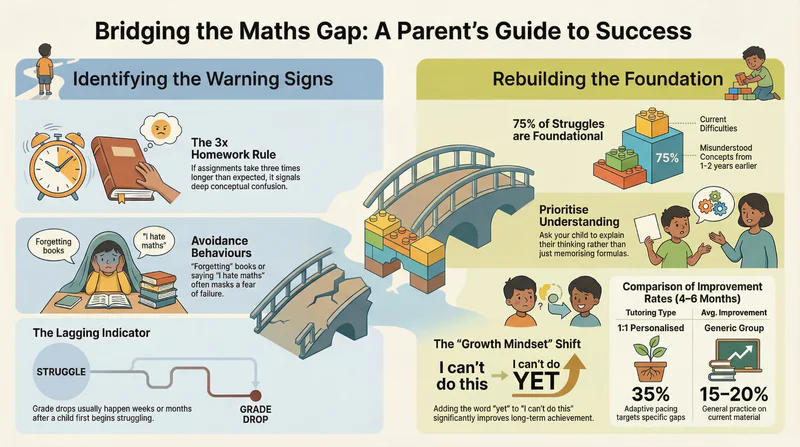
Watch for warning signs beyond grades: homework battles lasting 3x longer than expected, avoidance behaviors, and declining confidence ("I hate math" statements).
Math is cumulative gaps from earlier grades compound over time, making current material harder. Identifying exactly where understanding breaks down is the first step to recovery.
One-on-one tutoring that pinpoints specific weak areas produces faster results than generic group classes or more practice problems of the same type.
Recognizing the Warning Signs
Math struggles don't always announce themselves with failing grades. Often, the signs are more subtle, and catching them early makes a big difference.
Watch for homework battles that seem disproportionate to the assignment. If a worksheet that should take 20 minutes regularly turns into an hour of frustration, something deeper is happening. Your child might be spending most of that time stuck, confused, or avoiding the work entirely.
Declining confidence is another red flag. Kids who once felt okay about math might start saying things like "I hate math" or "I'll never get this." These statements often signal that they've hit a wall they don't know how to climb over.
You might also notice avoidance behaviors. Suddenly "forgetting" to bring home assignments, rushing through work just to finish, or becoming unusually anxious before tests can all point to underlying struggles.
Grade drops are the most obvious sign, but they're often a lagging indicator. By the time grades slip, your child may have been struggling silently for weeks or months.
Why Kids Fall Behind in Math
Kids fall behind in math primarily because of missed foundational concepts that make new material impossible to understand. Math is cumulative each concept builds directly on the ones before it. Miss one building block (like understanding fractions in 3rd grade), and everything stacked on top (decimals, percentages, ratios, algebra) becomes shaky or impossible.
Let's say your child didn't fully grasp fractions in third grade. They understood enough to pass the test, but the concept never really clicked. Fast forward to fifth grade, and now they're working with decimals and percentages, both of which depend on a solid understanding of fractions. The new material isn't just hard; it feels impossible because the foundation isn't there.
Research supports this. A study published in Psychological Science found that children's understanding of fractions and division in elementary school uniquely predicts their algebra performance and overall math achievement years later, even after controlling for IQ, reading ability, and family income.You can read the study here.
Pace mismatch is another common culprit. Classroom teachers have 25 or 30 students and a set curriculum to cover. They can't always slow down when one child needs more time on a concept. Your child might understand 80% of a lesson but miss a crucial 20%, and the class moves on regardless.
Sometimes the teaching style simply doesn't match your child's learning style. Some kids need visual explanations. Others need to work through problems hands-on. When there's a mismatch, concepts that could make sense just don't land.
What Doesn't Work
The three approaches that consistently fail are: assigning more practice problems of the same type, using pressure/punishment for bad grades, and doing the work for your child. Here's why these common strategies backfire and what to do instead.
More of the same rarely helps. If your child didn't understand a concept the first time, having them do 50 more practice problems won't magically create understanding. It just creates 50 more opportunities for frustration.
Pressure and punishment make things worse. Threatening consequences for bad grades or forcing extra study time often increases math anxiety without improving comprehension. Your child ends up associating math with stress, which makes learning even harder.
Doing the work for them feels helpful in the moment but creates dependency. If you solve the hard problems so homework gets finished, your child never develops the skills to work through challenges independently.
Strategies That Actually Help
The most effective strategies are: pinpointing exact skill gaps (often 1-2 years back), focusing on understanding over memorization, celebrating effort rather than correct answers, and creating low-pressure practice environments. Start by finding where understanding actually breaks down this might mean going back a grade level or two to find solid ground to build from.
Focus on understanding over memorization. Kids who memorize procedures without understanding why they work will eventually hit a wall. Ask your child to explain their thinking, not just show their answer. If they can teach a concept back to you, they actually understand it.
Celebrate effort and progress, not just correct answers. When your child works hard on a problem, acknowledge that work regardless of the outcome. This builds the persistence they'll need to push through future challenges.
Create a low-pressure practice environment at home. Math games, puzzles, and real-world applications like cooking measurements or calculating discounts can reinforce concepts without the stress of formal homework.
When to Get Professional Help
Get professional help when: gaps span multiple concepts/grade levels, homework sessions consistently end in tears, your child's confidence has collapsed, or home strategies haven't worked after 2-3 months. Sometimes parental support isn't enough, and that's completely okay. Specifically, consider bringing in a tutor when:
Your child has significant gaps spanning multiple concepts or grade levels
Homework help sessions consistently end in tears or arguments
Your child's confidence has dropped to the point where they've given up
You've tried home strategies for a few months without meaningful progress
The key is finding the right kind of help. Group tutoring can work for kids who just need extra practice, but children with real gaps often need something more targeted.
One-on-one math tutoring allows an instructor to identify your child's specific weak points and address them directly. There's no waiting for other students, no embarrassment about asking "basic" questions, and no moving on until the concept actually clicks. The difference comes from adaptive pacing mentors spend exactly the right amount of time on each concept gap rather than following a fixed curriculum schedule.
Personalized instruction also means the pace adjusts to your child. Some concepts might take five minutes. Others might take five sessions. That flexibility is exactly what struggling students need.
Building Long-Term Math Confidence
Catching your child up on missed concepts is the first step. Building genuine confidence is what keeps them moving forward.
Help your child develop a growth mindset around math. The belief that math ability can improve with effort and practice is more predictive of success than innate talent. When they say "I can't do this," add the word "yet" to the end of that sentence. Research from Stanford University's Carol Dweck has shown that students who believe their math abilities can grow through effort significantly outperform those who view math ability as fixed even when controlling for initial skill level.
Connect math to things they care about. If your child loves video games, talk about how game designers use math. If they're into sports, explore statistics together. Making math relevant transforms it from abstract torture to a useful tool.
Set realistic expectations for progress. Your child didn't fall behind overnight, and they won't catch up overnight either. Steady improvement over weeks and months is the goal, not instant transformation.
Taking the First Step
If your child is struggling with math, the worst thing you can do is wait and hope it gets better on its own. Math gaps don't close themselves. They widen.
Start by having an honest, low-pressure conversation with your child about how math feels to them. You might be surprised by what they share when they don't feel judged.
Then consider whether outside support could help. Afree trial class with a qualified tutor can help you understand exactly where your child stands and what it would take to get them back on track. There's no obligation, just clarity about your options.
Your child isn't bad at math. They just need the right support to fill in the gaps and rebuild their confidence. And with the right approach, that's absolutely achievable.
Frequently Asked Questions
How do I know if my child's math struggles are serious or just temporary?
Temporary struggles last 2-3 weeks and resolve with a little extra practice. Serious struggles persist for months, cause increasing anxiety, and involve gaps in foundational concepts (not just current material). If homework battles have become routine, grades continue declining despite effort, or your child has given up ("I'm just bad at math"), the struggles have moved beyond temporary.
What grade-level gaps are most common in struggling math students?
At Codeyoung, diagnostic assessments of struggling 5th-7th graders most commonly reveal gaps in: fractions (understanding equivalence and operations), place value and decimal concepts, multiplication fluency, and word problem comprehension. These foundational gaps from 3rd-4th grade create cascading difficulties with ratios, percentages, algebra, and higher-level problem-solving.
Should I hire a tutor or try helping my child myself first?
Try home support first if: gaps are minor (1-2 concepts), your child is receptive to your help, and you have time/patience for regular practice sessions. Hire a tutor if: gaps span multiple concepts/years, homework help ends in tears/arguments, you're unsure where gaps begin, or home efforts haven't improved things after 4-6 weeks of consistent trying.
How long does it typically take for a struggling child to catch up in math?
For students with 1-2 year gaps, expect 4-6 months of consistent personalized instruction (2-3 sessions weekly) to build solid foundations and restore grade-level performance. Deeper gaps (3+ years) may require 8-12 months. Progress isn't linear students often show little visible improvement for weeks, then sudden breakthroughs as concepts click into place.
Can math anxiety be fixed, or is it permanent once it develops?
Math anxiety is fixable but requires addressing both skill gaps AND emotional associations. Research from the University of Chicago shows that when students' underlying math competence improves through proper instruction, anxiety decreases significantly. Success breeds confidence as kids master previously confusing concepts, the anxiety-triggering "I don't understand" moments become less frequent. Combine skill-building with low-pressure practice and celebrating effort over correctness.
What's the difference between a math tutor and personalized math instruction?
Generic tutors help with homework and current assignments. Personalized instruction starts with diagnostic assessment to identify specific gaps, builds custom learning paths addressing those exact weaknesses, adjusts pacing based on mastery (not calendar), and focuses on conceptual understanding rather than just getting tonight's homework done. The goal is permanent skill-building, not temporary grade maintenance.