In 1965, a book called Vedic Mathematics was published by Indian scholar Bharati Krishna Tirtha. It described 16 mathematical principles drawn from ancient Sanskrit texts, each one offering a shortcut to a class of arithmetic problems that standard methods handle slowly. Schools largely ignored it. Parents and tutors paid close attention.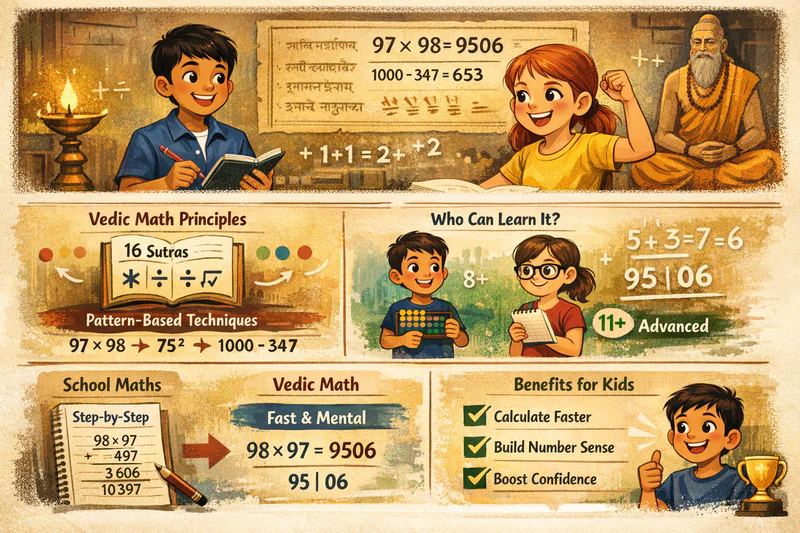
Six decades later, Vedic math for kids has become one of the most sought-after supplementary maths approaches in the USA, UK, Canada, and Australia, particularly among families who want their children to calculate faster, build stronger number sense, and feel genuinely capable at maths rather than just adequate.
This guide explains what Vedic math actually is, which techniques are appropriate at which ages, how it fits alongside school maths, and what parents can reasonably expect once children start applying it.
Key Takeaways
Vedic math is a system of 16 pattern-based calculation principles that make arithmetic faster and more intuitive for children.
It is not a replacement for school maths. It is a complement that makes standard methods easier to apply.
Children aged 8 and above can begin with beginner Vedic techniques; advanced sutras suit ages 11 and up.
Vedic math builds number sense, not just speed. Children understand why shortcuts work, not just how to perform them.
At Codeyoung, Vedic maths is taught as a structured part of the maths curriculum for children aged 6 to 14, with techniques sequenced by difficulty level.
What Is Vedic Math and Why Do Kids Take to It So Quickly?
Vedic math is a collection of calculation techniques, each based on a sutra (a short Sanskrit phrase that encodes a mathematical principle). The sutras cover multiplication, division, squaring, square roots, fractions, algebra, and more. What makes them useful for children isn't their age. It's how they work.
Standard maths algorithms are procedural. Follow the steps, get the answer. Vedic techniques are pattern-based. They exploit specific numerical properties that make a whole category of calculations faster. When a child understands the pattern behind a technique, they retain it far longer than a procedure they've memorised without context.
Children also respond well because the results feel surprising. A child who can calculate 97 × 98 in their head in four seconds, while their parent reaches for a calculator, has had an experience that changes their relationship with maths. That emotional shift, from anxiety to confidence, is one of the most practically valuable outcomes Vedic instruction produces.
The Core Vedic Math Techniques, Explained for Each Age Group
Not every Vedic technique is appropriate for every age. The beginner techniques are genuinely simple; the advanced ones require a solid multiplication base and comfort with two-digit mental arithmetic. Here's how they sequence.
Vedic Maths Techniques by Age and Difficulty
How does the Vedic base method work for kids?
The base method multiplies numbers that are close to a round number like 10, 100, or 1000. Find how far each number is from the base (the deficit), subtract one number's deficit from the other number, then multiply the two deficits together. For 97 × 98: both are 3 and 2 below 100 respectively. 97 minus 2 gives 95; 3 times 2 gives 06. Answer: 9506. Children who understand the logic find this faster than any standard algorithm for numbers near 100.
How Is Vedic Math Different from What Kids Learn at School?
This is one of the most common questions parents ask, and it's worth answering clearly. Vedic math is not a competing curriculum. It doesn't ask children to abandon what they're taught at school. It gives them additional tools that make the school methods easier to apply.
School maths is built around standard algorithms: column addition and subtraction, long multiplication, long division, borrowing and carrying. These algorithms are reliable and general. They work on any numbers. Their limitation is speed and mental workload: they require writing things down and following multiple steps in sequence.
Vedic techniques work faster for specific categories of numbers. A child doing long multiplication for 98 × 97 on paper takes 45 to 60 seconds. The same child using the base method takes 10 seconds mentally. The school method is still valid. The Vedic method is faster in that context. Children who have both available are simply better equipped than those who have only one.
School Maths vs Vedic Math: How They Compare
Want your child to learn Vedic maths with a qualified instructor who teaches it as a structured, progressive programme? Book a free trial class at Codeyoung and see the difference in your child's first session.
Three Vedic Techniques You Can Teach at Home This Week
You don't need an instructor to introduce Vedic math at home. The beginner techniques are accessible enough that most parents can learn and teach them in a single sitting. Here are three that work well for home practice.
Technique 1: Multiplying by 11 (The Digit-Sum Method)
Write the first digit, add the two digits and write the result in the middle, write the last digit.
43 × 11: first digit 4, middle is 4+3=7, last digit 3. Answer: 473. When the middle sum is 10 or more (try 75 × 11), 7+5=12, so write 2 in the middle and carry 1 to the first digit. Answer: 825.
Children aged 8 and above can typically master this in one session. It works every time, for any two-digit number. And it almost always produces a moment of genuine delight when a child realises they can beat a calculator.
Technique 2: Squaring Numbers Ending in 5
Take the tens digit. Multiply it by the next number up. Write 25 at the end.
65²: tens digit is 6, next up is 7. 6 × 7 = 42. Append 25. Answer: 4,225. Try 85²: 8 × 9 = 72, append 25. Answer: 7,225. It works for any number ending in 5, at any size. Some children extend this to three-digit numbers (like 125²) once they understand the logic.
Technique 3: Subtraction from 1000 Using Nikhilam
For any number being subtracted from 1000: subtract each digit from 9 except the last, which is subtracted from 10.
1000 - 467: 9-4=5, 9-6=3, 10-7=3. Answer: 533. No borrowing, no carrying. Children who struggle with the standard borrowing method often find this immediately easier, because the rule is simple, consistent, and never produces ambiguous intermediate steps.
Does Vedic Math Actually Improve School Performance?
The research on this is encouraging. A 2018 study published in the International Journal of Research in Education and Science found that students who received Vedic maths instruction alongside their standard curriculum showed statistically significant improvements in arithmetic speed, accuracy, and reported confidence in maths compared to control groups receiving standard instruction only.
The mechanism isn't mysterious. Vedic techniques reduce the cognitive load of basic calculation. When a child can multiply two-digit numbers mentally, they have more working memory available for the actual problem they're trying to solve: a word problem, an algebraic equation, or a geometry question. The arithmetic becomes background capability rather than foreground effort.
Parents whose children use Vedic maths at Codeyoung often report the same observation: their child's school performance in maths improves not just in speed but in confidence. They participate more in class. They feel less anxious about tests. They approach harder problems without immediately assuming they can't do them.
How Codeyoung Teaches Vedic Maths as Part of a Structured Programme
Teaching Vedic maths effectively requires more than sharing a list of tricks. Children need to understand why each technique works, practise it on a range of problem types, and have it reinforced before moving to the next one. A disorganised introduction, with ten techniques crammed into two weeks and no clear sequence, produces surface-level recall that fades quickly.
Codeyoung's math classes for kids introduces Vedic techniques progressively, sequenced by difficulty and age-readiness. Instructors assess each child's existing calculation base before introducing the first technique, and they move forward only when the foundational skills are solid. Each technique is taught with both the mechanical steps and the mathematical logic behind it.
Children in the programme also practise standard school maths alongside Vedic methods, so the two approaches reinforce each other rather than competing for the child's attention. The goal isn't to replace what schools teach. It's to give children a second way to see the same problem.
Frequently Asked Questions About Vedic Maths for Kids
What is Vedic math and is it suitable for children?
Vedic math is a system of 16 calculation techniques based on ancient Indian mathematical principles. It's well-suited to children because the techniques are pattern-based, produce fast results, and build genuine number sense rather than requiring rote memorisation. Beginner techniques are accessible from around age 8, and the system scales progressively through to advanced techniques for secondary school students. It's used supplementally alongside standard school maths, not instead of it.
At what age should kids start learning Vedic math?
Children can begin with introductory Vedic techniques from around age 8, once they have a solid foundation in times tables up to at least 5x and basic addition and subtraction. Starting too early, before those foundations are in place, tends to produce confusion rather than speed. Intermediate techniques like the base method suit ages 10 to 11, and the advanced vertically-and-crosswise method works well from age 11 onwards with consistent practice.
Does Vedic math conflict with what kids learn in school?
No. Vedic math doesn't replace school algorithms. It complements them. Children learn both: the standard method that works on all numbers, and the Vedic shortcut that works faster on specific number types. Most children find their school maths actually improves after Vedic instruction because they become more comfortable and flexible with numbers in general. No teacher or curriculum requires children to use only the standard method on classwork or tests.
Is Vedic math just tricks, or does it build real understanding?
When taught well, Vedic math builds genuine mathematical understanding. Each technique is rooted in a real numerical property. The base method works because of how complements interact with place value; the squaring-by-5 technique works because of the difference of squares identity. Children who understand why the techniques work develop stronger number sense than those who simply memorise procedures. This is why the quality of instruction matters significantly with Vedic maths.
How long does it take for kids to see results from Vedic math?
With 1 to 2 structured sessions per week, most children see measurable speed improvements in the specific techniques they're practising within 3 to 4 weeks. Broader improvements in number sense and general arithmetic confidence typically become noticeable after 2 to 3 months of consistent practice. The timeline depends on the child's starting level, the consistency of practice, and whether they're getting live instruction or working independently.
Can parents teach Vedic math at home without training?
Yes, for the beginner techniques. The ×11 digit-sum method, squaring numbers ending in 5, and the Nikhilam subtraction technique are all teachable by a parent who spends 20 minutes learning them first. The intermediate and advanced techniques, particularly the base method and vertically-and-crosswise multiplication, benefit significantly from a qualified instructor who can explain the underlying logic and spot errors in the child's reasoning rather than just their answers.
Is Vedic math recognised by schools and education boards?
Vedic math is not part of standard national curricula in the USA, UK, or Australia, though some schools in India have begun incorporating it formally. It is widely recognised among maths educators as a legitimate and effective supplementary approach. Children are never penalised in school for using Vedic methods. Any valid method that produces a correct answer is acceptable. The advantage is in speed and mental calculation, which helps particularly in timed assessments.
How does Vedic math help kids with maths anxiety?
Vedic techniques give children reliable tools they feel in control of. When a child solves a problem their classmates are struggling with, using a shortcut that feels almost like a secret, their confidence shifts noticeably. The tricks also frame maths as something interesting and pattern-filled rather than threatening and arbitrary. Consistently, children with maths anxiety who start Vedic instruction report feeling more willing to attempt problems they would previously have avoided.
What is the difference between Vedic math and abacus learning?
Abacus training develops mental calculation through visualising an abacus frame, which improves working memory and speed for basic operations. Vedic math develops mental calculation through mathematical pattern recognition and algebraic shortcuts. Both improve calculation speed, but through different mechanisms. Abacus training is typically most effective before age 10; Vedic techniques have a wider age range and extend more naturally into algebra and higher maths. Many families find the two approaches complementary.
Will Vedic math help my child prepare for competitive maths exams?
Yes, particularly for exams with timed sections requiring mental calculation or estimation. AMC, Olympiad-style competitions, SAT maths, and other standardised tests all reward students who can calculate quickly and confidently without a calculator. Vedic techniques are especially useful in these contexts because they reduce time spent on arithmetic, leaving more cognitive space for the reasoning the exam is actually testing. Many competitive maths students use Vedic methods as part of their preparation toolkit.
A Different Way of Seeing Numbers Is Worth Teaching Early
Vedic math works because it treats arithmetic as something to understand, not just to perform. When a child grasps why the base method produces the right answer in four seconds, they've learned something real about how numbers behave under multiplication. That insight compounds. It makes the next technique easier to learn and the next problem easier to approach.
Start with one technique this week. The ×11 digit-sum method takes about 10 minutes to explain and produces results children want to show off immediately. Build from there, one pattern at a time. The confidence that follows is more durable than any exam result, and it tends to change how children feel about maths in general.
For a structured, progressive Vedic maths programme taught by a qualified 1:1 instructor, explore Codeyoung's math classes for kids aged 6 to 14.
Ready to build your child's maths confidence with Vedic techniques?
Codeyoung's 1:1 live maths programme covers Vedic maths alongside school curriculum support for children aged 6 to 14. Expert instructors, flexible scheduling, and a free first class with no commitment.