Coding and Math for Kids: How Learning Both Gives Children a STEM Edge
Coding and Math for Kids: How Learning Both Gives Children a STEM Edge
Most parents treat coding and maths as separate extracurricular decisions. Coding class on Tuesday, maths tutor on Thursday. The two disciplines live in separate timetable slots and rarely intersect in the child's experience. This separation is artificial and, it turns out, a missed opportunity.
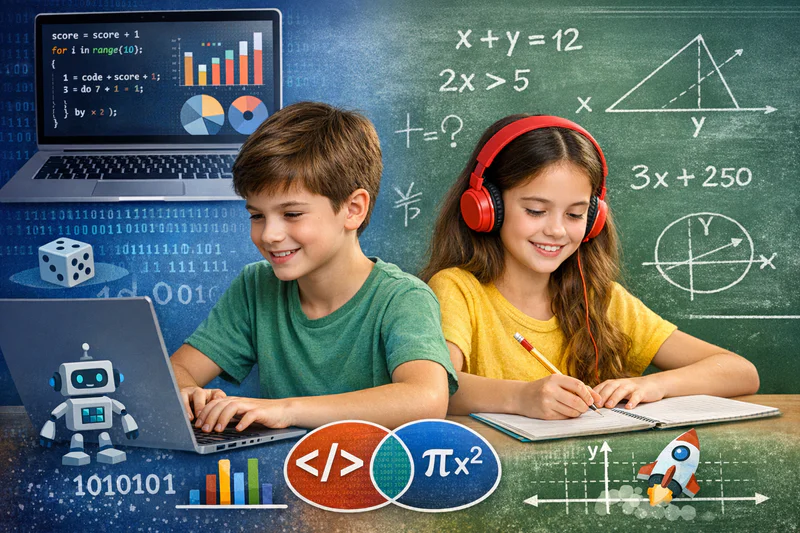
Coding and math for kids are not just compatible disciplines. They are mutually reinforcing in specific, concrete ways. Coding makes abstract mathematical concepts tangible. Maths gives coding projects precision, scope, and real analytical power. Children who develop both skills simultaneously build a qualitatively different kind of STEM capability than those who develop each in isolation.
This guide covers the specific connections between coding and maths that matter most for children, the research on how each discipline strengthens the other, the right age to bring them together, and how parents can help integrate both in a way that amplifies the impact of each.
Key Takeaways
Coding applies mathematical concepts in purposeful, real-world contexts, making abstract ideas in maths more concrete and accessible.
Mathematical reasoning gives children the analytical foundation to progress from basic coding to advanced work in data science, AI, and game development.
Research shows that children who learn coding alongside structured maths show stronger performance in both subjects than those who learn each separately.
The connection between coding and maths becomes particularly powerful from age 10 onwards, when children begin working with Python and real mathematical problems simultaneously.
Codeyoung offers both coding and maths as live 1:1 programmes, designed to work together and reinforce each other across a single child's learning journey.
Where Coding and Maths Actually Overlap: The Specific Connections
The relationship between coding and maths is not a vague "they're both logical" observation. There are specific mathematical concepts that appear directly and repeatedly in coding work, and specific coding skills that make mathematical concepts more intuitive. Understanding these overlaps helps parents see why investing in both is more efficient than investing in either alone.
Where Coding and Maths Directly Overlap for Children
This table explains something parents often observe but can't always articulate: children who code tend to find school maths easier over time, even when the coding curriculum isn't explicitly maths-focused. The concepts reinforce each other through repeated, practical application.
How Does Learning Maths Make a Child a Better Coder?
The relationship runs in both directions. Just as coding makes maths more accessible, mathematical fluency makes coding more powerful. Children with strong maths foundations progress faster in coding and can tackle more sophisticated projects sooner.
The specific mathematical capabilities that most directly accelerate coding progress are:
Mental arithmetic fluency. A child who can calculate quickly in their head spends less cognitive effort checking intermediate values during debugging and more effort on the logical structure of their code. This might sound minor; it isn't. Cognitive load is finite, and fluent arithmetic frees it for higher-order thinking.
Algebraic thinking. Understanding variables, expressions, and equations makes the transition from basic to intermediate coding much smoother. Children who are comfortable with algebraic thinking find function definitions, return values, and variable scope intuitive rather than confusing.
Logical reasoning. Conditional statements in code are Boolean logic. Children who have practised working with "if this and not that" statements in maths contexts handle nested conditionals and complex program flow more confidently than those who haven't.
Statistical intuition. Data science, AI, and game development all involve probability and statistics. Children who understand averages, distributions, and basic probability before encountering these concepts in a coding context progress through data work much faster.
What Does the Research Say About Learning Coding and Maths Together?
The research base on coding-maths integration has grown significantly over the past decade, and the findings are consistent.
A 2021 meta-analysis from the American Educational Research Association, examining 56 studies across primary and secondary school populations, found that students who received coding instruction alongside structured maths showed statistically significant improvements in both mathematical reasoning and computational thinking compared to those who received each discipline in isolation. The effect was strongest for students aged 9 to 13: the developmental window when both coding concepts and algebraic thinking are being introduced.
A separate longitudinal study from King's College London, tracking students across five years, found that children who developed strong coding skills during primary school were significantly more likely to choose advanced mathematics in secondary school. The researchers attributed this to the confidence and competence that coding builds with abstract, rule-based thinking: the same skills that make higher maths feel accessible rather than threatening.
Why does coding specifically improve maths performance in children?
The core mechanism is purposeful application. A child who learns that variables can hold any value learns this abstractly from a textbook. A child who writes a game where the player's score is stored as a variable and increases by 10 with every correct answer understands it experientially. The concept becomes concrete through real use. Research consistently shows that concepts encountered in purposeful, applied contexts are retained more durably than those learned in abstract isolation.
Want your child to develop both coding and maths skills through live 1:1 instruction that reinforces each discipline? Book a free trial class at Codeyoung to see both programmes in action.
Age-by-Age: How to Bring Coding and Maths Together for Your Child
The integration of coding and maths looks different at different ages because both disciplines evolve as children develop. Here is a realistic picture of how the two can work together at each stage.
Integrating Coding and Maths by Age Group
The integration becomes most powerful at the 10 to 12 age group, which is also where both disciplines start demanding more abstract thinking. Python functions and algebraic functions are conceptually identical: a rule that maps an input to an output. A child learning both simultaneously in this period often experiences a rapid click of understanding in both subjects simultaneously.
Practical Ways to Connect Coding and Maths at Home
Parents don't need to be mathematicians or programmers to help their children see the connection between coding and maths. These are practical, low-effort approaches that reinforce both disciplines through the child's existing activities.
Ask maths questions during coding sessions. When a child's game has a score, ask: "What would the score be if you got every question right? How many correct answers to reach 100?" These are mental maths questions embedded in a context the child cares about.
Use coding to explore maths concepts the child finds hard. A child struggling with fractions can write a simple Python script that calculates fractions of different numbers. Seeing the output change as the numerator and denominator change creates a dynamic understanding that static examples don't.
Connect real-world data to both. Sports statistics, weather data, or household energy use are all datasets that children can explore using simple code and that involve real maths (averages, percentages, graphs). The maths becomes motivated by curiosity.
Celebrate connections when the child spots them independently. When a child says "this is like the thing we did in maths class" unprompted, that recognition is more valuable than any worksheet. Acknowledge it and explore the connection together.
Codeyoung's coding and maths programmes are designed to be taken alongside each other, and instructors across both tracks are aware of the connections so they can reinforce them explicitly during sessions.
Which STEM Careers Specifically Require Both Coding and Maths?
For parents thinking about long-term outcomes, the careers that require strong foundations in both coding and maths are also the ones projected to see the most significant growth and compensation over the next decade.
Data science requires both Python programming and statistics. Machine learning engineering requires both coding and linear algebra. Financial technology roles require both programming and quantitative reasoning. Game development uses both code and geometry. Environmental modelling uses both programming and calculus. Robotics engineering requires both coding and physics-level maths. The overlap is not incidental. It is structural: the most complex and valuable problems in technology require both the ability to build systems and the ability to reason about them mathematically.
A child who develops strong foundations in both coding and maths during school years is not just prepared for any single one of these careers. They are positioned to choose among them based on interest rather than capability. That optionality is one of the most valuable outcomes a parent can invest in.
Frequently Asked Questions: Coding and Maths for Kids
Does coding actually help children with school maths?
Yes, and the research supporting this is substantial. Studies from the American Educational Research Association and multiple university research groups consistently show that children who receive coding instruction alongside standard maths education perform better in mathematical reasoning assessments than those who receive maths instruction alone. The mechanism is practical application: coding gives children repeated, purposeful encounters with the same mathematical concepts they study in school, which deepens understanding and improves retention.
At what age should children start learning coding and maths together?
Children can start learning both from age 6, with the integration becoming most powerful from around age 10. At ages 6 to 9, the connection is fairly informal: games in Scratch involve counting and coordinates, which reinforces basic arithmetic. From age 10 onwards, when Python introduces functions, variables, and data types, the overlap with algebra and early statistics becomes explicit and educationally significant. The 10 to 13 window is where deliberate integration produces the strongest compounding effect.
Do children need to be good at maths before starting to code?
No. Children can begin coding successfully without strong maths foundations, particularly using tools like Scratch that involve minimal explicit mathematics. As children progress into Python and more advanced coding work, comfortable arithmetic and basic algebraic thinking become increasingly useful. The good news is that regular coding practice tends to improve mathematical fluency as a byproduct, so the two skills develop together even when the child starts coding without strong maths ability.
What is the best way to help a child connect coding and maths at home?
The most effective approach is to use coding to explore maths problems the child finds difficult or interesting, rather than keeping the two in separate contexts. A child who struggles with fractions can write a Python script that demonstrates fractional division with visible outputs. One who enjoys statistics can build a simple programme that analyses sports data. The goal is to make the mathematical concept feel purposeful by embedding it in something the child wants to build.
Is coding or maths more important for STEM careers?
Both are important, and the most significant STEM careers require both in combination. Neither is straightforwardly more important than the other because they serve different functions: maths provides the analytical framework for reasoning about problems, and coding provides the tools to build and test solutions. Children who are strong in one but weak in the other face specific ceilings in advanced STEM work. The most career-relevant investment is developing genuine competence in both rather than depth in only one.
How does Python specifically connect to the maths children learn at school?
Python is particularly rich in maths connections. Variables in Python mirror algebraic variables. Functions in Python match the mathematical function concept of mapping inputs to outputs. Lists and data structures support statistics and probability work. The matplotlib library produces graphs of mathematical functions that children have studied in class. The random module produces probabilistic experiments. For children aged 10 and above, almost every topic in the school maths curriculum has a direct Python equivalent that makes it more concrete and testable.
Can a child who dislikes maths enjoy coding?
Yes, and this is one of the most consistent and encouraging findings in children's coding education. Many children who describe themselves as "not a maths person" discover through coding that they are actually quite comfortable with mathematical thinking when it is applied purposefully rather than practised abstractly. The coding context removes the social pressure and negative associations that many children have developed around maths class, and the mathematical concepts appear as useful tools rather than subjects to be studied. Coding is often the best intervention available for rebuilding a child's relationship with mathematics.
What Codeyoung programme should a child take if they want to develop both coding and maths?
Codeyoung's most effective approach for children who want to develop both skills is to enrol in the coding track appropriate to their age (starting with Scratch for ages 6 to 9, or Python for ages 10 and above) and the maths programme simultaneously. Instructors across both tracks are aware of the overlaps and can reinforce connections explicitly. For children specifically interested in data science or AI as longer-term goals, beginning the Python AI/ML track after establishing solid Python foundations develops both skills in a deeply integrated way.
Does strong maths make learning AI and machine learning easier for kids?
Significantly. Machine learning involves probability, statistics, linear algebra, and calculus at the conceptual level. Children who arrive at AI/ML study with strong mathematical intuition, particularly around how data distributions work and what averages and variances mean, learn machine learning concepts substantially faster than those arriving with weak maths backgrounds. The investment in strong maths during primary and early secondary school pays particularly large dividends when a child reaches AI work at ages 13 to 17.
How does Codeyoung's maths programme differ from standard school maths?
Codeyoung's maths programme covers school curriculum topics alongside mental maths techniques (including Vedic maths methods) and problem-solving strategies that the standard classroom rarely has time to address. The 1:1 live format means the instructor can identify exactly where a child's understanding is incomplete and address it directly rather than moving forward with the class. The result is both stronger school performance and a broader mathematical capability that serves children well when they encounter maths in coding, science, and other STEM contexts.
Two Disciplines. One Compounding Advantage.
Coding and maths are not just compatible. They are mutually amplifying in ways that compound over time. A child who develops both skills does not just perform better in two separate subjects. They develop a qualitatively different kind of STEM capability: the ability to reason about complex problems analytically and to build working solutions to them. That combination is what the most significant roles in science, technology, and data-driven fields require.
The investment is straightforward: structured maths instruction alongside project-based coding education, started early and maintained consistently. The return is a child who finds both subjects accessible, sees the connections between them naturally, and enters secondary school and beyond with a genuine and demonstrable STEM edge.
Explore Codeyoung's coding programmes and maths programme for children aged 6 to 17, or book a free trial session to see how the two disciplines work together in practice.
Give your child the coding and maths combination that builds a real STEM edge.
Codeyoung offers personalised 1:1 live coding and maths classes for children aged 6 to 17. Expert instructors across both subjects, flexible scheduling, and a completely free first class with no commitment.