How to Improve Your Child's Math Skills at Home (Without the Tears)
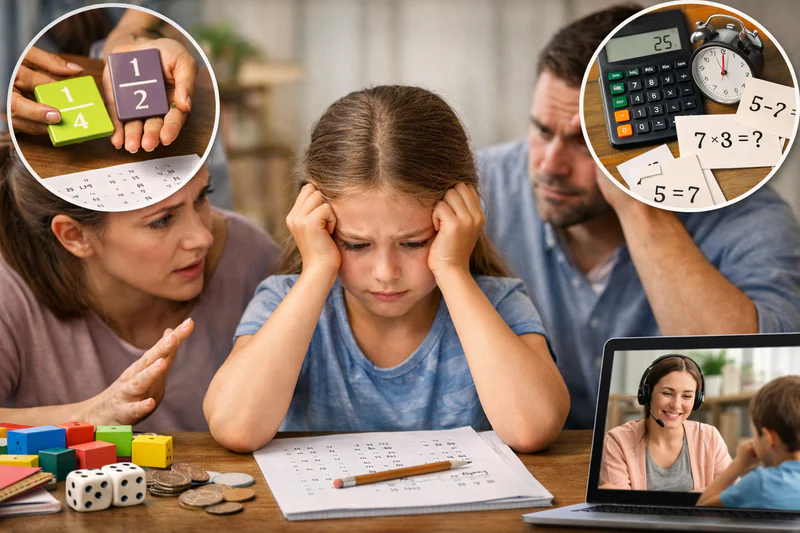
The maths homework session that turns into a standoff is a familiar scene in many households. A child stares at a page of problems, says they don't understand, and within ten minutes someone is frustrated, someone is crying, and nothing has been learned. If this happens regularly in your home, the problem is not that your child lacks ability. It is almost certainly something else.
Improving math skills for kids at home requires understanding what is actually causing the difficulty before reaching for more practice worksheets. Maths struggles have specific, identifiable causes, and most of them are fixable with the right approach. This guide covers those causes, practical techniques that work for each one, and how parents can support maths improvement at home without becoming a source of additional stress.
No tutoring degree required. No advanced mathematics background needed. What works is specific, patient, and more accessible than most parents assume.
Key Takeaways
Most childhood maths struggles trace back to a specific gap in foundational knowledge, not a general lack of ability.
Maths anxiety is a real, documented phenomenon that impairs working memory and makes existing difficulties worse. Reducing pressure is the first step, not increasing practice.
Short daily sessions of 10 to 15 minutes outperform long weekend study blocks for building mathematical fluency.
Real-world maths contexts, cooking, shopping, sport statistics, travel time, motivate children more reliably than abstract exercises.
When home practice isn't enough, structured 1:1 live instruction accelerates progress significantly by identifying and filling gaps a parent cannot always see.
What Actually Causes Children to Struggle With Maths?
Before trying to fix a maths problem, it is worth understanding what is causing it. The causes are different, and they call for different responses. Applying more practice to the wrong problem typically makes things worse.
Common Causes of Maths Struggles in Children and Their Solutions
The single most important diagnostic question a parent can ask is: when exactly did maths start feeling hard? If the child can point to a specific topic or a specific school year, that is almost certainly where the foundational gap sits. Fixing the symptom (fractions feel hard) without fixing the cause (multiplication tables are shaky) produces temporary improvement at best.
Maths Anxiety: The Problem That Makes Everything Else Worse
Maths anxiety is not a general nervousness about school. It is a specific, documented psychological response to mathematical situations that activates the same brain regions as physical threat. Research from Stanford University found that maths-anxious children show reduced activity in problem-solving brain regions and increased activity in fear-processing regions when they see a maths problem. In plain terms: anxiety literally impairs the working memory children need to solve maths.
This matters practically because it means that increasing pressure on a child who has maths anxiety, more homework, timed tests, parental frustration during study sessions, makes their actual performance worse even when the underlying maths knowledge is there. The intervention needs to address the anxiety first.
How do you reduce maths anxiety in a child at home?
Start by separating the child's identity from their maths performance. "You're just not a maths person" is one of the most damaging things a child can hear, from a parent or a teacher, because it frames ability as fixed. Replace it with growth-oriented language: "this is a hard topic and it takes time, let's figure out which part is tricky." Then find one maths topic the child can do well and let them do it successfully several times before moving to the hard material. Small wins rebuild the confidence that anxiety has eroded.
7 Practical Techniques That Actually Improve Maths Skills at Home
These techniques are not complex. They are specific and consistent, which is what separates approaches that work from ones that feel productive but don't build lasting skills.
1. Use the 10-Minute Daily Rule Instead of Long Sessions
Ten minutes of maths practice every day produces stronger fluency than an hour on Sunday. Short, consistent retrieval practice builds the automatic recall that makes harder maths accessible. The content should rotate: a few mental arithmetic questions, one word problem, one topic from the current school unit. Keep it short enough that it ends before the child is tired of it.
2. Identify the Exact Gap, Not Just the Subject
"Maths is hard" is too broad to fix. "Multiplying fractions is hard" is more specific. "I don't know what happens when you multiply two fractions together" is specific enough to address directly. Help your child identify the narrowest version of the difficulty. That is the thing to practise. Everything built on top of that gap will start to make sense once the foundation is solid.
3. Make Maths Visible in Daily Life
Ask your child to calculate the tip at a restaurant. Get them to work out how many days until a family holiday. Have them compare unit prices at the supermarket. These are real calculations with real purposes, and children who do them regularly develop an intuitive sense for whether answers are reasonable. This estimation skill, knowing roughly what an answer should be before calculating exactly, is one of the most underrated maths skills there is.
When home practice isn't enough, a qualified 1:1 maths instructor can identify exactly where the gap is and fill it efficiently. Book a free trial maths class at Codeyoung to see the difference structured instruction makes.
4. Play Maths Games Instead of Drilling
Card games, board games, and simple number games apply the same maths that worksheets do, without the emotional association that worksheets often carry. Twenty-One (a simple card game built on addition) practises mental addition in a way that feels nothing like homework. The game 24, where four numbers must be combined using any operations to make 24, builds number sense and creativity simultaneously. These are not substitutes for practice. They are more enjoyable and often more effective forms of the same practice.
5. Talk Through the Thinking, Not Just the Answer
When your child gets an answer, ask how they got it. Not to check their method, but to help them articulate their reasoning. A child who can explain "I rounded 49 to 50, multiplied by 3 to get 150, then subtracted 3" understands the maths in a way that a child who just wrote down 147 does not. The ability to describe a mathematical process is a strong indicator of genuine understanding rather than memorised procedure.
6. Separate Maths Practice From Homework Time
Maths homework and maths practice are not the same thing. Homework is completing assigned tasks that may be at the edge of the child's current ability. Practice is working on things the child can do but needs to consolidate. Both are valuable, but mixing them creates confusion. If a child is already struggling with tonight's homework, that is not the moment for extra practice. Homework first, then a short session on something the child knows well, finishes on a positive note.
7. Use Visual Representations Before Abstract Rules
Abstract rules land better when they follow concrete experiences. Before explaining that "a negative times a negative is a positive," show it with a number line. Before introducing the formula for area, have the child count squares inside a shape. Before teaching long division, work through the sharing-out logic with physical objects. The rule then feels like a shortcut for something the child already understands rather than an arbitrary instruction to memorise.
When Is Home Practice Not Enough? Knowing When to Seek Help
Most maths difficulties at home can be meaningfully improved with consistent daily practice, reduced pressure, and the right techniques. Some cannot. There are specific signs that indicate a child needs more structured support than a parent can provide during homework time.
The child has been struggling with the same topic for more than four to six weeks despite regular practice.
The child's school maths grade is declining consistently rather than plateauing.
Maths anxiety is so significant that the child refuses to engage with maths at all, even in low-pressure situations.
The parent cannot confidently identify where the foundational gap is, which makes targeted practice impossible.
The child has specific learning differences such as dyscalculia, which affect number processing in ways that require specialist instruction.
In these situations, a qualified 1:1 maths instructor brings something that home practice and school classes cannot: the ability to observe exactly where the child's understanding breaks down, adapt the approach in real time, and build confidence incrementally through a pace and method tailored specifically to that child.
How does 1:1 maths instruction differ from school maths for children who are struggling?
School maths moves at the average pace of the class. A child who needs more time on fractions before moving to algebra does not get it in a group setting, so they arrive at algebra with a shaky foundation and fall further behind. In a 1:1 session, the instructor stays on fractions until the child genuinely understands them. There is no class to keep up with, no risk of embarrassment from asking the same question twice, and no pressure to move forward before the foundation is solid. For children who are struggling, this personalisation is often the single most impactful change.
Codeyoung's 1:1 live math classes are built on this principle. Instructors assess the child's specific gaps in the first session and build a personalised plan from there, covering school curriculum topics alongside mental maths, Vedic techniques, and problem-solving strategies that strengthen number sense across the board.
Does Maths Improvement at Home Actually Make a Difference to School Performance?
Yes, consistently. But the key is that the home practice has to address the right thing. Additional practice on topics a child already understands provides minimal benefit. Targeted practice on the specific foundational gap is what moves school performance.
The most reliable predictor of school maths improvement is daily low-stakes practice combined with a reduction in maths-related pressure. Children who experience maths at home as something manageable and sometimes even enjoyable show measurable improvements in school within one to two terms. The mechanism is partly the skill consolidation and partly the anxiety reduction, both of which contribute independently to performance.
Frequently Asked Questions: Improving Maths Skills for Kids at Home
How can I improve my child's maths skills at home without making it stressful?
The most important step is separating maths practice from maths homework. Homework carries its own pressure; practice should not. Keep home practice sessions short (10 to 15 minutes), focus on topics the child can mostly do (consolidating success, not drilling difficulty), use games and real-world contexts rather than worksheets, and avoid expressing frustration during the session. Ending on something the child got right matters more than covering more material.
What are the best maths apps or tools for improving kids' maths at home?
For mental arithmetic practice, Prodigy and Mathletics are well-structured platforms that adapt to the child's level. Khan Academy offers strong free video explanations for any school topic a child is struggling with. For number sense and fluency, the card game 24 and basic calculation games on physical cards or dice are often more effective than screen-based apps because they remove the distraction of the device. No app replaces targeted instruction, but the best ones make daily practice feel less like a chore.
My child says they hate maths. What do I do?
Start by taking the statement seriously rather than dismissing it. Behind "I hate maths" is almost always a specific experience of failure or confusion that generalised into an identity. Identify which part of maths produced that experience if you can. Then find one maths context your child genuinely enjoys, games, cooking measurements, sport statistics, and engage with that first. Rebuilding a positive experience with numbers is the foundation for everything else. Telling a child to keep trying at something they hate, without addressing what created the hatred, rarely works.
Does maths anxiety go away on its own as children get older?
Without intervention, maths anxiety typically worsens over time rather than resolving itself. As the curriculum advances, children with anxiety fall further behind, which reinforces the belief that they are incapable, which deepens the anxiety. Early intervention, reducing pressure, building success experiences, and identifying foundational gaps, is significantly more effective than waiting. Parents who notice consistent maths distress in primary school should treat it as a signal to act, not as something the child will grow out of.
How many minutes a day should a child practise maths at home?
Ten to fifteen minutes of focused daily practice is the research-supported target for primary school children. For secondary school children working on more complex material, 20 to 30 minutes is appropriate. Beyond these durations, diminishing returns set in quickly, particularly for children who find maths challenging. Consistency matters far more than duration: 10 minutes every day for a month produces better fluency gains than three 70-minute sessions per week.
Should I use the same method the school uses, or try something different?
Generally, start with the school's method for the current topic to avoid confusing the child with two different approaches simultaneously. If the school's method clearly isn't working after several genuine attempts, alternative approaches (such as Vedic maths techniques, visual models, or different worked examples) are worth trying. The goal is understanding, not adherence to any particular method. Children who understand a concept using an alternative method can almost always make sense of the school's method afterward.
What is the most important foundational maths skill for children to have?
Number sense: the intuitive understanding of how numbers relate to each other, what makes an answer reasonable, and how operations affect values. Children with strong number sense can estimate, catch errors, and approach unfamiliar problems with flexibility. It underpins every area of maths from basic arithmetic through to algebra and beyond. Number sense is built through mental maths, estimation practice, and real-world calculation rather than through formal procedures alone.
Can improving maths at home help my child prepare for standardised tests?
Yes, significantly. Standardised tests such as the SAT, state assessments, and 11+ examinations reward speed, accuracy, and the ability to apply maths flexibly to unfamiliar problems. All three improve with consistent home practice that emphasises mental calculation, number sense, and word problem reasoning alongside the formal curriculum topics. Children who practise mental maths daily for 6 to 12 months before a test are measurably faster and more accurate than those who rely on school instruction alone.
Is online maths tutoring as effective as in-person for children who are struggling?
For most children, live 1:1 online maths instruction is as effective as in-person, and in some cases more so because the child is in a familiar, comfortable environment without commute fatigue. The critical factor is the live and 1:1 nature of the instruction, not the physical setting. Pre-recorded online content is significantly less effective than either live format because it cannot respond to where the individual child's understanding breaks down in real time.
How does Codeyoung's maths programme help children who are struggling?
Codeyoung's live 1:1 math classes for children starts each new student with an assessment to identify the specific foundational gaps that are causing current difficulties. The instructor then builds a personalised plan that addresses those gaps while keeping pace with the school curriculum. Sessions cover mental maths, Vedic techniques, and problem-solving strategies alongside the specific school topics the child is working on. The 1:1 format means every session is fully responsive to the individual child's understanding rather than a whole-class average.
Maths Improvement Starts With the Right Diagnosis, Not More Practice
Most children who struggle with maths are not struggling because they lack the ability to understand it. They are struggling because something earlier didn't quite land, because the pressure has made the subject feel threatening, or because the way it's been explained hasn't connected with how they think. Each of these is fixable.
The techniques in this guide don't require mathematical expertise from parents. They require patience, consistency, and the willingness to find out what is actually causing the difficulty before deciding what to do about it. That diagnostic step, identifying the real cause rather than treating the symptom, is what separates home maths support that helps from home maths support that doesn't.
When home support isn't enough, explore Codeyoung's 1:1 live maths programme for children aged 6 to 14, or book a free trial session to see how structured, personalised instruction changes the maths experience for your child.
Ready to fix your child's maths struggles with the right support?
Codeyoung offers personalised 1:1 live maths classes for children aged 6 to 14, covering school curriculum support, mental maths, and Vedic techniques. Expert instructors, flexible scheduling, and a completely free first session.