Every parent researching coding education eventually hits the same wall: Python or Java? Both are powerful, both are professionally relevant, and both appear in top-tier tech careers. Choosing the wrong starting point, however, can slow a child's progress or kill their enthusiasm before it even begins.
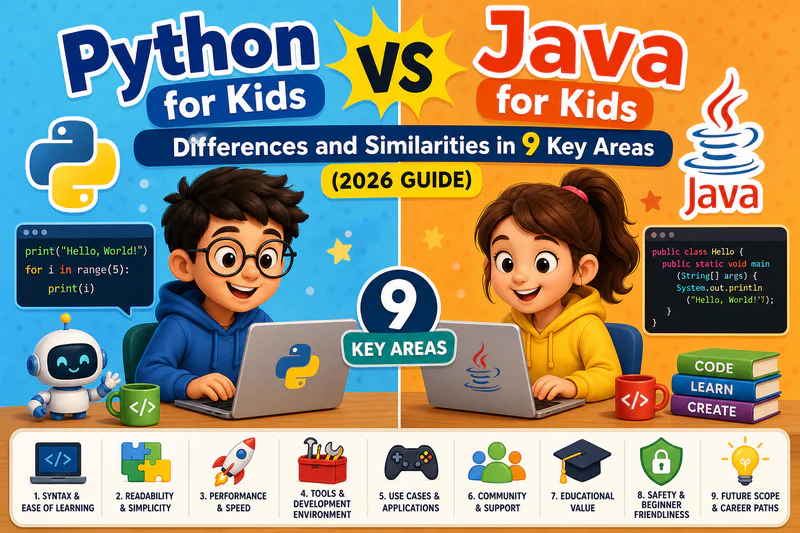
This guide breaks down Python for kids vs Java for kids across 9 critical areas, with code examples, a comparison table, 2026 career data, and a clear learning pathway for every age and skill level.
Quick Comparison: Python for Kids vs Java for Kids in 9 Key Areas
1. Syntax & Readability
Python for kids is frequently described as the closest thing to writing instructions in plain English. There are no mandatory semicolons, no type declarations, and no boilerplate class wrappers just to print a line of text. For a child encountering code for the first time, this simplicity is transformative, it lets them focus on thinking logically rather than fighting the language itself.
Java for kids is a different experience entirely. It demands that students understand types, classes, access modifiers, and method structures before they can write a working program. That discipline is genuinely valuable, but it can feel overwhelming without proper scaffolding.
Hello World, the clearest illustration:
# Python for kids – Hello World
print("Hello, World!")
// Java for kids – Hello World
public class HelloWorld {
    public static void main(String[] args) {
        System.out.println("Hello, World!");
    }
}
The contrast is stark. Python accomplishes in one line what Java needs eight lines to express. For a young learner, that gap matters enormously in the first few weeks.
Factorial function comparison:
# Python – Factorial
def factorial(n):
    if n == 0:
        return 1
    return n * factorial(n - 1)

print(factorial(5))  # Output: 120
// Java – Factorial
public class Factorial {
    public static int factorial(int n) {
        if (n == 0) return 1;
        return n * factorial(n - 1);
    }

    public static void main(String[] args) {
        System.out.println(factorial(5));  // Output: 120
    }
}
Python for kids wins on readability at every level. That said, Java's explicit structure teaches habits that matter deeply in professional software development.
2. Performance & Speed
Java compiles code into bytecode that runs on the Java Virtual Machine (JVM). This approach gives Java a substantial performance advantage, benchmarks consistently show Java executing CPU-intensive tasks 3–5x faster than Python's interpreted model.
Python's interpreter reads and executes code line by line, which introduces overhead. For most beginner projects, web scrapers, data visualizations, simple games, this difference is invisible. But for high-frequency trading systems, real-time mobile applications, or large-scale enterprise backends, Java's speed advantage is decisive.
Think of it like the efficiency of vedic math classes compared to long-form arithmetic. Vedic math classes teach students to compute in optimized mental shortcuts, that's exactly what Java's compiled execution model does. Just as vedic math classes train the brain to find the fastest path to an answer, Java's JVM optimizes code execution at the machine level. Python, by contrast, is like showing all your working on paper: more readable, equally correct, but not built for raw speed.
For Python for kids working on AI models, data analysis, or automation scripts, performance is rarely a bottleneck. When a teenager advances to building scalable Android apps or enterprise systems, Java's speed becomes a serious advantage.
3. Learning Curve
Python for kids has one of the flattest learning curves in modern programming. Children as young as 8 can begin writing functional scripts within their first session. The language's design philosophy prioritizes human readability, which means young learners spend their energy on problem-solving rather than syntax debugging.
Java for kids is more accurately described as a language for teens. Its object-oriented requirements, strict typing, and verbose syntax demand a degree of abstract thinking that typically emerges around ages 12–14. Students who attempt Java too early, without structured support, often struggle and disengage.
This is where online coding classes for kids make a meaningful difference. Structured, mentor-led programs sequence the learning appropriately: Python-first for foundational concepts, Java introduced progressively as logical thinking matures. Trying to self-teach Java from YouTube tutorials without guidance is where most young learners stall.
Math foundations also play a significant role. Students with strong arithmetic reasoning adapt to Java's type system and algorithmic structure faster. Online math programs for kids that reinforce logical sequencing and number sense give learners a real head start when transitioning to typed languages. Similarly, math tutoring for kids focused on problem decomposition directly mirrors how Java programs are architected, breaking a large problem into modular, reusable methods.
4. Object-Oriented Programming (OOP) Foundations
Both Python and Java support object-oriented programming, but their relationships with OOP are fundamentally different.
Python for kids allows learners to write fully functional programs without ever touching a class. OOP can be introduced gradually, as a student's understanding deepens. This optional approach lowers the barrier to entry while still making OOP available when it's needed.
Java for kids requires OOP from day one. Every Java program lives inside a class. Every method belongs to an object. This isn't a design flaw, it's deliberate. Java was built to enforce software engineering best practices, which is why it remains the dominant language in university computer science programs globally.
For teenagers aiming at software engineering careers, mastering Java's strict OOP model is a professional credential in itself. Online coding classes for kids that introduce OOP through Python first, then reinforce the same concepts in Java, produce students who understand why OOP matters, not just how to type it.
5. Platform Independence & Ecosystem
Python runs on virtually every operating system with minimal configuration. Its flexibility makes it the go-to language for web development (Django, Flask), scripting, AI research, and data pipelines. A Python script written on a Mac will run identically on Linux or Windows.
Java's "Write Once, Run Anywhere" philosophy, powered by the JVM, has made it indispensable in enterprise environments where software must run across heterogeneous server infrastructure. More visibly for teenagers, Java powers the entire Android app development ecosystem.
This is why app development classes for kids almost universally include Java. If a teenager dreams of building their own Android application, something that runs on over 3 billion active devices worldwide, Java is the language they need. App development classes for kids that teach the Android SDK give students a direct path from learning Java syntax to publishing a real app on the Google Play Store. That tangible outcome is one of Java's most compelling selling points for young learners.
6. Libraries & Frameworks
The library ecosystem is where each language's true strengths become visible.
Python's key libraries for young learners:
TensorFlow & Scikit-learn, machine learning and AI model building
NumPy & Pandas, data manipulation and analysis
Pygame, 2D game development (perfect for beginners)
Matplotlib, data visualization
Java's key frameworks for advanced students:
Android SDK, native mobile app development
Spring Boot, enterprise-grade backend systems
LibGDX, cross-platform game development
Hibernate, database management
For Python projects for kids, libraries like Pygame and Matplotlib make it possible to build Python projects for kids that are genuinely impressive, functional games, data dashboards, and even basic AI classifiers, within weeks of starting. Java projects, by contrast, require more upfront investment before producing visible results, which is why structured mentorship matters so much.
7. Community & Support
Python's global community is vast, beginner-oriented, and exceptionally well-documented. Stack Overflow, GitHub, and dedicated Python-for-kids forums provide immediate support for almost any question a young learner might have. The volume of free beginner tutorials, video courses, and interactive platforms (Replit, Jupyter Notebooks) makes self-directed learning genuinely viable.
Java's community is equally large but skews toward professional developers and enterprise engineers. Resources exist for beginners, but they require more filtering to find content appropriate for younger audiences. This is precisely where math tutoring for kids and 1:1 coding mentorship add outsized value, a human mentor who understands both Java's complexity and a teenager's learning style can compress months of confusion into focused, productive sessions. Math tutoring for kids that simultaneously reinforces logical thinking and algorithmic decomposition directly accelerates a student's ability to navigate Java's structured syntax.
The integration of coding and math for kids creates a compounding advantage: children who are comfortable with mathematical reasoning adapt to both Python and Java concepts far more quickly than those approaching programming without that foundation.
8. Career Prospects & Market Demand (2026)
The 2026 job market data tells a clear story, both languages are valuable, but in different domains.
According to data from the TIOBE Index and multiple tech hiring platforms, Python has climbed to the #1 most popular programming language globally in 2026, with Python job postings growing 18% year-over-year in Q1 2026, driven almost entirely by AI and data engineering roles. Python developer median salaries sit at approximately $133,000 annually in the US, with a projected 22% job growth between 2025–2029.
Java remains firmly in the top 3, commanding durable demand in enterprise software, cloud infrastructure, and Android development. Java's growth is steadier (approximately 3% YoY) but entrenched, major financial institutions, healthcare platforms, and government systems run on Java backends that won't be replaced anytime soon.
Career pathways for young learners in 2026:
Python path: Data Scientist, ML Engineer, AI Researcher, Backend Developer, Automation Specialist
Java path: Android Developer, Enterprise Software Engineer, Cloud Architect, Backend Systems Engineer
Combined: Full-Stack Engineer, Solutions Architect, Technical Lead
For parents thinking long-term about STEM careers for kids, fluency in both languages is the most future-proof outcome. Python for kids builds the foundation; Java for kids builds the ceiling.
9. Real-World Applications & Future Opportunities
Python for kids shines in areas that define the next decade of technology. AI model training, data analysis, web automation, and scientific research all run on Python. For teenagers interested in game design for teens, Python's Pygame library offers an accessible entry point, building simple 2D games that teach core programming logic without drowning in syntax.
Java for kids delivers in mobile and enterprise applications. Building a working Android app is one of the most motivating projects a teenage programmer can complete. It produces something real, shareable, and deployable, a tangible proof of skill that belongs on any college application or portfolio.
The strategic play for most young learners is sequential: start with Python for kids to build problem-solving intuition and programming confidence, then transition to Java for kids at around ages 13–15 to develop enterprise-grade discipline and mobile development capability. Students who follow this path emerge with a genuinely rare skill set.
How to Choose the Right Language for Your Child in 2026

Age 8–11: Start with Python for kids. The clean syntax, immediate results, and rich project library keep young learners engaged. Python coding classes designed for beginners introduce variables, loops, and functions in a context that feels like play, not study.
Age 12–14: Continue deepening Python for kids with data science and AI projects. Begin introducing Java concepts, OOP, type systems, method design, through structured online coding classes for kids that sequence the transition carefully.
Age 15+: Java for kids becomes fully accessible. This is the right time to explore Android app development, enterprise logic, and scalable system design. App development classes for kids at this level can take a student from zero Java knowledge to a published Android app in 6–12 months.
Math foundation matters enormously at every stage. Students who practice with online math programs for kids, particularly those reinforcing logical sequencing, pattern recognition, and arithmetic fluency, consistently outperform peers in both Python and Java environments. The mental math tricks for kids that build number sense translate directly into algorithmic thinking, which is the core skill underlying all programming.
For parents seeking the most efficient path, enrolling children in Python for kids courses early and pairing coding study with a strong math curriculum produces the best long-term outcomes.
Conclusion
Python for kids and Java for kids are not competitors, they are complements. Python for kids is the most effective starting point for young learners: accessible, powerful, and directly connected to the most in-demand career fields of 2026. Java for kids is the natural next step for teenagers ready to build enterprise-grade software, Android applications, and scalable systems.
The clearest path forward is structured and sequential. Enroll younger children in Python for kids courses to build confidence and computational thinking. Pair that with online math programs for kids to develop the logical foundation that both languages demand. Progress to Java for kids with the support of mentors, whether through app development classes for kids or dedicated 1:1 instruction, when the student is ready. Children who follow this integrated approach to coding and math for kids don't just learn to code. They build the problem-solving mindset that defines the most successful engineers of the next generation.
Frequently Asked Questions
Is Java harder than Python for kids?
Yes, Java for kids is significantly more challenging than Python for kids. Java requires understanding object-oriented programming, strict type declarations, and verbose syntax from the very beginning. Python for kids uses clean, English-like syntax that most children can grasp within their first few lessons. Most educators recommend starting with Python for kids before transitioning to Java for kids at around age 13–15.
What age is best to start Python for kids?
Python for kids is appropriate from age 8 onwards. Its minimal syntax and immediate feedback loop make it one of the most accessible first programming languages available. For children under 8, block-based languages like Scratch serve as an effective visual precursor to Python for kids. Structured online coding classes for kids can begin Python instruction effectively from third or fourth grade.
Can kids learn Java for app development?
Absolutely. Java for kids is the foundation of Android app development, making it one of the most practical languages a teenager can learn. App development classes for kids that teach the Android SDK give students direct experience building real mobile applications. Most students benefit from 12–18 months of Python for kids before transitioning into app development classes for kids focused on Java.
How do math skills influence learning Python or Java?
Mathematical reasoning is deeply correlated with programming aptitude. Students who engage with online math programs for kids that develop logical sequencing, pattern recognition, and arithmetic fluency adapt to programming concepts significantly faster. For Java specifically, the abstract thinking required for OOP and type systems mirrors the structured reasoning developed through math tutoring for kids. Even Python for kids benefits from strong math foundations, particularly when working on data science and AI projects.
What are the best online coding classes for kids?
The best online coding classes for kids combine structured curriculum with experienced mentors who understand child development. Effective programs introduce Python for kids first, then progressively incorporate Java for kids, OOP, and specialized tracks like app development classes for kids or AI/ML. CodeYoung's online coding classes for kids offer personalized 1:1 instruction that adapts to each student's pace and learning style.
How do vedic math classes relate to programming speed?
The connection between vedic math classes and programming performance is conceptual but powerful. Vedic math classes train students to find the most efficient computational path, eliminating unnecessary steps, recognizing patterns, and arriving at answers faster. This mirrors Java's compiled execution model, which optimizes code into efficient JVM bytecode before running. Students who practice vedic math classes often develop the kind of algorithmic efficiency mindset that makes them naturally better at writing optimized code in both Python and Java. Vedic math classes, in this sense, are mental performance training for future programmers.
Which language offers more future career opportunities?
Both Python for kids and Java for kids lead to strong career outcomes, but in different directions. Python for kids is the gateway to the fastest-growing career fields in 2026: AI/ML engineering, data science, and automation. Java for kids leads to durable, high-paying roles in enterprise software, Android development, and cloud infrastructure. According to 2026 data, Python developer roles are projected to grow 22% through 2029. The most competitive candidates will have fluency in both. For comprehensive guidance, explore STEM careers for kids to understand the full landscape of tech roles young learners can pursue.
How can 1:1 math tutoring help in learning Java?
Math tutoring for kids that targets logical decomposition, breaking a complex problem into ordered steps, directly mirrors Java's method-based, class-structured architecture. Math tutoring for kids focused on algorithmic thinking helps students understand why Java requires separate methods, why data types matter, and how objects model real-world systems. Students receiving dedicated math tutoring for kids consistently adapt to Java's steep learning curve faster than peers without that support.
Are there fun projects to practice both languages?
Python for kids projects include building text-based games, data visualizations, web scrapers, and beginner AI classifiers, all achievable within weeks. For Java for kids, building a simple Android calculator, a to-do list app, or a basic game using LibGDX provides excellent hands-on practice. Explore curated Python projects for kids to find age-appropriate challenges that build skill progressively. For Java, app development classes for kids provide structured project tracks that culminate in a publishable Android application.