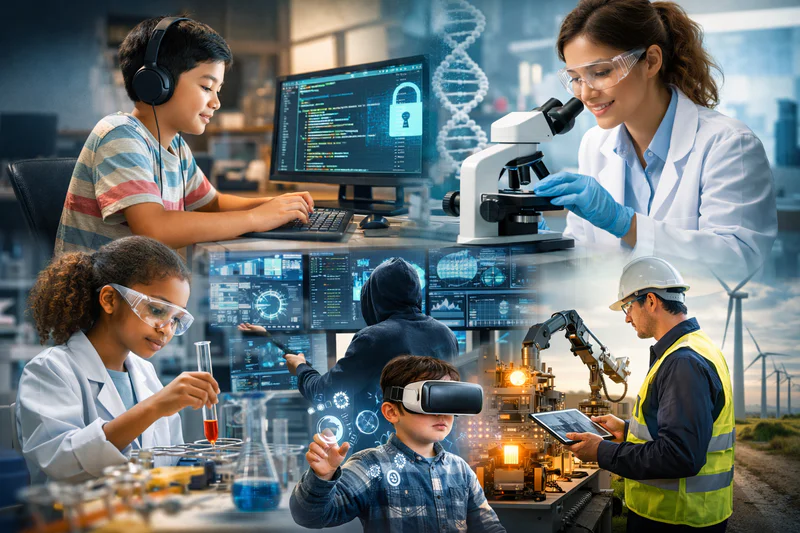
STEM Careers for Kids: What Jobs Will They Be Ready For?
By 2030, an estimated 85 million jobs are projected to be displaced by automation while 97 million new roles emerge that require distinctly human capabilities applied to technology-rich environments. The majority of those new roles sit in STEM fields. Software development, data science, biomedical engineering, environmental technology, AI research, cybersecurity: these are not speculative future jobs. Many of them are already among the fastest-growing and best-compensated positions in the global economy.
STEM careers for kids is not a conversation about pressuring children toward specific professions. It is a conversation about which skills, built during childhood, open the widest range of doors in adulthood. The answer is consistent: technical literacy, analytical thinking, coding, and scientific reasoning provide access to a wider range of career options than almost any other skill set a child can develop before 18.
This guide covers the most significant STEM career fields, what each one involves, how children can begin building relevant skills now, and how to talk to children about STEM in a way that motivates rather than pressures.
Key Takeaways
STEM roles are projected to grow significantly faster than the overall job market through 2032, with software development, data science, and biomedical fields leading growth.
Children don't need to choose a specific STEM career in childhood; building broad foundational skills (coding, mathematical reasoning, scientific thinking) keeps all options open.
Coding is the most transferable STEM skill across career paths, relevant to software, data science, engineering, healthcare technology, environmental science, and more.
The skills that STEM careers reward, systematic thinking, comfort with ambiguity, data literacy, and collaborative problem-solving, are all developable from childhood with the right instruction.
Codeyoung's programmes in coding, maths, and science are specifically designed to build the foundations that lead to meaningful STEM pathways from as early as age 6.
The Fastest-Growing STEM Careers and What They Actually Involve
Parents often have an outdated picture of what STEM careers look like. The white-coat scientist, the isolated programmer in a dark office, the engineer surrounded by blueprints. The reality of 2026 STEM careers is broader, more collaborative, and more diverse than these stereotypes suggest.
Fastest-Growing STEM Career Fields in 2026
The projection figures above are from the US Bureau of Labor Statistics, and they consistently point in one direction: roles that involve working with data, technology, and complex systems are growing faster than the general job market by a significant margin. The careers that are declining fastest are those involving routine, predictable tasks that can be automated.
Which STEM Skills Should Children Start Building Now?
The most valuable insight for parents is this: the specific career a child will pursue is unknowable in primary school, and it will probably be shaped by technologies and industries that don't exist yet in their current form. What is knowable is which foundational skills appear across the widest range of STEM careers. Building those now is the most future-proof investment in a child's education.
Foundational STEM Skills and How Children Build Them
Coding is notable in this table because it appears, directly or indirectly, in building almost every foundational skill. This is why coding education consistently appears as the most high-leverage single investment parents can make in a child's STEM preparation: it develops computational thinking, systems thinking, problem decomposition, and introduces data literacy, all within the same learning activity.
Want your child to start building the skills that STEM careers actually require? Book a free trial class at Codeyoung and find the right starting point for their age and interests.
Do Children Need to Decide on a STEM Career Early?
No. And the pressure to do so can be actively counterproductive. Children who are told at age 10 that they should become a software engineer because it pays well tend to develop a transactional relationship with STEM subjects that eventually produces burnout rather than sustained engagement. The research on intrinsic versus extrinsic motivation in education is consistent: external rewards and career-focused pressure produce short-term compliance and long-term disengagement.
What works better is building skills through activities the child finds genuinely interesting, without over-indexing on a specific career destination. A child who loves building games in Python is developing machine learning prerequisites. One who loves designing websites is developing UX skills. One who is fascinated by chemistry is developing the foundation for materials science or pharmaceutical work. The career connection is real, but it doesn't need to be stated as a goal for the skill-building to be valuable.
How do you talk to children about STEM careers without creating pressure?
Frame STEM as problem-solving, not as employment. Ask "what problems do you find interesting that technology could help solve?" rather than "what do you want to be when you grow up?" Connect current learning to visible real-world impact: explain that the person who built the app they use every day started by learning to code, or that the scientists who developed a vaccine they received studied biology and chemistry at school. Keep the conversation curious rather than prescriptive, and let the child's own interests guide which specific STEM areas they develop most deeply.
STEM Careers That Will Exist in 2035 That Don't Fully Exist Today
One of the most honest things parents can hear about STEM career preparation is that many of the most significant roles their children will hold in 2035 don't have clear names yet. The World Economic Forum estimates that 65% of children entering primary school today will work in job types that don't currently exist. This is not a reason for anxiety. It is a reason to focus on transferable capability rather than specific job training.
Some emerging STEM career areas worth watching as children develop their skills:
AI Ethics and Governance: As AI systems make more consequential decisions about human lives, roles that combine technical understanding with ethical reasoning and policy expertise are growing rapidly. Children who develop both coding skills and strong critical thinking are natural candidates.
Climate Technology and Carbon Engineering: The transition to sustainable energy systems is creating demand for engineers, data scientists, and materials scientists focused on renewable energy, carbon capture, and climate modelling.
Genomics and Personalised Medicine: Advances in genetic sequencing are creating new roles that combine biology, computer science, and data analysis. Bioinformatics is one of the fastest-growing specialist fields in healthcare.
Human-AI Interaction Design: As AI systems become ubiquitous, designing the interfaces, experiences, and communication norms around them will require specialists who understand both human psychology and machine learning systems.
Quantum Computing Applications: Quantum computing is moving from research labs toward commercial application. Children who develop strong physics and mathematics foundations may find themselves at the forefront of an entirely new computing paradigm.

How STEM Education at Codeyoung Prepares Children for Future Careers
Codeyoung's programmes are not designed to train children for specific job roles. They are designed to develop the foundational capabilities that every significant STEM career requires: computational thinking through coding, quantitative reasoning through maths, and systematic inquiry through science. These three disciplines, taught together, produce children who can learn new technical tools quickly, reason clearly under uncertainty, and build solutions to problems that haven't been fully defined yet.
Across 45,000+ students in the USA, UK, Canada, and Australia, Codeyoung has found that children who develop strong foundations in coding and maths during primary and early secondary school enter their GCSE, A-Level, and university years with a measurable advantage in STEM subjects. Not because they know more content, but because they have developed the thinking habits that make new technical content accessible.
The programmes relevant to STEM career preparation include coding (Python, web development, Java, AI/ML, game development, and app development), maths (mental arithmetic, Vedic techniques, and school curriculum support), and science (physics, chemistry, biology, and earth science through curiosity-led live instruction).
Are STEM Careers Right for Every Child?
The straightforward answer is no, and parents should be wary of any framework that suggests otherwise. Not every child will pursue a STEM career, and that is entirely fine. Meaningful, well-compensated work exists across the full spectrum of human endeavour.
What is true is that STEM literacy, the ability to understand and work with data, technology, and scientific concepts at a basic level, is becoming a general life skill rather than a specialist one. A child who becomes a journalist will work with data. One who becomes a lawyer will encounter AI-generated evidence. One who becomes a designer will use generative AI tools. STEM education doesn't lock children into technical careers; it ensures they can operate competently across whatever field they choose to enter.
The goal is not to produce engineers. It is to produce capable, adaptable thinkers who are not limited in their choices by an early deficit in technical literacy.
Frequently Asked Questions About STEM Careers for Kids
What STEM careers are most in demand right now?
The most in-demand STEM careers in 2026 include AI and machine learning engineering, data science and analytics, cybersecurity, software development, biomedical engineering, and environmental science and technology. All of these fields are growing significantly faster than the general job market. AI/ML roles in particular are seeing exceptionally rapid demand growth as organisations across every sector integrate AI into their operations. Software development remains the most broadly accessible STEM career path, with the widest range of entry points and specialisations.
How can parents help their child develop STEM skills from a young age?
The most effective approaches are structured and engaging rather than purely academic. Enrol children in coding classes from around age 6 using visual tools like Scratch, progressing to Python by age 10 to 11. Support maths development through daily mental arithmetic practice and real-world application. Encourage science curiosity by discussing how everyday things work and doing simple at-home experiments. Normalise technology as something to understand and build, not just consume. The compounding effect of consistent exposure across all three STEM disciplines is significantly greater than intensive focus on any single one.
Is coding the most important STEM skill for children to learn?
Coding is the single most transferable STEM skill because it appears directly or indirectly in the majority of high-growth STEM careers. It also develops computational thinking, problem decomposition, and data literacy as byproducts of the learning process itself. That said, coding alone is not sufficient: the highest-value STEM professionals combine coding with strong mathematical reasoning and domain-specific scientific knowledge. For most children, the optimal approach is coding as the primary technical skill, with maths and science developed in parallel.
What is the average salary for STEM careers?
STEM careers consistently rank among the highest-compensated fields globally. In the USA, the median annual wage for computer and information technology occupations exceeds $100,000. Data scientists earn a median of $108,000 and AI engineers typically exceed $120,000. Biomedical engineers earn around $97,000. These figures vary by location, experience, and specialisation, but STEM roles broadly outperform the national median salary across the USA, UK, Canada, and Australia, often by significant margins even at entry level.
Do girls have equal opportunities in STEM careers?
Opportunity is equal; representation remains unequal, particularly in computing and engineering. Girls who receive early, quality STEM education, particularly coding instruction before age 12, are significantly more likely to pursue STEM subjects in secondary school and university. Research from the Computing Research Association shows that girls who try coding in primary school are more than twice as likely to express interest in a computing career than those who don't encounter coding until secondary school. Early exposure matters specifically because it prevents the formation of "not for me" attitudes before they become entrenched.
What is the difference between STEM and STEAM education for kids?
STEM stands for Science, Technology, Engineering, and Mathematics. STEAM adds Arts, recognising that design thinking, creative problem-solving, and communication are increasingly integral to technology careers. The distinction matters somewhat in practice: children who develop both technical skills and creative, design-oriented thinking are particularly well-suited to careers in UX/UI design, product development, science communication, and human-AI interaction design. Most quality STEM programmes already incorporate creative elements, even if they don't explicitly use the STEAM label.
Can a child become interested in STEM if they haven't shown interest by age 10?
Yes, and with age-appropriate approaches it happens regularly. Interest in STEM is not a fixed trait that either exists or doesn't by a certain age. Many children who express no interest in technology at age 10 become genuinely enthusiastic about coding at 13 when they discover game development or AI. The key is finding the specific application of STEM that connects with the child's existing interests, not trying to make them interested in "coding" or "science" as abstract concepts. The entry point matters more than the age.
How does maths education affect a child's STEM career readiness?
Strong mathematical reasoning is a gating factor for many of the highest-growth STEM careers, particularly data science, AI/ML engineering, financial technology, and quantitative research. Children who arrive at university with weak maths foundations often find themselves unable to progress in their first-choice STEM field without significant remedial work. Building strong maths skills during primary and secondary school, including mental arithmetic fluency, algebraic thinking, and basic statistical reasoning, keeps the widest range of STEM career doors open well into adulthood.
What STEM subjects should children focus on in secondary school?
The most career-relevant secondary school STEM subjects are mathematics (at the highest level available), computer science, physics, and chemistry. Biology is important for healthcare-adjacent career paths. For children interested in software development or AI, mathematics and computer science are the core priorities. For those interested in engineering, mathematics and physics are foundational. Pursuing at least one science subject alongside mathematics and computer science at advanced level provides the broadest range of university STEM programme options.
How does Codeyoung prepare children specifically for STEM careers?
Codeyoung prepares children for STEM career pathways by building three foundational capability areas through live 1:1 instruction: computational thinking and coding through its coding programmes (Python, AI/ML, web development, Java, app development), quantitative reasoning through its maths programme, and scientific inquiry through its science programme. The combination of these three, developed consistently from childhood, produces the kind of rounded technical literacy that the most significant STEM careers require.
Build the Foundations. The Career Will Follow.
The most useful thing a parent can do for a child's STEM career prospects is not to choose the right specific path early. It is to build strong, broad foundational skills that keep all paths open. Coding, mathematical reasoning, and scientific thinking are the three pillars that underpin the majority of high-growth STEM careers, and they are all developable from childhood with the right instruction.
Children don't need to know what they want to be at age 10. They need to be developing the capabilities that will make them effective, adaptable, and genuinely valuable in whatever field they ultimately choose. That is what STEM education, done well, delivers.
Explore Codeyoung's coding, maths, and science programmes for children aged 6 to 17, or book a free trial session to find the right starting point for your child.
Start building your child's STEM foundations today.
Codeyoung offers personalised 1:1 live coding, maths, and science classes for children aged 6 to 17. Expert instructors, flexible scheduling, and a completely free first class with no commitment required.