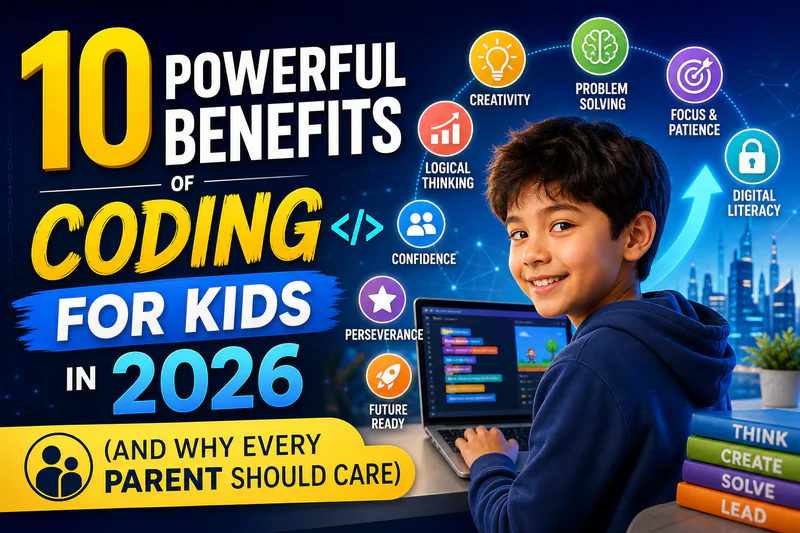
There are over 67,000 open software engineering roles at major tech companies right now, and that number is still climbing. According to CompTIA's State of the Tech Workforce 2026 report, the tech sector is expected to replace roughly 323,000 workers annually through 2036. The message for parents is unambiguous: coding is no longer a niche skill. It is the new foundational literacy.
The benefits of coding for kids extend far beyond writing lines of Python or dragging blocks in Scratch. Coding teaches children how to think, persist, create, and communicate, skills that matter in every career and every classroom. This guide breaks down the 10 most important benefits of coding for kids in 2026, along with the tools and programs that deliver them best.
The 10 Benefits of Coding for Kids, At a Glance
Before we go deep, here is a structured summary. This table is designed to give parents and educators an instant reference map of what coding actually develops, and where it pays off in real life.
Each of these benefits is explored in full below, with specific tools, platforms, and learning pathways mapped to each one.
Benefit 1: Coding Builds Razor-Sharp Problem-Solving Skills
One of the most well-documented benefits of coding for kids is the dramatic improvement in problem-solving ability. When a child writes a program, they must break a large challenge into smaller, manageable steps, a cognitive strategy called decomposition. When something breaks (and in coding, something always breaks), they learn to debug: to isolate the error, test a fix, and try again.
A 2026 study published in PubMed Central confirmed that early coding instruction significantly improves problem-solving and computational thinking across age groups. These aren't abstract classroom gains, they transfer directly to science, mathematics, and everyday logical reasoning.
Enrolling children in online coding classes for kids gives them a structured environment to develop this problem-solving mindset from the very first session. Pairing that with online math programs for kids reinforces the same analytical thinking from two complementary directions, accelerating overall STEM performance.
Benefit 2: Coding Supercharges Logical and Algorithmic Thinking
Logic is the backbone of every discipline that matters in the modern economy, law, medicine, engineering, finance, and of course computer science. One of the most underappreciated benefits of coding for kids is how rapidly it builds formal logical reasoning.
Python for kids is the gold standard here. Python's clean, readable syntax forces young learners to think in sequences: if this happens, then do that; otherwise, do something else. This conditional thinking trains the brain to evaluate cause and effect, weigh options, and construct structured arguments. According to data from Itransition's 2026 software statistics report, Python is the most sought-after programming language in the job market, with 45.7% of recruiters actively seeking Python proficiency.
Starting Python for kids at age 10 or 11 plants the seeds for a future in data science, artificial intelligence, or software engineering. Learning to navigate STEM careers for kids begins with exactly this kind of logical, structured thinking, and coding is the most effective way to build it.
Benefit 3: Scratch Programming for Kids Unlocks Early Cognitive Development

Not every five-year-old is ready to type lines of code, and they don't need to be. Scratch programming for kids offers a visual, drag-and-drop interface developed at MIT that makes programming intuitive, playful, and deeply effective for younger learners.
Scratch programming for kids develops spatial reasoning, sequencing, pattern recognition, and creative design, all before a child ever types a single line of text-based code. Children build animated stories, interactive games, and mini-applications using colorful code blocks, understanding the logic of loops, conditions, and events without even realizing they are learning computer science fundamentals.
Research consistently shows that children who engage with Scratch programming for kids demonstrate stronger memory, concentration, and problem-solving abilities. The cognitive architecture that Scratch builds in ages 5 to 10 is precisely the foundation that Python for kids and more advanced tools build upon later. It is not just an intro course, it is where genuine digital literacy begins.
Benefit 4: Coding Reinforces Math, Naturally and Powerfully
One of the most practically significant benefits of coding for kids is what it does for mathematics. Coding is, at its core, applied math. Variables, functions, loops, conditionals, coordinate systems, every major programming concept maps directly onto a math concept. Children who code regularly develop a more intuitive relationship with numbers and logic than those who rely on traditional instruction alone.
This is why coding and math for kids represents such a powerful combination for building a genuine STEM edge. Access to dedicated online math programs for kids alongside coding instruction creates a reinforcing loop, each discipline strengthens the other.
The parallel with vedic math classes is instructive here. Vedic math classes are celebrated for building mental agility, rapid calculation, and deep numerical intuition through pattern-based techniques. Coding develops a remarkably similar cognitive profile: it trains the brain to recognize patterns, apply rules consistently, and think several steps ahead. Parents who invest in both vedic math classes and coding education for their children are giving them a decisive advantage in quantitative reasoning. The combination of math tutoring for kids with structured coding practice is among the most effective STEM investments available today.
Benefit 5: Coding Builds Resilience and a Growth Mindset
Every program breaks. Every algorithm has a flaw. Every coder, beginner or expert, spends a significant portion of their time debugging. This is not a bug in learning to code; it is the feature.
The repeated cycle of writing, testing, failing, and fixing is one of the most powerful character-building experiences available to children. Among all the benefits of coding for kids, the cultivation of resilience and a genuine growth mindset may be the most enduring. A child who has learned that broken code is not failure, it is just the next problem to solve, carries that perspective into every academic challenge and life obstacle.
A 2026 study published in Taylor & Francis found that coding club participation produced measurable gains in resilience (+0.22 effect size) and confidence (+0.47 effect size) in participating students. These are not trivial outcomes. They are the psychological foundations of high-performance learners.
Benefit 6: Coding Teaches Emotional Regulation, Not Just Logic
This benefit surprises many parents. Coding is not purely an intellectual exercise, it is an emotional one. Sitting with a problem that will not cooperate, resisting the urge to quit, maintaining focus through repeated errors, these are acts of emotional discipline.
Research highlighted in why coding teaches emotional regulation shows that children who code regularly develop superior frustration tolerance, impulse control, and attentional focus. These are the same executive functions that underpin academic success, healthy relationships, and professional performance.
The benefits of coding for kids in this domain are distinct from what you get in standard STEM classes. Math tutoring for kids builds numerical skill. Science experiments build curiosity. But coding, with its high frequency of setbacks and its demand for sustained focus, uniquely trains emotional regulation in a way that few other childhood activities can match.
Benefit 7: Coding Sparks Creativity and Innovation
Coding is fundamentally a creative act. Children who code do not just consume digital content, they produce it. They design games, build interactive stories, animate characters, and develop tools that solve real problems. This shift from passive consumer to active creator is one of the most transformative benefits of coding for kids in the modern digital environment.
App development classes for kids are a powerful vehicle for this creative expression. When a child builds an actual app, even a simple one, they must think like a designer, a product manager, and an engineer simultaneously. What problem does this solve? Who will use it? How should it look and feel? These questions develop entrepreneurial instincts alongside technical skills.
The natural extension of this creative journey is game design for teens, where older learners channel their passion for gaming into building the games themselves. Scratch programming for kids plants the creative seed; app development classes for kids and game design programs help it flourish.
Benefit 8: Coding Prepares Kids for Future STEM Careers and Job Markets
Software job openings in the U.S. have surged more than 30% in 2026 alone, according to data from TrueUp tracked by Business Insider. Despite the rise of AI, the demand for people who can understand, direct, and build with technology is accelerating, not declining. The benefits of coding for kids in terms of career preparation have never been more concrete.
Python for kids is the gateway to this future. Python is the primary language of artificial intelligence, machine learning, data science, and automation, the four fastest-growing sectors of the 2026 economy. A teenager with strong Python for kids foundations is not just prepared for a career in tech; they are prepared to work alongside AI tools intelligently in virtually any profession.
Online coding classes for kids provide the structured curriculum and expert instruction needed to move from beginner-level Scratch programming for kids to intermediate Python for kids and beyond. Starting online coding classes for kids early gives children years of compounding advantage in STEM career readiness.
Benefit 9: Coding Boosts Confidence and Communication Skills
There is something profoundly confidence-building about creating something that works, something you built from nothing. Children who complete coding projects develop a tangible sense of self-efficacy that extends into the classroom, the playground, and eventually the boardroom.
In collaborative online coding classes for kids, learners regularly present their projects, explain their logic, and give feedback to peers. These experiences develop verbal articulation, the ability to explain technical concepts in plain language, and the collaborative mindset that employers consistently identify as the most valuable professional skill.
The benefits of coding for kids in this social and communicative dimension are often overlooked. Coding is not a solitary activity, it is a language. Children who learn it gain a shared vocabulary with the most innovative communities in the world.
Benefit 10: Coding Opens Doors to Entrepreneurship via App Development Classes for Kids

The greatest entrepreneurs of the next decade will not just have business ideas, they will have the technical skills to build them. App development classes for kids are where this entrepreneurial journey begins in earnest.
When children learn to develop apps, they move from abstract thinking to tangible creation. They define a problem, design a solution, build a prototype, test it with real users, and iterate based on feedback. This is the startup cycle, compressed into an educational format accessible to children as young as 11 or 12.
App development classes for kids that integrate Python for kids, UI/UX fundamentals, and product thinking are among the most future-forward investments a parent can make. The benefits of coding for kids who pursue app development extend across entrepreneurship, engineering, design, and beyond.
Age-Appropriate Coding Tools and Class Recommendations
Knowing what age should a child start coding is the first practical question most parents face. Here is a clear roadmap:
Ages 5–10: Scratch Programming for Kids Scratch programming for kids is the ideal starting point. The visual, block-based interface eliminates typing barriers and focuses entirely on logical thinking, sequencing, and creativity. Children build games, stories, and animations while absorbing the core architecture of programming without feeling like they are doing "computer science."
Ages 10–14: Python for Kids Python for kids is the natural next step. As children develop the ability to think abstractly and handle greater complexity, Python's readable syntax and vast application range, from web development to data analysis to AI, make it the most valuable language to learn. Python for kids at this age builds directly toward real career skills.
Ages 12 and up: App Development Classes for Kids App development classes for kids bring everything together. Students apply Python skills (or JavaScript alternatives), design thinking, and product logic to build functional applications. This is where technical skill meets entrepreneurial vision.
Throughout all stages: Math Tutoring for Kids + Online Math Programs for Kids The benefits of coding for kids are amplified significantly when paired with dedicated mathematics support. Math tutoring for kids ensures that the quantitative foundations coding relies on, algebra, logic, functions, and patterns, are firmly in place. Online math programs for kids and vedic math classes that develop mental agility and rapid number processing directly enhance a child's coding performance by sharpening the logical intuition coding demands.
Codeyoung offers integrated programs spanning online coding classes for kids, online math programs for kids, and math tutoring for kids, all structured to grow with your child from Scratch programming for kids all the way through advanced Python for kids and app development classes for kids.
Conclusion
The benefits of coding for kids in 2026 are broader, deeper, and more consequential than most parents realize. From Scratch programming for kids building early cognitive foundations to Python for kids opening doors to AI-era careers, from app development classes for kids nurturing entrepreneurial instincts to the quiet but profound development of emotional regulation, coding delivers skills that transform children into capable, resilient, creative thinkers.
The best time to start was yesterday. The second-best time is now. Explore Codeyoung's integrated programs in online coding classes for kids and math tutoring for kids to give your child a structured, expert-guided path through every stage of their coding journey, from their first Scratch project to their first Python for kids program to their first fully-built app.
Frequently Asked Questions
What are the benefits of coding for kids?
The benefits of coding for kids span cognitive, academic, emotional, and career domains. Coding builds problem-solving ability, logical reasoning, math skills, resilience, creativity, and communication confidence. In 2026, the benefits of coding for kids also include direct preparation for an AI-driven job market where Python for kids, app development classes for kids, and computational literacy are foundational career assets.
How do online coding classes for kids work?
Online coding classes for kids are structured, instructor-led sessions delivered via live video. Students learn in small groups or one-on-one formats, working through projects in Scratch programming for kids, Python for kids, or app development. Codeyoung's online coding classes for kids are project-based and paced to each child's skill level, ensuring mastery at every stage.
What age should a child start coding?
Most children can begin coding as early as age 5 using Scratch programming for kids. From ages 10 to 12, transitioning to Python for kids is appropriate and highly effective. There is no single "right" age, the key is matching the tool to the developmental stage. Scratch programming for kids works brilliantly for young learners; Python for kids and app development classes for kids suit older, more abstract thinkers.
How does Scratch programming for kids improve cognitive skills?
Scratch programming for kids develops spatial reasoning, sequencing, pattern recognition, and creative design through a visual interface that requires no typing. Children learn loops, conditionals, and events, core programming concepts, while building games and stories. Research shows that Scratch programming for kids measurably improves memory, focus, and computational thinking in children aged 5 to 10.
In what ways does Python for kids prepare children for future jobs?
Python is the dominant language of artificial intelligence, data science, and automation, three of the fastest-growing fields of 2026. Python for kids introduces children to real-world programming logic, data structures, and problem-solving patterns. With Python for kids as their foundation, teenagers enter higher education and the workforce with skills that 45.7% of tech recruiters specifically seek.
How do app development classes for kids encourage entrepreneurship?
App development classes for kids place children in the role of product creator: they identify a problem, design a solution, code a prototype, and test it with users. This mirrors the actual startup development cycle and builds entrepreneurial thinking alongside technical skill. App development classes for kids that incorporate Python for kids and design fundamentals create young innovators prepared to build real-world products.
How does coding connect to math skills and online math programs for kids?
Coding is applied mathematics. Variables, functions, loops, and algorithms directly correspond to algebra, logic, and numerical reasoning. Children who practice coding alongside online math programs for kids experience a powerful reinforcing effect, each discipline strengthens the other. Online math programs for kids that focus on logical reasoning and pattern recognition align naturally with the cognitive demands of coding, making both subjects easier and more intuitive.
Why consider vedic math classes alongside coding?
Vedic math classes develop the same mental agility, pattern recognition, and rapid logical processing that coding demands. The focused, disciplined arithmetic techniques taught in vedic math classes build the kind of numerical intuition that makes coding more natural and more powerful. Parents who combine vedic math classes with online coding classes for kids give their children a dual advantage in computational speed and logical depth.
Can math tutoring for kids complement coding education?
Absolutely. Math tutoring for kids ensures that the mathematical foundations coding relies on, algebra, functions, ratios, and logical inference, are solidly in place. Children who receive math tutoring for kids alongside coding instruction tend to progress faster in both subjects. Codeyoung's online math programs for kids are specifically structured to complement coding education, making math tutoring for kids and coding a natural, high-value pairing for STEM success.
How does coding teach emotional regulation and resilience?
Coding demands patience, sustained focus, and the ability to tolerate setbacks without quitting. Every debugging session is an exercise in emotional regulation. Children who code regularly develop measurably stronger frustration tolerance and impulse control, skills that carry into academic performance, social relationships, and professional life. The benefits of coding for kids in this emotional domain are supported by 2026 academic research showing significant gains in resilience and confidence from coding participation.