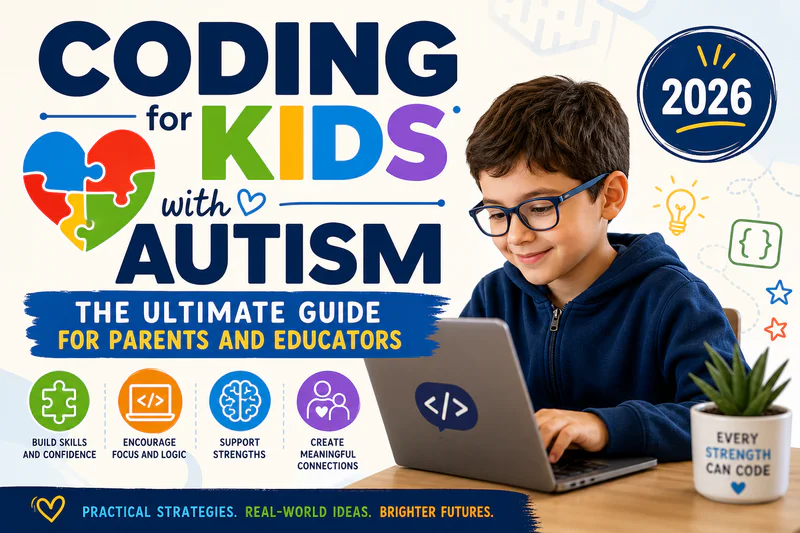
Your child notices patterns you miss. They remember rules precisely, focus intensely on topics they love, and think in systems most people can't visualize. These aren't obstacles, they are the exact skills that make great programmers.
This guide is written for parents and educators who want to understand why coding for kids with autism is such a powerful match, and how to get started in the most supportive, effective way possible.
Why Coding for Kids with Autism Is a Natural Fit
Many of the traits associated with autism spectrum disorder (ASD), hyper-focus, pattern recognition, attention to detail, affinity for rules, and systematic thinking, are the very same traits celebrated in professional software development. When you reframe these characteristics not as challenges to overcome but as genuine cognitive strengths, coding stops being a "therapeutic activity" and starts looking like a career pathway hiding in plain sight.
Programming languages are, by their nature, rule-bound and predictable. Code behaves the same way every time. There are no ambiguous social cues to decode, no shifting expectations, just clear inputs, logical processes, and reliable outputs. For autistic learners who thrive in structured, consistent environments, this is profoundly reassuring.
Research supports what many parents and educators already sense. Studies consistently show that coding helps neurodivergent children improve problem-solving confidence and cognitive flexibility. Coding for kids with autism isn't just beneficial, it is, for many children on the spectrum, a genuinely natural fit.
Common Challenges and How to Overcome Them
That said, the path isn't without its bumps. Understanding where difficulty arises allows parents and educators to design better learning environments.
Sensory sensitivities are a significant consideration. Bright screens, background noise, uncomfortable chairs, or flickering monitors can derail focus entirely. Creating a calm, predictable workspace, good lighting, noise-cancelling headphones if needed, a consistent desk setup, removes these barriers before they become problems.
Executive functioning hurdles can make starting a task, switching between activities, or managing a multi-step project feel overwhelming. Breaking coding lessons into small, defined micro-tasks with clear visual checkpoints helps enormously. Tools like visual timers and progress trackers make abstract goals feel concrete.
Social learning environments can be anxiety-inducing for some autistic children. This doesn't mean group learning is off the table, it means the format matters. Small groups, structured collaboration (rather than open-ended group work), and clearly defined roles within team projects can make the social dimension of learning feel safer and more manageable.
The key principle across all of these: reduce uncertainty, celebrate consistency, and build in predictability wherever possible.
When and How to Start Coding for Kids with Autism

Most child development specialists and coding educators recommend introducing foundational programming concepts between ages 5 and 6. At this age, children, including those on the autism spectrum, are developmentally ready to engage with cause-and-effect thinking, sequencing, and basic logical reasoning. These are the building blocks of coding.
Starting early doesn't mean starting with complex text-based languages. The progression matters enormously:
Ages 5–7: Visual, drag-and-drop tools like Scratch programming for kids or ScratchJr. The interface is intuitive, and the immediate visual feedback satisfies the autistic learner's need to see cause and effect instantly.
Ages 8–10: Transitional block-based tools like Blockly, which introduce more structured logic while keeping the visual interface.
Ages 10–12+: Text-based languages like Python for kids, which reward the systematic, detail-oriented thinking common in autistic learners.
Pacing is deeply personal. Some children will race through these stages; others will spend a year in Scratch programming for kids and emerge with remarkable depth. Neither approach is wrong. The goal is engagement and genuine understanding, not speed.
Best Programming Languages and Tools for Kids with Autism

Choosing the right tool makes an enormous difference. The following table compares the top languages and platforms specifically through the lens of autistic learners:
Scratch programming for kids remains the most widely recommended entry point for children on the spectrum, largely because it removes the barrier of typed syntax entirely. Python for kids, meanwhile, has gained significant traction as autistic learners progress, its readable, almost English-like syntax and strict logical structure feel satisfying rather than arbitrary. For children with a specific passion project, app development classes for kids offer the kind of deep-dive, purpose-driven learning that hyper-focus absolutely thrives on.
The Overlapping Benefits of Coding and Math for Kids with Autism
Coding and mathematics share the same cognitive DNA: pattern recognition, sequential logic, rule-following, and algorithmic thinking. For autistic learners, this overlap is a genuine advantage, strengthening one naturally reinforces the other.
Online math programs for kids that emphasize structured problem-solving, number patterns, and logical reasoning directly support the skills children use when they write their first loops in Scratch programming for kids or debug their first Python for kids project. The mental muscles are the same.
Math tutoring for kids in a 1:1 setting is particularly powerful for autistic learners. Patient, personalized instruction, where the tutor adapts to the child's pace rather than a classroom schedule, builds the kind of mathematical confidence that translates directly into coding competence. Many autistic children who resist math in a group setting respond exceptionally well to individualized attention, where there is no social pressure and no arbitrary time constraint.
It's also worth exploring vedic math classes as an alternative approach to numeracy. Vedic math classes use pattern-based, systematic mental calculation techniques that can feel almost algorithmic, a method of processing numbers that appeals strongly to neurodivergent thinkers who prefer structured, rule-governed systems over rote memorization. Vedic math classes offer a genuinely different cognitive pathway to mathematical fluency that many autistic learners find both engaging and intuitive.
Explore how coding and math for kids work together to create a powerful STEM foundation.
Choosing the Right Learning Environment: 1:1 vs Group Online Coding Classes for Kids
For many autistic children, the learning environment itself is as important as the curriculum. This is one of the clearest reasons why online coding classes for kids have become the preferred format for families navigating ASD.
At home, the sensory environment is controllable. Your child sits in their own chair, in their own space, without fluorescent lights, unpredictable classroom noise, or the social complexity of a physical group setting. Online coding classes for kids eliminate these friction points entirely, making it significantly easier for autistic learners to focus on the actual content.
The question of 1:1 vs group coding classes for kids is nuanced. Here's a practical framework:
1:1 coding instruction is ideal when:
Your child needs a customized pace (faster or slower than typical)
Sensory or anxiety-related issues make group environments difficult
The child benefits most from consistent, predictable interaction with one trusted instructor
You want direct feedback tailored to your child's specific project or special interest
Small group online coding classes for kids become valuable when:
Social skill development is a learning goal
Your child has progressed to a point where peer collaboration is enriching rather than stressful
Structured team projects (like app development classes for kids) provide the right level of social scaffolding
Neither format is universally superior, the right choice depends on where your child currently is, not where you think they should be. Many families use both: 1:1 instruction for core skill-building and small group sessions to develop collaborative confidence. Online coding classes for kids make both formats equally accessible from the comfort of home.
Practical Tips for Parents and Educators
Supporting coding for kids with autism well means thinking about the whole environment, not just the curriculum. These are evidence-informed, practical strategies:
Create a sensory-friendly workspace. Minimize visual clutter on the desk. Use consistent, warm lighting. Offer noise-cancelling headphones. Keep the setup the same each session to reduce transition anxiety.
Let special interests lead. App development classes for kids are particularly effective here, if your child loves animals, space, or video games, build the project around that passion. Motivation is the single most powerful variable in learning.
Use positive reinforcement deliberately. Celebrate small, specific wins: finishing a for-loop, debugging a script, completing the first level of Scratch programming for kids. Specific praise ("You figured out why the sprite wasn't moving, that's real debugging!") is more motivating than generic encouragement.
Break sessions into defined chunks. 20–30 minute focused segments with a clear activity and a predictable endpoint work better than open-ended long sessions for most autistic learners.
Embrace computational thinking as a framework.Computational thinking for kids, the ability to break problems into smaller steps, recognize patterns, and design solutions, is a transferable skill that benefits autistic learners across every subject, not just coding.
Collaborate with educators and therapists. Share what your child is working on in coding with their broader support team. Goal-setting benefits from being coherent across home, school, and therapy contexts.
Career and Future Opportunities in Tech for Autistic Individuals
The stakes here are genuinely significant. According to data compiled in 2026, approximately 85% of autistic college graduates are unemployed or underemployed, a figure that reflects not a lack of ability, but a lack of access to the right pathways, accommodations, and preparation.
Technology is changing this picture. Major companies including Microsoft, SAP, and Google have launched dedicated neurodiversity hiring programmes specifically because autistic professionals bring measurable strengths in quality assurance, data analysis, cybersecurity, systems thinking, and software engineering. The demand for these skills is growing faster than the talent pipeline supplying them.
Coding for kids with autism isn't just about childhood enrichment. It is early-stage career preparation for a sector that genuinely values the way autistic minds work. A child who spends ages 6 to 16 building with Scratch programming for kids, progressing to Python for kids, and eventually shipping real projects through app development classes for kids will enter adulthood with a portfolio, a skill set, and a sense of professional identity that dramatically changes their trajectory.
There is also a deeply personal benefit: coding builds self-efficacy. The experience of writing code that works, of creating something that didn't exist before, is one of the most reliable builders of confidence and emotional regulation available to young learners. Read more about why coding teaches emotional regulation and how this compounds over time.
For a broader perspective on the documented advantages, the coding benefits for kids extend well beyond screen time, shaping how children think, communicate, and persist through challenges.
Conclusion
The connection between autism and coding isn't coincidental, it's structural. The traits that define many autistic learners (precision, pattern recognition, systematic thinking, intense focus) are the exact traits that define great programmers. The question was never whether autistic children can code. The question is whether we give them the right environment, tools, and support to let that ability emerge.
Whether you start with Scratch programming for kids at age 6 or explore online coding classes for kids with one-to-one instruction, the pathway forward is clearer than it has ever been. Begin where your child is, build on what they love, and trust that their unique mind is already wired for this.
Frequently Asked Questions
What is the best programming language for kids with autism?
The two most recommended options for coding for kids with autism are Scratch programming for kids and Python for kids. Scratch programming for kids is ideal for beginners aged 5–10 because it is entirely visual and block-based, removing the barrier of typed syntax while building genuine logical thinking. Python for kids suits older or more advanced learners, its clean, rule-bound syntax aligns perfectly with the structured, detail-oriented thinking common in autistic learners. Both support coding for kids with autism in ways that feel intuitive rather than forced.
At what age should children with autism start coding?
Most educators recommend introducing coding for kids with autism from ages 5 to 6, starting with visual tools like Scratch programming for kids or ScratchJr. At this age, children are developmentally ready for sequencing and cause-and-effect reasoning, the cognitive foundations of programming. Early exposure to online coding classes for kids at this stage builds confidence and familiarity that pays dividends throughout later learning.
How do coding and math tutoring for kids complement each other?
Math tutoring for kids and coding share the same logical foundation: pattern recognition, sequential reasoning, and algorithmic problem-solving. Personalized math tutoring for kids builds the number fluency and logical reasoning that directly supports coding comprehension. Online math programs for kids that emphasize structured, rule-based problem-solving, including vedic math classes for neurodivergent learners who process numbers systematically, reinforce exactly the skills children apply when learning Python for kids or debugging a Scratch programming for kids project.
Are online coding classes for kids better for children on the autism spectrum?
For many autistic children, online coding classes for kids offer a significant advantage: a controlled, sensory-safe learning environment at home, with no unpredictable social dynamics or sensory overstimulation from a physical classroom. Online coding classes for kids also make it far easier to personalise the session format, pacing, and instruction style to the child's specific needs. That said, "better" depends on the individual, some children thrive in small-group online settings, while others benefit most from 1:1 online instruction.
How can 1:1 vs group coding classes for kids affect learning outcomes for autistic children?
Both formats serve important purposes in coding for kids with autism. 1:1 online coding classes for kids provide personalised attention, consistent instructor relationships, and complete control over pacing, ideal for children who need individualized support or have sensory sensitivities that make group settings difficult. Group online coding classes for kids introduce structured peer interaction, collaborative problem-solving, and social skill development within a safe, low-pressure digital environment. Many families find that combining both, 1:1 for skill-building, group sessions for collaboration, produces the strongest outcomes.
How can app development classes for kids help harness special interests?
One of the most powerful strategies in coding for kids with autism is channeling special interests into project-based learning. App development classes for kids do exactly this, they give children the tools to build something they genuinely care about, whether that's an app about dinosaurs, a space exploration game, or a music player. This project-driven format leverages hyper-focus (one of autism's greatest strengths) and transforms it into computational thinking, planning, and real technical skill. Explore online coding classes for kids that offer project-based app development as part of a structured, personalised curriculum.