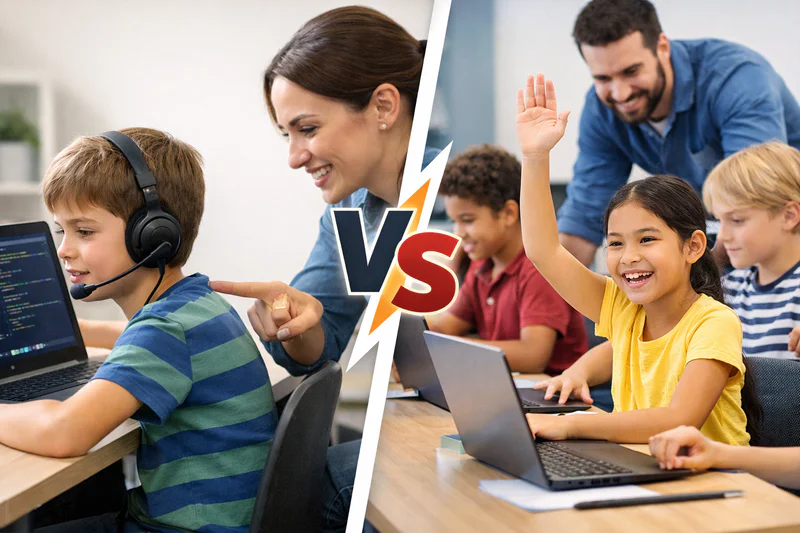
1:1 vs Group Coding Classes for Kids: Which Actually Works Better?
When parents start looking for coding classes for their children, they quickly discover there are two fundamentally different formats available: live 1:1 sessions where a child works exclusively with one instructor, and group classes where one instructor teaches several children simultaneously. The price difference is significant. The outcome difference is larger.
The debate between 1:1 coding classes vs group classes for kids is not primarily about the curriculum. Most reputable programmes teach similar content. What differs is the pace, the adaptability, the depth of feedback, and the likelihood that a child exits the programme with skills they can actually apply independently. These differences are not subtle.
This guide covers what the evidence says about each format, the specific situations where each works best, what to look for when evaluating either, and how to match the format to your child's specific needs and learning style.
Key Takeaways
Research consistently shows 1:1 instruction produces faster skill development and stronger retention than group instruction of comparable duration.
Group coding classes work well for children who are highly self-motivated, socially driven learners who thrive in collaborative environments.
1:1 instruction is particularly valuable for children who struggle with confidence, have specific learning gaps, or progress faster than average.
The main advantage of group classes is social engagement and lower cost; the main disadvantage is that the instructor cannot adapt to any individual child's pace.
Codeyoung's model is built entirely on 1:1 live instruction because the evidence for its effectiveness with children learning coding is strong and consistent.
The Core Difference Between 1:1 and Group Coding Instruction
The structural difference between the two formats is straightforward and has significant downstream consequences for learning outcomes.
In a group coding class, the instructor designs the session for the average student in the room. The child who grasps a concept quickly waits. The child who needs more time falls behind. The instructor cannot pause to re-explain something to one student without affecting the pace for everyone else. Questions are answered at the class level, not the individual level. Feedback on code is limited because there is simply not enough time to review every student's work during the session.
In a 1:1 session, none of these constraints exist. The instructor's entire attention is on one child. When the child gets stuck, the instructor responds immediately. When the child advances quickly, the curriculum moves forward without waiting. When the child's code produces an error, the instructor can walk through that specific error in that specific context, not a generalised version of the error for a hypothetical student. The session adapts continuously to the individual.
1:1 vs Group Coding Classes: Full Comparison
What Does Research Say About 1:1 vs Group Instruction for Children?
The research on this question is remarkably consistent. Educational psychologist Benjamin Bloom's landmark 1984 study, known as the "2 Sigma Problem," found that the average student receiving 1:1 tutoring performed two standard deviations above the average student in a conventional classroom setting. Two standard deviations represents an enormous effect: a child performing at the 50th percentile in a group class might perform at the 98th percentile with individual instruction covering the same content.
More recent research from the Stanford Graduate School of Education confirms this finding holds across subjects and age groups. For coding specifically, a 2020 study from the University of Washington found that children receiving 1:1 coding instruction showed 40% higher retention of core programming concepts after three months compared to children in group instruction covering the same curriculum.
Why does 1:1 instruction produce such dramatically better results?
The mechanism is primarily about error correction and working memory. When a child makes a mistake in a group class, the error often goes undetected until it has compounded into a larger misunderstanding. In a 1:1 session, the instructor sees the error immediately and addresses it before it becomes a foundation problem. Coding is particularly susceptible to this dynamic because concepts build on each other: a shaky understanding of loops makes functions harder, which makes classes harder, which makes every advanced topic harder. Catching and fixing gaps early is exponentially more valuable in coding than in subjects where topics are more independent.
When Does a Group Coding Class Work Well for Kids?
Group coding classes are not without merit. For specific children in specific situations, they are a reasonable choice. Being honest about when they work well makes the comparison more useful than simply declaring 1:1 instruction superior in every case.
Group classes tend to work best for children who:
Are highly self-motivated and have enough intrinsic drive to keep up with a fixed-pace curriculum without external adaptation
Find social energy genuinely motivating and work better when surrounded by peers doing the same activity
Are at the very beginning of their coding journey and are exploring whether they enjoy coding before committing to regular instruction
Are working on collaborative projects that genuinely benefit from having teammates to think through problems with
Have limited budget and need an entry point that is financially accessible before deciding to invest in 1:1 instruction
Coding camps, which are intensive short-format group experiences, are particularly good for initial exposure. A week-long summer coding camp can generate genuine enthusiasm for the subject. That enthusiasm then provides the motivation for sustained 1:1 learning afterward. Many of Codeyoung's students come from exactly this pathway: a camp sparked the interest, and 1:1 instruction then built the actual skill.
See the difference 1:1 live instruction makes from the very first session. Book a free trial class at Codeyoung and watch your child code with an instructor's full attention for 45 minutes.
Children Who Benefit Most From 1:1 Coding Instruction
While 1:1 instruction produces better average outcomes than group instruction across the board, certain child profiles see the most pronounced benefits.
Which Children Benefit Most From 1:1 Coding Instruction
How to Evaluate Any Coding Programme, Regardless of Format
Format is the most important structural decision, but it does not substitute for evaluating the quality of the specific programme. A poor 1:1 programme can produce worse outcomes than a well-run group class. These are the questions worth asking regardless of format.
What does the child build by the end of the first month? Any programme confident in its outcomes can answer this specifically. Vague answers ("they'll develop coding skills") are a warning sign.
How are instructors vetted and trained? Technical competence and teaching ability are different skills. The best programmes screen for both.
What happens when a child falls behind or gets stuck? In a 1:1 programme, the answer should be "the instructor adapts immediately." In a group programme, there should be a clear process for supplementary support.
Is there a free trial? No reputable programme should hesitate to offer one. The first session is the most reliable indicator of ongoing quality.
Can you observe a session? For younger children especially, parents should be able to watch at least the trial session to assess the instructor's approach and the child's engagement.
Is 1:1 Coding Instruction Worth the Higher Cost?
This is the question most parents are really asking. 1:1 instruction costs more per session than group instruction. Whether it represents better value depends on what outcome you are measuring.
If the measure is hours of instruction received, group classes offer more hours for the same spend. If the measure is skill actually acquired and retained, the calculation is different. A child who attends 30 group sessions and exits with superficial coding knowledge has received less value than a child who attends 20 1:1 sessions and exits able to build independent projects. The return on investment depends on what the instruction actually produces, not how many sessions it provides.
How much faster do children progress in 1:1 coding instruction compared to group classes?
Based on Bloom's 2 Sigma research and more recent coding-specific studies, children in 1:1 instruction typically reach the same skill milestones in roughly half the time required in group settings. A child who might reach intermediate Python proficiency after 40 group sessions could reach the same level in 18 to 22 1:1 sessions. Over the duration of a year's instruction, the gap in skill level between formats is significant. For parents prioritising long-term coding capability over session count, 1:1 instruction is the more cost-effective choice.
Codeyoung's 1:1 live coding programme for children aged 6 to 17 has been built on this principle since the company's founding. Across 45,000+ students in the USA, UK, Canada, and Australia, the consistent finding is that children in 1:1 instruction reach meaningful skill milestones faster, maintain motivation more consistently, and are more likely to continue learning beyond the initial programme period. Explore the full coding curriculum to see which tracks are available for your child's age and interests.
Frequently Asked Questions: 1:1 vs Group Coding Classes for Kids
What is the main advantage of 1:1 coding classes over group classes for kids?
The main advantage is adaptability. In a 1:1 session, the instructor adapts every explanation, every project choice, and every pacing decision to one child. When that child gets stuck, the instructor responds immediately. When they advance quickly, the curriculum moves forward without waiting. No group class can do this: the instructor must pace for the average, which means both fast and slow learners are underserved. For skill development specifically, this adaptability produces measurably better and faster outcomes.
Are group coding classes ever better than 1:1 for kids?
Group classes have genuine advantages for children who are highly social and find peer energy motivating, for introductory exploration before committing to sustained instruction, and as a lower-cost entry point when budget is a primary constraint. Coding camps and short-format group experiences are also effective for sparking initial enthusiasm. For sustained skill development over months, however, 1:1 instruction consistently produces stronger outcomes for the majority of children.
How do I know if my child would do better in a 1:1 or group coding class?
Consider three things. First, how does your child learn in other settings: do they thrive with full adult attention, or do they prefer group environments? Second, does your child have specific gaps or anxieties around technology or new skills that would benefit from patient, adaptive instruction? Third, how ambitious are the goals: for serious skill development, 1:1 instruction is nearly always the better vehicle. For initial exposure or casual exploration, a group setting is a reasonable starting point.
What instructor-to-student ratio makes a group coding class effective?
A ratio of 1 instructor to 4 to 6 students is the practical upper limit for any meaningful individual attention in a group coding class. Beyond this, the instructor spends the session managing rather than teaching, errors go uncorrected for extended periods, and children who need more time on a concept simply fall behind rather than getting help. Many coding programmes advertise group classes with 10 to 20 students per instructor. At those ratios, the instruction is effectively self-paced with a presenter in the room.
My child is shy. Which coding class format is better?
1:1 instruction is typically better for shy children. In a group class, shyness often prevents children from asking questions, flagging confusion, or sharing their work for feedback. These are exactly the moments where learning happens. In a 1:1 session, there are no peers to feel self-conscious in front of. Questions are encouraged, confusion is normal, and the instructor's feedback is entirely private. Many children who describe themselves as shy or reserved are highly engaged and verbally active in 1:1 coding sessions.
What is the typical cost difference between 1:1 and group coding classes for kids?
Group coding classes typically cost between $15 and $50 per session depending on the provider, class size, and session length. Live 1:1 coding instruction from a qualified instructor typically ranges from $30 to $100 per session. The per-session cost of 1:1 is higher, but the skill-per-hour ratio is significantly better. A parent who spends the same total amount on 1:1 sessions as on group sessions will typically see their child reach a higher skill level in fewer total sessions, making the investment more efficient when measured against outcomes rather than hours.
Can kids make friends or build social skills in 1:1 coding classes?
The peer social element of group classes is absent in 1:1 instruction. That said, the instructor relationship in a 1:1 setting does develop meaningful communication skills: explaining your reasoning, asking precise questions, and discussing technical ideas clearly. Children who attend 1:1 coding sessions alongside other social activities (school, sports, group hobbies) are not socially disadvantaged. The coding class itself doesn't need to be the source of peer connection.
What should I observe in a 1:1 coding trial session to know if it's good?
Watch for four things. First, is the child writing code from the first few minutes rather than watching? Second, does the instructor ask guiding questions when the child gets stuck rather than just fixing the problem? Third, does the child look engaged and curious rather than passive or confused? Fourth, does the child produce something working by the session's end, even something small? A yes to all four is a strong indicator of quality instruction. A session where the instructor does most of the typing while the child watches is the clearest warning sign.
How does Codeyoung's 1:1 format compare to group coding camps and classes?
Codeyoung's model is entirely 1:1, with no group sessions. Every class involves one child and one qualified instructor. Sessions are typically 45 to 60 minutes, with the full time dedicated to that child's specific project, pace, and questions. Across 45,000+ students, Codeyoung has consistently found that this format produces faster milestone achievement and stronger motivation continuity than comparable group instruction. Group coding camps can complement 1:1 learning well for social coding experiences, but they don't substitute for the sustained, personalised instruction that builds durable skills.
Is self-paced online coding as good as a live group class?
No. Self-paced video content is the least effective of all formats for children learning to code. Without a live instructor, errors go uncorrected indefinitely, confusion compounds, and motivation collapses when the content becomes challenging. Most children who attempt self-paced coding courses stall within the first month. Group live classes, despite their limitations, at least provide real-time human interaction and some form of accountability. Self-paced content is best used as a supplement to live instruction, not as a standalone learning method.
The Format Decision Matters as Much as the Curriculum
Parents spend a lot of time evaluating which coding language or curriculum is best for their child. The format decision deserves equal attention. Two children can follow the same Python curriculum and come out with dramatically different skill levels depending on whether they had an instructor who could adapt to them individually or one who was managing a group of twelve.
The evidence is clear. For most children, most of the time, 1:1 live instruction produces faster progress, stronger retention, and more durable motivation than group instruction of comparable duration. The higher per-session cost is offset by the lower total session count needed to reach the same skill level.
Explore Codeyoung's 1:1 live coding programmes for children aged 6 to 17, or book a free trial session to experience the difference that full instructor attention makes from the very first class.
Give your child the full attention they deserve in every coding session.
Codeyoung offers personalised 1:1 live coding classes for children aged 6 to 17 across Python, Scratch, Web Development, Java, MIT App Inventor, and AI/ML. Expert instructors, flexible scheduling, and a completely free first class.