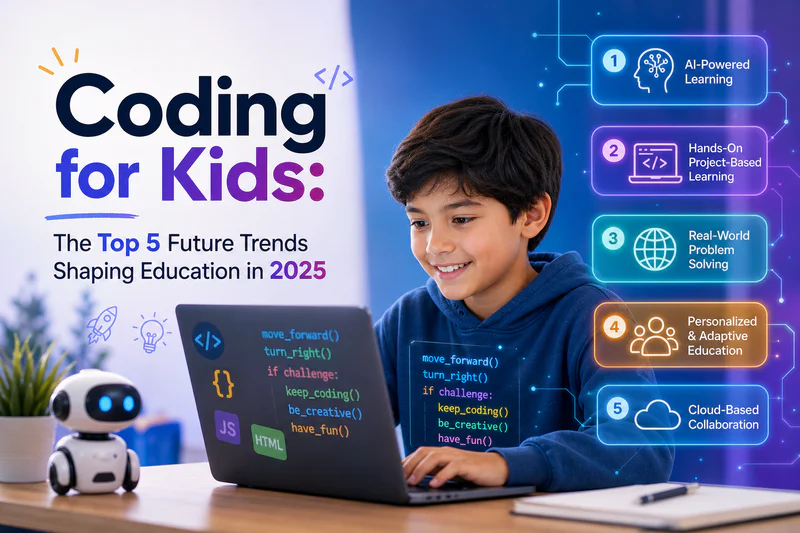
The online coding for kids market is projected to grow at a CAGR of 14.8% through 2034, and the World Economic Forum's Future of Jobs Report 2025 makes one thing clear: technology fluency is no longer optional. For today's children, coding is a foundational skill, as essential as reading or mathematics.
This guide breaks down the top 5 coding trends redefining children's education, the best coding platforms available today, and why live 1:1 coding classes are producing the strongest outcomes for kids aged 6–17.
Why Coding for Kids Is Crucial for Future Success
Coding for kids delivers far more than technical ability. Research consistently shows that children who learn to code develop stronger critical thinking, sharper mathematical reasoning, and greater creative problem-solving skills. They learn to break complex challenges into manageable steps, a cognitive habit that pays dividends across every subject and, eventually, every career.
Beyond academics, coding builds resilience. Debugging code teaches children that failure is a step in the process, not the end of it. Collaborative coding projects, increasingly common in the best coding programs for 6–17 year olds, develop communication and teamwork skills that employers consistently rank among the most valuable traits in candidates.
The data from Codeyoung reinforces this. With over 3.5 million live classes delivered and 50,000+ students enrolled, Codeyoung's online coding classes for kids maintain an 85%+ course completion rate, a number that far outpaces industry averages for self-paced digital learning. That outcome gap isn't accidental. It's the direct result of live 1:1 coding classes taught by expert instructors who adapt in real time to each child's pace and learning style.
Top 5 Coding Trends in 2026

These aren't speculative predictions, they are active forces already reshaping how coding for kids is taught globally. Parents who understand these trends can make far smarter decisions about which programs and platforms will serve their child best.
Each of these trends points in the same direction: passive, one-size-fits-all instruction is becoming obsolete. The best coding programs for 6–17 year olds are those that personalize, engage, and challenge students simultaneously. Live 1:1 coding classes sit at the intersection of every single one of these trends.
Age-Based Coding Learning Paths: When Should Kids Start?

Coding for kids isn't a single experience, it's a progression. The right tools, languages, and challenges should evolve as a child grows. Here's how the learning journey typically unfolds across age groups.
Ages 5–7: Visual Play and Pattern Recognition This is the ideal stage to introduce Scratch programming for kids. Scratch's drag-and-drop interface removes the barrier of syntax and lets young learners experiment with sequences, loops, and basic logic through animation and games. The goal here is curiosity, not complexity.
Ages 8–10: Building Logic Through Projects At this stage, children are ready for more structured Scratch projects and can begin exploring block-based environments that introduce conditional statements and variables. The best online coding classes for kids in this range use gamified storytelling and mini-projects to hold attention and build genuine understanding.
Ages 11–13: Transitioning to Text-Based Code This is where Python typically enters the picture. Its clean, readable syntax makes it the near-universal starting point for text-based coding. Online coding classes for kids in this tier should include real mini-applications, calculators, quizzes, simple games, so students see immediate, tangible results.
Ages 14–17: Advanced Concepts and Career Exploration Teenagers are ready for JavaScript, web development, app creation, and even introductory AI projects. The best coding programs for 6–17 year olds at this stage incorporate industry-relevant tools and collaborative projects that directly mirror professional workflows. Live 1:1 coding classes at this level become mentorship, not just instruction.
Codeyoung's online coding classes for kids are specifically structured around these developmental stages, ensuring that every learner, from a 6-year-old exploring Scratch to a 17-year-old building web apps, receives a curriculum matched to their exact readiness.
Top 5 Best Coding Platforms for Kids in 2026
The market for coding for kids has never been stronger, but not all platforms deliver equal outcomes. These five stand out for their approach, quality, and results.
Codeyoung, The premier destination for structured, live 1:1 coding classes for kids aged 6–17. With 3.5 million+ classes delivered and an 85%+ completion rate, Codeyoung combines expert instruction with personalized curricula across Scratch, Python, JavaScript, and more. For parents who want measurable outcomes, not just screen time, this is the benchmark for online coding classes for kids.
Scratch, The gold standard for beginners. Scratch programming for kids aged 5–10 uses a block-based, drag-and-drop interface that makes coding immediately visual and rewarding. Developed at MIT, it remains the most widely used entry point for coding for kids globally. It's free, browser-based, and supported by a massive community of young creators.
Code.org, A free, curriculum-aligned platform used in thousands of schools worldwide. Code.org offers a clean progression from block-based coding for beginners through to more advanced concepts. An excellent supplementary resource to reinforce what children learn in live classes.
Tynker, A strong gamified platform that incorporates AR and VR projects at more advanced levels. Tynker is well-suited to the best coding programs for 6–17 year olds who are visually motivated and respond strongly to game-driven challenges. Its curriculum spans beginner Scratch-style blocks through to Python and JavaScript.
CodaKid, Project-based courses built around real industry languages and tools, including Python, JavaScript, Minecraft modding, and Roblox game development. CodaKid targets children aged 8–14 who are ready to move beyond introductory coding and want to build genuine applications they're proud of.
Why Live 1:1 Coding Classes Are the Best Choice for Kids
Self-paced platforms have a role to play, particularly for motivated, self-directed older teenagers. But for most children, especially those aged 6–13, live 1:1 coding classes consistently outperform every alternative model when measuring actual mastery and long-term engagement.
The reason is straightforward: a skilled instructor adapts in real time. When a child gets stuck on a loop concept, a live teacher doesn't let confusion compound, they reframe, re-explain, and use a different example on the spot. No pre-recorded video can do that. No automated platform can do that.
Codeyoung's proprietary data makes this concrete. With over 50,000 students completing live 1:1 coding classes across more than 3.5 million sessions, the platform maintains an 85%+ completion rate, compared to industry averages below 15% for self-paced online courses, according to research tracking MOOCs and digital learning platforms. The difference isn't the curriculum. It's the human connection.
There's also a motivation dimension that parents frequently underestimate. When a child knows a real teacher is waiting, someone who knows their name, remembers their last project, and genuinely cares about their progress, they show up. Accountability, encouragement, and celebration of small wins are features that no app can fully replicate. That's precisely what makes live 1:1 coding classes the most reliable path to lasting coding skill for kids.
The Path Forward for Your Child
Coding for kids is not a niche hobby, it is a foundational competency for the generation that will build, manage, and lead the AI-powered world taking shape right now. The five trends outlined here, AI personalization, gamification, immersive environments, collaborative projects, and ethical coding education, all point toward one conclusion: children who receive structured, expert-guided coding education today will hold a significant advantage tomorrow.
The most effective way to give your child that advantage is through expert-led, personalized instruction. Explore Codeyoung's live 1:1 online coding classes for kids and find the right program for your child's age, goals, and learning style. The best coding programs for 6–17 year olds aren't found by accident, they're chosen by informed parents who understand what's at stake.
Frequently Asked Questions
What age should a child start coding?
Children can begin coding for kids programs as early as age 5. At this stage, visual tools like Scratch programming for kids are ideal, they introduce core logic concepts through play, with no syntax barriers. The earlier a child starts, the more fluent and confident they become with technology by their teenage years. That said, it is never too late to start: even teenagers new to coding can reach strong proficiency through structured live 1:1 coding classes within 12–18 months.
What are the best coding programs for 6–17 year olds?
The best coding programs for 6–17 year olds combine structured curriculum, personalized instruction, and age-appropriate tools. Codeyoung's live 1:1 coding classes are consistently ranked among the top choices for this age range, thanks to their expert instructors, proven completion rates, and progressive curriculum from Scratch through Python and JavaScript. Scratch, Code.org, Tynker, and CodaKid are also strong options depending on a child's age and learning goals.
Are online coding classes for kids worth it?
Absolutely. Online coding classes for kids offer access to expert instruction without geographic limits, flexible scheduling that fits family life, and personalized pacing that classroom environments rarely achieve. When delivered as live 1:1 coding classes, as Codeyoung does, the outcomes are measurably stronger than self-paced alternatives. Coding for kids is one of the highest-ROI educational investments a parent can make: the skills transfer directly into academic performance, career readiness, and long-term confidence with technology.
How do live 1:1 coding classes differ from self-paced options?
Live 1:1 coding classes provide real-time feedback, instant correction of misconceptions, and the accountability of a dedicated teacher who knows your child's specific progress. Self-paced platforms offer flexibility but lack the ability to adapt when a student gets stuck, meaning confusion often persists and motivation drops. Codeyoung's live 1:1 coding classes maintain an 85%+ completion rate precisely because a real instructor keeps every child engaged, challenged, and progressing.
What coding language should my child start with?
For children aged 5–10, Scratch programming for kids is the definitive starting point. Its visual, block-based environment builds logical thinking without the complexity of written syntax. From ages 10–13, Python is the natural next step, it's readable, versatile, and the most widely used language for beginner-to-intermediate coding for kids programs. Teenagers aged 14–17 can progress into JavaScript, HTML/CSS, and more specialized languages depending on their interests, which the best coding programs for 6–17 year olds will guide them toward systematically.