AI is no longer a subject reserved for university students or tech professionals. For kids growing up today, understanding artificial intelligence is becoming as foundational as reading, writing, and arithmetic, and the job market is already reflecting that shift.
This guide covers the best AI courses for kids across every format: live 1:1 instruction, structured school-aligned programs, and free self-paced platforms. Whether your child is 6 or 16, there's a meaningful starting point here.
How We Evaluated These Courses
We looked at seven platforms across four criteria: age range, format (live vs. self-paced), price, and how much genuine AI or ML exposure kids actually get (not just "coding with an AI theme"). We also factored in instructor quality, institutional backing, and how well each option works for different learning styles. For most families, one platform stood out as the clearest starting point — but the right fit depends on your child's age and how they learn best.
Quick Comparison
TL;DR: For most kids, Codeyoung is the default starting point — live 1:1 instruction means faster progress and no motivation drop-off. If budget is a constraint, pair Scratch or Code.org (under 10) with Machine Learning for Kids (10+) as a free alternative path. Teens who want serious depth can layer in MIT Day of AI or iD Tech on top.
1. Codeyoung, Best for 1:1 Live AI and Coding Instruction
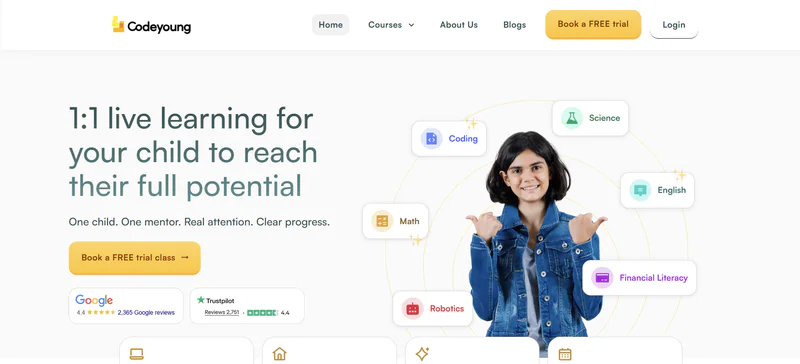
Ages: 6–18 | Price: From $20/class | Format: Live, online
If your child learns best with direct guidance and real-time feedback, Codeyoung stands in a category of its own. Rather than dropping kids into a pre-recorded video queue, Codeyoung pairs each student with a dedicated mentor for live, one-on-one instruction, covering coding, AI-adjacent STEM skills, math, and science.
The quality bar for their instructors is genuinely high. Mentors are selected from the top 1% of applicants, and the teaching approach is grounded in Benjamin Bloom's research on the "2 Sigma effect", the well-documented finding that 1:1 tutoring produces dramatically better outcomes than classroom-based instruction. In practice, this means lessons flex around your child's pace, interests, and learning gaps rather than following a rigid script.
Beyond the live sessions, Codeyoung offers two tools worth knowing about:
After School App (free): An AI-powered learning companion with 20,000+ quizzes and automated performance evaluations, useful for reinforcing concepts between classes.
Sandbox: An in-browser coding workbench where students build and test projects without any setup friction.
The curriculum is STEM-accredited, and Codeyoung holds a 4.5+/5 rating on Google with 50,000+ students enrolled globally. A free trial class is available, which makes it a low-risk way to see if the format clicks for your child.
Book a free trial class at Codeyoung
2. MIT RAISE / Day of AI, Best Free Curriculum for Classrooms and Self-Study
Ages: 11–18 | Price: Free | Format: Self-paced / teacher-led
Developed by MIT's RAISE initiative (Responsible AI for Social Empowerment and Education), Day of AI is a free, openly available curriculum designed for middle and high schoolers. It's built with educators in mind but works equally well for motivated students and parents pursuing structured self-study at home.
The material goes beyond "AI is cool" territory. Students explore how AI systems actually work, including how algorithms are trained, where bias enters the picture, and how AI is already shaping healthcare, criminal justice, and media. That critical lens makes it one of the more intellectually honest AI curricula available for this age group.
For kids aged 11 and up who are ready to move past block-based coding and engage with real concepts, Day of AI is an excellent free resource, especially as a complement to hands-on platforms.
3. AI4K12 Initiative, Best for Structured K–12 AI Literacy Progression
Ages: 5–18 | Price: Free | Format: Self-paced / supplemental
AI4K12 is a national initiative backed by two major professional organizations, the Computer Science Teachers Association (CSTA) and the Association for the Advancement of Artificial Intelligence (AAAI). The goal is straightforward: build a coherent, grade-by-grade framework for AI education from kindergarten through 12th grade.
The curriculum is organized around five big ideas:
Perception, how machines sense the world
Representation and Reasoning, how AI processes information
Learning, how models train on data
Natural Interaction, how humans and AI communicate
Societal Impact, what AI means for communities and ethics
This structure makes AI4K12 particularly well-suited for homeschooling families or parents who want to supplement school learning with something academically rigorous. The resources are free, downloadable, and regularly updated.
4. Scratch (MIT Media Lab), Best for Young Kids Getting Started (Ages 6–10)
Ages: 6–10 | Price: Free | Format: Self-paced, browser-based
Scratch isn't an AI course in the strict sense, but it's where millions of kids begin building the computational thinking skills that make AI education possible later on. Developed by MIT Media Lab, Scratch uses a visual, block-based programming environment where kids snap code together like puzzle pieces to create games, animations, and interactive stories.
What makes it relevant to AI learning is the growing ecosystem of extensions. The "Machine Learning for Kids" integration (covered next) plugs directly into Scratch, letting children layer real ML concepts onto projects they already know how to build. It's a natural bridge from creative play to genuine AI experimentation.
For children under 10, starting with Scratch before introducing dedicated AI tools is almost always the right sequence.
5. Machine Learning for Kids, Best for Hands-On ML Projects (Ages 10+)
Ages: 10+ | Price: Free | Format: Self-paced, project-based
Machine Learning for Kids is one of those rare tools that delivers real technical substance without requiring any prior expertise. The platform lets students train actual machine learning models, using IBM Watson's infrastructure, through simple, guided interfaces. Projects include image recognition, text classification, and chatbot building.
The learning loop is well-designed: kids collect training data, build a model, test its accuracy, and then use that model inside a Scratch or Python project. That end-to-end process, from raw data to working AI, gives students genuine insight into how machine learning actually functions, not just a surface-level simulation.
It's open-source, used in schools across the world, and entirely free. For a 10–13 year old who's outgrown block coding but isn't ready for a full Python course, this is an ideal next step. You can explore the platform at Machine Learning for Kids.
6. iD Tech, Best for Intensive AI/ML Camps (Ages 13–18)
Ages: 13–18 | Price: Paid (varies by program) | Format: Camp and year-round online
iD Tech has been running technology programs for young people for over two decades, and their AI and machine learning courses are among the most structured options available for teenagers. The curriculum covers Python for AI, data science fundamentals, and applied machine learning, taught by instructors in live, small-group settings.
The flagship offering is a summer camp format (both residential and virtual), but year-round online courses are also available. For a high schooler who wants to go deep, whether for personal interest, college applications, or competition prep, iD Tech provides a level of rigor that most free platforms don't match.
The trade-off is cost: iD Tech programs sit at a premium price point compared to other options on this list. But for the right student and goal, the investment is well-justified.
7. Code.org, Best Entry-Level Introduction to CS and AI Concepts
Ages: 6–18 | Price: Free | Format: Self-paced, school-aligned
Code.org is the most widely used computer science education platform in the world, active in tens of thousands of schools globally. For AI specifically, it offers dedicated modules on machine learning, data and AI ethics, and how algorithms make decisions, woven into its broader CS curriculum tracks.
It's not the deepest AI resource on this list, but it serves a real purpose: making foundational concepts accessible to kids who've never touched code. The AI and ML modules are age-appropriate, visually engaging, and free. For a younger child or a family just starting to explore this space, Code.org is a smart, low-friction first step before moving to more advanced platforms.
How to Choose the Right AI Course for Your Child
With seven options on this list, the decision comes down to four things.
Age and skill level matter most. Under 10, start with Scratch or Code.org — they build the right mental models without overwhelming kids early. Ages 10-14 is where it gets interesting: this is when hands-on ML projects click, and when live instruction starts making a real difference. Codeyoung works well here because the mentor adapts to where your child actually is, not where the curriculum assumes they should be. Teenagers 14 and up can handle the deeper conceptual work of MIT Day of AI or the intensity of iD Tech.
Learning style is the second variable, and honestly the most important one to get right. Self-paced platforms are great in theory — in practice, most kids lose momentum without someone to keep them accountable. If your child has ever abandoned an online course halfway through, that's your answer. A live 1:1 format like Codeyoung tends to fix that problem because there's a real person on the other end who notices when something isn't clicking.
Budget is real, and the free options here are genuinely good. But free and self-paced means your child is doing it alone. If you can invest in live instruction, the progress curve is noticeably steeper.
Goals matter too. General AI literacy for school readiness is different from wanting to build an actual project or prep for a competition. The table below maps each goal to the right starting point.
Conclusion
AI is already reshaping every major industry, and the children who understand it early will have a meaningful advantage as they move through school and into their careers. Starting that education now, even with a free platform, matters more than waiting for the "perfect" course.
For families who want the fastest path to real progress, booking a free trial class with Codeyoung is a practical first move. The 1:1 format removes the guesswork, and there's no commitment required to see how it works for your child. Start there, then layer in supplemental resources as their skills develop.
Frequently Asked Questions
What age should kids start learning AI?
There's no single right age, but children as young as 6 can begin building the computational thinking skills that underpin AI through tools like Scratch. Dedicated AI and machine learning concepts are typically introduced around ages 10–12, when abstract reasoning becomes more accessible.
Do kids need to know coding before taking an AI course?
Not necessarily. Several platforms on this list, including Code.org and AI4K12, are designed for complete beginners. That said, a basic familiarity with coding concepts makes AI learning significantly easier and more meaningful. Starting with block-based coding first is usually the better sequence for younger children.
Are free AI courses for kids actually good?
Yes, several free options on this list are excellent. MIT Day of AI, AI4K12, Machine Learning for Kids, and Scratch are all high-quality resources developed by reputable institutions. The main limitation of free platforms is the absence of real-time feedback and personalized instruction, which live courses like Codeyoung provide.
How is Codeyoung different from other coding platforms for kids?
Codeyoung offers live, one-on-one instruction rather than pre-recorded content or group classes. Each student is matched with a dedicated mentor who tailors lessons to their pace and goals. This personalized format, grounded in established educational research, tends to produce faster, more durable results than self-paced alternatives. A free trial class is available to experience the format firsthand.
What's the best free AI course for kids?
For younger children (6–10), Scratch is the best starting point. For ages 10–14, Machine Learning for Kids offers the most hands-on, genuine AI experience at no cost. For teenagers, MIT's Day of AI curriculum provides depth and rigor that few free resources can match.