Online Maths Classes for Kids: What to Look for
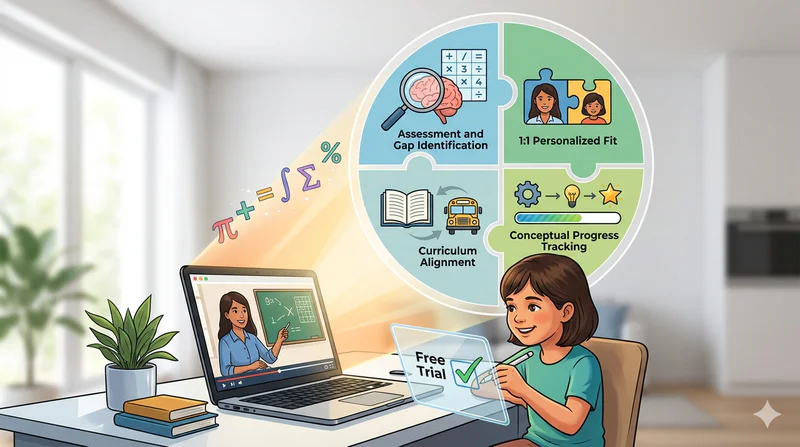
Online Maths Classes for Kids: What to Look for Before You Enrol
Search "online maths classes for kids" in 2026 and you'll get hundreds of results: apps, subscription platforms, tutoring marketplaces, self-paced video courses, AI-powered tools, and live instruction providers. They all claim to improve maths performance. They do not all deliver on that claim equally.
The difference between an online maths class that genuinely moves a child forward and one that produces activity without progress is almost always a function of format, not content. A child can watch excellent maths videos for 100 hours and emerge with surface familiarity but without the capacity to solve problems they haven't seen before. A child who receives 20 well-targeted live 1:1 sessions can close a specific gap that had been widening for two years.
This guide gives parents the framework to make that distinction before spending money: what to look for, what to avoid, the questions to ask any programme, and what genuine maths progress looks like over weeks and months.
Key Takeaways
Instruction format is the single most important variable in online maths, live 1:1 instruction consistently outperforms group classes, apps, and self-paced content for identified gaps and sustained progress.
Any reputable online maths programme should assess the child's specific level and gaps before the curriculum begins, not place them by year group alone.
A free trial class before committing is non-negotiable, one session reveals more about fit than any amount of website research.
The right metrics for maths progress are conceptual (can the child explain why?) and applied (can they solve unfamiliar problems?), not just test scores on familiar material.
Codeyoung's maths programme covers school curriculum support, mental arithmetic and Vedic techniques, and foundational gap-filling, all in live 1:1 sessions for children aged 6 to 17.
The Four Types of Online Maths Classes (and What Each Actually Delivers)
Before evaluating specific programmes, it helps to understand the four main formats that online maths education takes and what each one realistically produces.
Online Maths Class Formats: What Each Delivers in 2026
The research on this is consistent. Benjamin Bloom's landmark study found students in 1:1 instruction scored two standard deviations above those in group instruction covering identical content. For maths specifically, where gaps compound and errors become habits if uncorrected, the advantage of live 1:1 is most pronounced. A child in the wrong format for their needs is not just making slower progress, they may be reinforcing the very misconceptions that need fixing.
For a broader picture of why format matters so much in children's maths education, see Maths for Kids: How to Build Strong Foundations at Home.
What Questions Should Parents Ask Before Enrolling?
Most online maths programmes use similar marketing language. "Expert instructors." "Personalised learning." "Proven results." These phrases are impossible to evaluate from a website. These questions cut through to what actually matters.
Questions to Ask Any Online Maths Programme Before Enrolling
What Should a Good Online Maths Session Look Like?
Parents who observe or participate in their child's maths sessions often aren't sure what they're evaluating. These are the specific signals that indicate a session is genuinely productive.
The child is doing the thinking, not the instructor
The most important signal in any maths session is where the cognitive work is happening. If the instructor solves problems while the child watches, the child is learning to watch maths. If the child is working through problems with the instructor asking guiding questions rather than providing answers, the child is doing maths. The distinction is stark and observable in real time.
A quality instructor asks: "What do you think the first step would be?" "Does that answer seem reasonable?" "What would happen if we changed this number?" These questions keep the child's problem-solving active throughout the session. A less effective instructor demonstrates the method and then asks the child to copy it.
Errors are explored, not just corrected
When a child makes an error, the response tells you everything about the instruction quality. A good instructor says "interesting, why did you do it that way?" before correcting. This reveals what the child was thinking and allows the correction to address the actual misconception rather than just the surface error. A routine "that's wrong, here's the right answer" leaves the misconception intact and the child no more likely to get it right next time.
Both conceptual and procedural understanding are developed
A session that only drills procedures (follow these steps) without ever addressing why those steps work is building procedural competence without conceptual understanding. Both matter. A child should be able to explain why the method works, not just apply it. A quality session balances procedural practice with conceptual questioning: "Why do we need a common denominator here? What would happen if we just added the numerators?"
For a detailed guide on what genuine maths understanding looks like versus surface procedural knowledge, see Fractions for Kids: Why They're Hard and How to Help and Number Sense for Kids: What It Is and How to Build It.
Want to see what a quality online maths session looks like for your child specifically? Codeyoung offers a free trial maths class, one 45-minute session, no charge, no commitment.
Book a Free Trial Maths Class →
What Children Need From Online Maths Classes at Different Ages
The right online maths programme differs significantly by age and current level. A programme excellent for a 7-year-old building number foundations is not appropriate for a 14-year-old preparing for GCSE. Here is what each age group most needs.
What Online Maths Classes Should Provide by Age Group
Red Flags: Online Maths Programmes That Are Likely to Underdeliver
These are the warning signs worth identifying before investing time or money.
No free trial. A programme that won't let a child experience one full session before payment is not confident its product holds up on first contact. Walk away.
Placement by year group rather than by assessment. Two children in the same year group can have completely different levels of mathematical understanding. A programme that places both in the same class without assessing individual gaps will serve neither well.
Gamification as the primary engagement mechanism. Badges, streaks, and points keep children clicking. They don't build mathematical understanding. A programme that leads with its gamification features rather than its instructional approach is optimising for engagement rather than learning.
Claims of rapid transformation. "Master maths in 30 days." "Your child will be ahead of their class in 3 sessions." Genuine mathematical development takes months of consistent work. Any programme promising rapid transformation is marketing rather than educating.
No mention of conceptual understanding. A programme that describes its approach entirely in terms of "covering the curriculum" and "practising problems" without mentioning conceptual development, understanding, or reasoning is likely producing procedural competence at best.
Fixed curriculum with no individual adaptation. A child who is confident in fractions but weak in algebra needs a different curriculum emphasis from one who has the opposite profile. A programme that can't adapt to individual needs is serving the average child, not the specific one in front of it.

How Do You Know If Online Maths Classes Are Actually Working?
The right metrics for maths progress are broader than test scores on familiar material. These are the signals worth tracking after 4 to 8 weeks of regular sessions.
Positive signals:
The child can explain their method, not just produce an answer
They estimate answers before calculating and check whether results are reasonable
They apply a concept correctly in a context slightly different from the one where they learned it
They are less likely to say "I don't know where to start" when facing a problem
School maths performance or confidence is noticeably improved
They show interest in maths topics or conversations outside sessions
Signals the programme may not be working:
The child performs well in session exercises but makes the same types of errors in school tests
They can complete familiar problem types but struggle when the format changes slightly
Confidence hasn't improved despite regular attendance
They still can't explain why a method works, only how to apply it
Specific gaps identified at enrolment haven't narrowed after 8 to 10 sessions
When signals point toward underperformance, the first step is a direct conversation with the programme, not immediate cancellation. A quality programme will be able to explain specifically what the child has and hasn't mastered and what the plan is for the gaps. If that conversation doesn't produce a specific, credible answer, finding a better fit is the right response.
For guidance on identifying whether a child needs extra maths support and what kind, see Signs Your Child Needs a Maths Tutor: When to Get Extra Help and My Child Is Falling Behind in Maths: How Online 1:1 Tutoring Helps.
How Codeyoung's Online Maths Programme Works
Codeyoung's maths programme delivers live 1:1 instruction for children aged 6 to 17 across the USA, UK, Canada, and Australia, aligned to each country's curriculum framework. Every new student begins with an assessment that identifies their specific strengths, gaps, and goals before the curriculum is designed.
Sessions integrate three areas that most maths programmes treat separately: school curriculum support (ensuring the child understands what their class is currently covering), mental arithmetic and Vedic techniques (building the calculation fluency that underpins confident mathematical reasoning), and foundational gap-filling (addressing concepts that weren't fully internalised earlier and are now producing difficulty in more advanced topics).
The 1:1 format means the instructor can identify the exact moment a child's understanding becomes uncertain: the hesitation, the incorrect direction, the plausible but wrong answer, and address it directly rather than moving on with the group. For children who have developed maths anxiety alongside knowledge gaps, this environment is particularly effective: the absence of peers, the unhurried pace, and the instructor's undivided positive attention consistently produce the psychological safety that enables genuine learning in children who have shut down in group settings.
For an honest picture of what improvement in maths actually looks like and how long it takes, see How to Improve Your Child's Maths Skills at Home and Maths Anxiety in Kids: Signs, Causes, and How 1:1 Tutoring Helps.
Frequently Asked Questions: Online Maths Classes for Kids
Are online maths classes as effective as in-person tutoring?
Research comparing online and in-person 1:1 instruction finds no significant difference in learning outcomes when instruction quality and format are held constant. The key variables are the instructor's skill, the instruction format (1:1 vs group), and the curriculum's fit to the child's specific needs: not whether the session happens in a room or over a screen. Online 1:1 instruction removes the commute, allows children to work on their own familiar device, and gives access to qualified instructors regardless of local availability. For most families, these are advantages rather than limitations.
How many sessions per week does my child need?
One live session per week is the practical minimum for consistent forward movement. Two sessions per week produces noticeably faster progress because spaced practice (revisiting material before it's fully forgotten) consolidates understanding more efficiently than weekly review. The right frequency also depends on urgency: a child preparing for an exam in 8 weeks benefits from two to three sessions per week. A child building long-term foundations is well-served by one to two sessions per week sustained consistently over months.
What age should children start online maths classes?
Children can begin structured online maths instruction from age 6, with sessions appropriate to their developmental stage (shorter, more visual, more concrete for younger children). Most families find supplementary online maths most valuable from around age 8 onwards, when school maths content accelerates and individual gaps begin to emerge. The most impactful intervention window is ages 8 to 12, when foundational gaps can be addressed before they compound into the secondary school curriculum.
How is online maths tutoring different from a maths app?
A maths app responds the same way to every child who uses it. A live instructor responds to your specific child in real time, their hesitations, their misconceptions, their specific error patterns, their motivation in the moment. Apps build procedural familiarity through repetition. Live instruction builds conceptual understanding through responsive dialogue. Apps are useful supplementary practice. Live instruction is what closes the gaps that apps can't diagnose.
My child does well in maths at school but I want to push them further. Can online classes help?
Yes. Enrichment is as valid a use of online maths instruction as remediation. Children who have met their grade-level requirements benefit from extension into more sophisticated topics, algebraic reasoning, combinatorics, statistics, mathematical proof: that school curricula rarely have time to explore deeply. Competitive maths preparation (Maths Olympiad, AMC, UK Junior Maths Challenge) is another area where 1:1 instruction produces stronger outcomes than self-study. A skilled instructor can identify exactly what would stretch a mathematically confident child meaningfully.
Should online maths classes cover the school curriculum or go beyond it?
Ideally both, depending on the child's needs. A child who is struggling at school needs instruction that addresses their current school topics alongside the foundational gaps that are causing the struggle. A child performing well at school may benefit from instruction that extends beyond the curriculum into richer mathematical thinking. A child preparing for specific exams needs curriculum-aligned practice. The best programmes adapt their emphasis to what the individual child needs rather than following a fixed approach regardless of the child's situation.
How long before I see improvement from online maths classes?
For most children, measurable confidence improvement is visible within 4 to 6 sessions when the instruction targets a specific identified gap. Conceptual improvement (the child can explain why, not just how) typically takes 6 to 12 sessions for a well-targeted topic. Broader curriculum performance improvement (visible in school tests) typically follows 6 to 10 weeks of consistent sessions. The timeline depends on how deep the gap is, how long it has been present, and how frequently sessions occur. A gap that has existed for two years takes longer to fix than one that appeared in the last term.
What makes Codeyoung's online maths classes different from other providers?
Three things distinguish Codeyoung's approach. First, the format: every session is live 1:1, with no group sharing of instructor attention. Second, the scope: sessions combine school curriculum support, mental arithmetic including Vedic techniques, and foundational gap-filling rather than covering only the current school topic. Third, the assessment: every student is assessed before the curriculum begins and the starting point is determined by what the child demonstrates, not by their year group. The first session is free with no commitment, which allows parents to evaluate all three before deciding. Book a free trial class to see the difference.
The Right Class Is the One That Adapts to Your Child
The best online maths class for a child is the one that starts from where that child actually is, not where their year group is supposed to be. That requires assessment before instruction, a format that allows real-time adaptation, and an instructor who can distinguish between a child who has followed a method and a child who has understood it.
None of these requirements are met by apps, pre-recorded courses, or large group classes. They are met by live 1:1 instruction with a skilled, qualified instructor who has the time and the information to respond to the individual child in front of them.
Explore Codeyoung's online maths programme for children aged 6 to 17, or book a free trial to see exactly what that looks like for your child.
Find the online maths class that actually works for your child.
Codeyoung's live 1:1 maths sessions are tailored to each child's specific level, gaps, and goals. Free first class, no commitment, assessment included in the trial session.