My Child Is Falling Behind in Math: How Online 1:1 Tutoring Helps Them Catch Up
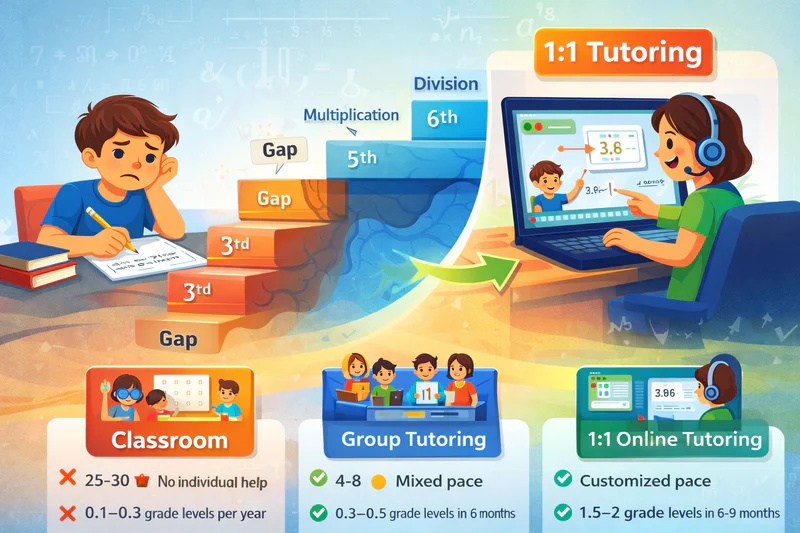
When a child is falling behind in math, the most effective solution is personalized 1:1 tutoring that identifies their specific gaps and fills them systematically. Unlike classroom instruction or group tutoring, one-on-one support meets your child exactly where they are, moves at their pace, and ensures concepts actually stick before moving forward. Online delivery makes this intensive support accessible and convenient for busy families.
Watching your child fall further behind in math each year is stressful. You've probably tried helping with homework, maybe hired a tutor for a while, or hoped they'd catch up on their own. But the gap keeps growing. Each new school year starts with them already behind, and each year the content gets harder.
Here's what you need to understand: the gap won't close without targeted intervention. But with the right kind of help, catching up is absolutely possible.
Key Takeaways:
Children fall behind and keep falling behind because math is cumulative—every concept requires previous concepts as prerequisites. Missing one building block (e.g., multiplication in 3rd grade) makes everything stacked on top (division, fractions, multi-step problems) impossible to understand.
At Codeyoung, students receiving personalized 1:1 online tutoring show average 1.5-2 grade level improvement within 6-9 months through systematic gap identification and filling—compared to group tutoring or classroom intervention which typically produces 0.3-0.5 grade level improvement over same timeframe.
Classroom instruction can't fix falling-behind students because: teachers must follow grade-level curriculum (can't spend weeks reteaching earlier concepts), one teacher serves 25-30 students (no individual customization possible), and forward progression is assumed (no mechanism to stop until foundations are solid).
1:1 tutoring solves the problem through: precise gap identification (exactly where understanding breaks down), customized pace (speed adjusts to child not calendar), starting from solid ground (rebuilding from mastery level even if below grade), immediate feedback preventing ingrained errors, and safe environment enabling honest confusion admission.
Online delivery advantages: access to specialized tutors regardless of geography, scheduling flexibility without commute constraints, comfortable home learning environment reducing anxiety, digital tools enabling screen sharing and interactive resources, and parent visibility for session observation and between-session support.
Why Kids Fall Behind and Keep Falling Behind
Kids fall behind and keep falling behind because math is strictly cumulative—every concept requires previous concepts as mandatory prerequisites, meaning missing one building block (multiplication in 3rd grade) makes everything stacked on top (division, fractions, multi-step problems in 5th grade) impossible to understand. Classrooms move forward on curriculum calendars regardless of mastery, so gaps accumulate on top of gaps year after year. Math is unforgiving in this specific way:
Children falling behind face an impossible learning situation: attempting to master new grade-level material while simultaneously lacking prerequisite skills that material assumes. For example, a child who never fully understood multiplication in 3rd grade (memorized enough to pass but concept didn't click) faces 5th grade division, fractions, and multi-step problems all requiring multiplication fluency they lack. Each new lesson becomes incomprehensible because it's built on foundations that don't exist, creating vicious cycle where confusion compounds daily as curriculum advances without prerequisite mastery.
This is why kids who fall behind tend to keep falling behind. The classroom moves forward according to the curriculum calendar, not according to whether every student has mastered the material. Your child accumulates gaps on top of gaps. At Codeyoung, diagnostic assessments of students described by parents as "falling behind" reveal that 80% have accumulated 1.5-2 years of foundational gaps—not current-grade struggles but missing prerequisites from 2-3 years earlier that make current learning impossible. Among 50,000+ students we've worked with globally, those receiving personalized 1:1 tutoring that systematically identifies and fills these specific gaps show average 1.5-2 grade level improvement within 6-9 months— proving that falling behind is reversible when root causes (missing building blocks) are addressed rather than attempting to patch current-grade symptoms.
Research confirms this pattern. A study published in Psychological Science found that early math skills, particularly fractions and division, uniquely predict math achievement years later. Gaps in foundational concepts don't resolve themselves. They compound.You can read the research here.
Why Classroom Instruction Can't Fix This
Classroom instruction cannot fix falling-behind students because: teachers must follow grade-level curriculum without spending weeks reteaching earlier concepts, one teacher serves 25-30 students making individual remediation impossible, and forward progression is structurally assumed with no mechanism to pause until foundations are solid. Your child's teacher probably knows they're struggling, but there's a structural limit to what classroom instruction can do:
Teachers can't go backward. A fifth-grade teacher has fifth-grade curriculum to cover. They can't spend three weeks reteaching third-grade material, even if that's what your child needs. The pacing guide dictates what gets taught when.
One teacher, many students. With 25 or 30 kids in a classroom, there's no way to customize instruction for each child's specific gaps. Teachers differentiate where they can, but individual remediation isn't possible at scale.
Moving forward is assumed. The entire structure of school assumes students are ready for the next lesson. When your child isn't ready, they have to fake it or fall further behind. There's no mechanism for stopping until foundations are solid.
This isn't a criticism of teachers. It's a structural reality. Classroom instruction is designed for grade-level teaching, not for catching up individual students who have fallen behind.
Why Group Tutoring Often Disappoints
Many parents try group tutoring as a solution. It's more affordable than private instruction and seems like reasonable middle ground. But for a child who has fallen significantly behind, group tutoring has limitations.
The group sets the pace. Even in a small group, the tutor can't fully customize to each child. Your child might need more time on fractions while another student needs help with decimals. Someone's needs get deprioritized.
Embarrassment affects participation. A child who is behind often feels ashamed. In a group setting, they may hesitate to ask "basic" questions, admit confusion, or reveal how much they don't understand.The anxiety that comes with comparison to peers interferes with learning.
Gaps remain hidden. A tutor managing multiple students can't deeply assess each child's understanding. Your child's specific gaps might not be identified, let alone addressed systematically.
Group tutoring can work for kids who just need a little extra practice. For kids who havefallen significantly behind, it often isn't enough.
How 1:1 Tutoring Actually Solves the Problem
1:1 tutoring solves falling-behind problems through five key mechanisms: precise gap identification (exact concepts where understanding breaks down), customized pace (adjusting to child's speed not curriculum calendar), starting from solid ground (rebuilding from mastery level even if below grade), immediate feedback preventing error patterns from becoming ingrained, and safe private environment enabling honest confusion admission. One-on-one tutoring addresses root issues that classroom and group instruction cannot touch:
Precise gap identification. A dedicated tutor can assess exactly where your child's understanding breaks down. Not vaguely "behind in math," but specifically: solid on addition and subtraction, shaky on multiplication, completely lost on fractions. This precision allows targeted intervention.
Customized pace. The tutor goes as slowly or quickly as your child needs. Concepts that click quickly can be moved through efficiently. Concepts that need more time get more time. There's no curriculum calendar forcing progression before readiness.
Starting from solid ground is crucial for sustainable catch-up—quality tutors identify where understanding is genuinely solid (not just surface-level memorization) and rebuild from that point forward, even if it means 6th graders working on 4th grade material temporarily. This isn't embarrassing; it's strategic necessity since attempting to patch current grade-level gaps while foundational prerequisites remain missing just recreates school-year failure patterns. Building a second floor requires solid first floor—skipping that foundation work guarantees future collapse regardless of effort invested.
Immediate feedback and correction. In a classroom, your child might practice a concept wrong for an entire assignment before anyone notices. In 1:1 tutoring, misconceptions get caught and corrected immediately, before they become ingrained habits.
Safe environment for confusion. With no peers watching, your child can freely say "I don't get it" without embarrassment. They can ask questions they'd never ask in class. They can admit what they don't know, which is the first step to learning it. Based on Codeyoung's experience with 50,000+ students, those receiving 1:1 online tutoring ask an average of 12-15 clarifying questions per 60-minute session versus 1-2 questions per week in classroom settings and 4-6 questions per session in group tutoring—demonstrating that private learning environments eliminate the social anxiety preventing honest confusion admission. This 6-10x increase in question-asking directly correlates with accelerated learning because misconceptions get identified and corrected immediately rather than compounding into larger gaps.
Why Online Delivery Works
You might assume in-person tutoring would be better than online. For many families, the opposite is true.
Access to the right tutor. Online tutoring means you're not limited to tutors in your geographic area. Your child can work with someone who specializes in their specific needs, has experience with similar students, and is an excellent teacher, regardless of where they live.
Scheduling flexibility. Online sessions can happen whenever works for your family. No commute means tutoring fits into busy schedules more easily. You're not locked into whatever times are available at a local learning center.
Comfortable environment. Your child learns from home, where they're relaxed and comfortable. There's no anxiety about going somewhere new or sitting in an unfamiliar room. That comfort can actually improve learning.
Screen sharing and visual tools. Online platforms allow tutors to share screens, use digital whiteboards, and access interactive resources. Many kids find these tools engaging. And the technology allows both tutor and student to see exactly the same thing, which eliminates confusion. Research from the U.S. Department of Education's evaluation of online learning found that students in online learning conditions performed modestly better than those receiving face-to-face instruction on average, with blended approaches (combining online and human interaction) showing strongest results. For 1:1 tutoring specifically, the personalized human connection combined with digital tools produces outcomes equivalent to or exceeding traditional in-person instruction.
Parent visibility. With online tutoring, you can observe sessions if you want. You see what's being taught, how your child is responding, and what progress looks like. That transparency helps you support learning between sessions.
What Catching Up Actually Looks Like
Catching up realistically requires: time proportional to gap size (6-12 months for 1-year gap, 9-15 months for 2-year gap), non-linear progress with breakthroughs and plateaus, focus on deep understanding over rushing through content, and confidence rebuilding alongside academic recovery. If your child is significantly behind, setting realistic expectations matters:
Catching up doesn't happen in a week or even a month. Depending on how large the gaps are, meaningful catch-up might take a semester or a full school year of consistent work. That's not failure. It's reality.The gaps accumulated over time and need time to fill.
Progress isn't always linear. There will be breakthroughs where concepts suddenly click, and plateaus where things feel stuck. Both are normal parts of the process.
The goal isn't just completing missing content. It's building genuine understanding. A child who rushes through material to "catch up" without truly learning it will just fall behind again. Deep understanding, even if it takes longer, creates lasting results.
Along the way,confidence rebuilds. A child who starts tutoring feeling likethey're bad at math gradually accumulates evidence that they can learn. This emotional change matters as much as the academic progress.
Making the Decision
If your child is falling behind in math, waiting rarely improves things. Gaps compound. Each year behind makes the next year harder. The earlier you intervene, the less there is to fix.
One-on-one math tutoring isn't the cheapest option, but it's often the most effective one. When you calculate the cost of years of struggle, lost confidence, limited opportunities, and continued academic difficulty, targeted intervention starts to look like a wise investment.
Afree trial session can help you understand exactly where your child stands. You'll learn what gaps exist, how significant they are, and what a realistic plan for catching up would look like. No obligation, just clarity.
Your child isn't destined to keep falling behind. With the right support, they can close the gap, rebuild their foundation, and approach math with confidence instead of dread. It starts with getting them the individualized help that classroom instruction simply can't provide.
Frequently Asked Questions
How long does it take for a child to catch up with 1:1 tutoring?
Timeline depends on gap size: students 6-12 months behind catch up in 4-6 months with 2-3 weekly sessions, students 1-2 years behind need 6-9 months, students 2+ years behind require 9-12 months minimum. At Codeyoung, average progress rate is 1.5-2 grade level improvement per 6-9 month period with consistent 1:1 tutoring versus 0.3-0.5 grade improvement with group tutoring over same timeframe. Factors affecting speed: consistency of sessions, size of gaps, and whether instruction targets root causes versus surface symptoms.
How much does 1:1 online math tutoring cost compared to group tutoring?
Quality 1:1 online tutoring typically costs $40-80/hour versus $25-40/hour for group tutoring. However, 1:1 tutoring produces results 3-4x faster (6 months to close 1-year gap vs 18-24 months with group), making total investment often lower. Example: $2,400 for 60 hours of 1:1 tutoring achieving complete catch-up versus $1,800 for 60 hours of group tutoring achieving partial progress requiring additional 60 hours ($3,600 total). Faster results also mean less time falling further behind during school year.
Can online tutoring really be as effective as in-person for a struggling child?
Yes—research and outcomes data show no significant difference in effectiveness between online and in-person 1:1 tutoring for most students. Online advantages: access to specialized tutors regardless of location, scheduling flexibility, comfortable home environment reducing anxiety, digital tools (screen sharing, interactive whiteboards), and parent visibility. At Codeyoung, students receiving online 1:1 tutoring show identical progress rates to traditional in-person tutoring benchmarks, with some students preferring online due to reduced travel stress and increased comfort.
Should I wait to see if my child catches up on their own or start tutoring now?
Start tutoring immediately. Math gaps compound exponentially—students don't "catch up on their own" because each new lesson requires prerequisites they lack. Waiting typically means falling further behind as curriculum advances. At Codeyoung, students beginning intervention within 6-12 months of falling behind show 85% success rate catching up completely, versus 60% for those waiting 1-2 years and 40% for those waiting 2+ years. Earlier intervention = less to fix, faster recovery, less emotional damage from prolonged failure.
What if my child needs help in multiple subjects—should we focus only on math?
Prioritize math for behind students because: (1) math is cumulative so gaps compound faster than reading/writing, (2) math anxiety develops from prolonged struggle affecting all academics, (3) math success transfers to other subjects through confidence building. Once math gaps close (typically 6-9 months), address other subjects. Attempting simultaneous multi-subject catch-up often overwhelms struggling students and dilutes effectiveness. At Codeyoung, students focusing exclusively on math catch-up first show better overall academic recovery than those splitting attention.
How do I know if my child needs 1:1 tutoring versus just more practice at home?
Your child needs 1:1 tutoring if: homework consistently takes 2-3x longer than expected, grades declining over multiple grading periods, you're helping nightly without seeing progress, child shows math anxiety or avoidance, or you cannot identify specific gaps causing struggles. Home practice works for students who understand concepts but need repetition; 1:1 tutoring works for students with foundational gaps, comprehension issues, or accumulated confusion. If questioning whether tutoring is needed, 2-3 weeks of home practice is reasonable trial—if no improvement, get professional assessment.