
The question arrives suddenly, usually after a parents' evening or a test score, and it is almost impossible to answer as asked. Behind has at least three meanings in ordinary use, they disagree with each other, and the one parents usually have in mind is the least informative of the three.
Sorting that out first is worth more than any worksheet, because two of the three meanings produce unnecessary alarm and one of them points at something real.
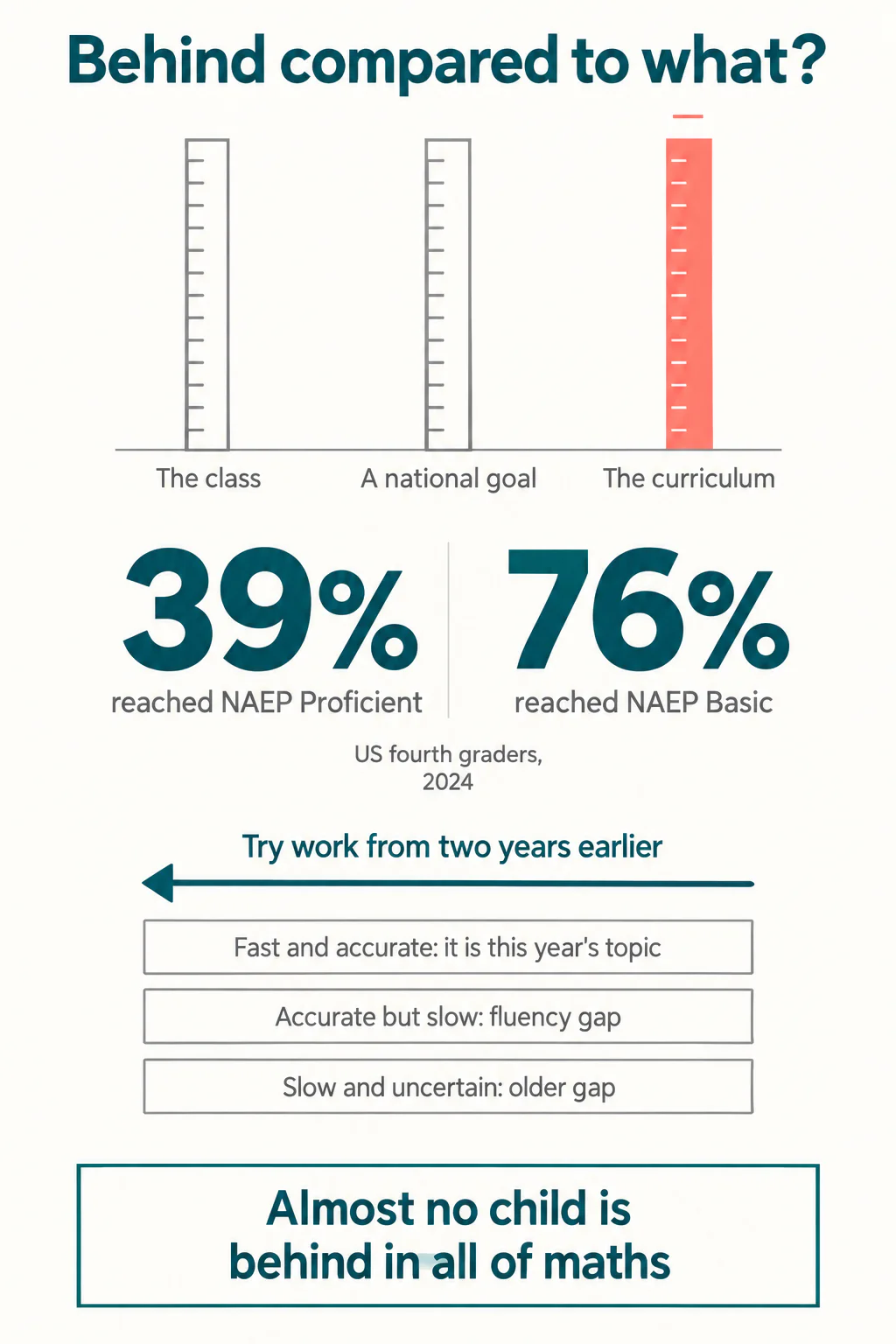
Three yardsticks, only one of them useful
Behind the class. Your child is in the bottom group, or slower than the child next to them. This is the comparison most families make and it measures a room rather than a child. In a strong class, a perfectly capable child sits at the bottom. In a weak one, a child with real gaps looks fine.
Below a national standard. This is where genuine confusion sets in. In the 2024 NAEP mathematics assessment, 39 per cent of US fourth-graders performed at or above NAEP Proficient and 76 per cent at or above NAEP Basic. Both figures were higher than in 2022.
Read those numbers carefully. If under two in five children reach Proficient, Proficient cannot mean typical. NAEP defines it as "solid academic performance for the given grade level and competency over challenging subject matter including subject-matter knowledge, application of such knowledge to real world situations, and analytical skills appropriate to the subject matter", and the National Assessment Governing Board which sets these levels describes Proficient as the goal for what all students should know. A goal, set deliberately high. A child who is not Proficient is in the majority, not in trouble.
The figure worth attention is the other one. Roughly a quarter of fourth-graders fall below NAEP Basic, and that is a different conversation entirely.
Behind the curriculum. This is the yardstick that helps, because it is specific, written down, and checkable at your kitchen table.
The checkpoints that matter most
Number facts give the cleanest year-by-year markers. The English national curriculum sets these expectations:
| End of year | Expected recall | US equivalent |
|---|---|---|
| Year 2 | Multiplication and division facts for the 2, 5 and 10 tables | Grade 1 to 2 |
| Year 3 | Facts for the 3, 4 and 8 tables | Grade 2 to 3 |
| Year 4 | All multiplication and division facts up to 12 × 12 | Grade 3 to 4 |
The word doing the work in each row is recall. Not able to work out. Not correct given time. Recalled, the way a familiar word is read rather than sounded out.
This matters more than any other checkpoint because of what it frees up. A child who has to compute 7 × 8 during a long division problem is spending working memory on the small step and has less left for the large one. They then get the long division wrong, and everybody concludes long division is the problem. It rarely is.
The two-year test
Here is the most useful ten minutes you can spend on this question.
Find five questions from two school years earlier than your child's current year. Not this year's topic. Two years back. Watch them work.
- Fast and accurate. The foundations are sound and the difficulty is genuinely with this year's content. That is a normal, local problem with a normal, local fix.
- Accurate but slow. The knowledge exists and is not automatic. This is the most common result and the most fixable, and it usually explains most of what looks like a general weakness.
- Slow and uncertain. The gap is older than the topic causing trouble now. Working on this term's material will not touch it.
Almost no child is behind across the whole of mathematics. What actually happens is that one or two foundations went unfinished, usually place value, number-fact fluency or fractions, and everything built on top of them looks shaky. Find the unfinished foundation and a lot of apparently unrelated problems resolve at once.
Not sure which level your child should start at? A free trial class with a Codeyoung teacher shows you exactly where they are and what they are ready for next, before you commit to anything.
Book a Free Trial →Five questions that reveal more than a test score
A mark out of twenty tells you how many were right. These five tell you what is actually happening.
- Can they get it right? Accuracy. The thing schools report and the least diagnostic of the five.
- Can they get it right quickly? Fluency. A child who is accurate but slow is doing more work than their classmates for the same marks, and will tire out sooner.
- Can they explain what they did? Understanding. A child who can follow a procedure and cannot say why it works will be fine until the procedure changes.
- Can they spot a wrong answer? Number sense. Offer 34 × 21 = 71 and see whether anything objects. This one is worth its own attention, and we covered it in asking whether an answer is sensible.
- Can they do it a different way? Flexibility. One method and no alternatives is fragile under pressure, which is exactly when exams happen.
Two and four are where quiet difficulties hide. A child can pass every test in a year while being slow at both, and the cost only becomes visible when the work gets longer.
What is not worth worrying about
A single bad test score. Tests measure a Tuesday. Look for a pattern across a term.
Being slower than an older sibling, or than the fastest child in the room. Speed of arriving is a poor predictor of where a child ends up.
Counting on fingers at six or seven. That is a stage, not a symptom, and rushing a child out of it usually replaces a visible strategy with a hidden guess.
Disliking maths this term. Liking a subject tends to follow being competent at it rather than the other way around, which is why confidence work aimed directly at feelings often disappoints. We looked at the sequence in building maths confidence.
What genuinely warrants attention
Single-digit facts still being computed at nine or ten. The clearest early-warning sign there is, and the most treatable.
No estimate before calculating. A child who cannot say roughly what the answer should be has nothing to catch an error with.
Avoiding starting. There is an important distinction here between a child who gets stuck and a child who does not begin. Getting stuck is ordinary. Not beginning is usually a prediction of failure, and it is a motivational problem wearing a mathematical costume.
"I am bad at maths" said as a fact about themselves. Once that becomes an identity rather than a description of Tuesday's lesson, it starts doing its own damage, because a child who believes it stops trying in exactly the situations where trying would help. We wrote about how to respond to that sentence in what to do when your child says they are bad at maths.
Right answers still losing marks. Worth separating from being behind, because it is a presentation and method problem rather than a knowledge one, covered in when the right answer still loses marks.
One more possibility that gets missed entirely: the child who is not behind at all and is bored. The behaviour can look identical from the outside. Telling the two apart matters, because the fixes are opposite.
What if your child is ahead?
The curriculum has an opinion on this, and it is not the one most families act on. Pupils "who grasp concepts rapidly should be challenged through being offered rich and sophisticated problems before any acceleration through new content."
Depth first. Harder problems using what they already know, before moving them onto next year's material. A child accelerated quickly often arrives at a higher level with quiet gaps that nobody checked, and those gaps surface two years later looking like a sudden collapse.
The same paragraph gives the instruction for the other direction: pupils who are not sufficiently fluent "should consolidate their understanding, including through additional practice, before moving on." Both halves say the same thing. Secure the current level properly before adding to it.
What to do with this
Run the two-year test this week. Ten minutes, five questions, and watch rather than mark. Then decide which of the three kinds of behind you are actually looking at, because a child who is behind the class, a child who is below a national goal, and a child with an unfinished foundation need three completely different responses, and only the third one is urgent.
If it turns out to be the third, the work is narrower than it feels. Find the specific foundation, rebuild it to the point of automaticity, and let the downstream problems resolve themselves. That is a far smaller job than re-teaching a year of mathematics, and it is the job most children described as behind actually need. If your own school maths makes that daunting, you are in good company, and helping with maths homework when you hated maths was written for exactly that.
Our online maths classes start with finding that foundation rather than with this term's chapter, because teaching the chapter to a child with a two-year-old gap is the most common way a term of tutoring gets wasted.
Codeyoung runs 1:1 live online classes for children aged 6 to 17, with a teacher who adapts the pace to your child rather than a fixed syllabus. The first class is free, so you can see how they respond before deciding.
Book a Free TrialSources: NAEP, 2024 mathematics national trends; National Assessment Governing Board, NAEP achievement levels; Department for Education, mathematics programmes of study. All checked 24 September 2026.