
There is a particular moment most parents of an anxious child will recognise. Your child works through a page of problems at the kitchen table, slowly but correctly. A week later the same questions appear in a class test and they come home with half of them blank, saying they went blank too.
Math anxiety in kids is the usual explanation for that gap, and it is more specific than the phrase suggests. It is not a dislike of the subject and it is not a gap in knowledge. It appears to be a competition for mental space, and understanding it that way changes what actually helps.
What the research says, and how far it goes
The finding that made this concrete came from Mark Ashcraft and Elizabeth Kirk in 2001. Working memory scores declined significantly as maths anxiety increased, and the detail that matters is the one usually left out: the decline appeared on working memory tests containing numerical information, and not on language-based ones.
That specificity rules out the obvious alternative explanation. An anxious child is not simply worse at everything under pressure. Something about numerical work in particular appears to consume the resource that numerical work needs.
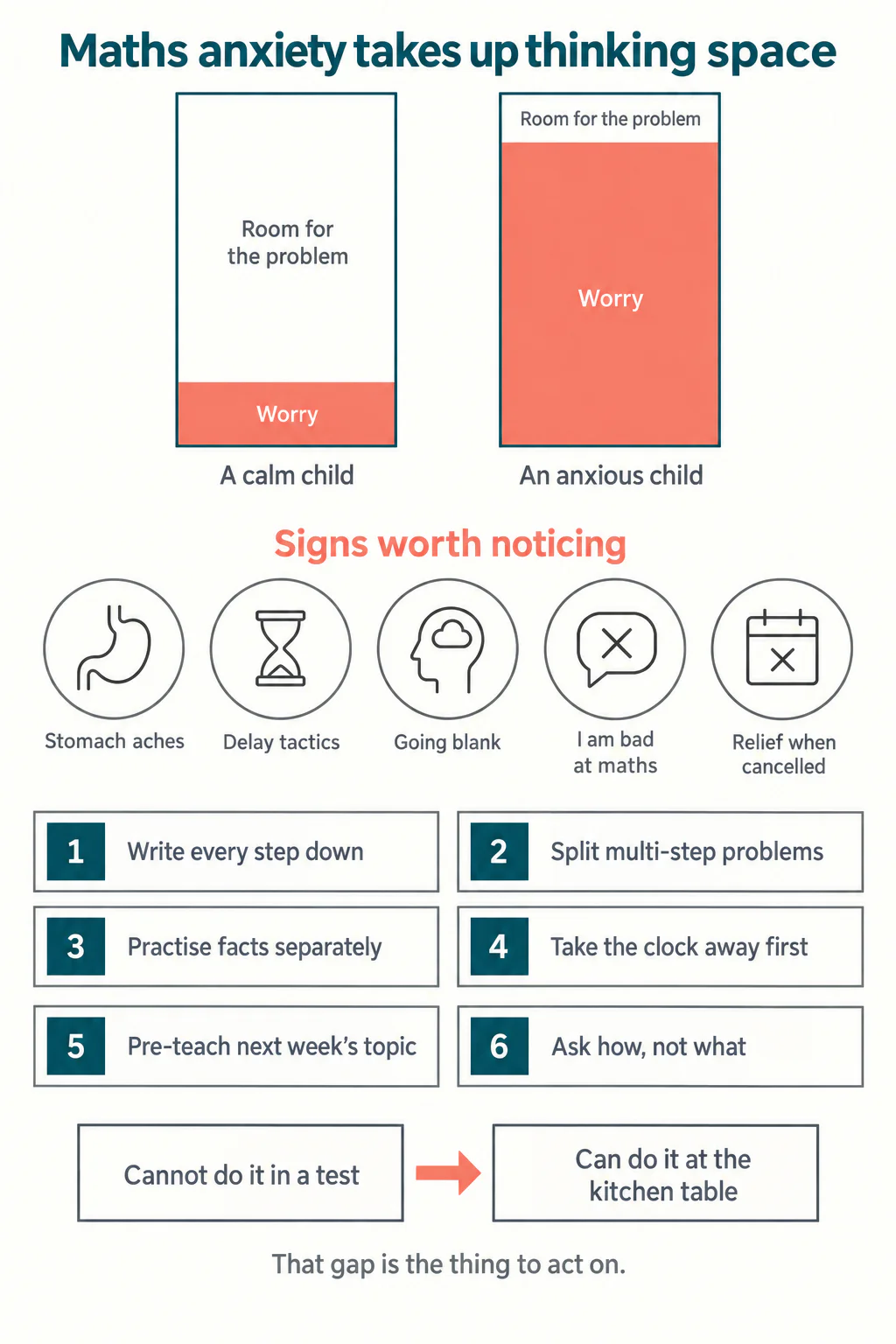
The proposed mechanism is straightforward. Working memory is the small mental workspace where you hold a few things at once, and multi-step arithmetic depends on it entirely. Anxiety fills part of that workspace with intrusive thoughts about how badly this is going. Less room is left for the problem, so the child performs below what they know, which produces more evidence that they are bad at maths, which produces more anxiety.
A 2021 meta-analysis supports working memory acting as a mediator here, reporting a significant negative indirect effect. It is worth being straight about its limits: it drew on eight unique samples and 1,824 participants, and the authors explicitly ask readers to treat that result as descriptive rather than prescriptive because the evidence base is still small. The mechanism is well motivated. The precise size of the effect is not settled, and anyone telling you otherwise has not read the paper.
How do you tell anxiety from not knowing?
This distinction is the whole of the diagnosis, because the two problems have opposite fixes. More practice helps a knowledge gap and makes an anxiety problem worse.
The test is simple enough to run this week. Take five questions your child got wrong in a test. Sit with them somewhere relaxed, with no clock, and ask them to try again while talking you through it.
- If they still cannot do them, it is a knowledge gap. Teach the topic. Anxiety may be present too, but it is not the main obstacle.
- If they work through them correctly, the knowledge was there in the test and could not be reached. That is the pattern worth acting on.
Our guide on what to do when your child says they are bad at maths covers the language side of this, and whether a child is genuinely behind covers the knowledge side.
The signs worth taking seriously
Maths anxiety announces itself through behaviour long before a child can name it.
- Physical complaints with a schedule. Stomach aches that arrive on maths mornings and lift by break.
- Elaborate avoidance. Sharpening pencils, fetching water, needing the right notebook. Delay is cheaper than starting.
- Going blank on the familiar. Forgetting a table they knew perfectly the day before, specifically when someone is watching or timing.
- Identity language. The shift from "I got this wrong" to "I am bad at maths" is the one to catch, because a fixed statement about yourself is not something practice can argue with.
- Relief out of proportion. Visible relief when maths is cancelled, larger than the relief about any other subject.
Not sure which level your child should start at? A free trial class with a Codeyoung teacher shows you exactly where they are and what they are ready for next, before you commit to anything.
Book a Free Trial →What makes it worse, usually with good intentions
Three common responses reliably backfire, and all three come from a parent trying to help.
A diet of mostly timed drills. Speed practice is not harmful in itself and fluency genuinely matters. But for a child whose working memory is already partly occupied, a clock takes more of what little is left. The result is a worse score, which confirms the fear that produced it.
Telling a child to relax. Reasonable advice that lands as an instruction to stop feeling something, which nobody can follow. Reducing what the task demands is achievable in a way that reducing the feeling directly is not.
Sharing your own maths history. Saying "I was terrible at maths too" is meant as solidarity. To a ten year old it reads as permission, and confirmation that this is hereditary and settled. Sympathise with the difficulty of the question rather than with the category of person who cannot do maths.
What actually helps: reduce the load
If the mechanism is a shortage of mental workspace, the intervention is to need less of it. Every practical step below follows from that one idea.
- Write every step down. Mental arithmetic is the most working-memory-expensive way to work. Paper is external memory, and using it is not a crutch.
- Split multi-step problems into stages, with the intermediate answer written on its own line. Most errors in anxious children are lost intermediate values, not faulty method.
- Separate fluency from problem solving. Practise tables in one session and word problems in another, so recall and reasoning never compete for the same space at the same moment.
- Remove the clock first, restore it later. Rebuild accuracy untimed until the work is genuinely easy, then reintroduce timing gradually, starting well inside what they can already do.
- Pre-teach rather than re-teach. Going over next week's topic in advance means the child meets it in class already knowing something, which changes their experience of the lesson from exposure to recognition.
- Ask for the method, not the answer. "How did you work that out" is a question they can succeed at even when the answer is wrong, and it produces the information you actually need.
Why 1:1 makes a difference here specifically
Class sizes are not a marketing complaint in this case, they are the mechanism. A large part of maths anxiety is social: being wrong where others can see, being last to finish, being asked in front of thirty people.
In a one-to-one lesson those triggers are simply absent. A child can be wrong repeatedly without an audience, work at whatever pace the topic needs, and say "I do not understand" without it costing anything. In my experience the first visible change is rarely a score. It is that the child starts asking questions again, which they stopped doing when being confused became embarrassing.
The second thing a teacher provides is accurate diagnosis. Parents find it genuinely hard to tell a knowledge gap from an anxiety response, because both look like a wrong answer on a page. Our guides to building maths confidence and strategies for children who dislike maths cover what that rebuilding looks like over a term.
When to look further
Maths anxiety and dyscalculia are different things and can occur together. Dyscalculia affects number processing itself and persists in calm, unhurried conditions with good teaching. Maths anxiety lifts, at least partly, when the pressure comes off.
If your child's difficulties stay constant regardless of setting, if they struggle with quantity and number sense rather than with procedures, or if a term of calm support produces no movement at all, ask the school about assessment. Getting that answer right matters more than any single technique on this page.
Wrapping up
Math anxiety in kids is best understood as a competition for a small amount of mental space, which is why it hits multi-step questions hardest and why it looks like forgetting. Test it by running the same questions again without a clock. If the knowledge reappears, stop adding practice and start reducing load: write every step, split the stages, separate fluency from reasoning, and take the timer away until the work is comfortable. And be careful with the sentence "I was bad at maths too", however kindly it is meant.
If you would like someone to work out which part is knowledge and which part is anxiety, a 1:1 maths class is designed to answer exactly that question.
Codeyoung runs 1:1 live online classes for children aged 6 to 17, with a teacher who adapts the pace to your child rather than a fixed syllabus. The first class is free, so you can see how they respond before deciding.
Book a Free TrialSources: Ashcraft and Kirk, The relationships among working memory, math anxiety, and performance, and a meta-analysis of working memory as a mediator in Frontiers in Psychology.