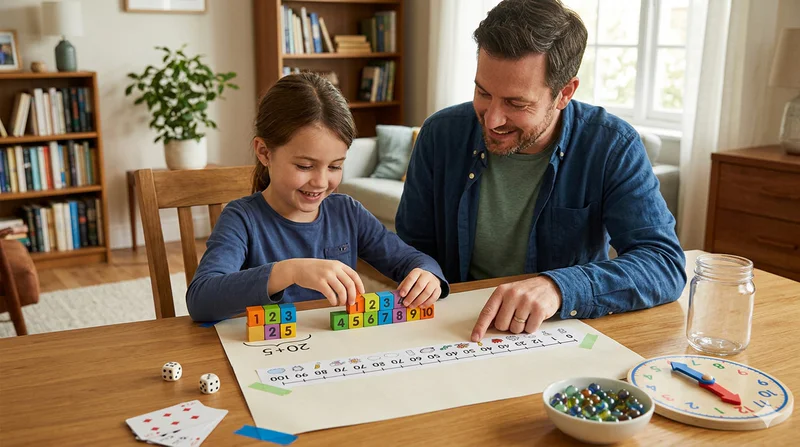
Number Sense for Kids: What It Is and How to Build It at Home
Two children in the same class are given the problem 98 + 47. The first child reaches for a pencil and carefully stacks the numbers in columns. The second child pauses for a moment and says "145, because 98 is nearly 100, so I did 100 + 47 = 147 and then took away 2."
Both children got the correct answer. But they approached the same problem from entirely different positions. The first child applied a procedure. The second child reasoned about numbers. The second child has number sense.
Number sense is one of the most important predictors of long-term mathematical achievement, and one of the least directly taught components of maths education. This guide explains what number sense actually is, why some children have more of it than others, what weak number sense looks like in practice, and what parents can do at home to build it systematically at every age.
Key Takeaways
Number sense is the ability to understand numbers flexibly, to estimate, compare, decompose, and reason about them rather than just calculate with them procedurally.
Children with strong number sense outperform those without it in every area of the maths curriculum, from arithmetic through to algebra and statistics.
Number sense is developed through experience and conversation, not through worksheets: the activities that build it most effectively are largely informal and often don't look like maths practice at all.
Weak number sense is identifiable early and fixable with the right activities, it is not a permanent trait or a sign of low mathematical ability.
Daily low-stakes numerical conversations are the single most effective thing parents can do to build a child's number sense at home.
What Is Number Sense and Why Does It Matter?
Number sense is an intuitive, flexible understanding of numbers and their relationships. It includes knowing that 7 is close to 10 and far from 100. Understanding that 24 can be thought of as 20 + 4, or as 4 × 6, or as 25 − 1, depending on which decomposition is most useful. Recognising that 499 × 2 is almost the same as 500 × 2. Knowing without calculating that 3 groups of 40 is more than 100.
None of these are calculations in the traditional sense. They are acts of numerical reasoning, understanding what numbers mean and how they relate to each other, rather than applying a procedure to produce an answer.
Research from Stanford University's education department has found that number sense at age 7 is one of the strongest predictors of mathematical achievement at age 11, controlling for general intelligence, reading ability, and socioeconomic factors. It predicts not just arithmetic performance but also performance in algebra, geometry, and statistics, domains that don't appear related to basic number understanding but which all depend on it at the foundational level.
What does strong number sense look like in a child?
A child with strong number sense can estimate an answer before calculating and knows whether their calculated answer is reasonable. They choose calculation strategies that fit the specific numbers in a problem rather than applying the same method to everything. They notice relationships between problems: "this is like the one we just did but with bigger numbers." They can work forwards and backwards through operations and explain their reasoning clearly. They are rarely surprised by their own answers because the approximate answer was already obvious to them before they calculated.
What Weak Number Sense Looks Like: The Signs Parents Should Know
Weak number sense is often invisible until it starts producing specific, recurring errors. These are the most reliable signals that a child's number understanding is procedural rather than conceptual.
Signs of Weak vs Strong Number Sense at Each Age
The most revealing test for number sense at any age is asking the child to estimate an answer before calculating, then check whether the exact answer is reasonable. A child with strong number sense narrows down to a range before starting. A child without it either refuses to guess (because they don't trust their numerical intuition) or produces estimates that are wildly off.
For a broader picture of the maths foundations that support number sense development, see Maths for Kids: How to Build Strong Foundations at Home.
The Six Core Components of Number Sense
Number sense is not a single skill but a cluster of related numerical understandings. Identifying which components are strong and which are weak helps parents focus home practice where it will have the most impact.
The Six Components of Number Sense and How to Build Each One
How Do You Build Number Sense at Home Without Formal Lessons?
The most effective number sense activities are largely informal, embedded in daily life rather than presented as maths practice. This is not a pedagogical accident. Number sense develops through repeated, low-stakes encounters with numerical reasoning in contexts the child finds relevant. Worksheets build procedural skill. Embedded numerical experience builds intuition.
The numerical conversation habit
The single highest-impact thing a parent can do is ask numerical questions naturally throughout the day. Not as tests, but as genuine curiosity and shared thinking.
"There are 23 people coming to the party. If each table seats 6, roughly how many tables will we need?" "The recipe feeds 4. We have 10 people coming. How much more flour do we need?" "The journey took 47 minutes last time. If we leave at 2:15, when will we get there?" "There are 3 packets of 8 biscuits. Is that enough for everyone to have 2 each?"
None of these require the child to produce a precise written answer. They require thinking about numbers in a real context, which is exactly what number sense is. A child who engages with these questions daily for a year develops numerical intuition that a year of worksheet practice rarely produces.
Estimation before calculation
Build the habit of asking "what do you think the answer will be?" before any calculation. For a 7-year-old: "before you work out 48 + 37, do you think the answer will be closer to 70 or 90?" For a 12-year-old: "before you calculate 23% of 64, is it going to be more or less than 15?"
This habit does two things. It forces the child to reason about magnitude before applying a procedure, which is exactly the mental process that number sense develops. And it gives the child a check on their own answer: if they estimated 80 and calculated 24, they immediately know something went wrong without being told.
Number talks: 5 minutes, any time
A number talk is a brief mental arithmetic discussion where the goal is to share strategies, not produce a single correct answer. Show a calculation: 15 × 4. Ask the child how they'd do it in their head. Then share your own method if it's different. "I'd do 15 × 2 = 30 and then double it again = 60. You said 10 × 4 = 40 plus 5 × 4 = 20, so 60. Same answer, different routes." The goal is for the child to see that there are multiple valid paths to the same numerical destination.
For mental arithmetic techniques that pair naturally with number talks, see Mental Maths Tricks for Kids: 9 Techniques That Actually Work.
Want your child's number sense assessed and built systematically through live 1:1 instruction? Codeyoung's maths programme identifies and targets specific gaps. Book a free trial class to see the approach in action.
Book a Free Trial Maths Class →
Number Sense Activities by Age Group
The right activity depends on the child's current level of numerical development. Here are specific, practical activities for each age group that build number sense through engagement rather than drill.
Ages 5 to 7: Building the foundations
Number line walks. Draw a number line on the ground with chalk. Call out a number and ask the child to jump to it. Then ask "is that closer to 10 or 20?" Spatial understanding of number placement is one of the earliest and most important components of number sense.
Subitising games. Subitising is the ability to instantly recognise a quantity without counting. Flash a quick arrangement of dots and ask how many. Start with groups of 3 to 5, progressing to 6 to 10. Subitising builds the direct number recognition that underlies rapid mental arithmetic.
Ten frames. A ten frame is a 2×5 grid of squares that a child fills with counters. Showing 7 dots on a ten frame makes it immediately visible that 7 is "3 away from 10." This spatial relationship between numbers and 10 is one of the most important foundations for all subsequent mental arithmetic.
Ages 8 to 10: Building flexibility
Decomposition challenges. "Give me three different ways to make 36." The child who can say "30+6, 4×9, 40−4, 18×2" has developed numerical flexibility that will accelerate fraction and algebra work.
Closest estimate wins. Pose a calculation and ask everyone to estimate the answer (parents included). Whoever is closest wins. This makes estimation feel competitive and fun while building the habit of approximate reasoning before precise calculation.
Number pattern investigation. "What do you notice about all the multiples of 9? What about square numbers, how much do they increase by each time?" Pattern investigation builds the noticing habit that is central to algebraic thinking.
Ages 10 to 13: Building proportional reasoning
Recipe scaling. Take a real recipe and scale it for a different number of people. This involves ratio, multiplication, and proportional reasoning in a context the child finds immediately meaningful.
Percentage estimation in daily life. "That's £48 and there's a 25% discount. Roughly how much will it cost?" The goal isn't exact calculation, it's learning to work with percentages as intuitive relationships rather than procedure-dependent calculations.
Mental maths challenges with Vedic techniques. Introduce one Vedic technique per week and apply it to 10 quick calculations. For Vedic techniques appropriate to this age group, see Vedic Maths for Kids: Ancient Techniques That Make Arithmetic Easy.

Why Do Schools Underdevelop Number Sense?
This is not a criticism of teachers, it's a structural observation about classroom constraints. Number sense develops through exploration, discussion, and individual reasoning. A class of 30 children moving through a fixed curriculum has limited time for the kind of open-ended numerical conversation that builds it.
School maths necessarily emphasises assessable outcomes: correct answers, correct procedures, progress through content. These are important. But number sense is difficult to assess directly and easy to bypass with procedural instruction that produces correct answers without genuine numerical understanding.
A child can pass a column addition test without any number sense. A child can pass a long multiplication test without any number sense. What number sense adds is not the ability to answer these questions correctly, it's the ability to check whether the answer is reasonable, to adapt the method to easier numbers, and to transfer numerical understanding to new problem types. These qualities show up later, in harder topics, and the gap between children who have them and those who don't widens significantly through secondary school.
This is exactly why home practice matters. The numerical conversation habit, estimation games, and decomposition activities that develop number sense are things parents can do in the gaps that formal schooling leaves, without requiring any specialist knowledge. For more on supporting maths development at home, see How to Improve Your Child's Maths Skills at Home.
Frequently Asked Questions: Number Sense for Kids
What exactly is number sense in maths?
Number sense is the ability to understand numbers flexibly and intuitively, to reason about their size, their relationships, and how they behave in different operations, rather than just applying memorised procedures. A child with strong number sense knows immediately that 399 + 201 = 600 without writing anything down, because they understand 399 as "one less than 400" and 201 as "one more than 200." They are working with the meaning of numbers, not just their symbols.
How early can you develop number sense in children?
Number sense development begins from infancy. Babies as young as 6 months show sensitivity to quantity changes in experiments. By age 3 to 4, children can demonstrate basic number sense through simple comparison tasks and subitising. The foundation phase for formal number sense development is ages 5 to 8, when spatial representations of number (number lines, ten frames, arrays) are most impactful. Early investment in this period produces benefits that compound throughout the entire maths curriculum.
Is number sense the same as being good at mental maths?
Related but not identical. Mental maths is the practical ability to calculate quickly without written working. Number sense is the broader numerical understanding that makes mental maths possible. A child with strong number sense finds mental maths strategies intuitive because they already understand number relationships. A child who has practised specific mental maths tricks but without underlying number sense can apply those tricks to the specific cases they've learned but struggles to adapt when the numbers change. Number sense is the foundation; mental maths strategies are built on it.
My child is good at times tables but struggles with word problems. Is this a number sense issue?
Very possibly. Times tables are a memory skill. Word problems require numerical reasoning, deciding which operation is appropriate, estimating the scale of the answer, checking whether the result makes sense in context. A child who is fluent at times tables but struggles with word problems often has strong memorisation but weak number sense. They know the facts but not the structure behind them. The fix is not more times table practice but activities that build number relationships and proportional reasoning. For specific approaches, see Maths for Kids: How to Build Strong Foundations at Home.
What are the best games to build number sense in children?
Card games are particularly effective because they naturally involve comparison, addition, and strategic numerical thinking. War (highest card wins) builds comparison. Blackjack variants build addition to a target. Rummy builds pattern recognition. Board games with dice and movement (Monopoly, backgammon) build quick addition and number line understanding. Dominoes builds subitising. Chess and strategy games build planning and consequence reasoning, which transfers to mathematical reasoning more broadly.
Can number sense be taught explicitly, or does it just develop naturally?
Both. Some children develop strong number sense through natural exposure to mathematical environments, conversations, and play. Others need more explicit instruction in number relationships, estimation strategies, and decomposition techniques. The activities in this guide can be used both as enrichment for children who are developing well and as targeted support for those showing signs of weak number sense. The key in both cases is the same: regular, low-stakes engagement with numerical reasoning in varied contexts, rather than more worksheets covering the same ground.
How does number sense affect a child's performance in secondary school maths?
Significantly. In algebra, recognising that expressions are generalisations of numerical patterns requires the number relationship understanding that is central to number sense. In geometry, spatial reasoning about measurements and scale depends on proportional reasoning. In statistics, interpreting data distributions requires magnitude understanding. The children who find secondary maths accessible are almost always those who arrive with strong number sense from primary school, regardless of how much secondary maths content they have been exposed to already.
Is number sense related to coding ability?
Yes, through the shared foundation of pattern recognition and logical reasoning. Children with strong number sense find coding concepts like variables, loops, and conditionals more intuitive because they are comfortable with abstract relationships between quantities. Coding in turn reinforces number sense by applying numerical concepts purposefully. Children who learn both coding and maths together consistently show stronger development in both domains than those who learn either alone. For the specific connections, see Coding and Maths for Kids: How Learning Both Gives Children a STEM Edge.
How does Codeyoung assess and build number sense in its maths programme?
Codeyoung's maths programme begins with an assessment that identifies which number sense components are strong and which need development, rather than simply placing children by year group. Sessions combine school curriculum support with deliberate number sense activities, estimation challenges, mental calculation with multiple strategies, number relationship exploration, and Vedic techniques that build proportional and multiplicative reasoning. The 1:1 format means the instructor can adapt in real time to what the child demonstrates, targeting the specific gaps rather than covering the same ground repeatedly. Book a free trial class to see the approach in action.
Number Sense Is the Foundation Every Maths Topic Builds On
A child with strong number sense does not just perform better at arithmetic. They find fractions more intuitive. They understand what algebra is actually doing. They can estimate and check their own work. They approach unfamiliar problems with flexibility rather than paralysis. They are, in the deepest sense, mathematically literate rather than just mathematically trained.
Building number sense doesn't require specialist knowledge. It requires the habit of talking about numbers naturally, asking "is that about right?" before accepting an answer, and treating numerical reasoning as a normal part of everyday thinking rather than a school subject to be completed and put away.
Five minutes of deliberate numerical conversation a day, started early and maintained consistently, produces a qualitatively different kind of mathematical understanding than any amount of worksheet practice alone. Start now, at whatever age your child currently is. It's never too early and never too late.
Explore Codeyoung's maths programme for children aged 6 to 17 to see how number sense and curriculum maths are developed together through live 1:1 instruction.
Build the number sense your child's maths future depends on.
Codeyoung's live 1:1 maths classes assess and develop number sense alongside school curriculum support for children aged 6 to 17. Free first class, flexible scheduling, no commitment required.