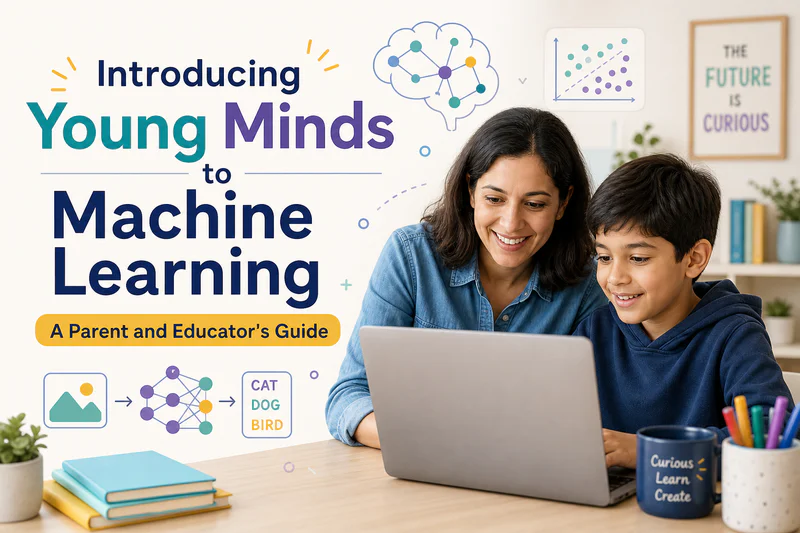
Every parent and educator has felt it, that moment when a child asks, "Why does YouTube always know what I want to watch?" The answer is machine learning for kids, and it's closer to their everyday life than most adults realize.
This guide demystifies machine learning, explains how to introduce it at every age from 6 to 17, and shows you exactly how to get started with structured, age-appropriate learning today.
What Is Machine Learning for Kids?
Machine learning for kids starts with a simple idea: instead of being programmed with rigid rules, computers learn from experience, just like humans do.
Think about how a child learns to recognize a dog. Nobody gives them a technical manual. They simply see enough dogs, hear the word "dog," and their brain builds a pattern. Machine learning works the same way. A computer is fed thousands of examples until it builds its own pattern-recognition ability.
So how is machine learning different from AI?Artificial Intelligence (AI) is the broad concept, building computers that can do "smart" things. Machine learning is a specific method of achieving AI, where the computer learns from data rather than following hard-coded instructions. All machine learning is AI, but not all AI is machine learning.
How Does Machine Learning Actually Work?
Here's where a good analogy makes all the difference.
Imagine your child is a detective trying to figure out if an email is spam or genuine. They read 1,000 emails and start noticing patterns, spam always mentions "free prizes" or "urgent offers." After enough examples, they can spot a suspicious email instantly without checking a rulebook. That's exactly what a machine learning model does.
Another way to think about it: picture a giant toy box. Every time your child puts a toy away, they sort it, cars go with cars, dinosaurs with dinosaurs. After doing this repeatedly, they don't even need to think about it. The sorting becomes automatic. Machine learning models do the same thing with data, sorting and categorizing based on patterns they've seen before.
The key steps in machine learning are:
Collect data, Feed the computer lots of examples (photos, words, numbers)
Train the model, The algorithm finds patterns in that data
Test the model, Check how well it makes predictions on new data
Improve, Adjust until accuracy improves
Types of Machine Learning: A Simple Comparison

There are three main types of machine learning for kids to eventually understand. Here's a clean breakdown:
Each type has real-world applications, from medical diagnosis (supervised) to recommendation engines (unsupervised) to robotics (reinforcement). Understanding these distinctions is the foundation of machine learning for kids at intermediate and advanced levels.
Machine Learning in Everyday Life
Kids don't need to look far to see machine learning in action. It's already shaping their daily routines.
When Netflix suggests a show your child will love, that's unsupervised machine learning analyzing viewing history. When Siri understands a question spoken in a noisy room, that's a speech recognition model trained on millions of voice samples. When YouTube lines up the next video automatically, it's a reinforcement learning algorithm optimizing for watch time.
Even the spam filter in your email inbox is a classic supervised learning model, trained on thousands of examples of "junk" versus "real" messages. Once children recognize these connections, machine learning for kids shifts from an abstract concept to something genuinely exciting and relevant.
Why Start Early? Age-Appropriate Learning Paths (Ages 6–17)

The earlier a child is introduced to computational thinking, the more naturally it becomes part of how they solve problems. Here's how to approach machine learning for kids at each developmental stage.
Ages 6–10: Curiosity and Foundational Thinking
At this stage, formal coding isn't the goal. Instead, build logical thinking through games like Scratch, unplugged AI activities, and hands-on sorting exercises that mirror how ML models categorize data. The best coding programs for 6–17 year olds at this level focus on patterns, decision trees, and cause-and-effect thinking.
Ages 11–14: First Steps into Code and Simple ML Projects
This is the ideal window to introduce Python for kids. Tweens can begin training basic models using beginner-friendly tools like Google's Teachable Machine, where they literally teach a computer to recognize images or sounds with no complex syntax required. Python for kids becomes the natural language here, readable, logical, and perfectly suited for building early ML projects.
Ages 15–17: Advanced Coding, Real-World Applications, and Ethics
Teenagers can engage with real datasets, build functional machine learning models, and start exploring the ethical dimensions of AI. The best coding programs for 6–17 year olds at this level include exposure to libraries like scikit-learn, project-based learning, and discussions on bias and fairness in algorithms.
Python as the Gateway to Machine Learning for Kids
Ask any data scientist or ML engineer what language they rely on most and the answer is almost always Python. There's a reason for that, and it's the same reason it's the perfect starting language for machine learning for kids.
Python reads almost like plain English. A 12-year-old can write a working script on day one without getting lost in complex syntax. More importantly, every major machine learning library, TensorFlow, PyTorch, scikit-learn, is built in Python. Learning Python for kids isn't just learning a coding language; it's opening the front door to the entire field of machine learning.
Once a child is comfortable with Python basics, variables, loops, functions, and lists, they have everything they need to start building their first simple ML models. That progression from Python fundamentals to AI projects is exactly the pathway that structured AI classes for kids are designed to support.
How to Get Started with AI Classes for Kids
The biggest barrier for most parents isn't motivation, it's not knowing where to begin. The good news is that high-quality online coding classes for kids have made structured AI and ML education accessible from home, with no prior experience required for either the child or the parent.
When choosing the right program, here's what to look for:
Age-appropriate curriculum, The best coding programs for 6–17 year olds are structured in stages, not one-size-fits-all
Live instruction, Real-time feedback from a teacher accelerates learning far faster than pre-recorded video
Project-based learning, Kids retain concepts far better when they build something real
Python integration, Any serious AI class for kids should introduce Python early and progress naturally into ML concepts
Small class sizes, Individual attention matters, especially when concepts get challenging
CodeYoung's AI classes for kids are structured around exactly these principles, guiding children from their first line of Python code through to building functional machine learning models, paced for their age group and learning style.
Ethical AI: Teaching Kids About Fairness and Bias in Machine Learning

Machine learning for kids shouldn't just be about building models, it should also include teaching children to question them.
ML models are trained on data, and data reflects the real world, including its flaws. If a facial recognition model is trained mostly on one demographic, it will perform poorly on others. If a loan-approval algorithm is trained on biased historical data, it may replicate those biases at scale. These are real problems with real consequences.
Introducing ethical thinking early doesn't mean overwhelming young learners with complexity. It means asking simple questions: "Is this fair? Who might this hurt? What data was used to train this?" Children who understand both the power and the responsibility of machine learning for kids are better prepared to build AI that genuinely serves everyone.
Future Careers: What Opportunities Exist in Machine Learning and AI?
The career case for machine learning for kids is compelling and backed by strong data. According to research from HeroHunt.ai, AI/ML hiring grew 88% year-over-year in 2025, and projected job growth for machine learning roles sits at approximately 31% through 2030, far outpacing most other occupations. The global machine learning market is projected to grow from $91.31 billion in 2025 to $1.88 trillion by 2035, according to industry analysis.
For children entering the workforce in the 2030s and 2040s, fluency in machine learning isn't a niche advantage, it's likely a baseline expectation across industries. Concrete career paths include:
Machine Learning Engineer, Designing and deploying production ML systems
Data Scientist, Analyzing data to extract actionable insights using ML models
AI Product Manager, Bridging technical and business teams building AI products
Computer Vision Engineer, Building systems that interpret images and video
NLP Specialist, Working with language models and conversational AI
Children who start with machine learning for kids today, through Python for kids programs and structured AI classes for kids, will have years of compounding experience by the time these roles become their reality.
Conclusion
Machine learning for kids is no longer a niche or advanced topic reserved for university classrooms. It is the defining literacy of the next generation, and the window to build that foundation is right now, during childhood, when learning is fastest and curiosity is highest.
Whether your child is 7 and just beginning to explore how computers think, or 16 and ready to build their first real ML model, the pathway is clear: start with Python for kids, progress into structured AI classes for kids, and find online coding classes for kids that meet them where they are developmentally. CodeYoung's curriculum is built precisely around this progression, from a child's first line of Python to their first working machine learning model, giving young learners the skills, confidence, and ethical awareness to shape the AI-driven world they'll inherit.
Frequently Asked Questions
Can young kids really understand machine learning?
Yes, absolutely. Machine learning for kids doesn't require advanced math or coding knowledge at the early stages. Children as young as 6 can grasp the core concept, that computers learn from examples, through games, sorting activities, and tools like Google's Teachable Machine. The key is using age-appropriate analogies and hands-on activities rather than technical explanations.
What age should kids start learning machine learning for kids?
Children can begin exploring the foundational ideas of machine learning for kids as early as age 6 through concept-based games and visual tools. Formal coding introduction typically works best from age 11 onward, with Python for kids serving as the natural entry point. By ages 15–17, young learners can engage with real datasets and functional ML models. The best coding programs for 6–17 year olds map their curriculum to these developmental stages.
Do kids need advanced math for machine learning for kids?
Not at the beginner or intermediate level. Introductory machine learning for kids focuses on pattern recognition, logical thinking, and coding, areas where basic math is sufficient. Advanced ML concepts do eventually involve statistics and linear algebra, but structured AI classes for kids and online coding classes for kids introduce these ideas progressively, long after the foundational excitement is established.
What are fun ways to explain machine learning for kids?
The detective analogy works brilliantly, the computer is a detective that studies thousands of clues (data) before solving a mystery (making a prediction). The toy-sorting analogy works for younger children: just as they group toys by type, an ML model groups data by patterns. For hands-on learners, tools like Google's Teachable Machine let kids literally train a computer using their own images in minutes. Machine learning for kids becomes engaging the moment it feels interactive, not theoretical.
How can I introduce machine learning for kids at home?
Start with free tools that require no coding knowledge. Google's Teachable Machine lets children train image or sound recognition models in a browser. Scratch has visual AI extensions built in. From there, enrolling in structured online coding classes for kids or AI classes for kids provides guided progression so learning doesn't plateau. Machine learning for kids works best when curiosity from home is supported by structured instruction.
Will learning machine learning for kids help with other school subjects?
Significantly. Machine learning for kids builds logical reasoning, data literacy, and systematic problem-solving, skills that transfer directly to mathematics, science, and critical thinking. Children who study Python for kids also develop stronger pattern recognition and sequential thinking. According to Microsoft's 2025 AI in Education Report, students who engage with AI tools actively demonstrate stronger agency over their own learning, which improves outcomes across subjects.
How do AI classes for kids and online coding classes for kids differ?
Online coding classes for kids typically cover a broad curriculum, programming fundamentals, game development, web design, and Python for kids. AI classes for kids are a specialized track within that broader space, focused specifically on machine learning concepts, model training, and ethical AI. Many of the best coding programs for 6–17 year olds offer both, with AI classes for kids positioned as an advanced pathway following foundational Python for kids courses. CodeYoung offers both pathways, structured to progress naturally from one to the other.
Why is Python for kids important before diving into machine learning for kids?
Python is the primary programming language of the machine learning field. Nearly every major ML library and framework, TensorFlow, PyTorch, scikit-learn, Keras, runs on Python. Children who complete Python for kids courses arrive at machine learning for kids with the coding literacy they need to actually build and experiment with models, not just learn about them conceptually. Skipping Python for kids and jumping directly into AI classes for kids leaves a critical foundation gap that slows progress significantly.