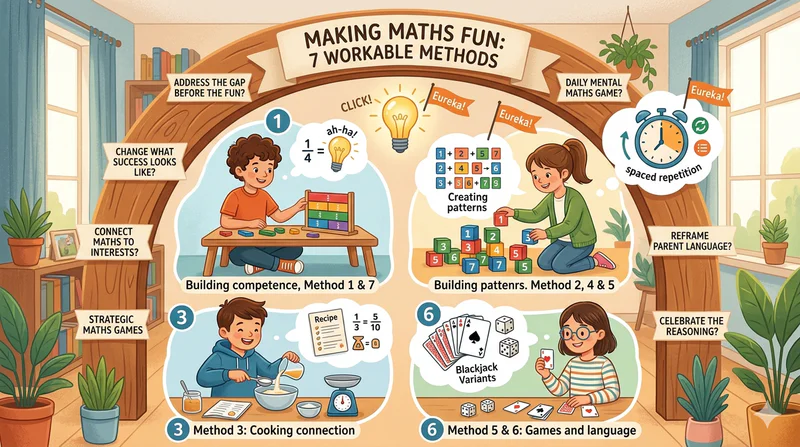
How to Make Maths Fun for Kids: 7 Methods That Actually Work
Most parents who search "how to make maths fun for kids" are looking for the same thing: a way to transform a subject their child currently avoids into one they'll engage with willingly. The instinct is usually to reach for games, rewards, or novelty activities that make maths feel less like maths.
This approach works briefly. It rarely works lastingly. The reason is that engagement isn't primarily produced by entertainment. It's produced by a specific combination of challenge and competence: a problem that's hard enough to be interesting but accessible enough to be solvable. That combination isn't something a game adds on top of maths. It has to come from within the maths itself.
The 7 methods in this guide are not tricks to make maths more palatable. They are approaches that genuinely change a child's relationship with the subject by addressing the real reasons maths feels unfun to most children who find it difficult.
Key Takeaways
Maths is unfun for most children not because it's inherently boring but because they're experiencing it at the wrong difficulty level, usually too hard due to unaddressed gaps, occasionally too easy due to insufficient challenge.
The most lasting way to make maths fun is to create genuine experiences of competence, moments where the child solves something difficult and knows they did it themselves.
Maths games and activities are useful, but only when the child already understands the underlying concepts, games over gaps produce games-shaped frustration, not fun.
Connecting maths to something the child already cares about produces more durable motivation than any incentive system.
The parent's language about maths at home has measurable effects on how children experience the subject, small shifts in framing produce significant changes in attitude over time.
Why Do Children Find Maths Unfun? The Real Reasons
Before choosing an approach, it's worth understanding what's actually driving the "maths is boring/hard/pointless" attitude. Most children who say maths isn't fun are communicating one of three things.
The work is too hard
The most common cause of negative maths attitudes is consistent difficulty without resolution. A child who regularly encounters maths problems they can't solve, doesn't understand the feedback they receive, and falls further behind each week develops a defensive avoidance that looks like disinterest but is actually self-protection. Making this maths "fun" with games doesn't address the underlying gap. Addressing the gap makes maths genuinely more enjoyable because competence is inherently satisfying.
The work is disconnected from anything meaningful
"When will I ever use this?" is not a rhetorical question from children, it's a genuine request for context. Maths presented in the abstract, applied to made-up scenarios that no child would actually encounter, feels purposeless. Children who can't see any connection between their maths work and anything they care about experience it as arbitrary difficulty. Connecting the same maths to something they actually think about changes the experience significantly without changing the content at all.
The child has absorbed a "not a maths person" identity
Research by Carol Dweck and others has shown that children who believe mathematical ability is fixed, you either have it or you don't, are significantly less resilient in the face of maths difficulty. They interpret struggle as confirmation of their deficit rather than as a normal part of learning. This identity belief often comes from a single formative experience (a discouraging comment, a highly visible failure, a class where peers consistently performed better) and persists long after the circumstances that produced it have changed.
For specific approaches to maths anxiety and the "bad at maths" belief, see Maths Anxiety in Kids: Signs, Causes, and How 1:1 Tutoring Helps and What to Do When Your Child Says They Are Bad at Maths.
7 Methods That Genuinely Make Maths More Engaging
Method 1: Address the gap before adding the fun
This is the most important method and the one most often skipped. If a child is struggling with their current school maths topic, adding games to the same material produces games-shaped frustration, not enjoyment. The fun only arrives when competence exists underneath it.
The first step for any child who finds maths unfun is an honest assessment of where exactly their understanding breaks down. Not "they're behind in maths" but "they're solid on multiplication but the conceptual gap in fractions means that every subsequent topic which builds on fractions also feels hard." Fix that specific gap first. The maths becomes more engaging automatically as the work becomes more accessible.
For identifying and addressing specific maths gaps, see Maths for Kids: How to Build Strong Foundations at Home and Fractions for Kids: Why They're Hard and How to Help.
Method 2: Change what success looks like in the session
For children who find maths unfun, the typical home practice session ends in one of two ways: correct answers (fine but not engaging) or incorrect answers (actively discouraging). Neither produces the experience of mathematical satisfaction that makes children want to return.
The fix is redefining success as "I figured something out" rather than "I got the right answer." Ask questions that have a thinking journey rather than a lookup answer. "How would you estimate the answer before you calculate?" "Can you think of two different ways to solve this?" "What would the answer be if the numbers were different?" These questions have no single right answer. They produce active thinking. And they make maths feel like exploration rather than testing.
Method 3: Connect maths to the child's specific interests
This is the most reliable single adjustment that parents can make, and it requires no specialist knowledge. Find the intersection between the maths topic the child is currently studying and something they genuinely care about.
A child who loves football: scoring averages, probability of winning from a given scoreline, comparing players' statistics using fractions and percentages. One who loves cooking: scaling recipes (ratio and proportion), measuring (fractions), budgeting a meal (percentages and money). One who codes: coordinate systems, loop counts, data analysis. One who loves music: rhythm as fractions of time, frequency ratios in harmonics.
The maths content doesn't change. The context changes. A child who is calculating 65% of 840 for a school worksheet and a child calculating 65% of 840 because they want to know how many of a stadium's seats would be occupied at 65% capacity are doing identical arithmetic. The second child is more engaged because the answer means something to them.
Method 4: Make mental maths a daily game, not a test
Mental arithmetic practice is most effective when it's brief, daily, and feels like a game rather than assessment. The structure: 5 minutes, during a natural family transition (in the car, during breakfast, while walking). Parent calls out a calculation, child answers. No writing. No marking. No pressure. Parent competes too, "I think it's about 45, what do you think?"
The key shifts that make this feel like a game rather than testing: both participants estimate rather than calculate precisely, the parent is genuinely uncertain sometimes, and wrong answers are met with curiosity ("interesting, how did you get that?") rather than correction. Over weeks, this builds mental maths fluency through spaced repetition in a low-stakes format that most children genuinely enjoy once it becomes routine.
For specific techniques to use in these sessions, see Mental Maths Tricks for Kids: 9 Techniques That Actually Work and Multiplication Tricks for Kids: Build Faster Times Tables.
Method 5: Use maths games strategically, not as the main event
Maths games genuinely help, but not as a replacement for understanding. They work best when used to consolidate concepts the child already understands, to build fluency once the concept is secure, and to create positive associations with maths practice in low-stakes moments.
Effective maths game types: card games (Blackjack variants for addition, War for comparison, Rummy for pattern recognition), board games with numerical strategy (Battleship, chess, backgammon), dice games that produce calculation situations naturally. The game should require genuine mathematical thinking rather than wrapping calculation in an unrelated game mechanic.
For a curated list of activities and games by age group, see Fun Online Maths Activities That Don't Feel Like Homework and Hands-On Maths Activities and Crafts for Kids in Just 10 Minutes.
Method 6: Reframe parent language about maths
Parents are the single most influential voice in how children form their mathematical identity. Specific phrases that parents commonly use have measurable effects on children's maths attitudes, both positive and negative.
Maths Language: What to Say Instead
The research on this is substantial. Children whose parents use process praise ("you worked hard") rather than ability praise ("you're smart") show significantly greater mathematical resilience and persistence in the face of difficulty. Small language shifts, applied consistently over months, produce measurable attitude changes.
Method 7: Celebrate the process of getting to an answer, not just the answer
When a child solves a maths problem, the typical parental response is to check whether the answer is correct. When it is, the session moves on. When it isn't, correction follows. Neither response acknowledges the most important thing that happened: the child's reasoning.
Children who feel seen for how they thought rather than only for whether they were right develop a stronger and more durable engagement with maths. "Walk me through how you got that" signals that the thinking matters. "What was your strategy?" shows interest in the approach. "What would you check to make sure?" invites self-verification rather than external correction.
These conversational habits build the mathematical metacognition: the ability to think about one's own thinking: that distinguishes children who continue growing in maths from those who stall at their current level.
How Do You Make Maths Fun for a Child Who Has Already Given Up?
Children who have genuinely disengaged from maths, "I hate maths," "I can't do maths," total avoidance of anything numerical, need a different starting approach from children who are merely neutral about the subject.
The key is rebuilding the experience of mathematical success before attempting to rebuild engagement with challenging content. Start significantly below the child's current school level, with material they can succeed at confidently. The goal for the first 2 to 3 sessions is not curriculum progress, it's the child experiencing competence in a maths context without failure or anxiety.
Once genuine mathematical confidence exists, even at a modest level: the child is far more open to tackling harder material. The sequence is: competence first, challenge second. Attempting to rebuild engagement through challenge first almost always fails with children who have already disengaged, because the challenge simply confirms the belief that they can't do maths.
For a detailed guide on working with children who have developed negative maths attitudes, see How to Motivate a Child Who Has Given Up on Maths and How to Build Maths Confidence in Children: Strategies That Work.
Age-Specific Ideas for Making Maths More Engaging
The most effective approaches for making maths engaging vary by age because children's motivational profiles, attention spans, and relationship with play change significantly across childhood.
Age-Appropriate Approaches to Engaging Maths at Home
Want your child to experience maths as genuinely engaging rather than just tolerable? Codeyoung's live 1:1 maths sessions start from where your child actually is and build the competence that makes engagement possible. Book a free trial class.
Book a Free Trial Maths Class →
What Does "Fun Maths" Actually Look Like in Practice?
Real mathematical engagement doesn't look like a fairground. It looks like a child who is deeply focused on a problem, who keeps working when they're stuck, who produces the answer themselves, and who says "can we do another one?" when the session ends.
That experience is not produced by making maths look like something else. It's produced by placing a child in the exact zone where challenge and competence meet, what psychologist Mihaly Csikszentmihalyi called "flow": the state of complete absorption in an activity that's at the edge of one's current ability.
Children in mathematical flow are not aware they're "doing maths." They're solving a problem. The numbers and operations are the tools, not the subject. Getting a child into mathematical flow, even briefly, even once, changes their relationship with the subject in a way that no game, reward, or motivational strategy can replicate.
The parent's job is not to make maths entertaining. It's to help the child find the level at which mathematical flow becomes possible, and then to protect the time and environment that allows it to happen.
For the complete framework on building maths foundations that make this possible, see Maths for Kids: How to Build Strong Foundations at Home and Number Sense for Kids: What It Is and How to Build It.
Frequently Asked Questions: How to Make Maths Fun for Kids
What are the best ways to make maths fun for children?
The most effective approaches are: addressing specific maths gaps so the work becomes accessible, connecting maths to the child's existing interests, using brief daily mental maths games rather than long worksheet sessions, celebrating the reasoning process rather than just correct answers, and reframing maths language at home to remove "not a maths person" narratives. Games and activities help when they're used to reinforce concepts the child already understands: not to distract from gaps.
How do I make maths fun for a child who hates it?
Start by diagnosing whether "hates maths" means "finds it too hard," "finds it pointless," or "has absorbed a negative maths identity." Each has a different first step. For children who find it too hard: address the specific gap before adding fun. For children who find it pointless: connect it to something they genuinely care about. For children with a negative identity: rebuild from confident successes at a lower level before introducing challenge. For a detailed guide, see Why Does My Child Hate Maths?
What maths games actually help children learn?
Games that require genuine mathematical reasoning rather than wrapping calculation in unrelated themes. Effective examples: card games involving comparison and quick arithmetic (War, Blackjack variants, Rummy), board games with numerical strategy (chess, backgammon, Battleship), dice games that generate natural calculation situations, and estimation challenges using everyday quantities. Games work best as consolidation tools, they're most effective when the underlying maths is already understood, not as the primary way to introduce concepts.
How much maths practice should kids do at home to build engagement?
Frequency matters more than duration for maths engagement. Five minutes of daily mental maths conversation produces stronger engagement over time than 35 minutes of worksheet practice once a week, because it builds the habit of regular mathematical thinking without the pressure of formal assessment. The daily contact with numbers, in a low-stakes conversational format, normalises maths as something that happens as a natural part of everyday life rather than as a school obligation.
Can maths ever become genuinely enjoyable rather than just tolerable?
Yes, for most children, under the right conditions. Mathematical enjoyment isn't rare or mysterious, it's the natural result of working at the right difficulty level with the right support. Children who experience genuine competence (solved it themselves), genuine challenge (it wasn't trivial), and genuine meaning (it connected to something they cared about) describe maths positively. The conditions for this are replicable. They require good instruction, appropriate difficulty calibration, and a home environment that treats mathematical thinking as interesting rather than burdensome.
What's the difference between making maths fun and making it easier?
Making maths easier removes the challenge. Making it fun involves keeping the challenge while changing the child's relationship with it. A child who finds fraction problems genuinely engaging is not finding them easy, they're finding them worth persisting through because they have a personal reason to solve them, because they've had the experience of getting through difficulty before, or because the context makes the answer feel meaningful. Fun and easy are different things. The goal is engaged difficulty, not eliminated difficulty.
Does coding help make maths more enjoyable?
Consistently. Children who learn coding alongside maths regularly report that maths concepts click faster and feel more meaningful through the coding context. Variables are more intuitive when you've used them in Python. Coordinate geometry is more natural when you've positioned sprites on a Scratch screen. Sequences and patterns make more sense when you've written loops that generate them. The coding doesn't make the maths easier, it gives the maths a purposeful context that makes difficulty feel worth persisting through. For more, see Coding and Maths for Kids: How Learning Both Gives Children a STEM Edge.
How does Codeyoung's maths programme approach engagement?
Codeyoung's maths programme addresses engagement at the source rather than through surface-level gamification. Sessions begin with an accurate assessment of where the child's understanding is genuinely confident and where it breaks down, then target the gap rather than covering curriculum above it. Instructors use the child's specific interests to contextualise maths problems, use mental arithmetic techniques (including Vedic methods) to build the fluency that makes mathematical exploration more enjoyable, and consistently praise the reasoning process rather than just correct answers. The first session is free with no commitment. Book a free trial class to see the approach in practice.
Fun in Maths Is a Byproduct of Competence, Not a Substitute for It
The children who find maths genuinely engaging are not the ones with the easiest worksheets or the most entertaining apps. They are the children who have accumulated enough genuine mathematical competence that hard problems feel like interesting puzzles rather than confirmation of inadequacy. That competence is built through consistent, well-targeted practice at the right level, in a context that makes the difficulty feel meaningful.
Making maths fun is not a task separate from teaching maths well. It is a consequence of teaching it well. A child who understands fractions at a conceptual level, who has developed mental arithmetic fluency, and who can approach an unfamiliar problem with genuine strategies rather than paralysis is a child who is capable of finding maths engaging. That child is built through the methods in this guide, one session, one gap addressed, one successful solution at a time.
Explore Codeyoung's maths programme for children aged 6 to 17, or book a free trial to find out where your child's foundations need strengthening and how quickly that can change.
Help your child discover that maths can actually be enjoyable.
Codeyoung's live 1:1 maths classes build the competence that makes mathematical engagement possible, for children aged 6 to 17. Free first class, flexible scheduling, no commitment required.