
Coding Summer Camp for Kids: What to Expect From an Online Programme
The phrase "coding summer camp" conjures a specific image for many parents: children in a classroom, a counsellor at the front, group projects, and a certificate at the end. That model exists, and it has genuine value: the social energy, the coding culture, the peer collaboration. But it has a significant limitation: with 10 to 20 children sharing one instructor's attention over 5 days, the individual child's coding time is more limited than it appears.
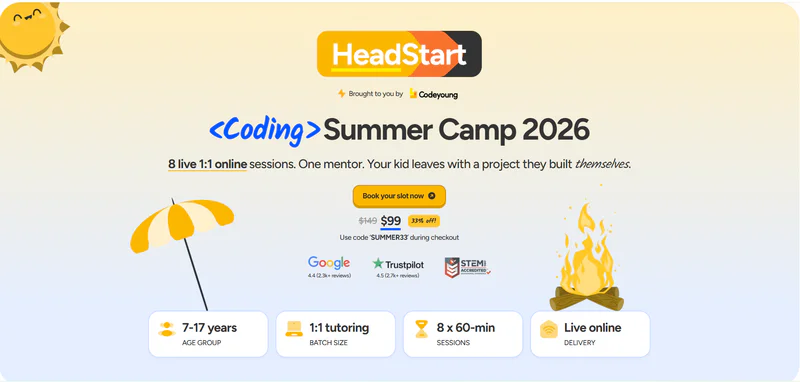
Online coding summer camps, specifically live 1:1 instruction spread across summer weeks, have emerged as a different and often more effective alternative for children whose goal is genuine skill development. Codeyoung's Summer Coding Camp is built on this model: not a residential week but a structured summer programme of live 1:1 sessions that produce real, lasting coding capability by September.
Key Takeaways
Codeyoung's Summer Coding Camp is a live 1:1 online programme for children aged 6 to 17, flexible enough to schedule around summer activities, intensive enough to produce independent coding capability before school resumes.
Children can choose from coding tracks including Scratch (ages 6 to 10), Python (ages 10+), web development, AI/ML, game development, and app development.
The 1:1 format means a child who attends twice per week for 8 weeks can go from complete beginner to independent coder: the milestone that most residential camps of 5 days cannot reliably produce.
Online 1:1 camp sessions produce more actual coding time per session than residential group camps, because the child codes throughout rather than waiting for shared instructor attention.
Codeyoung's Summer Coding Camp continues seamlessly into the school year: the momentum built over summer is maintained, not dropped in September.
Online vs Residential Coding Summer Camp: The Honest Comparison
Both formats have genuine strengths. The right choice depends on what parents are primarily trying to achieve.
Online 1:1 vs Residential Coding Summer Camp: What Each Produces
The ideal scenario for many families is both: a residential camp for the social and cultural experience, plus online 1:1 sessions throughout the summer for genuine skill development. If choosing only one, the decision should be based on primary goal: social coding experience (residential) or independent coding capability (online 1:1).
For a more detailed look at what online coding instruction produces versus other formats, see Summer Coding Classes for Kids: What to Look for in 2026 and Online vs In-Person Coding Classes: Which is Best?
What Coding Tracks Are Available in Summer Camp?
Codeyoung's Summer Coding Camp covers six learning tracks, each appropriate for different ages, starting levels, and interests. Children don't have to choose in advance: the free first session helps identify the right track before committing.
Scratch (Ages 6 to 10): Block-based visual programming. Perfect for complete beginners who want to make games, animations, and interactive stories. No typing barrier. All of the programming logic. By the end of summer, children on this track typically have 3 to 5 complete Scratch projects and a solid foundation for Python at age 10 to 11.
Python: Beginner to Intermediate (Ages 10 to 14): The most popular summer track. Starts with text-based games (guessing games, quizzes, calculators) and progresses through Pygame game development, file handling, and data projects. Children who complete this track can start new Python projects independently and have a portfolio of 4 to 6 complete programmes.
Python AI/ML (Ages 13 to 17): For children who already have Python foundations and want to explore machine learning. Covers classification models, data handling with NumPy and pandas, and builds to a first working AI project by the end of summer. One of the highest-demand skills in the current technology job market.
Web Development (Ages 11 to 17): HTML, CSS, and JavaScript. Builds from first webpage to interactive multi-page website. By the end of summer, children on this track have a personal portfolio site and understand how the web works from the ground up.
Game Development (Ages 11 to 16): Python Pygame or Unity. For children motivated by games who want to build the kinds of games they've always played. This track has the highest natural motivation for children who are gamers but haven't coded before.
App Development (Ages 12 to 17): MIT App Inventor for beginners, progressing to Swift or Kotlin for older students. Produces working mobile apps that run on real devices, one of the most immediately impressive and shareable summer coding outputs.
What a Week of Summer Coding Camp Looks Like
For a child doing two sessions per week over summer, the typical weekly pattern looks like this.
Session 1 (Monday or Tuesday morning): The instructor and child review what was worked on since last session. Today's goal is agreed: "Add a high-score system that saves between game sessions." The child spends 30 to 35 minutes building toward this goal with the instructor guiding, asking questions, watching for errors, adjusting the challenge in real time. The session ends with the high-score feature working and a "next step" agreed: "Before Thursday, try adding a sound effect when the score updates."
Between sessions (Tuesday to Thursday): The child spends 15 to 20 minutes adding the sound effect challenge. They get stuck. They try two things. One works. They show their parent what they made.
Session 2 (Thursday morning): The instructor sees what the child added independently. "That sound effect is great, how did you figure it out?" The child explains. The instructor builds on it immediately: "Now let's make a different sound for each score milestone." The session ends with a significantly more complete and polished game than existed at the start of the week.
That pattern, session, independent practice, session, independent practice, is what produces the independent coding habit that distinguishes Codeyoung's summer camp graduates from children who only coded during formal instruction time.
Every track starts with a free first session. Your child codes something real in session one, no commitment needed to see exactly what the programme looks like.
Explore the Summer Coding Camp →
What Children Build by the End of Summer
The most meaningful evidence of summer coding camp progress is what the child has produced. Not a certificate or a completion badge, actual projects. Here is what typical output looks like by the end of an 8-week summer across the main tracks.
Scratch (8 sessions): Two to three complete games including a multi-level platformer or a quiz game with custom sprites the child drew themselves. Plus several shorter experimental projects. Shareable as links on scratch.mit.edu.
Python beginner (16 sessions): Four to five complete text projects plus the beginning of a Pygame game. A text adventure the child wrote the story for. A quiz with 20 questions on a topic they chose. A calculator with error handling. A word-frequency counter. These are in a folder on the child's device, runnable, demonstrably theirs.
Python AI/ML (16 sessions): A working image classifier or text sentiment analyser built on a real dataset, with code the child wrote and can explain. A portfolio notebook showing the data exploration and model training process.
Web development (16 sessions): A 4 to 5-page personal website with CSS styling, JavaScript interactivity (a quiz, a to-do list, an animated element), deployed on GitHub Pages with a live URL.
Game development (16 sessions): A complete Pygame game with multiple levels, sound effects, a high-score system, and game-feel polish. Something the child would genuinely want to share.
For more on what children typically build at each stage of their coding journey, see Coding Projects for Kids: 10 Ideas That Build Real Skills and Kids Who Code: Real Stories and What the Journey Looks Like.
Frequently Asked Questions: Summer Coding Camp for Kids
What is Codeyoung's Summer Coding Camp?
It's a live 1:1 online coding programme running through July and August for children aged 6 to 17. Children choose a coding track (Scratch, Python, web development, AI/ML, game development, or app development) and work in personalised sessions with a qualified instructor toward real, complete projects by the end of summer.
How is this different from a residential coding summer camp?
The primary difference is in actual coding time and personalisation. In a residential camp, the instructor's attention is shared across a group of 10 to 20 children. In Codeyoung's 1:1 online camp, every minute of every session is the instructor responding to this specific child's code, questions, and progress. Children in the 1:1 format consistently produce more complete and more complex projects than those in group settings over the same number of weeks.
What coding track is right for my child?
The free first session includes a brief assessment that identifies the right track. As a guide: Scratch for ages 6 to 10 with no prior experience; Python beginner for ages 10 to 12 with no prior experience; Python AI/ML for ages 13+ with solid Python in place; web development for any age interested in building websites; game development for any age motivated by gaming; app development for older children wanting to build mobile apps.
How many sessions per week does the Summer Coding Camp involve?
Families choose their frequency. Two sessions per week is the most popular choice, it provides enough coding time for real progress while leaving summer days free. Three sessions per week is available for families who want faster progress or have a specific goal (a project for a competition, a portfolio for a school application). One session per week is the minimum for meaningful forward movement.
What do children need to participate in the Summer Coding Camp?
A laptop or desktop computer, a stable internet connection, and a browser or the free software for their track (Python + Thonny or VS Code, both free). Detailed setup instructions are included in the booking confirmation. No prior coding experience required for beginner tracks.
Can the Summer Coding Camp continue into the school year?
Yes, and this is strongly recommended. The camp transitions seamlessly into Codeyoung's year-round coding programme at the same pace and with the same instructor. Most families reduce frequency from 2 to 3 summer sessions to 1 to 2 school-year sessions, maintaining momentum rather than stopping entirely.
What other summer camps does Codeyoung offer?
Alongside coding, Codeyoung runs summer camps in English, maths, and Digital SAT preparation. Coding and maths is the most popular combination, as the two subjects reinforce each other strongly throughout both summer and the school year.
How do I book the Summer Coding Camp?
Visit the Summer Coding Camp page, select your child's age and preferred track, and book a free first session. The first session is a full 45-minute live 1:1 session, your child codes something real in session one.
The Summer Is Long Enough to Go from Beginner to Builder
Eight weeks. Two sessions per week. Forty minutes of dedicated coding with a qualified instructor who adapts to your child in real time. That's enough: not to produce a professional, but to produce an independent coder who can start and finish projects on their own, who has a folder of real projects on their device, and who arrives at school in September with a capability their classmates almost certainly don't have.
That is what Codeyoung's Summer Coding Camp is designed to produce. And the first session to test whether it's right for your child is free.
Explore Codeyoung's Summer Coding Camp and all available tracks for children aged 6 to 17.
Turn your child's summer into a coding breakthrough.
Codeyoung's Summer Coding Camp: live 1:1 sessions, real projects, six coding tracks for ages 6 to 17. The first session is completely free.