Choosing the Best Online Coding Classes for Kids in 2026
Every parent today faces the same dilemma: a marketplace flooded with platforms all claiming to offer the "best" coding for kids, yet very few that deliver genuine, measurable results. Making the right choice in 2026 means cutting through that noise with a clear, structured framework.
This guide gives you exactly that, a practical, no-fluff roadmap for evaluating and selecting the right online coding classes for kids for your child's age, learning style, and goals.
Why Coding Literacy Matters for Kids in 2026
Coding for kids is no longer optional enrichment, it is foundational digital literacy. According to Research and Markets, the global market for online coding classes for kids is valued at USD 6.51 billion in 2026 and is projected to reach USD 13.7 billion by 2030, growing at a 20.4% CAGR. That growth reflects a profound, worldwide recognition: children who learn to code are better prepared for an automated, AI-driven economy.
Beyond career readiness, the cognitive benefits of coding for kids are significant. Structured programming education sharpens logical thinking, builds sequencing skills, and teaches children how to break complex problems into manageable steps. These are precisely the same skills that make strong mathematicians, scientists, and engineers.
Digital fluency is increasingly expected, not just in tech careers, but across healthcare, finance, media, and design. Children who engage with online coding classes for kids early develop an adaptive, problem-solving mindset that serves them in every subject and every career path.
What to Look For Before You Enrol in Online Coding Classes for Kids
Choosing the right platform requires more than reading a homepage. Before committing, parents should evaluate every program against a concrete checklist. For a deeper breakdown, read our guide on what to look for before you enrol in any online program.
Here are the most critical factors to assess:
Age-appropriate curriculum: Does the program start with Scratch programming for kids (ages 6–8) and progress logically to Python for kids and beyond? Curriculum sequencing signals genuine pedagogical design.
Instructor quality: Credentials matter. Look for certified educators with both a coding background and teaching experience, not just one or the other.
Class format and size: Whether you choose 1:1 or group formats, small student-to-teacher ratios are non-negotiable. Personalised attention is what separates good programs from forgettable ones.
Project-based learning: Quality online coding classes for kids should produce real deliverables, games, websites, or apps. App development classes for kids that build portfolio projects are vastly superior to lecture-only formats.
Progress tracking and parental visibility: Parents should receive regular updates, not just end-of-term reports. Transparent dashboards and mentor communication are indicators of a professional program.
STEM integration: The best platforms do not treat subjects in silos. Look for programs that combine coding with online math programs for kids, reinforcing computational thinking holistically.
Cost transparency and refund policies: Reputable providers clearly outline fees, trial class options, and cancellation terms. Avoid programs with hidden costs or no trial period.
Course Recommendations by Age Group
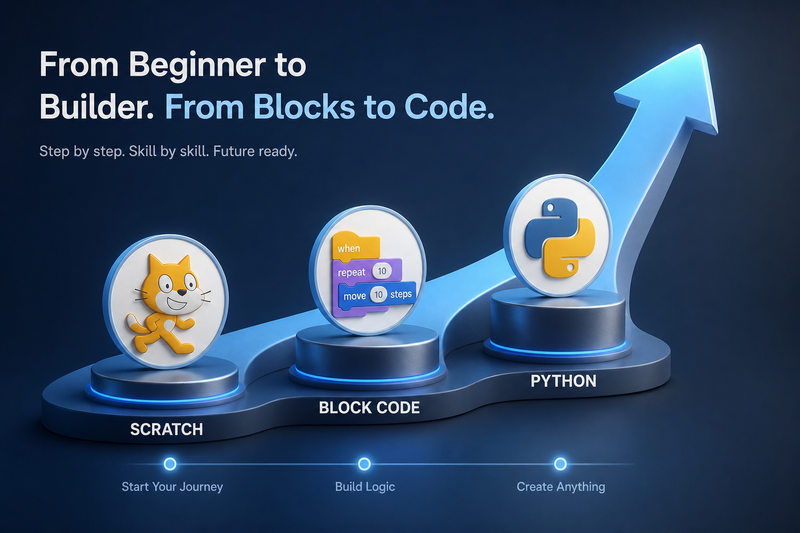
Age-based learning roadmap for kids coding classes showing progression from Scratch at ages 6 to 8 to Python, JavaScript, and AI tools for older students
Not all online coding classes for kids are built equally for every developmental stage. Matching the language and complexity to your child's age is essential for engagement and retention. Use this table as your quick-reference guide when comparing platforms.
To go deeper on age-specific recommendations, our detailed resource on how to choose the right coding course for your child walks you through every stage with practical examples.
Types of Online Coding Classes for Kids
Online coding classes for kids generally fall into three delivery formats, each with distinct advantages depending on your child's personality and pace.
Self-paced platforms offer flexibility but typically lack live interaction. They work well as supplements, not as primary learning environments. Without a qualified human instructor providing real-time feedback, children often stall when they hit conceptual roadblocks.
Group live classes provide peer interaction and healthy collaborative energy. They are cost-effective and can motivate children through shared projects. However, groups above six students often mean individual questions go unanswered, and quieter children can disengage without personalised encouragement.
Live 1:1 mentorship is widely regarded as the gold standard for online coding classes for kids. The instructor can adapt explanations in real time, identify specific gaps, and pace lessons to exactly match the child's progress. This is particularly valuable when introducing complex concepts like Python for kids or advanced app development classes for kids, areas where confusion compounds quickly without immediate correction.
The debate between formats is well worth exploring in depth. Our article on 1:1 vs group coding classes for kids lays out the evidence clearly so you can make an informed decision.
Integrating Coding and Math: The STEM Edge
One of the most underappreciated factors when selecting online coding classes for kids is the relationship between programming and mathematics. Coding is, at its core, applied mathematics, and children who receive strong math foundations consistently progress faster through coding curricula.
Online math programs for kids that run alongside coding instruction create a powerful feedback loop. Mathematical concepts like variables, functions, and conditional logic map directly onto programming constructs. When a child is comfortable with mathematical reasoning, grasping Python for kids becomes significantly more intuitive.
This is also where vedic math classes offer a surprising and underutilised advantage. Vedic math classes train children to perform rapid mental calculations using structured, pattern-based methods. This kind of structured cognitive training builds exactly the same mental agility needed to write efficient algorithms, optimise code logic, and debug systematically. Platforms that incorporate vedic math classes alongside coding instruction give children a measurable cognitive edge.
Similarly, math tutoring for kids, whether focused on school curriculum reinforcement or advanced problem-solving, develops the analytical patience that separates competent programmers from outstanding ones. A platform that provides quality math tutoring for kids alongside its coding track is investing in the whole learner, not just a single skill set. For a detailed look at how these two disciplines amplify each other, read our piece on coding and math for kids.
Red Flags to Avoid When Choosing Online Coding Classes for Kids
Not every platform deserves your investment. When evaluating online coding classes for kids, walk away immediately if you encounter:
Video-only content with no live instruction: Pre-recorded lessons have their place, but they cannot replace a qualified instructor who adapts to your child's pace and questions in real time.
Vague or generic curricula: If a platform cannot clearly articulate what your child will build, create, or achieve in each module, that is a serious gap.
Unqualified instructors: Coding for kids demands instructors who understand both pedagogy and programming. One without the other leads to either technically inaccurate teaching or content too abstract for young learners.
No parental communication or progress updates: Responsible platforms keep parents informed. Silence between enrolment and invoice is not acceptable.
Oversized group classes: Once a class exceeds six to eight students, individual attention drops sharply. For complex topics like Python for kids or app development classes for kids, this translates directly to weaker learning outcomes.
Why Codeyoung Is a Trusted Choice in Online Coding Classes for Kids
Codeyoung has been designed from the ground up to address every criterion outlined in this guide. The curriculum spans every developmental stage, from Scratch programming for kids as young as six, through to advanced Python for kids, JavaScript, and real-world app development classes for kids that result in portfolio-worthy projects.
What distinguishes Codeyoung from generic platforms is its commitment to holistic STEM education. The program integrates online math programs for kids and vedic math classes directly into the learning pathway, ensuring that students develop the mathematical rigour that makes coding instruction stick. The math tutoring for kids component reinforces logical reasoning, giving children the cognitive scaffolding they need to tackle increasingly complex programming challenges.
All instructors are certified, experienced, and work with low student-to-teacher ratios, making quality math tutoring for kids and personalised coding guidance genuinely achievable, not just a marketing claim. Every student builds real projects through structured app development classes for kids, walking away with a portfolio that demonstrates their skills concretely. If you are serious about finding high-quality online coding classes for kids that deliver measurable outcomes, Codeyoung warrants serious consideration.
Conclusion
Choosing the right online coding classes for kids in 2026 comes down to three non-negotiable factors: curriculum quality matched to your child's age, instructor credibility supported by small class sizes, and genuine STEM integration that connects coding for kids with strong mathematical foundations.
The market is large and growing, but so is the variation in quality. Use the evaluation checklist, age-group table, and red flag criteria in this guide to compare platforms with confidence. Whether your child is just discovering Scratch programming for kids or is ready to advance into Python for kids and app development classes for kids, the right program exists. Your task is simply to find the one that earns it.
Frequently Asked Questions
What age should my child start online coding classes for kids?
Children as young as 6 can begin online coding classes for kids through visual, block-based environments like Scratch programming for kids. Starting early builds logical thinking habits that compound significantly over time, making later transitions to Python for kids and app development classes for kids far smoother.
Which coding language is best for beginners: Scratch programming for kids or Python for kids?
For children aged 6–10, Scratch programming for kids is the ideal starting point. Its drag-and-drop visual interface removes syntax barriers and focuses on logic and creativity. Python for kids becomes appropriate from around age 10–11, once foundational programming concepts are understood. Many strong online coding classes for kids use both in a structured, progressive sequence.
Are online coding classes for kids as effective as in-person classes?
Yes, provided the online coding classes for kids feature live instruction, qualified teachers, and low class sizes. Research consistently shows that live online learning with real-time feedback matches or exceeds in-person outcomes for structured subjects like coding for kids and math tutoring for kids.
How do app development classes for kids complement coding learning?
App development classes for kids translate abstract coding concepts into tangible, motivating outcomes. When children build real apps or games, they apply Python for kids syntax, logical problem-solving, and design thinking simultaneously. Project-based app development classes for kids also produce portfolio evidence of skill, something that matters greatly as children advance academically and professionally.
How important is math tutoring for kids alongside coding?
Extremely important. Math tutoring for kids directly strengthens the logical and algebraic thinking that underpins all coding for kids curricula. Children receiving structured math tutoring for kids alongside online coding classes for kids typically progress faster, make fewer syntax errors, and demonstrate stronger algorithmic reasoning.
What makes vedic math classes beneficial for coding skills?
Vedic math classes train children to recognise patterns, compute mentally using structured rules, and approach problems from multiple angles. These are precisely the cognitive skills that produce cleaner, more efficient code. Platforms offering vedic math classes alongside online coding classes for kids are investing in the deeper cognitive development that makes truly capable young programmers.
How often should kids attend online coding classes for kids?
Most experts recommend two to three sessions of online coding classes for kids per week for consistent progress without burnout. This frequency allows children to practice between sessions, reinforcing coding for kids concepts and building genuine fluency rather than surface familiarity.
Can online math programs for kids improve coding outcomes?
Absolutely. Online math programs for kids that focus on logical reasoning, pattern recognition, and structured problem-solving directly support coding skill development. Children enrolled in quality online math programs for kids alongside their coding track consistently demonstrate stronger performance in Python for kids, algorithmic challenges, and app development classes for kids.
What's the difference between 1:1 vs group coding classes for kids?
In 1:1 online coding classes for kids, the instructor tailors every explanation, exercise, and pacing decision to one child. This is particularly valuable for complex subjects like Python for kids or advanced app development classes for kids. Group coding classes for kids foster peer learning and collaboration but require small class sizes, ideally under eight students, to maintain meaningful personalisation. The right choice depends on your child's learning style and the complexity of the content.
How can I monitor my child's progress in online coding classes for kids?
Choose platforms that provide structured progress dashboards, regular mentor check-ins, and parent communication updates. Quality online coding classes for kids should offer visibility into completed projects, skill milestones reached, and areas for improvement, not just attendance records. App development classes for kids that produce finished projects give parents the most direct evidence of real progress.
Comments
Your comment has been submitted