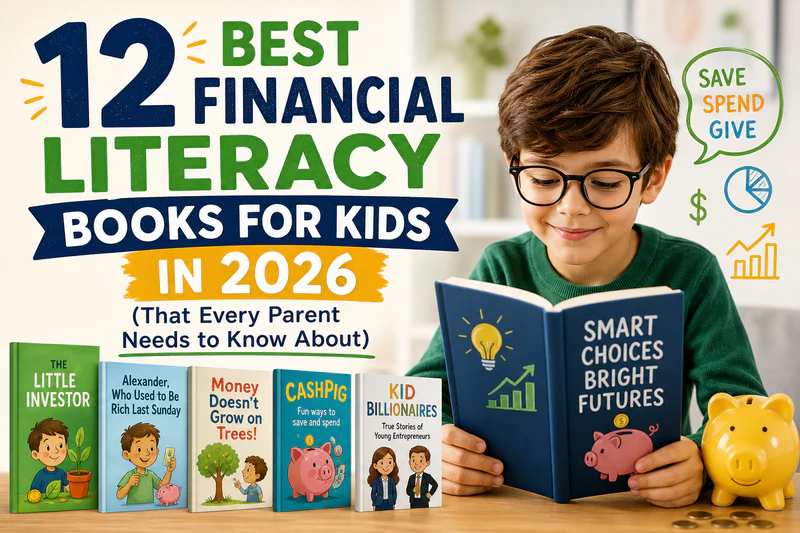
Research from Cambridge University confirms that children's money habits are largely set by age seven. Yet according to a 2025 NASBE assessment, only 49% of U.S. adults demonstrate adequate financial literacy, and Gen Z scores the lowest of any generation, correctly answering just 38% of personal finance questions. The pattern is clear: waiting until adulthood to teach money skills is too late.
The solution starts with the right financial literacy books for kids, paired with the mathematical and digital foundations that turn book knowledge into real-world capability.
Why Financial Literacy Books for Kids Need to Be Paired with Math and Coding Skills
Reading about money is an excellent starting point. But without strong numerical reasoning and digital literacy, children absorb concepts they cannot apply. In 2026's cashless, algorithm-driven economy, financial competence demands more than understanding what a piggy bank is.
The math-money connection is non-negotiable. Budgeting requires arithmetic. Compound interest requires understanding percentages and exponents. Comparing prices, calculating discounts, and evaluating savings rates all rely on numerical fluency. When children struggle with these calculations, the lessons from even the best financial literacy books for kids remain abstract. This is precisely where online math programs for kids become essential, structured, progressive math practice ensures that the numbers behind money concepts click into place.
For children who need more personalised support, math tutoring for kids can directly address gaps in understanding compound interest, percentages, and basic budgeting arithmetic. A child who has read about saving 20% of their allowance but cannot calculate 20% of £5 needs targeted numerical help, not more reading.
Speed matters too. Vedic math classes train children in rapid mental arithmetic, which is surprisingly powerful in everyday financial contexts. Whether a child is comparing prices at a market stall, estimating change, or mentally calculating a discount, the fast calculation skills developed through vedic math classes translate directly to sharper money decision-making in the moment.
The coding connection is equally compelling. Coding for kids develops the logical, goal-oriented, sequential thinking that underpins financial planning. Building a budget is structurally similar to writing an algorithm: define your inputs (income), apply rules (spending limits), and output a result (savings). Online coding classes for kids reinforce this systematic thinking in ways that complement every money lesson in these books.
There are wonderfully hands-on applications too. After reading a book about running a lemonade stand, a child who has explored Scratch programming for kids can actually build a digital lemonade-stand simulation, pricing inventory, tracking revenue, and calculating profit. Scratch programming for kids makes abstract entrepreneurship concepts tangible and fun. For older children, Python for kids opens doors to real financial analysis: fetching stock market data, building simple interest calculators, or automating a savings tracker. Advanced finance and data-driven investing increasingly rely on programming, and Python for kids is the ideal entry point.
The most forward-thinking application? App development classes for kids give financially literate children the tools to build their own budgeting apps, allowance trackers, or spending dashboards. A child who understands compound interest AND can build an app to visualise it is genuinely prepared for financial independence. For a deeper look, explore this guide on app development for kids and what children can realistically create.
To understand how these skills build on each other, the maths for kids complete guide is an excellent companion resource for parents.
Summary Table: Top 12 Financial Literacy Books for Kids (2026)

Illustrated comparison chart of 12 financial literacy books for kids by age group and core money lesson.
Detailed Reviews: The 12 Best Financial Literacy Books for Kids
1. One Cent, Two Cent, Old Cent, New Cent, Dr. Seuss & Jan Berenstain
Ages: 3–5 | Core Lesson: What money is
This rhyming introduction uses the beloved Seuss format to explain coins, currency, and the basic concept of exchange. It is the ideal first financial literacy book for kids who are just beginning to notice money in everyday life. Parents can reinforce the lesson by letting toddlers sort coins and identify denominations, a simple activity that also supports early numeracy.
2. Bunny Money, Rosemary Wells
Ages: 4–7 | Core Lesson: Making spending choices
Ruby and Max's shopping trip goes delightfully wrong, illustrating how quickly money runs out when you spend without a plan. The story is warm, funny, and immediately relatable. After reading, give children a small budget for a real shopping errand and watch the concept land with memorable force. This is one of the most effective financial literacy books for kids at this age range precisely because it teaches through consequence, not lecture.
3. The Berenstain Bears' Trouble with Money, Stan & Jan Berenstain
Ages: 5–8 | Core Lesson: Earning, saving, and impulse control
Brother and Sister Bear discover that money requires effort to earn and discipline to keep. The book gently introduces concepts of chores-for-pay, saving jars, and the temptation of impulse spending. It pairs beautifully with real-life allowance systems. Parents looking to improve their child's math skills at home will find the savings jar concept in this book is a natural bridge to practical arithmetic.
4. Alexander, Who Used to Be Rich Last Sunday, Judith Viorst
Ages: 5–9 | Core Lesson: Small purchases add up
Alexander starts the week with a dollar from his grandparents and ends it with nothing, spending in tiny increments that felt harmless at the time. This book is a masterclass in teaching opportunity cost and cumulative spending to young readers. After reading, parents can use vedic math classes techniques to help children mentally add up small expenses and see how they compound over a week.
5. Money Ninja, Mary Nhin
Ages: 6–10 | Core Lesson: Saving goals and delayed gratification
Part of the Ninja Life Hacks series, this book uses a growth mindset framework to teach children about setting savings goals and resisting immediate temptation. The narrative is punchy and visually engaging, making it one of the most accessible financial literacy books for kids in this age bracket. A natural extension: help children use a simple spreadsheet, introduced through online math programs for kids, to track their progress toward a savings goal.
6. The Everything Kids' Money Book, Brette Sember
Ages: 8–12 | Core Lesson: Budgeting, banking, and earning
This practical reference-style book covers an impressive range of topics: how banks work, what interest means, how to earn money, and how to create a basic budget. It reads less like a story and more like a user manual for money, which makes it invaluable for curious pre-teens. Math tutoring for kids can help cement the interest and percentage calculations introduced here, turning conceptual knowledge into computational confidence.
7. The Lemonade War, Jacqueline Davies
Ages: 8–12 | Core Lesson: Entrepreneurship and profit
Siblings Evan and Jessie compete to earn the most money before school starts, learning about pricing strategy, marketing, and customer service along the way. It is one of the best financial literacy books for kids who have entrepreneurial instincts. After reading, encourage children to design their own lemonade-stand simulation using Scratch programming for kids, coding the pricing logic, inventory management, and profit tracking as an interactive game.
8. Finance 101 for Kids, Walter Andal
Ages: 9–13 | Core Lesson: Income, budgeting, taxes, and banking
Written by a finance professional specifically for young readers, this book provides one of the most comprehensive introductions to real-world money mechanics available in children's literature. It covers income, expenses, taxes, credit, and even basic investing. The breadth makes it an ideal companion to math tutoring for kids, where a tutor can walk through the calculations behind each concept chapter by chapter.
9. Grandpa's Fortune Fables, Will Rainey
Ages: 9–14 | Core Lesson: Investing and long-term wealth building
Told through a series of fables narrated by a wise grandfather, this book demystifies investing in a way children genuinely enjoy. The stories cover compound interest, diversification, and the power of time in wealth creation. It is one of the most forward-thinking financial literacy books for kids because it explicitly connects patience and planning, the same skills that coding for kids develops through project-based learning.
10. How to Turn $100 into $1,000,000, James McKenna & Jeannine Glista
Ages: 10–15 | Core Lesson: Goal-setting and early investing
Practical, direct, and genuinely motivating, this book gives children a step-by-step framework for building wealth from small beginnings. It covers budgeting, saving, entrepreneurship, and investment in accessible language. Online coding classes for kids complement this book beautifully, the same methodical, milestone-based thinking that drives coding projects maps perfectly onto the goal-setting framework the book teaches.
11. The Young Investor, Katherine R. Bateman
Ages: 11–15 | Core Lesson: Stocks, bonds, and compound interest
One of the most financially rigorous books on this list, The Young Investor explains the mechanics of the stock market, different asset classes, and the mathematics of compound growth. This is where Python for kids becomes genuinely relevant: children who have worked through this book can use Python for kids to write simple scripts that model compound interest growth, fetch real stock data via APIs, and visualise investment scenarios. The connection between financial literacy and programming has never been more tangible.
12. Rich Dad Poor Dad for Teens, Robert T. Kiyosaki
Ages: 13–17 | Core Lesson: Assets, liabilities, and financial mindset
Adapted from the international bestseller, this teen edition introduces the foundational concept that wealthy people acquire assets while others accumulate liabilities. It shifts how teenagers think about earning, spending, and building long-term wealth. This book pairs naturally with app development classes for kids, a financially literate teen who understands asset-building can apply that mindset directly to creating a budgeting app or a personal finance tool, turning conceptual knowledge into a tangible digital product.
How to Use Financial Literacy Books for Kids at Home: Practical Activity Ideas

Reading is the starting point, not the finish line. Here is how to translate each book's lessons into lasting skills.
Set up a three-jar savings system. After reading any of the savings-focused titles (Money Ninja, Bunny Money, Berenstain Bears), give children three physical jars labelled "Spend," "Save," and "Give." Allocate their allowance across all three and revisit the allocation weekly. This simple structure turns abstract concepts into visible, tangible progress.
Apply vedic math classes techniques during real shopping trips. Before visiting a shop or browsing online, challenge your child to mentally calculate totals, compare unit prices, or estimate change. The rapid mental arithmetic skills built through vedic math classes make these exercises quick and confidence-building rather than frustrating.
Where children encounter genuine difficulty with the maths behind financial concepts, calculating percentage discounts, understanding interest rates, working through budget scenarios, integrating online math programs for kids provides structured practice that builds genuine numerical fluency. This is particularly valuable after reading books like Finance 101 for Kids or The Young Investor, which introduce moderately complex calculations.
Encourage coding projects that reinforce money lessons. After finishing The Lemonade War, a child who has explored Scratch programming for kids can build a digital version of the lemonade stand from the story. After reading How to Turn $100 into $1,000,000, a child with Python for kids experience can model the compound interest scenarios from the book in code. These projects deepen comprehension and add a practical STEM dimension to every money lesson.
Financially literate children with app development classes for kids experience can take this further, designing and building their own allowance trackers, savings goal apps, or spending dashboards. The coding and math for kids combination creates a genuine STEM edge, transforming children from passive consumers of financial information into active builders of financial tools.
Bridging Financial Literacy to STEM: Why Coding and Math Matter in 2026 Finance

In 2026, financial competence and digital competence are inseparable. Cashless payments, algorithmic trading, robo-advisors, and AI-driven budgeting tools are the infrastructure of modern money management. A child who understands money but cannot navigate digital financial tools will be at a significant disadvantage.
The STEM careers for kids landscape reflects this reality directly. Financial analysts, data scientists, fintech developers, and quantitative traders all require a fusion of numerical literacy and programming skill. The financial literacy books for kids on this list plant the conceptual seeds; STEM education ensures those seeds grow into real capability.
Codeyoung's online coding classes for kids are specifically designed to build the logical, problem-solving mindset that financial planning demands, from structured goal-setting to systematic analysis of trade-offs. Paired with targeted math tutoring for kids, this creates a holistic after-school education that prepares children not just to understand money, but to command it.
The synergy between these disciplines is explored in detail in this guide on coding and math for kids, required reading for any parent building a serious learning plan for 2026 and beyond.
Conclusion
The 12 financial literacy books for kids in this guide cover every developmental stage, from a three-year-old discovering what a coin is to a seventeen-year-old learning to differentiate assets from liabilities. Each book is a powerful starting point, but only a starting point.
True financial independence in 2026 requires children to read, calculate, and build. Pair these financial literacy books for kids with Codeyoung's online math programs for kids to sharpen the numerical foundations, and explore online coding classes for kids to develop the logical thinking and digital skills that modern financial competence demands. Start early, stay consistent, and give your child every advantage the intersection of literacy, mathematics, and technology can offer.Frequently Asked Questions
At what age should kids start reading financial literacy books for kids?
Start as early as age three. Research from the University of Cambridge confirms that money habits begin forming before age seven, making early exposure critical. Simple picture books like Bunny Money or One Cent, Two Cent introduce foundational concepts, exchange, choice, and value, in age-appropriate formats. By age seven, children can engage with more structured financial literacy books for kids that introduce saving, earning, and budgeting.
How do online math programs for kids complement financial literacy books for kids?
Financial literacy books for kids teach the concepts; online math programs for kids build the numerical skills needed to apply them. Understanding compound interest requires working knowledge of percentages and exponents. Creating a budget requires addition and subtraction fluency. Online math programs for kids provide structured, progressive practice that directly supports the calculations children encounter in money-focused books, ensuring the lessons stick beyond the story.
Can math tutoring for kids help if my child struggles with financial math concepts?
Absolutely. Many children grasp the narrative of a financial literacy book, the idea that saving is good, or that spending adds up, but struggle when they try to calculate the actual numbers. Math tutoring for kids provides personalised support for the specific calculations that cause difficulty: working out 15% interest, dividing a budget across categories, or comparing the long-term outcomes of different savings rates. Targeted math tutoring for kids turns comprehension into genuine computational ability.
How do vedic math classes help kids make smarter money decisions?
Vedic math classes train children to perform complex arithmetic quickly and mentally, without a calculator. In everyday financial situations, comparing prices in a shop, calculating a tip, estimating whether a discount is genuinely good value, this speed is a real advantage. Children who have trained through vedic math classes develop the numerical confidence to make faster, more accurate money decisions in real time, reinforcing every lesson from their financial literacy books for kids.
Why is coding for kids important alongside financial literacy books for kids?
Financial planning and coding both require the same core thinking skills: breaking a problem into smaller parts, defining rules and conditions, testing assumptions, and iterating toward a goal. Coding for kids systematically develops this logical, goal-oriented mindset. A child who builds projects through online coding classes for kids learns to think in systems, precisely the kind of thinking needed to create and stick to a financial plan, manage a budget, or evaluate an investment.
How can Scratch programming for kids be used to reinforce money lessons?
Scratch programming for kids provides an ideal platform for turning financial literacy concepts into interactive projects. After reading The Lemonade War, children can code a lemonade-stand business simulation, programming prices, tracking inventory, and calculating daily profit. After reading Money Ninja, they can build a savings goal tracker with a visual progress bar. Scratch programming for kids makes abstract financial literacy books for kids lessons concrete, creative, and genuinely memorable.
What is the role of Python for kids in learning about investing and the stock market?
As children progress to more advanced financial literacy books for kids like The Young Investor, Python for kids becomes a powerful companion tool. Python for kids enables children to write scripts that model compound interest over time, fetch live stock market data through APIs, or simulate investment portfolio performance. The advanced finance industry runs heavily on Python, introducing Python for kids early gives financially literate children a direct pathway toward data analysis, quantitative finance, and financial technology careers.
How do app development classes for kids support financial independence?
App development classes for kids give children the technical skills to build the financial tools they read about. A child who understands budgeting from their financial literacy books for kids, and who has completed app development classes for kids, can design and build a working allowance tracker, a savings goal app, or a personal spending dashboard. This transforms financial literacy from a passive concept into an active, self-directed practice, the most powerful form of financial independence there is.
Where can I find trusted online math programs for kids and online coding classes for kids?
Codeyoung offers structured, expert-led online coding classes for kids covering everything from beginner Scratch programming for kids through to Python for kids and app development classes for kids. Their online math programs for kids provide progressive, personalised instruction that directly supports the numerical skills underlying every financial concept children encounter in their reading. Both programmes are designed to complement each other and can run alongside any of the financial literacy books for kids on this list.
Are financial literacy books for kids still relevant in a mainly digital and cashless economy?
More relevant than ever, but they must be paired with digital skills. In 2026's cashless economy, children rarely handle physical currency, which makes conceptual financial education through books even more important. However, the application of that knowledge now happens through digital interfaces: contactless payments, online banking, investment apps, and budgeting platforms. Financial literacy books for kids provide the conceptual framework; coding for kids and online math programs for kids ensure children can navigate, evaluate, and even build the digital financial tools that define modern money management.