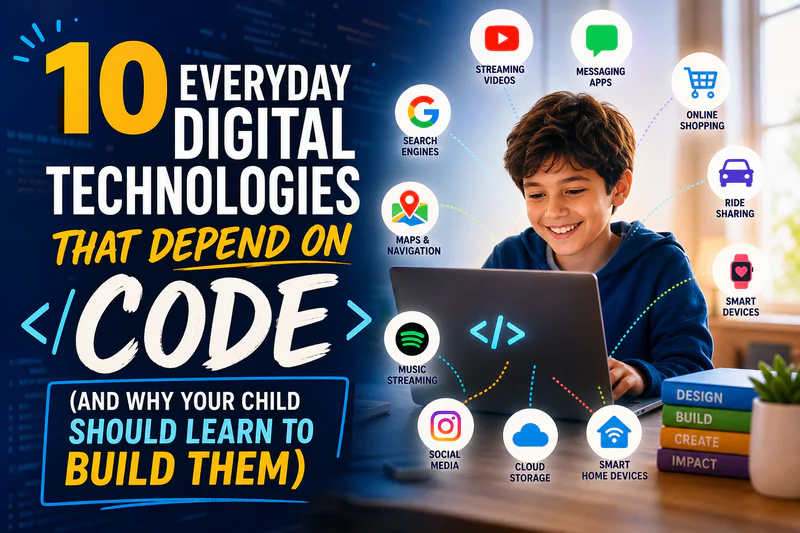
Your child woke up this morning, checked their tablet, streamed a show, and asked a smart assistant what the weather was like, all before breakfast. Behind every single one of those moments sits millions of lines of code. The question is: will your child grow up to consume that technology, or create it?
This guide breaks down the 10 most common digital technologies kids interact with every day, reveals the code that powers them, and shows exactly how coding for kids transforms passive tech users into future builders and innovators in 2026.
What Are Digital Technologies, And Why Does Code Power All of Them?
Digital technologies are any tools or systems that process, store, or transmit information electronically. That covers everything from the websites your child visits to the GPS guiding your family road trip. What ties all of them together? Code.
At its core, code is a set of instructions written in a programming language that tells a device what to do. Without it, your smartphone is an expensive paperweight. Streaming services, social media, GPS, email, none of it functions without developers writing precise logical instructions behind the scenes. According to the Bureau of Labor Statistics, computer and IT occupations are projected to grow 11.7%, significantly faster than average, making the ability to code one of the most future-proof skills a child can develop today.
The earlier a child understands this, the sooner they stop seeing technology as magic and start seeing it as something they can build themselves. That shift in perspective, from consumer to creator, is exactly what coding for kids delivers.
The 10 Everyday Digital Technologies That Depend on Code

Here is a clear breakdown of the 10 digital technologies your child uses most, the code powering each one, and the best languages to learn them:
Every single technology in that table was built by someone who once learned to code. The good news? Your child can too.
How to Turn Your Child from Tech Consumer to Tech Creator in 2026
The 2025 Common Sense Census found that 81% of children under 13 now have their own device. Teens spend an average of over 7 hours daily in front of screens. That's a massive amount of time interacting with code that almost no child understands. Coding for kids flips that equation entirely.
Start with the Foundations: Scratch and Python

For younger children (ages 6–12), Scratch programming for kids is the ideal entry point. Scratch uses visual, drag-and-drop blocks that teach the same logical thinking behind game console programming, loops, conditionals, event triggers, without requiring a child to memorize complex syntax. When a child builds a game in Scratch, they're using the same foundational logic that powers AAA video games and interactive apps. That's not a small thing.
For older children and pre-teens ready to move beyond visual coding, Python for kids is the natural next step. Python is the language powering streaming recommendation engines, GPS algorithms, voice AI, and the majority of today's machine learning systems. It's beginner-friendly, reads almost like plain English, and is used by professional developers at Google, Netflix, and NASA. Starting your child on Python early gives them direct access to the languages running the technologies they use every single day.
Build Real-World Skills Through App Development
When kids understand how their tablet or smartphone works, that every app was deliberately built by a developer, they start asking a transformative question: "Could I build that?" The answer is yes. App development for kids is no longer a niche pursuit. Structured app development classes for kids teach children to design user interfaces, write backend logic, and deploy functional applications, skills that directly map to the smartphone and tablet ecosystem they already navigate fluently.
Enrolling your child in online coding classes for kids provides structured, curriculum-based app development classes for kids that go far beyond YouTube tutorials. The guided environment ensures kids build progressively, retain concepts, and stay motivated with real project milestones.
Don't Overlook Math, It's the Engine Behind the Code

Coding and mathematics are inseparable. The GPS route-finding algorithms in your navigation app use geometry and graph theory. Streaming service recommendation engines use statistics and linear algebra. The logical structure of any Python for kids program depends on the same computational thinking built through strong math education.
This is where online math programs for kids play a critical supporting role. Strong numeracy gives children the problem-solving instinct that makes coding click faster. For children looking for an additional edge, vedic math classes offer a fascinating parallel: the rapid mental calculation techniques at the heart of vedic math mirror the way computers process data at high speed, breaking complex problems into elegant, systematic shortcuts. Just as vedic math classes train the brain to find efficient pathways through numbers, coding for kids trains young minds to construct efficient logical pathways through problems.
Math tutoring for kids that emphasizes logical reasoning, pattern recognition, and sequential thinking directly accelerates coding comprehension. The two disciplines reinforce each other, which is why the most forward-thinking STEM curricula in 2026 treat coding and math for kids as a unified skillset rather than separate subjects.
Look Beyond the Classroom, Think Careers
The technologies your child uses today, social media, smartphones, AI assistants, are the industries they'll work in tomorrow. Coding for kids doesn't just teach a programming language; it opens a direct path to STEM careers for kids in software engineering, AI development, cybersecurity, data science, and product design. These roles exist because someone wrote the code behind the 10 technologies in the table above, and they'll continue to be among the highest-demand, highest-paying careers in the global economy.
The coding benefits for kids extend well beyond career readiness. Children who learn to code develop stronger problem-solving skills, better logical reasoning, improved persistence, and a measurable boost in mathematical ability, transferable advantages that benefit them in every academic subject.
Conclusion
Every technology your child interacts with, from the GPS guiding your car to the AI assistant answering their questions, is powered by code written by people who learned exactly what your child can learn today. The 10 technologies in this guide are not abstract concepts; they are the daily reality of modern life, and they are all built on a foundation of coding for kids that is now more accessible than ever.
In 2026, the most powerful gift you can give your child is not another device to consume, it's the skills to build one. Explore online coding classes for kids and structured Python for kids programs at CodeYoung, and take the first step toward turning your child from a tech consumer into a tech creator.
Frequently Asked Questions
How does coding for kids unlock understanding of everyday technology?
Coding for kids teaches children the logical instructions, the "language", that every digital device follows. When a child learns to write code, they understand why their smartphone responds to a tap, why a streaming service buffers, or why GPS recalculates a route. Instead of experiencing technology as a black box, they see it as a system they can understand, modify, and eventually build themselves.
What are the best online coding classes for kids to start with?
The best online coding classes for kids begin with visual, block-based environments like Scratch programming for kids for younger learners, then progress to text-based languages like Python for kids as they advance. Structured online coding classes for kids, like those offered by CodeYoung, provide curriculum-designed learning paths, live instruction, and project-based milestones that keep children engaged and progressing systematically.
Why is Python for kids important for future tech skills?
Python for kids is arguably the single most important coding language a child can learn in 2026. Python powers AI, machine learning, data science, web development, GPS algorithms, and streaming service recommendation engines. It's the language behind some of the world's most-used technologies. The Python for kids complete guide shows how even beginners can start building real, functional Python projects quickly, making it the ideal first text-based language for children ready to move beyond Scratch.
How do app development classes for kids connect to smartphones and tablets?
Every app on your child's tablet or smartphone was created by developers using specific coding frameworks and logic structures. App development classes for kids teach exactly those frameworks, how to design an interface, write the functional code behind it, test it, and deploy it. These classes make smartphones and tablets tangible: instead of a mystery, a child sees them as platforms they are fully capable of building for.
What is Scratch programming for kids and why is it foundational?
Scratch programming for kids is a visual, block-based coding environment developed by MIT. It teaches core programming concepts, loops, conditionals, variables, and events, using drag-and-drop blocks rather than typed syntax. This makes coding for kids accessible from as young as age 6. The logical thinking Scratch programming for kids develops is identical to the thinking behind professional game development, making it the ideal first step before transitioning to Python for kids or other text-based languages.
How do online math programs for kids support coding skills?
Online math programs for kids build the foundational skills, logical sequencing, pattern recognition, algebraic thinking, and problem decomposition, that directly accelerate coding comprehension. GPS algorithms, for example, rely on graph theory and geometry. Python for kids programs use variables and functions rooted in algebraic logic. Children enrolled in strong online math programs for kids consistently find coding concepts easier to grasp because the underlying thought processes are already familiar.
Can vedic math classes improve my child's coding speed and logic?
Yes. Vedic math classes train students to solve complex numerical problems through elegant mental shortcuts, a cognitive approach that directly parallels how efficient code is written. Just as coding for kids teaches children to solve a problem with the fewest, most logical steps, vedic math classes train the brain to find the most direct mathematical pathway. Children who practice vedic math classes tend to develop sharper computational intuition, which translates into faster debugging and cleaner logical structures when they code.
How does coding and math tutoring for kids prepare them for STEM careers?
Coding and math tutoring for kids builds the comprehensive STEM foundation required for virtually every high-demand career in 2026 and beyond. AI engineers, data scientists, software developers, cybersecurity analysts, and robotics engineers all rely on a combination of strong coding skills and rigorous mathematical reasoning. Math tutoring for kids that emphasizes problem-solving, combined with coding for kids that teaches applied logic, creates the exact profile that top universities and future employers will be looking for.
What coding languages should kids learn first?
The recommended learning path for most children is: Scratch (ages 6–10) → Python (ages 10+) → JavaScript or Swift/Kotlin (for web or app development). Scratch programming for kids builds the conceptual foundation. Python for kids opens the door to AI, data, and backend development. App development classes for kids then teach platform-specific languages that let children build and ship real applications. Online coding classes for kids typically guide children along exactly this progression.
How do coding programs help kids build problem-solving skills?
Coding is, at its core, structured problem-solving. Every program a child writes requires them to break a large challenge into smaller steps, test their logic, identify errors, and iterate. This process, often called computational thinking, is the same mental framework used by engineers, scientists, and entrepreneurs. Coding for kids, especially when paired with online math programs for kids and math tutoring for kids, builds a problem-solving instinct that extends far beyond the screen.