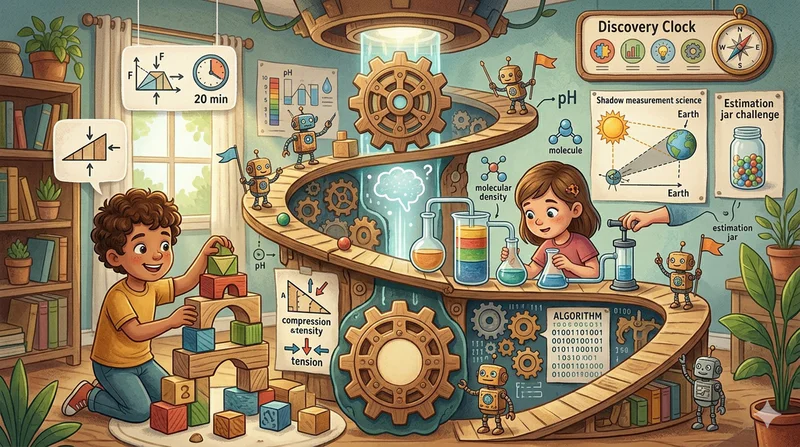
STEM Activities for Kids at Home: 10 Ideas That Take Under 30 Minutes
Most STEM activity guides for parents involve equipment you don't have, preparation that takes longer than the activity, or demonstrations the child watches rather than experiments they run. This guide does none of that.
The 10 STEM activities for kids at home below require common household items, take under 30 minutes each, and produce genuine scientific and mathematical thinking rather than the appearance of it. Each one is chosen not for spectacle but for the specific cognitive habit it develops, and each connects directly to the kind of thinking children need in school STEM subjects, coding education, and eventually STEM careers.
Key Takeaways
The most effective home STEM activities are those that require the child to predict, test, observe, and explain: not just watch a demonstration.
STEM thinking (systematic observation, data recording, pattern recognition, hypothesis testing) develops through repeated low-stakes activities far more effectively than through occasional elaborate projects.
Activities that connect to the child's existing interests produce more engagement and deeper thinking than generic "educational" experiments.
Every activity below develops thinking habits that transfer directly into school science, maths, and coding, they're not just entertainment.
The parent's role is to ask questions, not provide answers: "What do you think will happen?" and "Why do you think that happened?" produce more learning than any explanation.
What Makes a Home STEM Activity Actually Educational?
The difference between a STEM activity and a STEM demonstration is who is doing the thinking. In a demonstration, the parent or a video shows what happens and the child watches. In an activity, the child predicts what will happen, does the experiment, observes the result, and tries to explain the difference between what they expected and what they saw.
That predict-test-observe-explain cycle is the scientific method in its simplest form. It is also the debugging cycle in coding: predict what your code will do, run it, observe what actually happens, explain the discrepancy, and adjust. Children who practise this thinking pattern through home STEM activities arrive at coding and school science with an intuitive grasp of systematic investigation that makes both easier.
Before any activity in this guide: ask the child "what do you think will happen?" Get them to commit to a prediction. After: ask "was that what you expected? Why do you think it happened that way?" The activity is the vehicle. The questioning is where the learning lives.
10 STEM Activities for Kids at Home, No Specialist Equipment Required
Activity 1: Paper Bridge Engineering (Ages 6+, Engineering, 20 minutes)
What you need: 10 sheets of A4 paper, a small pile of coins or small objects as weights, two stacks of books as supports.
The challenge: Build a bridge across a 20cm gap using only paper that can hold as many coins as possible without collapsing. No tape, no glue, no folding rule, just paper shaped and arranged to carry weight.
What it develops: Structural engineering thinking. Children discover that folded paper (accordion folds, tubes, triangles) is dramatically stronger than flat paper. The key insight: that shape affects strength, not just material, is fundamental to both engineering and programming: the same data in a different structure can be enormously more efficient.
Parent prompt: "Why do you think the folded version held more? What shape do you think would be even stronger?"
Activity 2: Kitchen Density Tower (Ages 7+, Science, 20 minutes)
What you need: A tall glass, honey, washing-up liquid, water (with food colouring), vegetable oil, a small object like a grape or a bead.
The challenge: Pour each liquid slowly into the glass in order (honey first, then washing-up liquid, then water, then oil). Each should form a distinct layer. Drop a small object in and observe where it settles.
What it develops: Understanding of density as a measurable property of matter rather than an abstract concept. Children see density visually and spatially. The layers make the relative ordering of densities immediately observable without any calculation.
Parent prompt: "Before you drop the object, where do you think it will land? What made you guess that? What does that tell you about the object's density?"
Activity 3: Pattern Prediction with Sequences (Ages 7+, Maths, 15 minutes)
What you need: Paper, a pencil, and a set of small objects (coins, blocks, pasta pieces).
The challenge: Start a sequence and ask the child to continue it. Begin with obvious ones (1, 2, 4, 8...) and progress to less obvious patterns (1, 1, 2, 3, 5, 8... or the sequence of square numbers). Then ask the child to create a sequence for you to continue.
What it develops: Pattern recognition and algebraic thinking. The child who can describe the rule behind a sequence ("each number is double the last") is developing the abstract generalisation skill that algebra formalises. In coding, this is loop and iteration thinking: what is the rule that generates the next value?
Parent prompt: "Can you describe the rule in words? Could you write a formula that generates any number in this sequence?"
Activity 4: Unplugged Sorting Algorithm Race (Ages 8+, Computer Science, 20 minutes)
What you need: 10 cards with random numbers written on them (or playing cards, use their face values).
The challenge: Ask the child to sort the cards from lowest to highest as fast as possible, but they can only compare and swap two adjacent cards at a time. Time them. Then introduce a different rule: they can pick any two cards and compare them. Time again. Discuss why one method might be faster.
What it develops: Algorithm intuition. This is an unplugged introduction to bubble sort (adjacent swaps) and selection sort (pick any two). Children who have physically experienced the difference between sorting algorithms have an intuitive understanding of computational efficiency that makes the formal concept in computer science much more accessible later.
Parent prompt: "What strategy did you use? Did it change as you went? What rule would you give a robot to sort the cards?"
Activity 5: Shadow Measurement Science (Ages 8+, Science and Maths, 25 minutes)
What you need: Sunshine, a ruler, a stick or pencil (fixed vertically with blu-tack), paper to record measurements.
The challenge: Measure the shadow of the same object every hour across a morning or afternoon. Record the length and direction each time. At the end, graph the results and describe the pattern.
What it develops: Data collection, graphing, and pattern recognition in a real scientific context. Children discover that shadows follow a predictable pattern across the day, which leads naturally to questions about why: the geometry of the sun's position. The graph they produce is their first real scientific dataset.
Parent prompt: "What time do you predict the shadow will be shortest? Why? What would the shadow look like at exactly midday?"
Activity 6: Estimation Jar (Ages 7+, Maths, 10 minutes)
What you need: A clear jar or container, small objects of one type (pasta pieces, coins, sweets), paper for recording.
The challenge: Ask the child to estimate how many objects are in the jar without counting. Then discuss their strategy, did they estimate a layer and multiply? Count a section? Compare to a known quantity? Count the actual total and see who was closest.
What it develops: Number sense and estimation, one of the most consistently undervalued maths skills. A child who develops reliable estimation strategies is building the same intuition that makes mental arithmetic and maths word problems easier. For the broader context of why estimation matters, see Number Sense for Kids: What It Is and How to Build It.
Parent prompt: "How did you arrive at your estimate? What strategy would make you more accurate next time?"
Activity 7: Egg Drop Challenge (Ages 10+, Engineering, 30 minutes)
What you need: A raw egg, straws, elastic bands, cotton wool, tissue paper, sticky tape, nothing else.
The challenge: Design and build a protective container for the egg using only the provided materials. The container must survive being dropped from a height of at least 2 metres (an upstairs window or landing).
What it develops: Engineering design thinking: identify the problem (egg breaks from impact), brainstorm solutions, build a prototype, test it, and iterate. Children who engage with this challenge understand viscerally why engineering projects involve multiple design-test-improve cycles: the same iterative process that software development uses.
Parent prompt: "What forces do you need to protect against? What materials will absorb impact? What would you change in the next version?"
Activity 8: Coordinate Art (Ages 9+, Maths, 25 minutes)
What you need: Squared paper (or print a coordinate grid), a pencil, coloured pens.
The challenge: Give the child a sequence of coordinates and ask them to plot and connect them to reveal a picture. Then ask them to create their own coordinate picture and write the coordinates as instructions for a family member to reproduce.
What it develops: Coordinate geometry, spatial reasoning, and the concept of programmatic instructions (the coordinate list is essentially an algorithm for drawing). This activity directly mirrors how Scratch and Pygame position objects on screen: a child who has plotted coordinates on paper understands x and y positions in code intuitively.
Parent prompt: "If you wanted to move the whole picture 3 units to the right, what would you change in the instructions?"
Activity 9: Kitchen Chemistry (pH Testing) (Ages 10+, Science, 25 minutes)
What you need: Red cabbage (or store-bought pH indicator strips), small cups, household liquids (lemon juice, baking soda solution, vinegar, milk, water, washing-up liquid).
The challenge: Boil red cabbage to extract its juice (it changes colour with pH). Test each liquid by adding a small amount of the indicator. Record the colour and sort liquids into acid, neutral, and alkaline categories.
What it develops: Systematic scientific investigation, classification, and the concept of a continuous variable measured on a scale. The child is doing real chemistry with a real indicator, red cabbage juice is used in genuine laboratory demonstrations.
Parent prompt: "Before we test it, do you predict lemon juice is acid or alkaline? What property of lemon juice led you to that prediction?"
Activity 10: Design a Scratch or Python Mini-Project (Ages 8+, Coding, 30 minutes)
What you need: A device with a browser (for scratch.mit.edu) or Python installed.
The challenge: Give the child 30 minutes to build something connected to one of the other activities above. A Scratch programme that animates the density tower layers. A Python script that generates the first 20 numbers of a pattern sequence. A coordinate art programme that draws their design automatically.
What it develops: The connection between the physical STEM thinking done in the other activities and computational implementation. A child who builds a programme that generates Fibonacci numbers has understood the pattern from Activity 3 at a level that allows them to express it as code. This is exactly the integration between science/maths thinking and coding that produces the strongest STEM learners.
Parent prompt: "What's the rule your programme needs to know to generate the next number? How would you express that in code?"
For the next steps beyond these starter projects, see Coding Projects for Kids: 10 Ideas That Build Real Skills.
How Do These Activities Connect to School STEM Subjects?
Each activity above maps directly to school curriculum concepts, often several at once:
STEM Activities and Their School Curriculum Connections
For a broader picture of how STEM thinking develops through childhood and connects to long-term career outcomes, see STEM Careers for Kids: What Jobs Will They Be Ready For?
Want your child to develop the coding and maths foundations that make STEM thinking most powerful? Codeyoung's live 1:1 sessions build these skills systematically. Book a free trial class to see the approach.
What Is the Parent's Role in Home STEM Activities?
The most effective thing a parent can do in any home STEM activity is ask questions rather than provide explanations. The moment a parent explains why the density layers form, the child switches from active investigator to passive audience. The learning value drops sharply.
The questions that produce the most learning are the ones that activate the child's own thinking:
Before: "What do you predict will happen?" "Why do you think that?" "What would need to be true for that to happen?"
During: "What are you observing?" "Is that what you expected?" "What would happen if you changed this variable?"
After: "How would you explain what happened?" "What would you do differently if you tried it again?" "What other questions does this make you want to answer?"
A parent who consistently uses this questioning pattern rather than explaining turns every STEM activity into genuine scientific thinking practice, regardless of whether the activity itself is technically sophisticated. The questions are the pedagogy.
For how this same inquiry-based approach applies to supporting coding at home, see How to Teach Kids to Code at Home: A Parent Guide.
Frequently Asked Questions: STEM Activities for Kids at Home
What are the best STEM activities for kids at home in 2026?
The best home STEM activities are those that require children to predict, test, observe, and explain: not just watch. The 10 activities in this guide (paper bridge engineering, density tower, pattern sequences, sorting algorithm race, shadow measurement, estimation jar, egg drop challenge, coordinate art, pH testing, and coding mini-projects) are all completable in under 30 minutes with household materials, and each develops a specific cognitive habit with direct school and career relevance.
What STEM activities are good for 6 to 8-year-olds?
For children aged 6 to 8, the most accessible activities from this guide are the estimation jar (builds number sense and mental estimation), the paper bridge challenge (builds structural thinking with no technical knowledge needed), the density tower (makes scientific properties visually concrete), and the pattern sequence game (builds early algebraic thinking through number pattern recognition). All four require only household items and are completable in 15 to 25 minutes.
What STEM activities are good for teenagers at home?
For teenagers aged 13 to 17, the most appropriate activities are the egg drop challenge (engineering design process with iteration), the pH testing experiment (real chemistry with genuine laboratory technique), the sorting algorithm race (computational thinking and algorithm comparison), and the coding mini-project (builds the direct connection between scientific thinking and computational implementation). Each of these produces the kind of systematic thinking that A-Level and AP science subjects expect.
Do home STEM activities need expensive equipment?
No. Every activity in this guide uses items already present in most households: paper, coins, common kitchen liquids, and a device with internet access or Python installed. The most elaborate setup required is the density tower, which needs five liquids found in any kitchen. The value of STEM activities comes from the thinking they require, not from the equipment used. A child who has systematically tested a hypothesis with pasta and a jar is doing better science than one who uses expensive equipment without understanding the investigative process.
How often should children do home STEM activities?
The thinking habits that STEM activities develop (curiosity, systematic observation, prediction before testing, pattern recognition) benefit most from regular low-intensity exposure rather than occasional elaborate sessions. One 20 to 30-minute activity per week, maintained consistently, produces more cognitive benefit than a month of intensive STEM camp followed by nothing. The activities work best when they become a natural part of how a family engages with the world: noticing patterns, asking "what would happen if?", and treating uncertainty as an invitation to investigate rather than a reason to look something up immediately.
How do home STEM activities connect to coding education?
The cognitive overlap between STEM thinking and coding is direct. Both require systematic problem decomposition, prediction before execution, careful observation of results, and willingness to iterate when the first approach doesn't work. Children who have developed STEM thinking habits through home activities find coding concepts more intuitive because the underlying problem-solving process is the same. The sorting algorithm race is essentially a hands-on introduction to algorithmic thinking. The coordinate art connects directly to screen coordinate systems in Scratch and Pygame. For more on this connection, see Coding and Maths for Kids: How Learning Both Gives Children a STEM Edge.
How does Codeyoung support STEM development beyond coding?
Codeyoung's programmes in coding, maths, and science are each designed to develop the three foundational STEM capabilities: computational thinking, quantitative reasoning, and systematic scientific inquiry. The coding programme's project-based approach builds engineering and algorithmic thinking. The maths programme's emphasis on number sense and mental arithmetic builds quantitative reasoning. The science programme's curiosity-led inquiry builds scientific thinking. Together, they produce the kind of rounded STEM capability that home activities alone cannot build as systematically.
STEM Thinking Is Built Through Doing, Not Watching
The 10 activities in this guide are not ends in themselves. They are practice opportunities for a set of thinking habits, predict, test, observe, explain, iterate: that underlie scientific and computational competence at every level. A child who does the estimation jar activity once learns that estimation is a skill. A child who does it weekly for a year develops reliable numerical intuition. The frequency and consistency of the practice matters more than the sophistication of any individual activity.
The best home STEM environment is not one filled with expensive kits or elaborate setups. It is one where questions like "why do you think that happened?" and "what would happen if we changed this?" are normal parts of everyday family conversation, and where uncertainty is treated as interesting rather than embarrassing.
Explore Codeyoung's coding, maths, and science programmes to build the systematic STEM foundations that home activities develop and professional instruction deepens.
Build the STEM foundations that home activities develop into.
Codeyoung's live 1:1 coding, maths, and science classes for ages 6 to 17 develop the systematic thinking that home STEM activities start. Free first class, no commitment required.