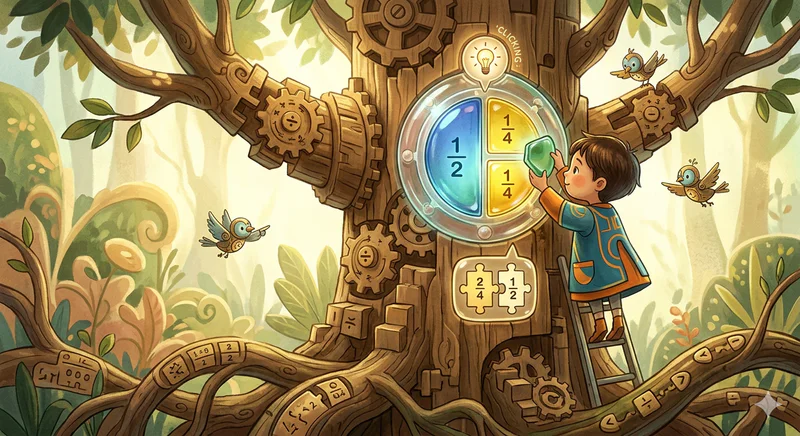
Fractions for Kids: Why They're Hard and How to Make Them Click
Fractions are the point in primary school where more children lose confidence in maths than anywhere else. Not algebra, not long division, not percentages. Fractions. And the reason is specific: fractions violate almost everything a child has been taught to believe about numbers up to that point.
Up to age 7 or 8, numbers behave predictably. Bigger digits mean bigger numbers. More digits mean bigger numbers. Adding makes things larger. Fractions for kids break every one of these rules. ½ is bigger than ⅓ despite having a smaller bottom number. ¾ is quite large even though neither of its digits is. Adding ½ + ½ doesn't give you ½ + ½ = 2/4, even though that's what the standard operation rules seem to suggest.
This guide explains exactly why fractions produce so much difficulty, identifies the three specific conceptual traps that cause most of the errors, and gives parents practical, concrete approaches for each stage from first introduction through to fractions in algebra.
Key Takeaways
Fraction difficulty is almost always conceptual rather than procedural: the child can apply algorithms but doesn't understand what the numbers represent.
Three specific misconceptions cause most fraction errors: treating the numerator and denominator as independent whole numbers, applying whole-number rules to fractions, and not understanding equivalent fractions as representations of the same quantity.
Physical, visual representations of fractions (fraction walls, number lines, real objects divided) fix conceptual gaps far more effectively than repeated procedural practice.
Times table fluency directly affects fraction performance, children who struggle with multiplication consistently find simplification, comparison, and fraction arithmetic harder.
Fraction understanding is the gateway to ratio, percentage, probability, and algebra, gaps here compound through every subsequent maths topic.
Why Are Fractions So Hard for Children?
Three specific cognitive traps account for the majority of fraction difficulty in children. Understanding them helps parents diagnose exactly where their child's understanding is breaking down.
Trap 1: The whole-number rule transfer error
Children spend their first three years of maths education learning rules about whole numbers. Bigger digit = bigger number. The number 9 is bigger than the number 3. These rules are reliable and correct for whole numbers. Fractions violate them.
A child who compares ½ and ⅓ and decides ⅓ is bigger because 3 is bigger than 2 is applying a rule that worked perfectly in every previous context. They are not making a careless error. They are making a systematic error produced by a reasonable generalisation that happens to be wrong for fractions.
The fix is not telling the child "the bigger bottom number means smaller fraction" as a new rule to memorise. That just adds a complication without addressing the underlying confusion. The fix is showing them physically why it's true: if you divide a pizza into 3 pieces, each piece is smaller than if you divide the same pizza into 2 pieces. The denominator tells you how many pieces the whole has been divided into, more pieces means smaller pieces.
Trap 2: The part-whole confusion
Many children understand fractions as "top number out of bottom number" without fully grasping what this means about a whole quantity. They can read ¾ as "three out of four" but cannot answer "what is ¾ of 20?" because the connection between the fraction symbol and the physical operation of dividing a quantity hasn't been made.
This confusion shows up most clearly when children add fractions incorrectly. A child who adds ½ + ½ and writes 2/4 is treating the numerator and denominator as independent whole numbers and adding each separately. They have not understood that a fraction is a single number representing a relationship between part and whole: not two separate numbers that can be operated on independently.
Trap 3: Equivalent fractions feel like different numbers
Children who have learned that different symbols represent different numbers (2 ≠ 3, always) often resist the idea that ½ = 2/4 = 3/6 = 4/8. These look like different numbers because they use different digits. Accepting that all four of these are the same quantity requires a more sophisticated understanding of number representation than anything the child has encountered in whole-number work.
This equivalent fractions gap produces errors throughout: wrong answers when adding or subtracting fractions (because the student doesn't convert to common denominators), failure to simplify (because the student doesn't see that 6/8 and ¾ represent the same thing), and confusion in ratio and percentage work that builds on equivalent fractions later.
What Children Need to Understand Before Operations on Fractions
One of the most common mistakes in fraction teaching is rushing to operations (adding, subtracting, multiplying, dividing fractions) before the conceptual foundations are secure. A child who doesn't fully understand what a fraction represents will apply the fraction arithmetic algorithms incorrectly and inconsistently, because the rules feel arbitrary rather than logical.
These are the concepts that must be in place before fraction operations are introduced.
Fraction Foundations: What Children Must Understand Before Operations
Fraction Operations: What They Mean and How to Teach Each One
Once the foundations above are secure, fraction operations make logical sense rather than feeling like arbitrary rules. Here is what each operation actually means and how to explain it so the rule follows from understanding rather than preceding it.
Adding and subtracting fractions: why common denominators are needed
The rule "find a common denominator before adding" feels arbitrary unless the child understands why it's necessary. The explanation: you can only add things that are the same unit. You can add 3 apples + 2 apples = 5 apples. You can't add 3 apples + 2 oranges and get "5 apples." Adding ½ + ⅓ without converting is like adding 1 half-pizza and 1 third-pizza and saying you have "2 fifths", the units don't combine that way.
Finding a common denominator converts both fractions into the same unit (sixths, in this case: 3/6 + 2/6 = 5/6) so they can be added meaningfully. The algorithm follows from the logic rather than being imposed on top of it.
Multiplying fractions: "of" is multiplication
"½ × ¾" is confusing in symbolic form. "½ of ¾" is immediately intuitive: take three-quarters of something, then take half of that. The word "of" in mathematical English means multiply, and making this connection explicit allows children to check their answers against their physical intuition. ½ × ¾ should be less than ¾ (because you're taking a fraction of it), which immediately rules out answers greater than ¾.
Dividing fractions: "how many fit?"
¾ ÷ ½ is best understood as a question: "how many halves fit into three-quarters?" The answer is 1½ (one whole half fits, and then half of another half fits). This interpretation makes the "flip and multiply" rule verifiable rather than mystifying: ¾ × 2/1 = 6/4 = 1½. The rule works, and the child can check it makes sense because 1½ halves in ¾ is physically plausible.
For the broader context of how fraction fluency connects to other maths topics, see Maths for Kids: How to Build Strong Foundations at Home and Number Sense for Kids: What It Is and How to Build It.
What Activities Help Children Who Are Stuck on Fractions?
The most effective fraction interventions are physical and visual before they are numerical. For a child whose fraction understanding is procedural and fragile, more practice with the same procedures rarely helps. Going back to concrete representations usually does.
The fraction wall
A fraction wall is a visual diagram showing rows of a bar divided into 1, 2, 3, 4, 6, 8, 10, and 12 equal parts. It makes equivalent fractions immediately visible (the ½ line aligns exactly with the 2/4 line, the 3/6 line, the 4/8 line), makes comparison intuitive (you can see that ⅔ is bigger than ½ by looking at which bar segment is longer), and makes addition with common denominators visual (find the row that matches both fractions, count along it).
A paper fraction wall a child builds themselves, by cutting and folding strips of paper into equal pieces, is more effective than a printed one because the physical construction of equal parts reinforces the denominator concept.
Real object division
Divide real food into fractions and ask questions. "If we cut this apple into 4 equal pieces and you take 3, what fraction do you have? What fraction is left?" "If we need ¾ of a cup of flour and the recipe serves 4, how much flour for 1 person?" The real context forces the child to think about what the fraction means physically rather than what symbols to manipulate.
Fraction on a number line
Draw a number line from 0 to 1. Ask the child to mark ½, then ¼, then ¾. Ask which of two fractions is closer to 1. Ask them to estimate where 5/8 would go between ½ and 1. This spatial representation of fractions develops the magnitude intuition that makes comparison, ordering, and estimation reliable rather than guess-work.
The simplification connection to times tables
Many children who can understand fractions conceptually still struggle with simplification and common denominators because their times table fluency is weak. Simplifying 12/16 requires seeing that 4 is a common factor of both: which requires knowing the 4 times table well enough to recognise 12 and 16 as multiples of 4. If times table fluency is the bottleneck, addressing that directly produces faster fraction progress than more fraction practice. See Multiplication Tricks for Kids: Build Faster Times Tables for targeted approaches.
Is fractions the topic where your child's maths confidence is breaking down? Codeyoung's maths instructors identify exactly where fraction understanding is shaky and fix it at the source. Book a free trial class.
Book a Free Trial Maths Class →
Fractions as a Gateway: Where Fraction Understanding Leads
Fractions are not a standalone topic. They are the gateway to a cluster of related concepts that dominate the secondary school maths curriculum. A child with shaky fraction foundations will encounter those foundations again, and find them harder, in every one of these areas.
How Fraction Understanding Connects to Later Maths Topics
The message of this table is clear: fraction understanding addressed thoroughly at ages 8 to 11 pays dividends across the entire secondary school curriculum. Fraction gaps left unaddressed compound. Every year the gap is present, more dependent topics are affected.
For a complete guide to maths foundations and when each topic matters, see Maths for Kids: How to Build Strong Foundations at Home.
How Do You Know Whether a Child Truly Understands Fractions?
Procedure and understanding are different things, and in fractions specifically, it is easy to confuse them. A child can follow the "find a common denominator, add the numerators, simplify" procedure correctly without understanding any of the three steps. The test of genuine understanding is not correct answers, it is the ability to explain and to apply flexibly.
These three questions reliably distinguish procedural from conceptual understanding:
"Why do you need to find a common denominator before adding?" A child with procedural understanding says "because that's the rule." A child with conceptual understanding says "because you can only add the same-sized pieces, if the pieces are different sizes, you can't just count them up."
"Which is bigger: 5/8 or 7/12? How do you know without calculating?" A child with genuine fraction magnitude sense can reason approximately: "5/8 is a bit more than half; 7/12 is also a bit more than half but 7/12 is 7 out of 12, which is a bit over half, they're close, let me think about it by finding what each is relative to ½..." This kind of reasoning, even if imprecise, shows far stronger understanding than a child who immediately reaches for a common denominator procedure.
"If 3/4 of a class of 28 children are present today, how many are here?" A child with connected fraction understanding sees this as "divide 28 into 4 equal groups, take 3 of them: 28 ÷ 4 = 7, 7 × 3 = 21." A child with only symbolic fraction knowledge gets stuck because the real-world application doesn't obviously look like a fraction algorithm.
For strategies when maths confidence is breaking down in the way that fraction difficulty often triggers, see Maths Anxiety in Kids: Signs, Causes, and How 1:1 Tutoring Helps and How to Help a Child Who Is Struggling With Maths.
Frequently Asked Questions: Fractions for Kids
Why do children find fractions so difficult?
Fractions are hard because they violate the rules children have learned about whole numbers. With whole numbers, bigger digits mean bigger values, adding makes things larger, and different symbols always mean different quantities. Fractions break all three of these rules: ⅓ is smaller than ½ despite 3 being larger than 2; multiplying two fractions can produce a smaller number; and ½ = 2/4 = 3/6 despite looking like three different numbers. The difficulty is predictable and understandable, not a sign of low ability.
What age should children start learning fractions?
Children can begin informal fraction concepts from age 5 to 6, through sharing activities (cutting things in half, into quarters) that introduce the idea of equal parts. Formal fraction instruction in most curricula begins around age 7 to 8 with halves, quarters, and thirds. Equivalent fractions and fraction comparison typically arrive at ages 9 to 10. Operations on fractions (adding, subtracting, multiplying, dividing) are introduced between ages 10 and 12 in most curricula. Each stage depends on the previous one being genuinely secure.
How do you explain fractions to a child who is confused?
Start with a physical object and divide it. "This pizza is the whole. I cut it into 4 equal pieces. Each piece is one-quarter, we write that as ¼. If you take 3 pieces, you have three-quarters, that's ¾." Keep the explanation tied to the physical object until the child can use the language (numerator, denominator, whole) to describe what they're seeing. Abstract fraction symbols should follow the physical understanding, not precede it.
Why does my child add fractions by adding numerators and denominators separately?
Because they are applying the rule they've used for every other arithmetic operation: treat each number in the expression independently. For whole numbers, 3 + 4 means operate on the 3 and the 4. A child who doesn't understand that a fraction is a single number (not two separate numbers) naturally treats ½ + ⅓ as "add the tops, add the bottoms." This is a conceptual gap, not a careless error. The fix is rebuilding the understanding of what a fraction is: a single value representing a relationship, before returning to fraction addition.
What is the best way to teach equivalent fractions?
The most effective approach combines physical representation and the multiplication pattern. First, show physically: fold a paper strip in half to show ½, then fold the same strip in half again to show 2/4: the same amount of paper is shaded, but it's divided into more pieces. Then show the pattern: ½ = 2/4 because multiplying both numerator and denominator by the same number (2) doesn't change the value. The physical confirmation that the shaded area hasn't changed is what makes the rule feel like a logical consequence rather than a memorised procedure.
My child can simplify fractions in exercises but can't use them in word problems. Why?
This is the procedure-without-concept gap. Simplification exercises are pattern-matching tasks that can be performed without understanding what fractions mean. Word problems require knowing that ¾ of 24 means dividing 24 into 4 equal groups and taking 3 of them, which requires connecting the fraction symbol to a physical operation on a real quantity. The fix is more work with fractions of quantities (find ¾ of 20, find ⅔ of 15) before returning to the word problem context, building the connection between fraction notation and practical division.
How do fractions connect to decimals and percentages?
They are all representations of the same underlying idea: a part of a whole expressed as a number. ½ = 0.5 = 50%. Converting between them fluently requires understanding all three forms as equivalent expressions of "one part out of two." Children who understand fractions conceptually find the transition to decimals and percentages straightforward. Children with only procedural fraction knowledge often struggle with decimals and percentages because the connection between the three forms isn't obvious from the symbols alone.
How does times table fluency affect fraction performance?
Significantly. Finding common denominators requires recognising shared multiples. Simplifying fractions requires identifying common factors. Both tasks are substantially faster and more accurate when times table knowledge is automatic. A child who has to laboriously work out whether 16 is divisible by 4 will find simplification slow and error-prone. The same child with fluent times tables sees it instantly. Building times table fluency is one of the most effective indirect investments in fraction performance. For targeted approaches, see Multiplication Tricks for Kids: Build Faster Times Tables.
How does Codeyoung teach fractions in its maths programme?
Codeyoung's maths instructors begin fraction instruction by assessing exactly where a child's understanding breaks down rather than starting from the beginning of the standard curriculum. For children with conceptual gaps, the instructor rebuilds the foundation using visual and physical representations before reintroducing procedural rules. For children with procedural competence but weak application, the instructor focuses on connecting fraction symbols to real-quantity problems. Sessions are fully adapted to each child's specific gap, whether that's denominator understanding, equivalent fractions, or the link between fractions and later topics like ratio and probability. Book a free trial class to see this approach in action.
Fractions Click When Children Understand What They Mean
The children who struggle most with fractions are not failing at maths. They are succeeding at the wrong level, applying whole-number rules to a system that works differently. The fix is not more practice of the same procedures. It is rebuilding the foundation: making fractions physical before making them symbolic, connecting the denominator to division of a real whole, and establishing equivalent fractions as a visual fact before presenting them as an algebraic rule.
A child who truly understands what ¾ means: not just what to do with the symbols ¾, but what quantity it represents and why the bottom number tells you about the size of each piece, can derive every fraction rule from first principles rather than memorising it. Those rules stop feeling arbitrary and start feeling inevitable. That is the difference between fraction knowledge that fades over summer and fraction understanding that persists into secondary school, into algebra, and into every topic that depends on it.
Explore Codeyoung's maths programme for children aged 6 to 17, or book a free trial class to have an instructor assess exactly where your child's fraction foundations need strengthening.
Fix your child's fraction foundations before they compound.
Codeyoung's live 1:1 maths classes identify and address fraction gaps at the source, for children aged 6 to 17. Free first session, flexible scheduling, no commitment required.