
Computational Thinking for Kids: What It Is and Why Beyond Coding
The term "computational thinking" appears frequently in discussions of children's technology education, but it's often either left unexplained or described so vaguely, "thinking like a computer", that it doesn't actually tell parents anything useful.
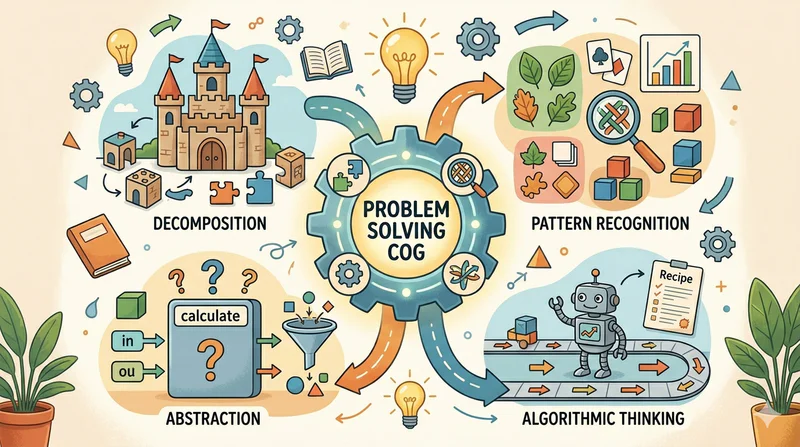
Computational thinking for kids is one of the most genuinely important educational concepts of the last decade, not because it's a trendy term but because the skills it describes, systematic problem decomposition, pattern recognition, abstraction, and algorithmic design, are exactly the skills that distinguish children who can handle complex, novel problems from those who can only handle familiar ones.
This guide explains what computational thinking actually involves, how it develops in children from age 6 upwards, how it connects to coding and computer science, and why its value extends into every academic subject and ultimately into every professional and personal domain a child will encounter.
Key Takeaways
Computational thinking consists of four specific habits of mind: decomposition, pattern recognition, abstraction, and algorithmic thinking, and none of them require a computer to practise.
Children as young as 6 can begin developing computational thinking through physical, unplugged activities that require none of the technical knowledge associated with coding.
Coding is one of the most effective ways to develop computational thinking because it requires all four components in combination, but it is not the only way, and computational thinking develops alongside coding rather than after it.
Computational thinking transfers into maths, science, writing, and problem-solving across all subjects, it is a general cognitive skill, not a technology-specific one.
In 2026, computational thinking is increasingly embedded in school curricula globally, including GCSE Computing, AP Computer Science Principles, and primary school computing programmes in the UK, USA, and Australia.
What Is Computational Thinking?
Computational thinking was formalised as an educational concept by computer scientist Jeannette Wing in a 2006 paper that argued it should be taught to all children as a fundamental intellectual skill, not just to those pursuing computing careers. Wing defined it as "the thought processes involved in formulating problems and their solutions so that the solutions are represented in a form that can be effectively carried out by an information-processing agent."
In plain terms: computational thinking is a framework for approaching hard problems systematically. It has four components, each of which is distinct and each of which can be developed independently.
1. Decomposition
Decomposition is breaking a large, complex problem into smaller, more manageable parts. Rather than attempting to solve a problem all at once, the computational thinker first identifies its component sub-problems and addresses each one separately. A child planning a party doesn't think "plan a party", they think "guest list, venue, food, entertainment, invitations" and address each. A child building a game doesn't think "build the game", they think "player movement, scoring, win condition, sound effects" and builds each component.
Decomposition is the most immediately transferable component of computational thinking. It helps with essay writing (break the argument into claims), science experiments (break the investigation into hypothesis, method, observation, conclusion), and project planning of every kind.
2. Pattern Recognition
Pattern recognition is identifying similarities, regularities, and structures within and across problems. A child who notices that every sorting problem has the same underlying structure, compare, decide, swap, can apply a sorting strategy to new sorting problems without starting from scratch. One who recognises that multiplication is repeated addition, and that division is repeated subtraction, can derive multiplication facts from addition facts rather than memorising them independently.
In coding, pattern recognition is what allows a child to apply a loop structure they learned in Scratch to a new loop requirement in Python. The language changed. The pattern, "repeat these steps while this condition is true", is identical. Recognising that identity is what makes learning a second language or a new programming paradigm much faster than learning the first.
3. Abstraction
Abstraction is identifying what is essential about a problem and deliberately ignoring what isn't. A child writing a function called calculate_area(width, height) has abstracted away everything specific about any particular rectangle and created a general solution that works for every rectangle. They've kept what matters (the relationship between width, height, and area) and discarded what doesn't (the specific dimensions of any single rectangle).
Abstraction is one of the most cognitively sophisticated of the four components because it requires the child to identify what's general and what's specific: a distinction that is central to scientific reasoning, algebraic thinking, and literary analysis. A scientist who can identify the general principle from a specific experiment has practised abstraction. A literature student who can identify the universal theme behind a specific story has practised abstraction. The computational context makes this skill explicit and teachable in a way that other subjects rarely do.
4. Algorithmic Thinking
Algorithmic thinking is designing a step-by-step procedure that reliably solves a problem: not just finding one answer, but finding a method that will always find the right answer when applied. A recipe is an algorithm. A set of directions from A to B is an algorithm. The long multiplication procedure is an algorithm. A sorting method is an algorithm.
What distinguishes algorithmic thinking from simply solving a problem is the requirement that the method be precise, unambiguous, and generalisable. "Be careful" is not an algorithm. "Check each step for errors before proceeding to the next" is. This demand for precision develops the habit of clear, systematic thinking that is valuable in every domain requiring procedural reliability.
How Computational Thinking Develops in Children
Computational thinking doesn't arrive all at once. It develops gradually through experience with problems that require its components, in formats appropriate to the child's developmental stage. Here is how each component develops across childhood.
Computational Thinking Development by Age Group
The development is not strictly age-gated: a highly engaged 9-year-old working on complex Scratch projects may develop abstraction at a level typical of an 11-year-old, while a 13-year-old who has never encountered systematic problem-solving activities may still be at the foundation level. The driver is experience with problems that require each component, not age alone.
Does Computational Thinking Require Coding?
No, and this is an important clarification, both for parents of younger children and for those who want to develop computational thinking in children who aren't yet ready for coding.
"Unplugged" computational thinking activities, those that develop the four components without any technology, are among the most effective foundations for later coding education because they build the conceptual framework before the syntactic complexity of code is introduced. A child who has physically sorted cards using a bubble sort algorithm understands the algorithm intuitively before they write a single line of Python. A child who has given their partner step-by-step directions to recreate a drawing without seeing it understands what an algorithm is at a level that no textbook definition can match.
Coding is the most powerful ongoing vehicle for developing computational thinking because it requires all four components in combination, produces immediate feedback on whether the thinking was correct, and builds cumulative complexity over time. But the components can be seeded earlier and reinforced outside coding sessions through the kind of unplugged activities described in this guide. For the overlap between computational thinking and computer science as a formal discipline, see Computer Science for Kids: What It Is and Why It Matters.
Unplugged Activities That Develop Computational Thinking at Home
These activities require no device, no specialist materials, and minimal parent knowledge of computing. Each directly develops one or more computational thinking components.
Give precise directions (Decomposition + Algorithmic Thinking, ages 5+): One person is the "robot" and follows instructions exactly as given. The other gives step-by-step instructions to move from one point to another or to perform a simple task. The robot cannot interpret or improvise, they follow the instructions precisely. When the instructions fail, the giver must identify exactly which step was wrong. This directly mirrors the debugging process in coding and teaches precision in sequential instructions.
Sort a deck of cards together (Pattern Recognition + Algorithmic Thinking, ages 7+): Sort a shuffled deck by suit and number. Then discuss the strategy used. Was it consistent? Could you write it down as a set of rules that someone else could follow? Introduce different sorting methods and compare them. This is a hands-on introduction to sorting algorithms, one of the most fundamental topics in computer science.
Spot what changes and what stays the same (Abstraction, ages 6+): Show two related images or scenarios and ask "what is different?" then "what is the same?" Extend to: "what would you need to know to be able to describe any situation like this?" This is the essence of abstraction: identifying what's general and what's specific. In maths, it's the move from arithmetic to algebra. In science, it's identifying the principle behind an experiment.
Design a recipe from scratch (Decomposition + Algorithmic Thinking, ages 8+): Ask the child to write down every step needed to make a simple dish, with enough precision that a robot could follow it without asking questions. Then "run" the recipe literally to find the ambiguities ("stir until combined", how long? how fast? which direction?). This is an exact analogue to the programming exercise of writing code precise enough that a computer can execute it without interpretation.
Create a field guide (Pattern Recognition + Abstraction, ages 9+): Ask the child to categorise a collection of objects (leaves, cards, rocks, images) by identifying the features that distinguish each group. Then ask them to write a rule that would allow a stranger to categorise any new object correctly. This develops the classification thinking that underlies both database design and scientific taxonomy.

Want your child to develop computational thinking alongside genuine coding skills? Codeyoung's live 1:1 sessions integrate both from session one. Book a free trial class to see it in action.
How Coding Develops Computational Thinking Specifically
Coding is the activity that exercises all four components of computational thinking simultaneously and at increasing depth over time. Here is how each component is developed specifically through coding practice.
How Coding Develops Each Computational Thinking Component
For the specific coding activities and projects that develop each component most effectively by age, see Coding Projects for Kids: 10 Ideas That Build Real Skills and Python Projects for Kids: 8 Ideas to Build Confidence.
Why Does Computational Thinking Transfer Beyond Technology?
The question parents most often ask about computational thinking is whether its benefits are limited to technology subjects. The research answer is clearly no, and the mechanism is straightforward.
The four components of computational thinking are useful in any domain that involves complex, multi-step problems with the potential for systematic solutions. That is most domains. Decomposition helps with essay writing (break the argument into claims and evidence), with science practicals (break the investigation into hypothesis, method, observation, analysis), and with every major project a student undertakes. Pattern recognition accelerates learning in any subject that has recurring structures, mathematics, grammar, historical analysis, musical composition. Abstraction is central to algebra, to scientific theorising, and to legal reasoning. Algorithmic thinking underpins any procedure-dependent activity, from chemistry lab protocols to surgery.
The children who develop strong computational thinking through coding aren't just becoming better programmers. They're developing a more powerful general problem-solving toolkit that makes them better learners across every subject they encounter. This is the argument that Jeannette Wing made in 2006, and two decades of educational research have consistently supported it.
For the specific connection between computational thinking and maths performance, see Coding and Maths for Kids: How Learning Both Gives Children a STEM Edge. For the broader picture of how coding education develops skills beyond programming, see Coding Benefits for Kids: 10 Reasons Every Child Should Learn to Code.
Frequently Asked Questions: Computational Thinking for Kids
What is computational thinking for kids in simple terms?
Computational thinking is a way of approaching complex problems by breaking them into smaller parts (decomposition), spotting patterns and similarities (pattern recognition), focusing on what's essential and ignoring what isn't (abstraction), and designing step-by-step solutions that reliably work (algorithmic thinking). It's called "computational" because these are the approaches used in computing, but the skills apply to any domain that involves systematic problem-solving. A child with strong computational thinking can tackle unfamiliar problems more effectively than one without it.
At what age should children start developing computational thinking?
Children can begin developing computational thinking from age 5 to 6 through unplugged activities that require following and designing precise sequences, identifying what's the same and different across situations, and breaking tasks into steps. Formal coding instruction: which develops all four components simultaneously, is typically introduced from age 7 to 8 with Scratch and from age 10 with text-based languages. The foundation activities require no technology and can be integrated into everyday activities long before formal coding begins.
Is computational thinking the same as coding?
No. Coding is one way to practise and develop computational thinking, and a very effective one. But computational thinking is a broader set of cognitive skills that can be developed through physical activities, maths, science, design challenges, and many other activities that don't involve a computer. The relationship is: computational thinking is the thinking framework; coding is one powerful way to practise and extend it. Good coding education develops computational thinking. Computational thinking helps children code better. They reinforce each other but neither is simply a subset of the other.
How does computational thinking help with school subjects beyond computing?
Decomposition helps with essay planning, project management, and experiment design. Pattern recognition accelerates maths learning (seeing structure in algebra and sequences), language learning (recognising grammatical patterns), and historical analysis (identifying recurring themes and causes). Abstraction is the cognitive operation behind algebraic generalisation, scientific principle identification, and thematic literary analysis. Algorithmic thinking supports any procedure-dependent learning, chemistry protocols, mathematical proofs, legal reasoning. The transfer is consistent and documented in educational research across multiple subjects and age groups.
What are the best activities to develop computational thinking without a computer?
The most effective unplugged activities are: giving step-by-step instructions to a "robot" partner who follows them precisely (algorithmic thinking and decomposition), sorting physical objects with an explicit, writeable rule (pattern recognition and algorithmic thinking), identifying what two different scenarios have in common (abstraction and pattern recognition), and designing a recipe or procedure that someone else could follow without asking questions (decomposition and algorithmic thinking). All of these can be done from age 5 upwards using household materials, and they build the conceptual foundations that make later coding education more productive.
Does computational thinking help children who aren't interested in technology?
Yes, because its value isn't technology-specific. A child who develops strong decomposition skills through coding projects uses those same skills in essay writing. One who develops pattern recognition uses it in maths and music. The fact that the skills were developed through coding doesn't limit their application. Many of Codeyoung's students report that the systematic thinking they developed through coding changed how they approached difficult problems in maths, science, and even creative subjects, well before they had any career interest in technology.
How is computational thinking assessed in school?
GCSE Computer Science in England assesses computational thinking directly through questions that require students to decompose problems, design algorithms, and apply abstraction to programming tasks. AP Computer Science Principles (USA) includes computational thinking as a core competency, assessed through both exam questions and a performance task. The International Baccalaureate Computer Science programme also embeds computational thinking throughout its assessment. As computing curricula have matured globally, computational thinking has moved from implicit to explicitly assessed, and students who have developed it through coding practice consistently outperform those who encounter the concepts only in exam preparation.
How does Codeyoung develop computational thinking in its coding sessions?
Codeyoung's instructors integrate computational thinking development into every project session rather than treating it as a separate subject. Before a child writes code, the instructor guides them through the decomposition step: "What are the separate parts of this programme?" During coding, pattern recognition is reinforced when a child encounters a familiar structure in a new context: "You've solved something like this before, what was your approach?" Abstraction is developed when a child is guided to write a function that works generally rather than for one specific case. Algorithmic thinking is practised every time a child is asked to plan their logic before writing it. These practices are consistent across every session at every level. Book a free trial class to see computational thinking developed in action from session one.
Computational Thinking Is the Most Transferable Skill Coding Builds
Of all the things coding education gives children, programming proficiency, career preparation, creative capability, technical confidence, computational thinking is the most broadly transferable. It is not a technology skill. It is a thinking skill that happens to be developed most powerfully through the activity of designing and building software.
A child who leaves school with strong computational thinking can approach any complex, novel problem with a systematic toolkit that most of their peers don't have. They know how to break problems down. They know how to look for patterns. They know how to strip away the non-essential. They know how to design reliable procedures. These capabilities make them more effective learners, more capable problem-solvers, and more adaptable professionals, in technology and in every field beyond it.
For the complete picture of what coding education builds across all dimensions, see the complete guide to coding for kids. To start developing computational thinking through live 1:1 instruction, explore Codeyoung's coding programmes for ages 6 to 17.
Build your child's computational thinking from session one.
Codeyoung's live 1:1 coding classes develop all four components of computational thinking through project-based instruction for children aged 6 to 17. Free first class, no commitment required.