Why Learning Web Development Early Can Shape Your Child’s Career
Web development is not only a technical ability but it is a manner of comprehending how the online world is constructed. Children should be exposed to web development at a tender age and this way they cease to be mere consumers of applications and websites and become developers. This exposure at such a young age will assist them in the development of problem-solving, thinking logically and finding out how things work behind the screen, which is useful in any future career.
With the world becoming technologically inclined in virtually all industries, having the confidence and flexibility of learning how to develop websites at an early age is beneficial. Young children who learn about technology at an early age do not fear it so much as they mature and would rather be open to trying, experimenting, and inventing. These talents do not make them stick to a single career, but rather provide them the flexibility to switch careers with changing technology and employment markets.
The kids web design is a perfect and age specific, entry point into this voyage. It is a mix of creativity and structure where children can observe fast and visible changes of what they do. Through their creation and construction of the simplest of websites, children are taught that technology is something they can create, not only use, and these seeds will grow up to interest and success in the future employment that is going to be largely technology-driven.
From Consumers to Creators: Making Web Pages for Kids

Children learn how to create websites and this turns the manner of their engagement with technology. Rather than merely using apps and browsing websites they start to learn how digital experience is built. Creating web pages with children creates a feeling of ownership, they are not being told what to do, they are creating something of their own. This work automatically initiates curiosity, promotes experimentation and builds on problem-solving abilities as children understand how to convert ideas into working pages.
The art of web design among children is at the cross of both creativity and reasoning. Children are allowed to select colors, patterns, photographs, and words as well as to understand how structure and rules ensure everything works in an easy way.
The instant results are one of the most encouraging matters: any minor alteration of code is immediately shown on the screen. The fast feedback loop keeps the kids in focus and assists them to relate their thoughts to real results.
Shifting the Screen Time Perspective

Screen time is not all created equally. Passive scrolling or video watching do not demand much interaction whereas coding a webpage will turn the screen time to active learning. By creating a website, kids create layouts, write and experiment with various ideas to determine what works. Rather than passively taking in digital content, they read, write, and enhance it, making screen time productive, skill-building time.
Finding the Best Website Development Courses for Kids

With the increase in the interest of the child in the world of technology, structured learning becomes a necessity. The appropriate site development programs offered to children are of clear progression, professional direction and practical projects that enable the concepts to be put in place. Guided courses offer mentorship, a structured learning process, and practice in the field unlike random video and unrelated tutorials, and give students a coherent learning direction. This method allows children to be educated about web development for kids in the long term, constructive manner of children, instead of the temporary interest, which is often brief.
A structured course will keep children engaged by making them see the purpose of learning every new thing and the way it relates to the larger context. Children also become confident through difficulties and real-world works because they will watch their skills improve with time.
Identifying the Right Curriculum for Different Age Groups

The learning according to the age is the key to keeping the children active and self-assured. Visual tools and basic HTML concepts are the most helpful to younger kids, as they are introduced to structure without being overloaded. Young users of middle school are now equipped to delve further into HTML and CSS as well as the more rudimentary JavaScript, to introduce a bit of interaction and logic. Younger children can go a step further to learn responsive design and create their own portfolios, as well as work on actual projects that are applicable in the industry. When a child is presented with a curriculum that suits his/her age and skill, learning is interesting, possible, and satisfying.
The Compound Effect of Technical Literacy

Web development is taught at a young age with a potent compounding effect similar to learning a new language at a young age. What one may start as a realization of the way a webpage is organized progressively leads to a larger technical knowledge base. Children begin to understand logic, systems thinking, and cooperation of various digital elements. This technology experience will increase their confidence and fluency over time, thus allowing them to change more readily as they adapt to the tools and platforms as they change.
Web development is a long term benefit instead of a short term skill. The ideas that children are taught (problem decomposition, structured thinking, and online communication) are transferred to most of the spheres beyond websites. By accumulating these skills each year, children are able to build a strong base upon which further learning in virtually any technology-related discipline can be built.
Why Web Development Is the “Gateway Skill” to Data Science and AI
Web development is usually an initial step to higher-level disciplines such as data science, artificial intelligence, and software engineering. As soon as children learn the fundamentals of the web, how information is transferred, how logic manages behavior, and how systems communicate, tools such as Python, databases, or AI systems start seeming much less daunting. Web development also gives context to abstract concepts and makes them more tangible and accessible.
Such development enables children to view technology as a system and not individual skills. It is only a natural jump, not a leap to enter the fields of data analysis, machine learning or intelligent applications with a solid web foundation, and makes the web development a real entry point to the profession of the future.
Soft Skills Gained: Project Management and Logical Thinking
The exposure at an early age to web development is much more than technical electricality - it creates life skills. By making a child a website, the child learns how to organize his work, divide large concepts into small steps and logically resolve problems. The experience of debugging errors teaches them to be patient and persistent and dealing with timelines and features should make them learn the fundamentals of project management. Such experiences teach children to think, be organized, and think systematically.
These interpersonal skills play out immediately in the real world. No matter the career path that a child is going to, be it business, leadership, entrepreneurial or even any other creative career, planning, logical reasoning and implementation of ideas is priceless. The development of the Web provides ownership and responsibility, which helps the kids to become sure decision-makers with the ability to transform ideas into results, which are the features of good leaders and innovators.
How Kids Learn Problem-Solving by Creating Websites Step by Step
Children are bound to acquire good problem-solving skills when they build websites step by step. Developing a web site means they have to think in stages; initially they have to think of how to lay out the site, then they have to add material, to the site and then to style the page and then they have to test the functionality of everything. The small problems in each stage, including correcting broken links, changing layouts, etc., would motivate the children to examine the problems and seek rational solutions instead of giving up.
The step-by-step strategy is also what teaches children to be able to divide a complex issue into manageable tasks. They cannot consider a web site as a single challenge and they learn to deal with it bit by bit. This develops confidence, patience and a systematic form of thinking over time which is not limited to web design but also to academics and life in general as a problem solver.
Child Coding or App development Through Real Projects
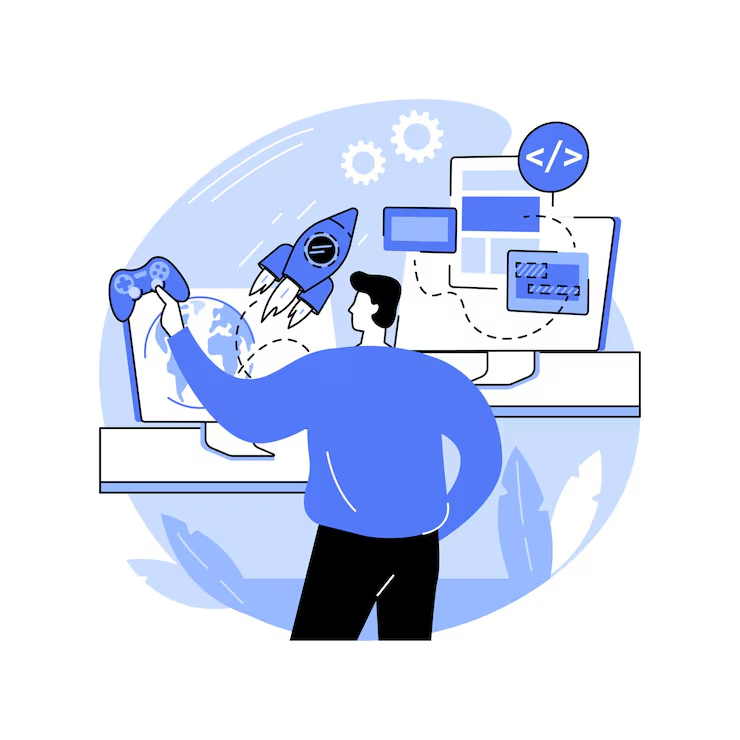
Children program coding and app creation are much more valuable, when children do not work on separate tasks, rather than real-life projects. A simple app or interactive web feature can be created to make children learn how ideas can translate to functional products. They get to know how to plan features, test and debug and get their work better, which can be compared to the real-life development cycles.
Responsibility and creativity also enhance working on real projects. Children experience the immediate benefits of their hard work, and this encourages them to acquire more complicated ideas with time. Regardless of the future of technology they may or may not have, the experience of creating something real equips them to take on new challenges by strengthening logical thinking, teamwork and innovation.
Learn Website Development for Kids Using Artificial Intelligence
The development of websites targeted at children with the help of Artificial Intelligence makes the learning process fun, interactive, and able to adapt to the future. Through AI-based applications, children can be taught how to create websites, how to create web page designs and the simplest of coding without having to deal with complicated syntax. AI can support children in their development by trying to provide smart ideas, correct mistakes, and speed up the process of web development, thus increasing their creativity and confidence at a very young age.
Kids will have the ability to solve problems, think logically, and be creative through AI-based web development learning. They are able to work on actual projects like personal site, school project or basic applications. The practical methodology makes children learn all about frontend design, the basics of backend development, and the concepts of artificial intelligence and have fun in the process.
Conclusion: Building a Brighter Future by Learning Web Development Early

Early web development is not the act of forcing children into technology professions but about giving them more opportunities. It empowers them with innovation, stamina, and trust as future gates continue to remain open in a digitally-driven world. Web development, as a future-proof base, gives kids the ability to comprehend and influence the technology that they live in.
The greatest lesson that parents should save is the following: children that learn to construct the web will not only cope with the future, they will also make it.
FAQs
How to build websites for kids?
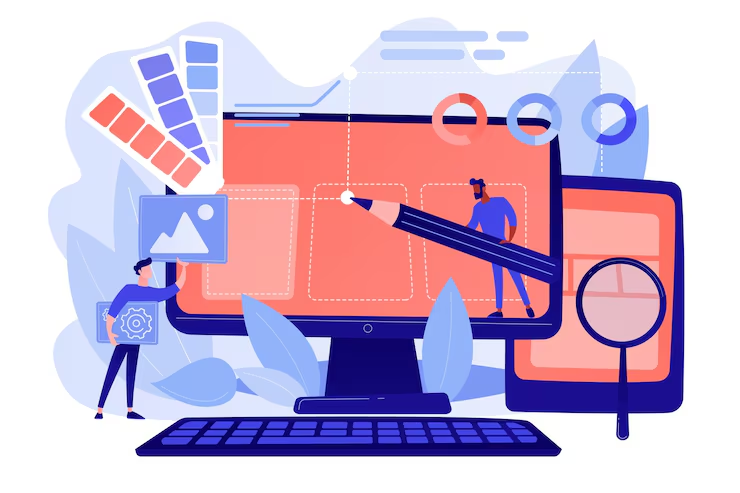
A website designed to suit children should be direct to the point and creative. The site is easy to read and follow with bright yet balanced colors and large readable fonts as well as evident icons, which children can easily grasp. There must be minimal content as well as graphics in the form of pictures, illustrations, and short blocks of text to keep the viewer entertained without straining their eyes.
It is also necessary to engage kids in the design process. Allow them to select themes, images or layouts in order to have a sense of ownership of what they are constructing. Such involvement develops creativity and confidence and makes them learn the impacts of design decisions on user experience.
Can an 8-year-old make a website using basic coding?

It is true that an 8 year old child will also be able to build a site using age-relevant tools and instructions. Novice platforms, visual constructors or basic lessons on HTML enable children to create simple pages but understand the framework of websites. At this age, it is a time of discovery and invention, as opposed to technical perfection.
Right with the right assistance kids soon know how to add text, images, and simple layouts. Web development is not only educational but entertaining as the experience teaches them to be more problem solvers, patient and proud enough to produce something of their own.
What are the 5 golden rules of web design for high school students?

Five golden rules of web design are simplicity, easy navigation, readability, consistency and user oriented design. The ease of use is ensured by a clean design that avoids confusion and user-friendly menus and buttons. Clear fonts and spacing make the content comfortable to read.
The predictability of colors, fonts and layouts makes it seem professional. Above all, a good web design is always user-friendly, i.e. making the page easy to navigate, access, and understand in accordance with the user needs and expectations.
Is Canva kid-friendly for front end development?

The canva is kid-friendly due to the drag-and-drop design system and the visual design. Children are able to design posters, layouts and other simple web-style designs without any technical skills. The system enables innovation and simplifies the process of conventional design software.
Nevertheless, young children could also use adult supervision. Under supervision, Canva emerges as a potent apparatus to master the fundamentals of learning design like layout, color play, and visual narration in a secure and entertaining manner.
How to create a web design for kids?

The first thing to do when creating a web page that targets kids is to select kid friendly tools or simple HTML concepts. Start with easy ones such as headings, pictures, and paragraphs to enable kids to get quick results of their efforts. The step-by-step approach also facilitates the process and creates confidence.
Get children to be creative and alter colors, designs or the content and then experiment with the appearance of the page. This practical measure makes learning a two-way interaction and makes the children not only get to know the importance of creativity but also get to know the importance of logic even as they go about constructing their own web page.