Web Development for Kids: What They Learn and Why It Matters
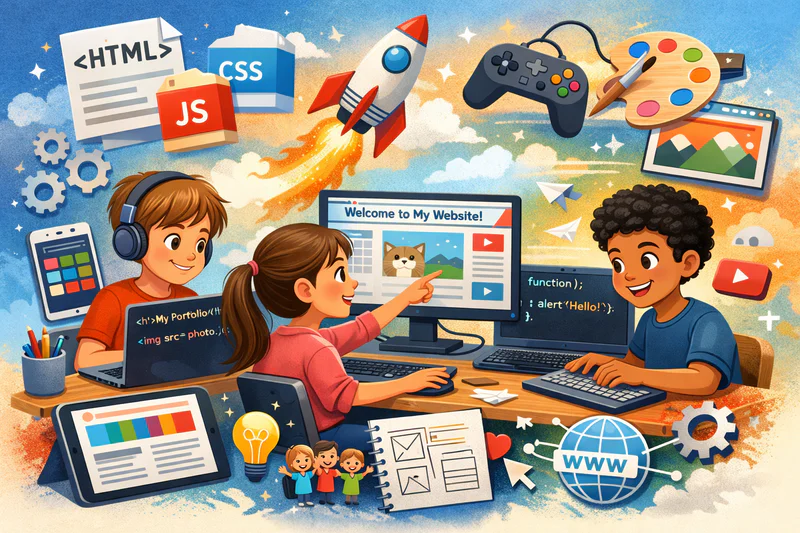
Every website your child visits every YouTube page, game site, or online shop was built by someone who started by learning the same fundamentals. HTML. CSS. JavaScript. These three technologies power the entire visible internet, and children as young as 10 can start understanding how they work.
Web development for kids isn't about producing professional developers at age 12. It's about giving children the ability to create something real something that lives on the internet, that their friends can visit, that they built with their own hands. That feeling of authorship over digital space is increasingly rare, and increasingly valuable.
This guide covers what children actually learn in web development, the right age to start, the skills it builds beyond just coding, and what parents should look for when choosing a programme.
Key Takeaways
Web development teaches children HTML, CSS, and JavaScript the three core technologies that build every website on the internet.
Children aged 10 to 12 can start learning web development and build their first working webpage within a few sessions.
Beyond coding, web development builds design thinking, problem-solving, and the ability to communicate ideas visually.
Web development is one of the most portfolio-friendly coding paths children can share their projects online from day one.
Skills from web development transfer directly to app development, UI/UX design, and full-stack engineering careers.
What Do Kids Actually Learn in Web Development?
Parents often picture web development as something abstract and technical. In practice, especially at the beginner level, it's quite concrete. Children start by building pages they can see immediately in a browser and that instant visual feedback makes the learning feel tangible rather than theoretical.
A structured web development course for kids covers three layers, each building on the last:
Web Development Learning Progression for Kids
In early sessions, a child might build a personal portfolio page their name, a photo, links to their favourite sites. Simple by professional standards. But built entirely by them, working exactly as intended. That first success is the anchor point for everything that follows.
The Real Skills Web Development Builds in Children
Coding is the obvious outcome. But ask any experienced web development instructor what actually changes in a child who sticks with the subject for six months, and the answers go well beyond syntax.
Why does web development improve problem-solving in kids?
Building a website involves constantly encountering things that don't work as expected. A layout that looks right on paper but breaks in the browser. A button that doesn't respond. A colour that clashes. Each of these is a small problem requiring diagnosis and a fix exactly the kind of iterative, evidence-based reasoning that strong problem-solvers use. Over time, children stop panicking when something breaks and start treating it as a puzzle. That shift is significant.
Beyond debugging, web development teaches children to think in systems. A webpage isn't a single thing it's a set of interdependent parts where changing one element affects others. Understanding that kind of systemic relationship is useful far outside coding.
Other skills that develop alongside the technical work:
Design thinking: deciding how to arrange content so it's easy to read and use
Attention to detail: a missing bracket or an extra space changes everything
Communication: a good website communicates ideas; children learn to think about their audience
Persistence: almost nothing works on the first try, and children learn to see that as normal rather than discouraging
What Age Is Right for Kids to Start Web Development?
The practical lower limit is around 10 to 11 years old not because younger children lack the intelligence, but because HTML and CSS require reading fluency, comfortable typing, and enough abstract thinking to understand that a tag written in one place controls what appears somewhere else on the page.
Children aged 10 to 13 are in a strong sweet spot. They're old enough to handle text-based syntax, young enough that the learning feels genuinely exciting and open-ended, and at an age where building something they can share with friends is highly motivating.
Web Development Readiness by Age
Prior coding experience helps but isn't required. A child who has done Scratch will find the logic of conditionals and events familiar; a child starting fresh will still make strong progress if the instruction is well-paced and project-based.
Curious whether web development is the right coding path for your child? Book a free trial class at Codeyoung and let our instructors assess what's the best fit.
How Web Development Compares to Other Coding Paths for Kids
Parents choosing a coding programme often wonder how web development stacks up against Python, Scratch, or app development. The honest answer is that each path has different strengths, and the best choice depends on the child's interests and goals.
Web Development vs Other Coding Paths for Kids
Web development has one specific advantage over most other paths: shareability. A website can be shown to anyone with a browser. No special software needed, no file to download, no platform to install. For children who are motivated by sharing their work which is most of them that matters a lot.
Many children at Codeyoung do both web development and Python. The skills are genuinely complementary: Python handles the logic and data processing, web development handles the interface. Together they cover the full stack of how modern software is built. Explore the web development programme and the full coding curriculum to see how the tracks work together.
What a Typical Web Development Learning Journey Looks Like
Children often worry that learning web development will feel like studying rather than creating. In a well-designed programme, it mostly feels like building. Here's a realistic picture of how progress unfolds over the first few months.
Sessions 1–4 (HTML foundations): Children write their first HTML page headings, paragraphs, links, images. They see it render in a browser and understand immediately that they control what appears. Most children find this deeply satisfying.
Sessions 5–10 (CSS styling): This is often where engagement spikes. Children can now change colours, fonts, layouts, and add basic animations. A page that was plain and functional suddenly looks like something they'd actually want to visit. Design instincts come out here some children who were uncertain about coding become very interested once they understand they can make things look the way they want.
Sessions 11–18 (JavaScript behaviour): The page becomes interactive. Buttons do things. Forms work. Content changes based on user input. This is where web development starts feeling like real software rather than a document.
By session 20, a motivated child working with a good instructor has typically built 3 to 5 complete web projects they're proud of. That's a portfolio. And a portfolio, even at 13, opens doors that a certificate or grade report doesn't.
How Do Parents Choose the Right Web Development Programme for Kids?
There's no shortage of options, which makes the choice harder than it should be. Here's what to prioritise and what to be cautious about.
What should parents look for in a coding course for kids?
The single most important factor is instruction format. Live 1:1 instruction produces faster, more durable results than group classes or self-paced videos, because the instructor can see exactly where a child is confused and adapt in real time. A child who gets stuck on a concept in a video course often just moves on without understanding it and that gap compounds. In a 1:1 session, there's nowhere to hide and no reason to pretend.
Look for these specifics:
Project-based curriculum: children should build real, complete things in every session, not just complete exercises
Age-appropriate pacing: a programme designed for adults or teenagers isn't the same as one built for 10 to 12-year-olds
Qualified, child-friendly instructors: technical knowledge and teaching skill are both required; one without the other isn't enough
Flexible scheduling: web development takes consistent practice; it needs to fit around school and activities without friction
A free trial: any programme confident in its quality will offer one
Codeyoung's web development classes for kids are delivered as 1:1 live sessions, with a curriculum that runs from HTML foundations through to JavaScript and responsive design. The programme has been developed and refined across more than 45,000 students in the USA, UK, Canada, and Australia.
Frequently Asked Questions About Web Development for Kids
What age should a child start learning web development?
Most children are ready to begin web development from around age 10 to 11. At this age, they have the reading fluency and abstract thinking needed to work with HTML tags and CSS properties. Children aged 12 and above with no prior coding experience can also start web development directly, without needing to go through block-based tools like Scratch first. Younger children are better suited to visual programming foundations before tackling text-based code.
Does my child need to know coding before starting web development?
No prior coding experience is required to start web development. HTML is genuinely beginner-friendly it reads closely to English, the errors are visible immediately in the browser, and the first session usually produces a working page that the child can see. Children who have done Scratch or Python will find some concepts familiar, but the web development path is fully accessible to complete beginners aged 10 and above.
What is the difference between web development and app development for kids?
Web development produces websites and web applications that run in a browser accessible on any device with the internet. App development produces native applications installed on Android or iOS devices. Web development tends to be more accessible as a starting point because the feedback loop is faster and no device-specific tools are needed. Many children do both eventually, since the skills are complementary and the underlying logic is similar.
Is JavaScript too hard for kids to learn?
JavaScript is harder than HTML and CSS but well within reach for children aged 12 and above, particularly when introduced after HTML and CSS are solid. The key is pacing and project context: children learn JavaScript much faster when they're adding interactivity to something they've already built and care about, rather than learning it in abstract exercises. Most children in structured 1:1 web development programmes encounter JavaScript within their first 3 to 4 months.
Can kids build a real website that goes live on the internet?
Yes, and in a well-structured programme they often do this within their first 10 to 15 sessions. Free hosting platforms like GitHub Pages allow children to publish their HTML/CSS projects online with no cost. Having a real URL to share with family and friends is one of the most motivating milestones in the early learning journey. It makes the work feel consequential rather than purely academic.
How is web development taught differently for kids versus adults?
Children's web development programmes use age-appropriate project themes, slower pacing through foundational concepts, more visual and immediate feedback loops, and instructors trained specifically to work with young learners. Adult courses assume faster reading comprehension, prior computer literacy, and motivation driven by career outcomes. A course designed for adults often demotivates children quickly because the examples and use cases don't feel relevant to their lives.
Will learning web development help my child get into a better school or university?
It can, particularly for children applying to technology or computer science programmes. A portfolio of self-built websites demonstrates initiative, technical skill, and creative thinking in a way that academic grades don't fully capture. Selective universities increasingly look for evidence of self-directed learning outside the classroom. A child who has built and published web projects has that evidence in a concrete, shareable form.
Is web development a good career path for kids to aim for?
Web and software development consistently ranks among the highest-demand and highest-paid career fields globally. The Bureau of Labor Statistics projects software developer roles to grow 25% by 2032. Front-end web developers, full-stack engineers, and UI/UX designers are all in sustained demand. But career outcomes aside, the skills built in web development systematic problem-solving, design thinking, building from nothing are valuable in almost any field.
How many hours a week should kids spend on web development practice?
Two to three hours per week splitacross two or three shorter sessions is enough to make consistent progress without creating pressure. One 1:1 live session per week supplemented by a short independent practice session between lessons tends to produce the best results. Intensity matters less than consistency. Children who practise a little often build skills faster than those who do long infrequent sessions.
What can kids build with web development skills?
Starting projects include personal pages, fan sites, and simple game interfaces. As skills develop, children build interactive quizzes, portfolio sites, basic web applications, and simple e-commerce layouts. Advanced students move into JavaScript frameworks, API integration, and full-stack projects combining front-end web code with a Python or Node.js back end. The range is wide enough that children with very different interests from creative design to logical engineering find something engaging in the subject.
Building on the Internet Is a Skill Worth Starting Early
Every page your child visits was built by someone. Web development is the process of learning to be that person. It teaches children to take an idea and turn it into something real and shareable a skill that sits at the intersection of creativity, logic, and communication.
Starting early matters because the concepts compound. A child who understands HTML at 11 finds CSS intuitive at 12 and JavaScript approachable at 13. By secondary school, they're building things their peers can only consume. That's a meaningful advantage, and it starts with a single page and a few lines of code.
Explore Codeyoung's web development programme for kids and see where your child could be in six months.
Ready to give your child a head start in web development?
Codeyoung offers personalised 1:1 live web development classes for children aged 10 to 17. HTML, CSS, and JavaScript taught through real projects with expert instructors and flexible scheduling. Free trial available.