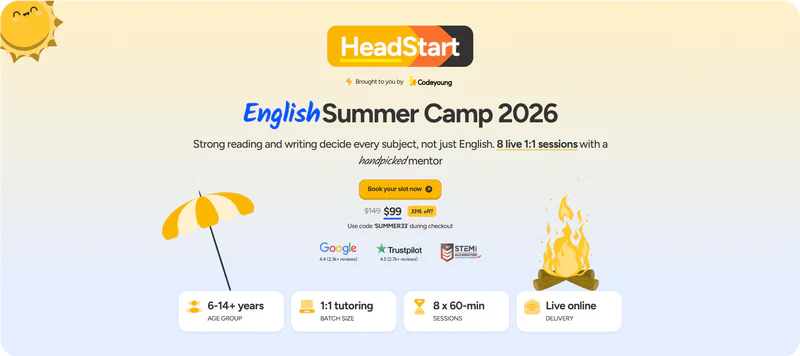
Summer English Camp for Kids: Build Real Skills Fast
English is the subject where gaps are most quietly damaging. A child who struggles with maths makes calculation errors that are visible and correctable. A child whose reading comprehension is below level, whose writing is structurally weak, or whose grammar contains persistent patterns of error doesn't always show it obviously, until a secondary school essay, a standardised test, or a university application makes the gap suddenly consequential.
Summer is the most underused window for English development. Without the pressure of school deadlines, children can work on the skills that actually matter: not just completing assignments but genuinely improving, with the focused, personalised attention that a classroom of 30 cannot provide. Codeyoung's Summer English Camp is built specifically around that opportunity.
Key Takeaways
Codeyoung's Summer English Camp runs as live 1:1 sessions for children aged 6 to 17 across reading, writing, grammar, and communication, tailored to each child's specific gaps and goals.
The camp is designed for the summer window: intensive enough to produce real progress before September, flexible enough to fit around summer activities.
A child who attends 2 to 3 sessions per week over 6 to 8 weeks can close a full year's worth of English gap, or build a year ahead of their current level.
Sessions are available for children at every level: from foundational reading and phonics to advanced essay writing, creative writing, and exam preparation.
Summer English instruction also benefits children learning English as an additional language, children preparing for competitive school or scholarship entry, and teenagers building academic writing skills for A-Level or AP work.
What Codeyoung's Summer English Camp Covers
The camp is not a fixed curriculum delivered to all children. Like all Codeyoung programmes, it works alongside the child's school curriculum, see How Codeyoung Works for the full picture of the live 1:1 format. For the summer coding equivalent, see Summer Coding Classes for Kids: What to Look for in 2026. It begins with an assessment of the specific child and builds a summer plan from what that assessment reveals. The four areas it works across are:
Codeyoung Summer English Camp: Areas Covered by Age Group
The camp works alongside the child's school curriculum rather than replacing it. For children who have identified weaknesses from their last school year: a teacher's comment about essay structure, a reading assessment that placed them below age level, a parent's concern about writing speed, those specific targets become the summer plan.
What a Summer English Session Looks Like
Each session is live, one-to-one, and 45 to 55 minutes. The instructor and child work together in real time over video call, with shared documents or text visible on both screens.
A typical session for a 10-year-old working on essay structure might begin by reviewing a paragraph they wrote independently before the session, identifying one specific structural issue (the argument point isn't clearly stated in the topic sentence), practising the correction on that paragraph, then applying the same technique to a new paragraph the child writes during the session. The session ends with the instructor setting a short independent writing task that applies what was practiced, completed before the next session.
The 1:1 format is what makes this different from any school-based or group English instruction. When the instructor reads a child's writing, they can see exactly which errors are patterns and which are one-offs, which concepts are internalised and which are still fragile, and where to focus the session's attention. A classroom teacher with 30 students cannot do this. A recorded video course cannot do this. Only a live instructor working with one child at a time can.
Who Benefits Most From the Summer English Camp
The summer camp is designed to serve children across a wide range of English levels and goals. These are the profiles where it produces the most consistent results.
Children who ended the school year below their expected level in reading or writing. The summer window is the most efficient time to close a gap, there is no ongoing school content competing for attention, and the focused 1:1 instruction can move at exactly the pace needed.
Children who are strong students but want to reach the top of their class. Moving from competent to excellent in English requires the kind of specific, targeted feedback on written work that summer 1:1 sessions provide. A strong Year 9 student who wants to reach the top of their GCSE preparation enters September with a genuine advantage.
Children with English as an additional language (EAL). The summer is an ideal window for EAL students to consolidate academic English vocabulary, grammar precision, and written structure without the daily pressure of keeping up with school content simultaneously.
Children preparing for competitive school entry. Grammar schools, independent school entrance exams (11+, 13+), and scholarship assessments all test English comprehension and writing at a level above the standard curriculum. Summer camp sessions targeted at these assessments make a significant difference to outcomes.
Teenagers preparing for GCSE or A-Level English. Summer before Year 10 or Year 12 is the most valuable preparation window for these qualifications. Establishing essay writing habits, close reading skills, and literary analysis technique before the course begins gives students a structural head start they maintain throughout.
Ready to make this summer count for your child's English? Codeyoung's Summer English Camp starts with a free assessment session to find exactly where to focus. No commitment required.
Explore the Summer English Camp →
What Progress Looks Like Over a Summer English Camp
Progress in English is less immediately visible than progress in coding or maths: a child who builds a working game has obvious evidence of progress; a child whose paragraph structure has improved needs a before-and-after comparison to see the same. The three areas where progress is most reliably observable after 6 to 8 weeks of summer English instruction are:
Writing confidence. Children who find writing laborious at the start of summer, who sit with a blank page for minutes before producing a sentence, typically develop a habitual starting strategy (a clear topic sentence, a concrete opening image, a direct statement of position) that removes the blank page problem. The writing doesn't become effortless, but it starts reliably. That shift is observable within 4 to 6 sessions.
Reading comprehension depth. A child who can read but struggles with inference questions, "what does this suggest about the character?", develops the habit of pausing to make the implicit explicit. By the end of summer, inference is something they do automatically rather than something they try to remember to do.
Grammar accuracy. Persistent patterns of error, comma splices, tense shifts, apostrophe confusion, can typically be fixed in 3 to 5 targeted sessions and then maintained with practice. A grammar error pattern that has persisted for years often responds quickly to direct 1:1 instruction that identifies and corrects it at the source rather than marking it in a returned essay.
How to Make the Most of the Summer English Camp
The families who see the most progress from summer English instruction share a few consistent habits.
Read alongside the camp. Children who are also reading independently during summer: not necessarily assigned texts, but books they've chosen, absorb vocabulary, sentence structure, and narrative technique passively alongside the explicit instruction in sessions. Even 15 to 20 minutes of daily reading accelerates progress in ways that additional session time cannot fully replicate.
Do the between-session writing tasks. The instructor typically assigns a short writing task at the end of each session: a paragraph, a response, a piece of creative writing. Children who complete these before the next session consolidate what was practiced far more durably than those who don't. The task is short by design; the habit of doing it is what matters.
Continue into the school year. English skills are cumulative. A summer of strong instruction followed by no further instruction produces a September boost that gradually erodes as school-year demands resume without ongoing support. Families who reduce frequency (from twice-weekly to once-weekly) rather than stopping entirely maintain the summer gains into the first term and beyond.
Frequently Asked Questions: Summer English Camp for Kids
What does Codeyoung's Summer English Camp cover?
The camp covers reading comprehension, writing (creative, narrative, and analytical), grammar and punctuation, and communication skills, tailored to each child's age, level, and specific goals. It is not a fixed programme delivered identically to all children, it begins with an assessment and builds a personalised summer plan from what that assessment shows.
What age range is the Summer English Camp for?
Ages 6 to 17. Younger children (6 to 9) focus on foundational reading, phonics, early writing, and vocabulary. Middle-range children (10 to 13) work on paragraph and essay structure, comprehension depth, and grammar accuracy. Older students (14 to 17) focus on advanced analytical writing, GCSE or A-Level preparation, and the academic register expected at secondary and post-16 level.
How many sessions per week does a child need for meaningful progress?
Two sessions per week over 6 to 8 weeks produces reliable, visible progress across most skill areas. One session per week produces steady incremental improvement. Three sessions per week is appropriate for children with a specific and time-sensitive goal (an upcoming entrance exam, a GCSE cohort starting in September) where faster progress is needed.
Is the camp suitable for children with dyslexia or reading difficulties?
Yes. The 1:1 format is particularly effective for children with dyslexia, reading difficulties, or specific learning differences because the instructor can adapt every aspect of the session to the child's specific profile, pacing, instruction method, written vs verbal work, font and display choices. Group classes cannot make these adaptations consistently; a live 1:1 instructor can make them in real time.
How is online English tutoring different from school English lessons?
School English lessons involve a teacher managing 30 students simultaneously. The teacher can identify average class needs but cannot consistently respond to individual written errors, individual comprehension patterns, or individual writing habits. A live 1:1 instructor reads the specific child's work, identifies the specific child's error patterns, and teaches to exactly that child's needs. The difference in pace of individual improvement is consistent and significant.
Can the camp help a child who has fallen behind in English at school?
This is where the camp is most effective. A child who ended the school year below their expected level in reading or writing has 6 to 8 summer weeks without new school content competing for attention. That window, with focused 1:1 instruction targeting the specific gap, consistently produces enough progress to change the child's starting position in September.
What subjects do Codeyoung's other summer camps cover?
Alongside the English camp, Codeyoung runs summer camps in maths, coding, and Digital SAT preparation. Families can enrol in multiple camps simultaneously, and many children combine English and maths or English and coding over summer.
How do I enrol my child in the Summer English Camp?
Visit the Summer English Camp page, select your child's age and goals, and book a free first session. No payment is required before the trial session. The first session includes a brief assessment of the child's current level and produces an initial writing or comprehension activity, so you see exactly what the programme looks like before committing to the full summer.
Summer Is the Most Efficient Time to Improve English
English development is quiet, cumulative, and slower to show than maths or coding progress. But it's also the subject that affects every other subject, reading comprehension underpins science, history, and geography; writing quality affects every marked essay across the curriculum; vocabulary breadth correlates with academic performance across every domain.
Summer is the window where that development can accelerate without the competing demands of an active school year. A child who arrives in September as a stronger reader, a more confident writer, and a more accurate grammarian is better positioned across their entire timetable: not just in English lessons.
Explore Codeyoung's Summer English Camp and book a free first session to see the programme in action for your child specifically. For the full picture of how Codeyoung's live 1:1 format works across all subjects, see How Codeyoung Works: What Happens in a Live Session.
Make this summer count for your child's English.
Codeyoung's Summer English Camp: live 1:1 sessions tailored to your child's specific level and goals. Free first session, no commitment required.