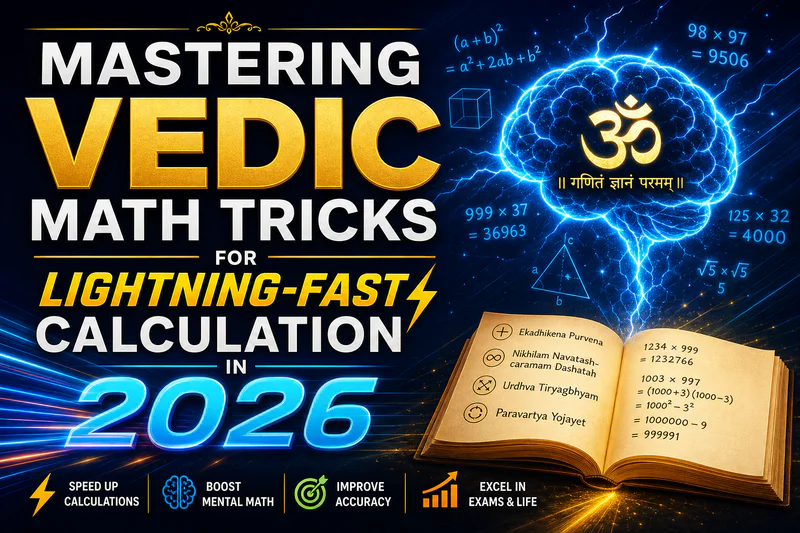
Most students don't struggle with math because they lack intelligence, they struggle because they're using slow, inefficient methods. Vedic math classes flip that narrative entirely, training young minds to calculate at speeds that feel almost impossible with conventional techniques.
This guide breaks down exactly what Vedic mathematics is, how its core tricks work step by step, and why combining vedic math classes with modern STEM skills like coding gives students a decisive edge in 2026 and beyond.
1. What Is Vedic Mathematics? A 2026 Primer
Vedic mathematics is an ancient system of mental calculation derived from the Vedas, specifically the Atharvaveda, and systematized in the early 20th century by Indian mathematician Bharati Krishna Tirthaji. It operates on 16 core sutras (Sanskrit word-formulas) and 13 sub-sutras that serve as algorithmic shortcuts for arithmetic, algebra, geometry, and even calculus.
What makes it distinct is the mental model it builds. Traditional school math teaches students to work right-to-left, carry digits, and follow rigid procedural steps. Vedic mathematics flips the script, many of its techniques work left-to-right, reduce multi-step problems into single-line solutions, and train the brain to recognize numerical patterns instantly.
Notably, starting from the 2025–26 academic session, Vedic mathematics was formally integrated into NCERT curricula in India, signaling global recognition of its pedagogical value. This makes enrolling in quality math classes more relevant than ever for students looking to get ahead. Modern online math programs for kids now bring these ancient techniques directly to a laptop or tablet screen, making access effortless regardless of geography.
2. Why Vedic Math Is the Secret Weapon for Every Student in 2026
Speed matters enormously in competitive exams. In tests like the JEE, NEET, SAT, or Math Olympiads, students typically have under two minutes per question. According to experts at Vedic Maths Mastery, applying Vedic techniques can cut calculation time by 50–80% compared to traditional methods, a staggering advantage when every second counts.
But the benefits go well beyond exam performance. Students who consistently practice Vedic methods report significantly reduced math anxiety. When a child realizes they can mentally multiply 97 × 98 in under four seconds, their relationship with numbers transforms. That shift in confidence is something no textbook alone can manufacture.
Vedic math also sharpens mathematical intuition, the ability to sense whether an answer is reasonable before working it out fully. This intuition is precisely what math tutoring for kids should aim to develop, and it's why dedicated, personalized instruction matters so much. One-on-one math tutoring for kids that incorporates Vedic methods accelerates this intuitive development far faster than a crowded classroom setting.
Finally, Vedic math is unusually inclusive. Its multiple solution pathways mean that visual learners, sequential thinkers, and pattern-seekers can all find an approach that clicks. Whether a child thrives in online math classes or prefers hands-on in-person instruction, Vedic techniques adapt beautifully to every learning style.
3. Breaking Down Vedic Maths Tricks: The Master Summary Table

The following table summarizes the most impactful Vedic math tricks, contrasts them with conventional approaches, and highlights what each technique builds cognitively, including the surprising parallels to algorithmic thinking in coding for kids.
This table is an excellent reference for parents evaluating vedic math classes and for students who want a quick cheat sheet before jumping into full practice.
4. The 8 Core Vedic Math Tricks with Step-by-Step Examples
Trick 1: Multiply Any Number by 11
Take your number, say, 53.
Write the first digit: 5
Add adjacent digits: 5 + 3 = 8
Write the last digit: 3
Result: 583 ✓
For numbers where the middle sum exceeds 9, carry the 1 to the left digit.
Trick 2: Square Any Number Ending in 5
Take 75.
Multiply the first digit by the next number up: 7 × 8 = 56
Append 25 to the result.
Answer: 5625 ✓
Trick 3: Base-100 Multiplication (Numbers Near 100)

Multiply 97 × 96:
Deviations from 100: 97 → -3, 96 → -4
Cross-subtract: 97 - 4 = 93 (or 96 - 3 = 93) → this is your left part.
Multiply deviations: (-3) × (-4) = 12 → this is your right part.
Answer: 9312 ✓
Trick 4: Left-to-Right Addition
Add 468 + 357:
Hundreds first: 400 + 300 = 700
Tens: 60 + 50 = 110 → running total: 810
Units: 8 + 7 = 15 → running total: 825 ✓
This technique is one of the most practical mental math tricks for kids for everyday use, from splitting bills to checking grocery totals instantly.
Trick 5: Nikhilam Subtraction (Complement Method)
Subtract 1000 - 637:
Subtract each digit from 9 except the last, which subtracts from 10.
9 - 6 = 3, 9 - 3 = 6, 10 - 7 = 3
Answer: 363 ✓
Trick 6: Urdhva-Tiryak (Vertically and Crosswise)
Multiply 23 × 41:
Vertical left: 2 × 4 = 8
Crosswise: (2 × 1) + (3 × 4) = 2 + 12 = 14 → write 4, carry 1 → left becomes 9
Vertical right: 3 × 1 = 3
Answer: 943 ✓
Trick 7: Squaring Numbers Near 50
Square 52:
52² = (50 + 2)²
Base square: 25 (for 50²/100)
Add the deviation: 25 + 2 = 27 (hundreds part)
Square the deviation: 2² = 04
Answer: 2704 ✓
Trick 8: Quick Division Using Ekadhikena Purvena
To find 1/19 as a recurring decimal:
Start with 1, multiply by 2 (one more than the denominator's first digit, 1).
Continue: 1, 2, 4, 8, 16, 32... adjusting carries as you go.
This generates the entire recurring cycle without long division.
Each of these tricks rewards consistent daily practice, which is exactly what structured vedic math classes are designed to build.
5. The Surprising Link Between Vedic Math and Coding for Kids

The connection between Vedic mathematics and programming is not metaphorical, it is structural. Every Vedic sutra is, at its core, an algorithm: a defined, repeatable sequence of steps that transforms an input into an output. This is precisely how code works.
Consider Scratch programming for kids. In Scratch, children learn to build sequences, use conditional logic, and create loops. The Ekadhikena Purvena sutra operates as a loop with a carry condition, structurally identical to a while loop in a Scratch block sequence. When children are already fluent in Vedic sutras through vedic math classes, transitioning to coding classes becomes dramatically smoother because the underlying logic is already wired in.
The benefits extend to more advanced programming as well. Python for kids becomes significantly more intuitive for students who have mastered Vedic math. Writing data manipulation scripts, building number-crunching functions, or exploring basic data science all require a strong numerical foundation. Students who can mentally verify outputs through Vedic mental math catch bugs faster and write cleaner algorithms. For students working on Python projects for kids, this mental agility is a genuine competitive advantage.
Even app development classes for kids benefit from this synergy. Building a functional educational app, say, a multiplication quiz or a geometry calculator, requires the developer to deeply understand the math behind the interface. Students who have internalized Vedic calculation methods design smarter logic, write leaner functions, and produce more efficient apps. The overlap between coding and math for kids is one of the most underappreciated advantages in STEM education today.
6. The Role of Vedic Math Classes in Structured Learning
Self-study has its limits. Most children who attempt to learn Vedic tricks from YouTube videos or worksheets plateau quickly because they lack systematic feedback. Structured vedic math classes provide what self-study cannot: a progressive curriculum that introduces tricks in the right sequence, a mentor who catches conceptual gaps before they compound, and consistent accountability that builds the practice habit.
Personalized math tutoring for kids that incorporates Vedic methods is particularly powerful for students who have already developed negative associations with mathematics. A skilled tutor can identify precisely which calculation anxieties a child carries and introduce the right Vedic shortcut to dissolve that specific block. That targeted approach is what separates quality math tutoring for kids from generic drill worksheets.
Online math programs for kids that focus on Vedic mathematics have matured significantly by 2026. Platforms like Codeyoung offer live, one-on-one vedic math classes with expert instructors, structured syllabi that progress from foundational sutras to advanced applications, and gamified practice environments that keep young learners genuinely engaged. For parents seeking holistic STEM enrichment, pairing vedic math classes with coding for kids programs creates a powerful dual curriculum that addresses both numerical fluency and computational literacy.
7. How to Practice Vedic Math Every Day (Habit-Building Guide)
The single most important factor in mastering Vedic math is daily, low-pressure repetition. Twenty minutes of focused practice outperforms two hours of occasional cramming every time.
Here are practical ways parents can embed Vedic math into everyday life:
Morning mental warm-ups: Before school, give your child two multiplication problems to solve using the Vedic method they're currently learning. Keep it fun, not stressful.
Grocery store math: Ask your child to mentally calculate the total of three items in the cart using left-to-right addition, or to estimate the price after a 25% discount using Vedic percentage tricks.
Timed drills: Once a week, run a 2-minute challenge, 20 multiplication problems solved using vedic math classes techniques. Track progress weekly to make improvement visible.
Digital flashcard apps: Pair physical practice with digital reinforcement tools that test the specific sutras your child is mastering.
Understanding computational thinking for kids, the ability to break problems into steps, identify patterns, and design efficient solutions, amplifies these daily Vedic math habits considerably. Children who practice both computational thinking and Vedic math develop a dual cognitive toolkit that serves them across every STEM discipline.
For kids who resist math practice, the framing matters enormously. Repositioning Vedic tricks as "secret shortcuts that most adults don't know" is far more effective than framing them as homework. Explore proven strategies that work for kids who hate maths to find the motivational angle that resonates with your child specifically.
Conclusion
Vedic math classes represent something rare in education: a system that is simultaneously ancient and cutting-edge, deeply rigorous and genuinely fun. For students in 2026, mastering these sutras means faster exam performance, sharper logical reasoning, and a stronger foundation for every STEM discipline they pursue.
The most future-proof path for any child today combines structured vedic math classes with quality online coding classes for kids. Mental speed, algorithmic thinking, and computational problem-solving are not separate skills, they are the same skill expressed in different languages. Equip your child with both, and you give them an edge that lasts well beyond the next exam.
Frequently Asked Questions
When should kids start vedic math classes?
Children as young as 8 can begin introductory vedic math classes, starting with multiplication shortcuts and addition techniques. By ages 10–12, students are ready for more complex sutras. The earlier a child begins quality math tutoring for kids that incorporates Vedic methods, the more deeply these mental models become ingrained before exam pressure sets in.
Does Vedic math help in board and competitive exams?
Absolutely. Research and student outcomes consistently show that Vedic math techniques can reduce calculation time by 50–80% in timed exams. For boards, JEE, SAT, NEET, and Math Olympiads, this speed advantage is decisive. Students enrolled in structured vedic math classes consistently report higher accuracy and lower exam-day anxiety compared to peers using only traditional methods.
How do vedic math classes differ from regular school math?
Regular school math prioritizes procedural correctness through multi-step written methods. Vedic math classes train students to see numerical patterns and execute calculations mentally in a single pass. Where school math builds foundational literacy, vedic math classes build computational speed and intuition, making the two highly complementary rather than competitive.
How does mastering Vedic math support coding for kids and app development classes for kids?
Every Vedic sutra is a structured algorithm, a defined sequence of logical steps. Students who internalize these sutras through vedic math classes develop the same pattern-recognition and step-sequencing abilities that make excellent programmers. In online coding classes for kids, this translates to writing cleaner loops, designing smarter functions, and thinking like a computer scientist. For students in app development classes for kids, strong mathematical logic directly improves how they architect calculations within mobile applications, making their apps more accurate and efficient.
Can online math programs for kids effectively teach Vedic math?
Yes, and in many ways, online math programs for kids are ideal for Vedic instruction. Live one-on-one online math programs for kids allow instructors to observe exactly how a child is processing a calculation mentally, identify errors in real time, and correct foundational misconceptions before they compound. The structured environment of quality online math programs for kids also ensures sutras are introduced in the pedagogically correct sequence, which matters enormously for long-term retention.
What are good Python projects for kids that benefit from Vedic math skills?
Students with a strong Vedic math background excel at Python projects for kids that involve number-crunching, encryption basics, or data analysis. Specific Python projects for kids where Vedic math gives an edge include: building a mental math quiz generator, creating a prime number sieve, writing a compound interest calculator, or developing basic data visualization scripts. The mental speed built through vedic math classes means students can verify their script's output intuitively, catching logical errors faster than peers without that training. Pairing Python for kids curriculum with vedic math classes is one of the smartest combinations available in STEM enrichment today.
How do parents support kids who struggle with Vedic math?
Start small and build momentum. If a child is frustrated, begin with the single easiest trick, multiplying by 11, and drill only that for two full weeks before introducing anything new. Quality math tutoring for kids in a one-on-one format accelerates this process dramatically, because a skilled tutor identifies the exact point of confusion and addresses it directly. Explore strategies that work for kids who hate maths for specific motivational frameworks, and consider that for some children, the gamified interface of online math programs for kids reduces resistance far more effectively than any worksheet. Consistency and encouragement, not pressure, are what convert struggling students into confident mental math practitioners.