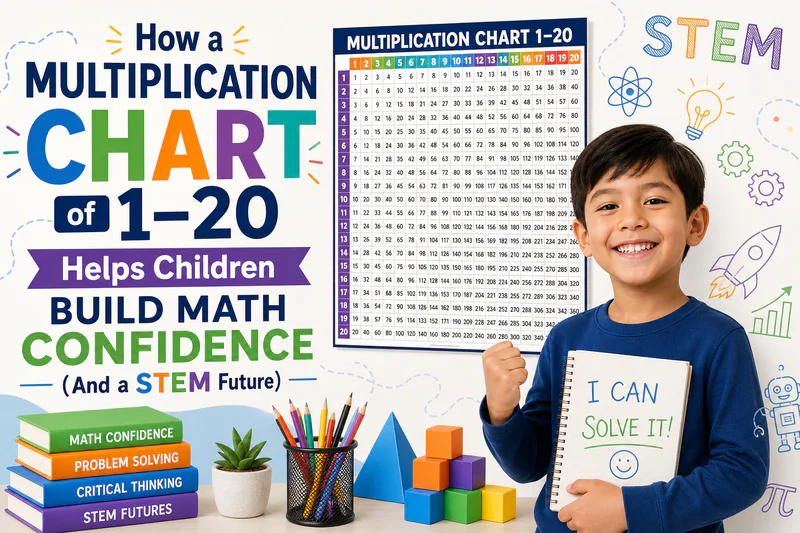
Times tables shouldn't feel like torture. Yet for millions of children in 2026, the nightly multiplication drill is still a source of tears, frustration, and a creeping belief that they're "just not math people." The good news: that belief is wrong, and a simple visual tool, the 1–20 multiplication chart, can flip the entire experience.
This guide shows parents exactly how to use the 1–20 chart to build genuine math fluency, introduces Vedic shortcuts for the trickier tables, and reveals something most parents don't expect: multiplication is the gateway to coding logic, Scratch games, and Python scripts.
What Is a Multiplication Chart of 1–20?
A multiplication chart of 1–20 is a structured grid that displays every product from 1×1 through 20×20. The rows and columns are both labeled 1 through 20, and the intersection of any row and column gives the answer instantly. At a glance, a child can locate 13×14 = 182 without mental effort, making it both a reference tool and a pattern-recognition trainer.
The 1–20 chart is meaningfully different from the standard 1–10 version taught in most primary classrooms. The 1–10 chart tops out at 100 products. The 1–20 chart covers 400 products and introduces number relationships that are invisible in the smaller grid, patterns in the 11s, symmetry in the 12s and 15s, and the elegant doubling logic of the 16–20 range. For any child enrolled in structured math tutoring for kids, graduating from the 1–10 to the 1–20 chart is one of the fastest ways to level up their arithmetic confidence.
Why 1–20 Beats the Standard 1–10 Chart
Most school curricula stop at 10×10. It's a reasonable starting point, but it creates a ceiling. The moment children encounter fractions, percentages, unit conversions, or early algebra, all of which appear by Grade 5, they need fluency with numbers beyond 100. A child who knows 16×7 = 112 on instinct processes these problems far faster than one who has to reconstruct the answer from scratch every time.
The 1–20 chart also builds stronger number sense. Seeing how 15×6 = 90 and 15×8 = 120 trains a child's brain to recognize multiples, anticipate patterns, and estimate confidently. This is the foundation for mental arithmetic and real-life problem solving, from calculating discounts at a store to splitting costs among friends.
Critically, the 11–20 range is where vedic math classes become a game-changer. Ancient Vedic techniques reduce the cognitive load of memorizing these larger tables to a set of elegant, repeatable patterns, something we'll break down shortly.
For parents looking at strategies that work for kids who hate maths, introducing the 1–20 chart through pattern-based discovery, rather than brute-force memorization, is one of the most effective pivots you can make.
Pattern & Trick Breakdown Table: Mastering the 1–20 Chart
This table is designed for parents and educators to use as a quick reference. Each range has a core mental trick and a direct connection to coding logic, because the same pattern recognition that unlocks times tables also powers computer programming.
Notice how every range rewards a child who already thinks in patterns. This is not a coincidence. Mathematicians and computer scientists use the same cognitive toolkit, which is exactly why mental math tricks for kids pair so naturally with early programming concepts.
Vedic Math Shortcuts for the Tricky 11–20 Tables

The 11–20 range is where most children hit a wall. Traditional rote memorization of 19×17 = 323 feels arbitrary and overwhelming. Vedic math classes solve this by providing a structural framework instead of isolated facts.
The most powerful Vedic shortcut for this range is the "base 10" method (drawn from the Sutra Nikhilam Navatashcaramam Dashatah). Here's how it works for 14×16:
Both numbers are close to the base of 10. Find how far each is above 10: 14 is +4, 16 is +6.
Add one number to the surplus of the other: 14 + 6 = 20. This is your left digit(s).
Multiply the two surpluses: 4 × 6 = 24. This is your right digit(s).
Result: 20 | 24 = 224. ✅
For the 11s specifically, the rule is even simpler: 11 × any two-digit number places the digit sum between the outer digits. So 11 × 43 = 4 (4+3) 3 = 473. Children in vedic math classes learn to apply these patterns in seconds, making the 11–20 range feel genuinely easy rather than intimidating.
Explore how vedic math for kids transforms not just the times tables but a child's entire relationship with mental arithmetic.
The STEM Secret: How Multiplication Connects to Coding

Here's the insight most parents miss: multiplication is not just arithmetic. It is, at its core, a loop. When a child calculates 7×5, they are performing the same operation a computer performs when it iterates: "add 7 to itself, 5 times." The conceptual bridge between the times table and the for loop is direct and deliberate.
This connection is why coding and math for kids is one of the most powerful pairings in modern STEM education.
Scratch programming for kids offers an immediately tangible way to experience this. In Scratch, a child can build a multiplication quiz game where a sprite asks "What is 13 × 7?" and the program checks their answer, all using loops and variables. Scratch programming for kids makes abstract multiplication concrete because the child both uses the math and sees it run as code. The feedback is instant, visual, and deeply satisfying.
Python for kids takes this further. A child who knows their 1–20 chart can write a Python script in under 10 lines that generates any multiplication table on demand:
number = int(input("Enter a number: "))
for i in range(1, 21):
    print(f"{number} x {i} = {number * i}")
This Python for kids exercise is not just reinforcement, it's transformation. The child goes from memorizing a table to generating one. Explore Python projects for kids that make this kind of mathematical thinking hands-on and genuinely fun.
From there, app development classes for kids become a logical next step. Understanding how multiplication scales data, powers algorithms, and drives user interfaces in mobile apps gives children a reason to care about math that extends far beyond the classroom. Many app development classes for kids integrate math logic as a prerequisite for building functional, dynamic applications, from quiz apps to simple calculators to games.
Enroll in online coding classes for kids to explore how structured programming curriculum builds on exactly the math foundations covered in this article.
7 Core Benefits of Using a Multiplication Chart
A well-used 1–20 chart delivers far more than memorized facts. Here's what parents consistently observe:
Faster mental math: Daily exposure to the grid trains the brain to recognize products automatically, reducing calculation time across all math domains.
Reduced math anxiety: Seeing the full chart demystifies large numbers. "20×20 = 400" stops feeling daunting when a child can trace it visually.
Stronger pattern recognition: The chart makes mathematical patterns, doubling, halving, symmetry, visually obvious in ways a textbook exercise never could.
Foundation for higher math: Fractions, ratios, algebra, and percentages all depend on fast multiplication retrieval. A child who knows the 1–20 chart cold has a measurable head start.
Bridge to coding logic: As outlined above, fluency with multiplication patterns maps directly onto loop logic, array manipulation, and algorithmic thinking.
Engagement through digital tools: Quality online math programs for kids use the chart as an interactive scaffold, generating adaptive quizzes, tracking mastery by table, and making practice feel like a game rather than a chore.
Confidence that compounds: Each table mastered makes the next one easier. The chart gives children a measurable, visible record of progress, a powerful motivator.
A Practical Weekly Practice Schedule for Parents
Consistency matters more than duration. Twenty focused minutes per day outperforms a two-hour weekend session every time. Here's a structured weekly framework:
Monday & Wednesday, Chart Exploration (15–20 min) Open the 1–20 chart and identify one pattern together. Ask: "What do you notice about all the 15s?" Let the child discover the pattern rather than being told it. Follow up with 10 rapid-fire oral questions from that table range.
Tuesday & Thursday, Online Math Programs (20 min) Use structured online math programs for kids to practice interactively. These platforms track which tables your child struggles with and serve targeted practice, far more efficient than random drilling. Good online math programs for kids also incorporate timed challenges that build processing speed alongside accuracy.
Friday, Coding Reinforcement (20–30 min) Spend Friday connecting math to coding for kids. If your child uses Scratch programming for kids, have them build or extend a multiplication quiz. If they're older, try a Python for kids script that auto-generates tables from 1–20 and asks the user to guess products before revealing answers.
Saturday, Vedic Math Session (15 min) Focus specifically on the 11–20 range using Vedic shortcuts from vedic math classes. Pick two tables, apply the base-10 method, and practice 5 examples together. Vedic math classes structured around weekly themes make this feel like puzzle-solving rather than homework.
Sunday, Review & Celebrate Progress Pull out the chart and quiz your child on whichever tables they found hardest during the week. Keep it light. Math tutoring for kids works best when the home environment reinforces the idea that mistakes are part of the process, not evidence of failure.
The goal over 6–8 weeks: full fluency across 1–10, strong recall across 11–15, and confident pattern-use for 16–20. Combining structured math tutoring for kids with this schedule consistently produces measurable results.
Conclusion
The 1–20 multiplication chart is far more than a classroom poster. Used strategically, it is a visual pattern trainer, a mental math launcher, a gateway to Vedic shortcuts, and the conceptual foundation of coding logic, all in a single grid.
The parents who get the best results in 2026 are the ones who treat math and STEM as a connected system: pairing structured math tutoring for kids with quality online math programs for kids, weaving in vedic math classes for the tricky upper tables, and introducing coding for kids concepts that show children exactly why multiplication matters beyond the exam. Start with the chart. Build the habit. Then watch arithmetic confidence grow into a fully realized STEM skill set.
Frequently Asked Questions
What age group benefits most from math tutoring for kids using the 1–20 chart?
Children aged 7–12 benefit most directly. By age 7, most children have the cognitive readiness to recognize multiplication as repeated addition. By age 12, fluency with the full 1–20 chart underpins pre-algebra, fractions, and geometry. That said, math tutoring for kids using the 1–20 chart as a visual reference is beneficial even for teenagers who have gaps in their foundational arithmetic.
How often should children practice multiplication charts to retain knowledge?
Daily short sessions of 15–20 minutes are far more effective than occasional long sessions. Research in spaced repetition consistently shows that math tutoring for kids works best when practice is distributed, small doses, frequently repeated. Aim for at least 5 days per week, mixing chart reference, oral drills, and digital practice through online math programs for kids.
How do vedic math classes help with memorizing larger multiplication tables?
Vedic math classes replace isolated memorization with pattern-based rules. Instead of forcing a child to memorize that 18×17 = 306 as a standalone fact, vedic math classes teach the base-10 method that makes any 11–20 multiplication calculable in seconds. This dramatically reduces the cognitive load of the 1–20 chart's upper range and gives children reusable mental tools rather than isolated data points. Vedic math classes also improve overall arithmetic speed, which boosts performance across all math subjects.
Can online math programs for kids improve multiplication learning at home?
Absolutely. The best online math programs for kids use adaptive algorithms to identify exactly which tables a child struggles with and serve targeted practice in real time. Unlike static worksheets, online math programs for kids provide instant feedback, gamified challenges, and progress tracking that keeps children motivated over weeks and months. Platforms that integrate the 1–20 chart into their curriculum produce notably faster mastery than drill-only approaches.
What is the relationship between multiplication and coding for kids?
Multiplication is conceptually identical to a loop in programming. When a child computes 6×8, they are performing what a computer executes as: repeat the operation of adding 6, eight times. This makes coding for kids a natural extension of math fluency. Children who understand multiplication patterns find loops, arrays, and iteration in coding for kids courses significantly more intuitive. The logic transfers directly.
How can Python for kids projects reinforce multiplication skills?
Python for kids projects reinforce multiplication in two ways: first, by having children write scripts that generate multiplication tables, turning passive knowledge into active production; second, by using mathematical operators inside programs that solve real problems. A child writing a Python for kids project to calculate the cost of multiple items, or to build a multiplication quiz game, experiences math as a creative tool. Python for kids is especially powerful for students aged 10 and up who are ready to see their math knowledge run as functional code.
Are app development classes for kids suitable only after mastering multiplication?
Not exclusively, but multiplication fluency significantly accelerates progress in app development classes for kids. Building dynamic apps, calculators, quiz platforms, score trackers, requires students to apply multiplication logic inside their code. Children who are already comfortable with the 1–20 chart find app development classes for kids far more accessible because they can focus on the programming concepts rather than getting stuck on the underlying math. App development classes for kids work best as a parallel stream, pursued alongside ongoing math tutoring for kids.
How do multiplication charts reduce math anxiety?
Math anxiety is often rooted in the fear of being wrong in real time. The 1–20 chart gives children a safe reference point, a visual anchor they can consult while building confidence. Over time, the need to look things up diminishes as retrieval becomes automatic. This progression from reference to recall builds genuine confidence. Combining chart use with supportive math tutoring for kids, rather than high-pressure timed tests, ensures children associate math with competence rather than stress.
What are effective strategies that work for kids who hate maths?
The most effective approach is replacing repetitive drilling with pattern-discovery and application. Let children find the ×11 pattern themselves before telling them the rule. Connect every math concept to something visual, physical, or digital. Online math programs for kids that use games and challenges replace the dread of worksheets with genuine engagement. Vedic math classes add a "magic trick" quality to calculation that many reluctant learners find compelling. And for tech-interested kids, showing how coding for kids is built on multiplication logic is often the motivational breakthrough that changes their relationship with math entirely.
How can parents combine math tutoring for kids with online coding classes for kids effectively?
The most effective combination treats math and coding as parallel, mutually reinforcing tracks. Schedule math tutoring for kids focused on the 1–20 chart and mental arithmetic 4–5 days per week, and online coding classes for kids 2–3 days per week. Choose coding curriculum, Scratch programming for kids for ages 7–10, Python for kids for ages 10–14, app development classes for kids for ages 12 and up, that explicitly uses mathematical thinking. When a child sees that the multiplication pattern they practiced on Tuesday powers the loop they write on Thursday, the motivation for both subjects multiplies.