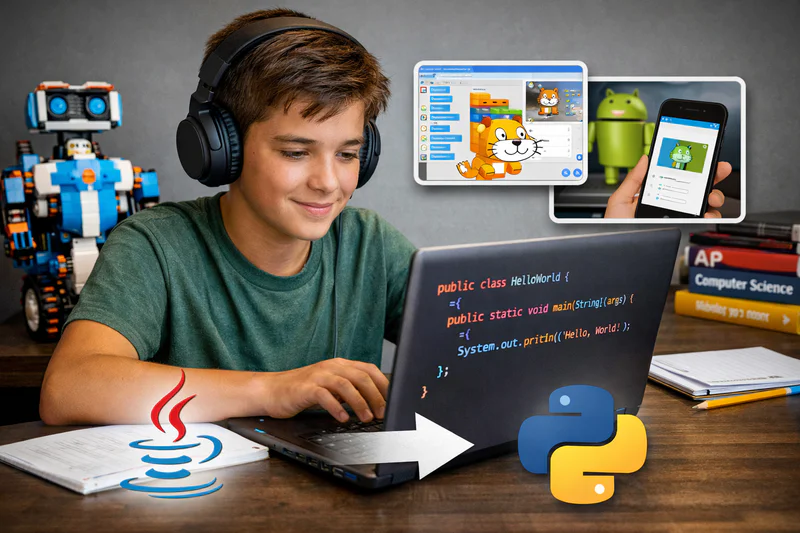
Java for Kids: Is It Too Hard, or the Perfect Next Step After Scratch?
Java has a reputation. Ask most people which programming language is the most intimidating and Java is near the top of the list. Verbose syntax, strict typing, object-oriented rules that feel rigid compared to Python's flexibility. Parents who hear their child is interested in Java sometimes worry they're reaching for something beyond their level.
That reputation is partly earned and partly outdated. For the right child at the right age, Java for kids is not just manageable. It is one of the most valuable coding paths they can pursue. Java is used to build Android applications, enterprise software systems, and large-scale back-end infrastructure. It is the language taught in Advanced Placement Computer Science in the USA and is a standard first language in computer science programmes at universities worldwide.
This guide settles the question of whether Java is too hard for children, covers the right age and prerequisites, explains what children actually build, and compares Java to Python so parents can make an informed choice.
Key Takeaways
Java is appropriate for children aged 13 and above who have some prior coding experience, particularly with Python or Scratch.
Java's strict structure and object-oriented design, while demanding, teach programming discipline that transfers directly to advanced computer science study.
Java is the primary language for Android app development and is central to AP Computer Science A in the USA, making it highly relevant for academic and career goals.
Python is a better first language for most children. Java is the better second language for children aiming at serious computer science study or Android development.
Codeyoung's Java programme for children aged 13 to 17 is taught as 1:1 live instruction, starting from the fundamentals and building toward real application projects.
Is Java Too Hard for Kids to Learn?
The difficulty question deserves a direct answer. Java is harder than Python for beginners. That is not a close call. Python's syntax is forgiving, readable, and designed to minimise the boilerplate required to do anything. Java requires more setup, more structure, and more understanding of types and classes before a "Hello, World!" programme works at all.
But "harder than Python" is not the same as "too hard for children." The ceiling question is the wrong one. The right question is: for which children, at which age, with which preparation, does Java become productive and rewarding rather than frustrating?
The answer: children aged 13 and above who have spent at least 6 to 12 months with Python or have a strong Scratch background find Java demanding but manageable, particularly with good 1:1 instruction. The initial friction is real. It passes within 4 to 6 sessions for most students. After that, the structure that made Java feel rigid starts to feel like scaffolding, which is actually what it is.
What makes Java harder than Python for beginners?
Java requires explicit type declarations: you must specify whether a variable holds an integer, a string, or a boolean before using it. It requires class wrappers around all code. It uses semicolons at the end of every statement. These rules feel like friction initially, but they serve a purpose: they force children to think precisely about what kind of data they are working with and how their code is structured. That precision is a programming discipline, and it's one that produces better software engineers over time.
Java vs Python for Kids: How to Choose the Right Language
This is one of the most common questions parents raise when their child is ready to move beyond beginner coding. Both languages are genuinely excellent choices. They serve different goals and suit different child profiles.
Java vs Python for Kids: Side-by-Side Comparison
For most children, Python first and Java second is the optimal sequence. Python builds programming intuition and confidence. Java then adds structural rigour and object-oriented discipline that takes that intuition to a more professional level. Children who have done both languages are noticeably more capable than those who have stuck to one.
Not sure whether Java or Python is the right next step for your child? Codeyoung's instructors assess each student before recommending a track. Book a free trial class and get a clear recommendation.
What Do Kids Actually Build When Learning Java?
One of the most effective ways to evaluate a coding track is to ask what children produce. Java projects at the children's education level are genuinely substantial, particularly compared to what's possible in Scratch or early Python.
Java Projects for Kids by Skill Level
The beginner projects look simpler than equivalent Python projects because Java requires more setup. But the object-oriented concepts that appear in the intermediate stage are where Java's real teaching value becomes clear. A child who builds a library management system in Java, complete with Book and Member classes, inheritance hierarchies, and encapsulated data, has understood object-oriented programming in a way that a Python student typically reaches several months later.
Why Is Java the Language for AP Computer Science and University Study?
AP Computer Science A, the College Board's advanced computer science qualification for US high school students, is taught entirely in Java. This is not an accident. Java's strict type system and enforced object-oriented structure mean that students who learn it develop the kind of precise, disciplined coding habits that university-level computer science demands. Students who arrive at university having already spent a year with Java are measurably better prepared for their first programming course than those who arrive with only Python experience, even if Python students find Java concepts accessible once introduced.
Beyond AP, Java is used as the primary teaching language in introductory computer science courses at a significant number of top universities, including Carnegie Mellon, the University of Washington, and others. Parents whose children have college-level CS aspirations should weigh this when deciding between Python and Java as a second language.
There is also the Android development dimension. Android, which runs on more than 70% of smartphones worldwide, is built primarily in Java and Kotlin (Kotlin is closely related and interoperable with Java). A child who learns Java and progresses toward Android development has a direct path to building applications for the most widely used mobile platform in the world.
What Object-Oriented Programming Means for Kids Learning Java
Object-oriented programming (OOP) is the core paradigm that Java enforces from the start. It is one of the most important concepts in all of professional software development, and it is one of the areas where Java teaches it most thoroughly.
The basic idea is that code is organised around objects, which represent real-world things or abstract entities. A Bank object has attributes (balance, account number) and behaviours (deposit, withdraw). A Car object has attributes (speed, fuel level) and behaviours (accelerate, brake). These objects interact with each other rather than existing as isolated functions.
Children who grasp this paradigm think about programming differently. Instead of writing a long sequence of instructions, they design systems of interacting components. This is exactly how professional software is built, and Java's insistence on OOP from the beginning means children develop this thinking early rather than having to unlearn procedural habits later.
How do you explain object-oriented programming to a child?
The most effective analogy for children is a physical one. Imagine building a video game. Every character is an object. Each character has stats (attributes) and actions they can perform (methods). The Warrior class and the Mage class are different types, but they both inherit from the same Character parent class, so they share some behaviours (like moving and taking damage) while having their own unique ones. This analogy maps directly to Java class hierarchies and is intuitive enough that most children aged 12 and above grasp it quickly.
How Does Learning Java Affect a Child's Broader Coding Development?
Java's impact on a child's programming development goes beyond the language itself. Children who learn Java develop specific habits that make them stronger programmers in any language they pick up afterward.
The first is precision. Java punishes imprecision: wrong types produce compile errors, missing semicolons stop the programme, poorly designed classes create maintenance problems. Children who code in Java learn to be careful, systematic, and deliberate. That habit transfers to every other language they use.
The second is architectural thinking. Java's insistence on classes from the very beginning pushes children to think about how to organise their code before writing it. This is design thinking applied to software, and it is a skill that most programmers spend years developing. Java students build it earlier.
The third is problem decomposition. Java projects, particularly at the intermediate level, require children to break a complex system into manageable classes and methods. This decomposition skill is the foundation of all professional software engineering. Explore Codeyoung's Java programme for kids alongside the full coding curriculum to see how Java fits into a broader learning path.
Frequently Asked Questions About Java for Kids
What age should kids start learning Java?
Most children are ready to begin Java from around age 13, particularly if they have 6 to 12 months of Python or Scratch experience beforehand. The strict syntax and object-oriented requirements make Java challenging for younger beginners who haven't yet developed programming intuition. Children aged 14 to 17 with a Python background typically find Java demanding but very manageable, and progress quickly once the initial syntax adjustment settles in after the first few sessions.
Should my child learn Python or Java first?
For most children, Python is the better first language. It has minimal syntax, immediate results, and a gentler learning curve that builds coding confidence quickly. Java as a second language, after 6 to 12 months of Python, produces children who get the best of both: Python's flexibility and intuition, plus Java's structural discipline and object-oriented depth. Children who start Java as a complete beginner can succeed, but they need more support through the initial adjustment period.
Is Java still relevant in 2026, given how popular Python is?
Very much so. Java remains one of the most widely used languages in professional software development, particularly for Android applications, large-scale enterprise back-end systems, and financial technology. It is the language of AP Computer Science A in the USA and is used in introductory courses at many top universities. Python's rise has not displaced Java in the domains where Java is strongest. Both languages are highly relevant, for different contexts.
What can kids build with Java that they can't with Python?
The most significant exclusive use case is native Android app development. Android's primary development ecosystem is Java and Kotlin, and children who want to build for Android specifically will need Java (or Kotlin, which is closely related). Beyond that, Java's strict type system and performance characteristics make it better suited for certain large-scale system design projects and for the specific preparation needed for AP Computer Science A, which is Java-only.
How long does it take a child to become proficient in Java?
Children with Python backgrounds typically reach functional Java proficiency, writing clean class-based programmes independently, within 15 to 25 sessions of 1:1 instruction. Children starting Java without prior coding experience need longer: the initial adjustment to syntax and type declarations takes more time. Full proficiency, including comfortable use of inheritance, polymorphism, and data structures, typically develops over 6 to 12 months of consistent weekly sessions.
Is Java used in school or for any standardised exams?
Yes. AP Computer Science A, the College Board's advanced computer science course for US high school students, is entirely in Java. Students who have prior Java experience before taking AP CSA have a significant advantage over classmates encountering the language for the first time in the course. Many competitive programming competitions also accept Java submissions, making it useful for children interested in maths olympiad-adjacent coding challenges.
What is Kotlin and how does it relate to Java for kids?
Kotlin is a modern programming language that runs on the same platform as Java (the Java Virtual Machine) and is fully interoperable with Java code. Google designated Kotlin as the preferred language for Android development in 2019. For children who learn Java first, transitioning to Kotlin for Android development is relatively smooth because the core programming concepts are shared. Java knowledge is not wasted when a student eventually moves to Kotlin; it makes the transition significantly easier.
Can a shy or less confident child do well in Java?
Java's demanding initial syntax can feel discouraging to children who lack coding confidence. In a 1:1 live format, instructors can manage this carefully: spending more time on the adjustment period, framing syntax errors as normal and expected, and choosing early projects that produce satisfying results quickly despite the additional complexity. Children who are initially intimidated by Java often develop strong confidence from it once they realise that the difficulty is consistent and learnable rather than arbitrary and endless.
How does Java help with AP Computer Science preparation?
AP Computer Science A tests object-oriented programming, algorithms, data structures, and Java-specific concepts including classes, inheritance, interfaces, and standard library use. Children who have studied Java in a structured programme before beginning AP CSA have already worked through the syntax adjustment and OOP fundamentals. They can focus on the exam's analytical and problem-solving dimensions rather than simultaneously learning a new language. Prep time is shorter, scores tend to be higher, and the experience is less stressful.
How does Codeyoung teach Java to children?
Codeyoung's Java programme for children aged 13 to 17 is delivered through live 1:1 sessions with a qualified instructor. The curriculum covers Java fundamentals, object-oriented programming principles, data structures, and real application projects. Sessions are tailored to each child's pace and prior experience. Children who have completed Python work at Codeyoung move directly into the Java track with their existing skills taken into account from the first session.
Java Is Demanding. For the Right Child, That Is Exactly the Point.
Java is not the right first language for most children. It is often the right second or third language, and for children with specific goals, such as AP Computer Science, Android development, or university-level computer science study, it is hard to find a better choice.
The difficulty that puts some parents off is the same quality that makes Java valuable. It forces precision, rewards architectural thinking, and produces programmers who can write code that is not just functional but well-structured. Children who emerge from a solid Java education are genuinely better prepared for advanced computing work than those who've stayed entirely within more forgiving languages.
Explore Codeyoung's Java programme for children aged 13 to 17, or book a free trial to find out whether Java or another track is the right next step for your child.
Ready for your child to take their coding to the next level with Java?
Codeyoung offers personalised 1:1 live Java classes for children aged 13 to 17. Expert instructors, structured curriculum from fundamentals to OOP, flexible scheduling, and a free first class with no commitment.