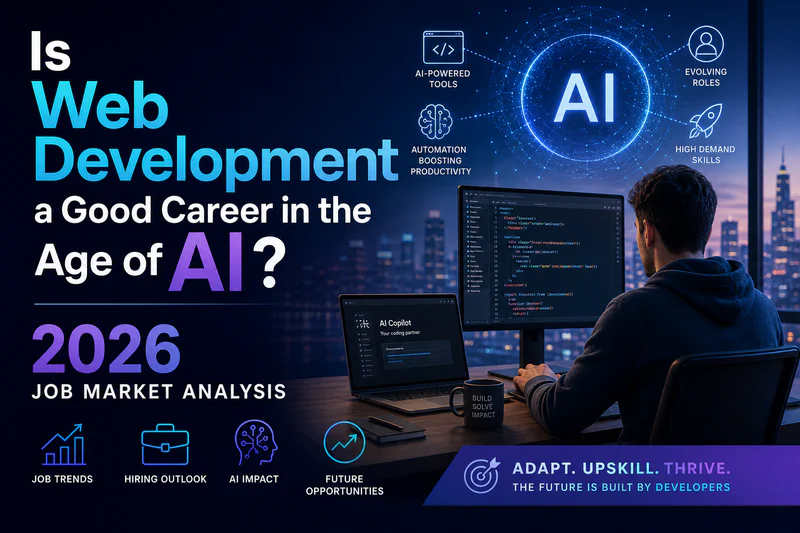
“Will AI Replace Web Developers?” Let’s Stop Panicking and Start Thinking
If you’ve typed “Is web development still a good career?” into Google recently, you’re not alone.
I understand the fear. With headlines claiming ai replace web developers, flashy demos showing AI that can build websites, and promises that machines can write code instantly, the anxiety feels real. I’ve personally tested multiple ai tools, experimented with ai generated code, and explored how ai technology fits into the development process. What I’ve learned is this: panic usually comes from not understanding how ai in web development actually works.
Students are worried. Parents are confused. Career switchers are second-guessing everything. And honestly? The fear makes sense. Everywhere you look, AI is building websites, writing code, designing layouts, and promising results in minutes. No-code tools are booming. AI website builders are everywhere. Headlines shout “Developers Are Obsolete!”
So let’s talk honestly.
This article is not about hype.
It’s not about fear-mongering.
And it’s definitely not about pretending AI doesn’t exist.
This is about how web development is evolving in 2026, what skills actually matter, and whether choosing this path is still a smart, future-proof decision.
The Impact of AI and Web Development Automation
AI didn’t suddenly enter web development—it quietly grew into it.
Automation has always been part of this field. From frameworks to libraries to reusable components, developers have been simplifying work for decades. What’s different now is speed.
AI tools can now:
Generate layouts
Suggest logic
Speed up workflows
Handle repetitive parts of building websites
But here’s the most important distinction you need to understand:
Automation of Tasks Is Not Replacement of Roles
This distinction answers the question people are really asking:
Will AI replace web developers? I’ve watched teams use ai powered tools to automate many tasks in the development process — from setting up web pages to optimizing web apps. This has made web developers faster, not irrelevant. The confusion begins when people assume automation equals replacement. In reality, ai algorithms excel at automating tasks, but they struggle with edge cases, ambiguous user input, and evolving user behavior.
When people ask me whether AI will replace web developers, I always respond with a counter-question: Replace them at what? Writing basic code? Yes, partially. Delivering digital solutions that match a client’s vision, improve user satisfaction, and adapt to user preferences? Not even close.
AI automates tasks.
Developers own decisions.
A website is not just code. It’s:
Understanding user behavior
Translating a client’s vision into digital reality
Designing experiences that actually make sense
Solving edge cases that tools don’t anticipate
AI can help, but it doesn’t “understand” context the way humans do.
How AI Tools Are Making Developers 10x More Productive
I personally leverage AI almost every day, and I’ve noticed a dramatic change in how web development flows. Modern ai tools assist with code generation, debugging, testing, and even rapid prototyping. This doesn’t remove the need for coding skills — it amplifies them. Let’s flip the narrative.![16 Best AI Website Design Examples & Inspiration [2025]](https://prod.superblogcdn.com/site_cuid_clvc4016q001j13bhaleswmt1/images/11d858b8fe14be6d913b825178860f4dfa833bc2-1600x840-1771946139196-compressed.webp)
Instead of asking “Will AI take developer jobs?”, ask:
“What happens to developers who know how to use AI?”
Short answer: they become faster, sharper, and more valuable.
1. Code Generation & Refactoring
AI now assists developers by:
Generating boilerplate code
Refactoring messy logic
Helping structure applications
But AI doesn’t replace thinking. Developers still decide:
What to build
How systems connect
Whether something is scalable or secure
AI can write code, but humans decide what code should exist.
2. Debugging, Testing, and Maintenance

By offloading repetitive tasks and boilerplate code, human programmers can focus on creative problem solving. I’ve worked with teams where AI handled setup, while developers focused on design concepts, user interactions, and customer experience.
Debugging used to consume hours. Now AI:
Spots common errors
Suggests fixes
Helps write test cases
This doesn’t eliminate developers—it frees them from repetitive tasks so they can focus on meaningful problem solving.
3. Faster Prototyping and Iteration
In 2026, speed is currency.
AI allows developers to:
Rapidly prototype ideas
Test concepts early
Iterate based on user interactions
This helps businesses move faster and developers think bigger.
AI is not a replacement.
It’s a multiplier.
Future-Proofing Skills: Is Web Development a Good Career Now?

People often ask me directly: Is web development still worth learning? My answer is simple: yes, but not the way it was taught 10 years ago. The skill set that keeps developers in high demand now includes strategic thinking, problem solving, and continuous learning.
I’ve seen developers struggle when they rely only on traditional web development skills without adapting. At the same time, I’ve watched others thrive by understanding the bigger picture — how business processes, user satisfaction, and digital experiences connect.
From Coding to Thinking
If you only want to type basic code, AI will compete with you. But if you want to create meaningful digital solutions, AI becomes your assistant, not your enemy. That’s why I tell learners to stop obsessing over whether AI will fully replicate human work and instead focus on how to work alongside it.
Moving from “Coder” to “Solution Architect”
In 2026, I see successful web developers acting less like code typists and more like architects. They don’t just build websites — they design systems that align with user preferences, business goals, and real-world constraints.
I’ve personally worked on projects where hand drawn sketches evolved into fully functional web pages. AI helped speed up the process, but humans made judgment calls, resolved edge cases, and ensured the final product felt human. That human touch cannot be automated.
P.S.A Shift I strongly believe in.
2026 Web Developer Job Outlook: New Roles and Opportunities
When people ask me about the future of web development, I never give a vague answer. I look at hiring patterns, startup needs, and how ai systems are reshaping roles rather than removing them. From what I’ve personally observed, the web development landscape is not shrinking — it’s shifting.
Yes, some routine coding roles are declining, especially those focused only on basic code and repetitive implementation. That’s where job displacement feels real. But at the same time, demand for skilled web developers who understand ai integration, user behavior, and digital experiences is growing fast.
I’ve worked with small businesses that tried low code tools and ai powered tools to save costs. Most came back needing human developers to fix logic gaps, handle edge cases, and improve user satisfaction. AI accelerated their work — it didn’t finish it.
rom what I see, companies want developers who can:
Build scalable web apps
Understand business processes
Improve customer experience
Combine software development with strategy
That’s why developers with a strong skill set, adaptability, and continuous learning mindset remain in high demand.
The Rise of AI Interface Design and Prompt Engineering
One trend I’m particularly excited about is how ai in web development is creating entirely new responsibilities. AI doesn’t live in isolation — it needs humans to design how people interact with it.
I’ve personally tested projects where ai models powered recommendations, but developers still had to design:
Clear user input flows
Meaningful user interactions
Interfaces that respect user preferences
This is where natural language processing meets frontend logic. Developers who understand how ai algorithms respond to prompts can design smarter, safer systems. AI can process data, but humans decide how that data is presented.
Prompt Awareness Is a Developer Skill Now
Prompt-driven experiences aren’t magic. They require a deeper understanding of how artificial intelligence behaves under different conditions. I’ve seen AI fail badly when prompts weren’t designed properly — and succeed beautifully when developers guided it thoughtfully.
This blend of creative problem solving and technical design is why AI-focused web roles are expanding, not disappearing.
Why Human Creativity Still Trumps Algorithms in Web Design
Let me say this clearly: no matter how advanced ai technology becomes, it cannot replace human creativity. I’ve watched AI generate layouts, content, and even animations — but it still lacks judgment.
Random examples - While reviewing emails and creating PPTs, AI can be very effective, polished, and accurate in all aspects, but still lacks a personalised touch.
I’ve worked on complex projects where AI suggestions looked perfect on paper but failed in real-world use. Human intuition caught those issues. That’s why AI will never fully replicate the role of human programmers in meaningful digital work.
The Human Touch Is Not Optional
When I help teams design digital solutions, the success always comes from empathy — not automation. AI can assist, but only humans can align a product with a client’s vision and real human needs.
I’ve tested enough tools, platforms, and workflows to say this confidently:
AI will not completely replace web developers.
It will replace:
Poor workflows
Inefficient processes
Developers who refuse to adapt
AI excels at automating tasks, handling repetitive tasks, and speeding up code generation. But it struggles with ambiguity, context, and judgment — the very areas where humans shine.
The idea that AI will replace web developers entirely ignores how messy real projects are. Websites aren’t static. Web pages evolve, users behave unpredictably, and businesses change direction constantly.
Conclusion: Should You Choose Web Development in 2026? (My Personal Verdict)
So let me answer this directly, based on everything I’ve seen, tested, and worked on.
Yes — web development is still a strong career choice in 2026.
But only if you:
Embrace ai and web development together
Leverage AI instead of fearing it
Focus on problem solving, not just syntax
Commit to continuous learning
The future of web development belongs to those who see AI as a collaborator, not a competitor. Developers who understand ai systems, machine learning, and software development fundamentals will continue to create meaningful, scalable digital experiences.
Frequently Asked Questions: The Future of Web Development in 2026
Q: Is web development still a good career choice in 2026?
A: Yes, absolutely! Web development remains a highly lucrative and strong career choice. However, the landscape has evolved. To succeed today, developers must embrace AI as a helpful collaborator rather than fearing it as a competitor.
Q: Will AI eventually replace human web developers?
A: No. While artificial intelligence can help you build websites and write boilerplate code much faster, humans are required to make those websites actually matter. AI lacks human empathy, judgment, and the ability to align a digital experience with complex business goals.
Q: What skills should new developers focus on to stay relevant?
A: Rote memorization of code is no longer enough. The future belongs to developers who focus heavily on complex problem-solving, understand how to integrate machine learning, and commit to continuous learning. It is about understanding software development fundamentals rather than just typing syntax.
Q: How can I prepare my child for the future of web development?
A: The best way to prepare your child is to introduce them to these concepts early! Enrolling them in online coding classes for kids or specific AI classes for kids teaches them to view technology as a tool they control. By learning web development for kids today, they build the resilient problem-solving skills needed to thrive alongside AI tomorrow.