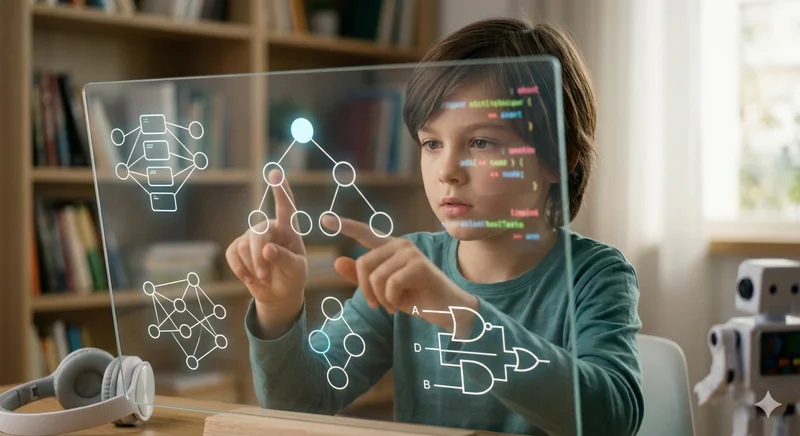
Computer Science for Kids: What It Covers and Why It Matters Beyond Coding
Parents often use "coding" and "computer science" interchangeably. Teachers sometimes do too. They're related, but they're not the same thing, and the difference matters if you're trying to understand what your child is learning or what they should be learning.
Coding is a skill: the ability to write instructions in a programming language that a computer can execute. Computer science is the broader academic discipline that coding lives within. It includes algorithms, data structures, logic, computational thinking, operating systems, networks, databases, and the mathematical foundations of software. A child can code well without knowing much computer science. A child who understands both codes better, solves harder problems, and has a stronger foundation for university-level study in any technical field.
This guide covers what computer science for children actually means, how it differs from coding, what its core concepts are and how they're taught, why it matters beyond programming, and how children can build genuine CS knowledge from primary school through to secondary.
Key Takeaways
Computer science is broader than coding, it includes algorithms, data structures, logic, systems, and mathematical reasoning that underpin all software and technology.
Children can begin building computer science thinking from age 6 through logic games, pattern recognition, and computational thinking activities that require no device at all.
AP Computer Science (USA) and GCSE/A-Level Computer Science (UK) are among the most valuable school qualifications for children interested in technology careers.
The thinking skills developed through computer science, algorithmic reasoning, abstraction, decomposition, transfer into maths, science, and problem-solving across every domain.
Coding education that focuses only on syntax and projects without the underlying CS concepts produces a child who can code but struggles with the hardest problems in their track.
What Is Computer Science and How Does It Differ From Coding?
The most useful analogy is the relationship between mathematics and arithmetic. Arithmetic is a skill: the ability to calculate. Mathematics is the broader discipline that includes arithmetic but also geometry, algebra, statistics, proof, and abstract reasoning. A child who knows arithmetic is useful in many contexts. A child who understands mathematics is equipped for a far wider range of problems.
Coding is to computer science what arithmetic is to mathematics. It's a practical skill embedded within a much broader intellectual discipline. Computer science covers:
The Core Areas of Computer Science and What They Cover
Computational Thinking: The CS Skill That Starts Earliest
Of all the areas of computer science, computational thinking is the one most directly relevant to children's education from the earliest ages, and the one most consistently undervalued by programmes that focus entirely on coding syntax and project completion.
Computational thinking consists of four interconnected habits of mind:
Decomposition: breaking a large, complex problem into smaller, manageable parts. This is what professional engineers do when they architect a system and what children do when they plan a coding project step by step rather than attempting to build everything at once.
Pattern recognition: identifying similarities, regularities, and repetitions within problems. Recognising that a sorting problem and a searching problem share structural similarities allows a child to apply solutions from one domain to the other.
Abstraction: identifying what's essential and ignoring what isn't. A child who writes a function called
calculate_area(width, height)has abstracted away everything specific about a particular rectangle and created a general solution that works for any rectangle.Algorithmic thinking: designing a step-by-step process that reliably produces the correct result. Not just finding an answer, but finding a method that will find the right answer every time the method is applied.
These four habits transfer out of computer science entirely. Decomposition helps children write better essays (break the argument into parts, address each one). Pattern recognition improves maths performance (recognising algebraic patterns). Abstraction improves scientific reasoning (identifying the general principle from a specific experiment). Algorithmic thinking improves any multi-step task planning.
How Does Computer Science Show Up in Children's School Curricula?
The presence of computer science in school varies significantly by country and year group, but in 2026 it is more embedded in formal education than at any previous point.
UK: Computing from Key Stage 1
In England, the National Curriculum includes Computing (which encompasses CS, digital literacy, and IT) from Year 1. At primary level, this includes decomposition, algorithms, and basic programming logic. At GCSE level, Computer Science covers algorithms, data structures, programming, systems architecture, networks, databases, and cybersecurity. A-Level Computer Science adds complexity theory, advanced data structures, and project work.
USA: AP Computer Science Principles and AP Computer Science A
AP Computer Science Principles covers computational thinking, algorithms, data, the internet, and the societal impact of computing in a language-flexible format. AP Computer Science A covers object-oriented programming in Java in depth. Both are recognised by universities and can earn college credit. College Board data consistently shows strong positive correlation between AP CS participation and college performance in technical subjects.
Australia and Canada
Both countries have embedded computational thinking and digital technologies into primary and secondary curricula, with increasing coverage of programming and CS principles at secondary level. The specifics vary by state and province, but the direction is consistent: CS concepts are entering formal education earlier and more systematically than ever before.
For children whose schools don't yet offer strong CS education, supplementary instruction through programmes like Codeyoung provides the foundation that formal curricula are increasingly expecting students to arrive with. See the complete guide to coding for kids for the full progression.
Want your child to develop genuine computer science thinking alongside coding skills? Codeyoung's live 1:1 instruction builds both together. Book a free trial class to see the approach in action.
What Good CS Education Looks Like for Children at Different Ages
Computer Science Learning Goals and Activities by Age Group
Why Does Computer Science Matter Beyond Technology Careers?
The most common parental question about CS education is implicitly career-oriented: will this help my child get a good job? Yes, strongly: the correlation between CS education and career outcomes in technology is well-documented. But limiting the value of CS to career preparation undersells it significantly.
Computational thinking, developed through CS education, improves problem-solving in every domain that involves complex, multi-step challenges. Research from the University of Washington's Computer Science department found that students with CS education backgrounds showed stronger performance in complex reasoning assessments across disciplines including biology, economics, and legal reasoning. The pattern recognition, decomposition, and algorithmic thinking developed in CS contexts transfer into analytical capability that is valuable regardless of career path.
In 2026, computational literacy: the ability to understand how software systems work, not just how to use them, is becoming a general professional competency rather than a specialist one. A journalist who understands data analysis. A doctor who can interpret algorithm-generated diagnostics. A lawyer who can evaluate AI-generated evidence. None of these are "tech careers," but all of them benefit from the foundational thinking that CS education develops.
For the connection between CS foundations and specific high-growth careers, see AI and Machine Learning for Kids: What Parents Need to Know in 2026.
How Parents Can Support CS Learning at Home
Computer science is more abstract than coding, and that abstraction can make parents feel less equipped to support it. In practice, the most valuable home support for CS development doesn't require any technical knowledge.
Play logic and strategy games. Chess, Battleship, Mastermind, and logic puzzle books all develop exactly the pattern recognition and algorithmic thinking that CS requires. They don't look like computer science, but they build the same mental habits.
Ask "why does it do that?" about technology. When a recommendation algorithm on a streaming service suggests something uncanny, ask the child how they think it knew. When a navigation app recalculates after a wrong turn, ask what it's doing. These conversations develop the habit of seeing systems behind surfaces: the core of computational thinking.
Encourage explanation of code, not just running of it. A child who can explain why their programme does what it does has genuine CS understanding. One who can run it but can't explain it has coding fluency without CS comprehension. The explanation habit is the most reliable way to develop the latter from the former.
Read about CS history and ideas. Books like "Hello World" by Hannah Fry or "The Code Book" by Simon Singh make CS ideas accessible and fascinating for children aged 12 and above. Understanding the ideas behind computing is as important as being able to use its tools.
For the full picture of how computational thinking develops through coding practice, see How to Teach Kids to Code at Home: A Parent Guide.
Frequently Asked Questions: Computer Science for Kids
What is the difference between computer science and coding for kids?
Coding is the practical skill of writing instructions in a programming language. Computer science is the broader academic discipline that includes algorithms, data structures, logic, systems, networks, and the mathematical foundations of all software. A child can code well without formal CS education, but a child who understands CS concepts codes better, solves harder problems, and has a stronger foundation for university study in any technical field.
Can young children learn computer science concepts?
Yes, from around age 6, though the format needs to be age-appropriate. Computational thinking, decomposition, pattern recognition, algorithmic thinking, abstraction, can be introduced through physical, unplugged activities that require no device. Sorting objects by different rules, giving step-by-step instructions to a partner, playing logic games, all of these develop CS thinking at an age where formal coding instruction isn't yet appropriate.
What is AP Computer Science, and should my child take it?
AP Computer Science Principles and AP Computer Science A are College Board courses taught in US high schools that cover CS fundamentals and Java programming respectively. Both earn college credit at many universities. Children with strong coding foundations who take AP CS A in particular are among the most prepared students entering university computing programmes. If your child's school offers these courses, taking them is strongly beneficial for any student interested in a technology or data-related career.
What is GCSE Computer Science and who should take it?
GCSE Computer Science is a secondary school qualification in England covering programming (typically Python), algorithms, data structures, systems architecture, networks, and databases. It's one of the most career-relevant GCSE choices for students interested in technology, data science, engineering, or any field that involves analytical reasoning. Students with coding experience find it significantly more manageable than those without. A-Level Computer Science is the natural progression and is well-regarded by UK universities for computing degrees.
What are algorithms, and why do children need to understand them?
An algorithm is a step-by-step procedure that reliably solves a particular type of problem. Sorting a list, searching for an item, finding the shortest path between two points, all of these have well-studied algorithms. Understanding algorithms helps children write more efficient code, solve problems they haven't encountered before by recognising structural similarities to problems they have, and understand why their programmes sometimes run slowly. At the school level, algorithm knowledge is central to GCSE and A-Level CS assessment.
What programming language is most commonly used in school computer science?
Python is the most widely used language in school CS education globally in 2026. GCSE Computer Science in the UK most commonly uses Python. AP Computer Science Principles is language-flexible but most teachers use Python. AP Computer Science A uses Java. University computer science programmes typically use Python for introductory courses and Java or C++ for data structures and algorithms courses. A child who learns Python well before university has a significant advantage in their first year regardless of which university language they encounter.
How does computer science relate to artificial intelligence?
Artificial intelligence is one of the most active research and application areas within computer science. AI systems are built on CS foundations: algorithms determine how models learn, data structures organise training data, logic governs how systems make decisions, and probability theory underpins uncertainty handling. A child who develops strong CS foundations before specialising in AI has significantly better understanding of why AI systems work as they do, not just how to use pre-built tools. For more, see AI and Machine Learning for Kids: What Parents Need to Know in 2026.
What should I look for in a computer science programme for my child?
A quality CS programme for children covers both the practical (writing code, building projects) and the conceptual (why does this algorithm work? what happens if we change this data structure?). It introduces CS vocabulary, algorithm, abstraction, decomposition, complexity, and applies it to real programming work rather than treating them as separate subjects. It progresses from concrete to abstract: starting with things the child can see and manipulate before introducing formal theory. And it builds cumulative understanding rather than covering isolated topics without connecting them.
How does Codeyoung build computer science foundations alongside coding?
Codeyoung's instructors integrate CS thinking into every coding session rather than treating it as a separate subject. When a child's programme runs slowly, the instructor uses it as an opportunity to discuss algorithmic efficiency. When a project requires choosing between a list and a dictionary, the instructor explains the structural difference and why one is more appropriate. When a function is designed, the instructor discusses abstraction, what this function is designed to do, and what it deliberately doesn't need to know. CS concepts enter through the work rather than arriving as theory before the work. Book a free trial class to see this integrated approach in action.
Coding Gets Children Started. Computer Science Takes Them Further.
A child who can code but doesn't understand the CS concepts behind their code will eventually hit a ceiling. The problems that require algorithmic thinking, the projects that need careful data structure choices, the systems that require understanding of how computers work at a lower level, these are where CS knowledge makes the decisive difference.
The good news is that CS thinking develops naturally through well-designed coding education. A child who is taught to think about why their programme works, not just how to make it work, is building CS foundations even when no one has used the phrase "computer science." The key is instruction that connects syntax and projects to the deeper concepts they're expressions of.
For the full picture of how coding and CS combine into a complete technical education, see the complete guide to coding for kids and the Python for Kids complete guide. Or book a free trial and see how Codeyoung builds both dimensions from the first session.
Build the coding skills and the CS thinking behind them.
Codeyoung's live 1:1 classes for children aged 6 to 17 develop both practical coding ability and the computational thinking that makes it powerful. Free first session, no commitment required.