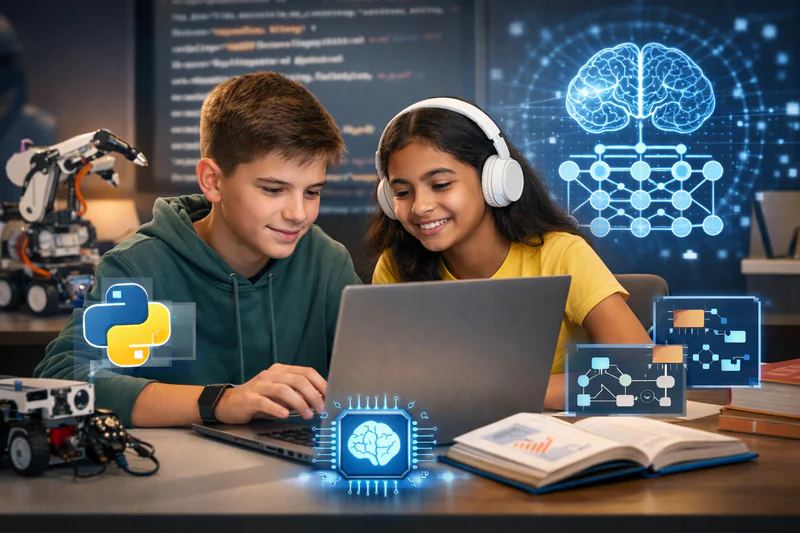
AI and Machine Learning for Kids: What Parents Need to Know in 2026
In 2026, the question is no longer whether artificial intelligence will affect your child's future career. It will. Every sector, from medicine to finance to creative work, is being reshaped by AI systems. The real question is whether your child grows up as someone who uses AI tools without understanding them, or as someone who understands how those tools work and can build new ones.
AI for kids is not the futuristic concept it sounded like five years ago. Children aged 12 and above can learn the foundational concepts of machine learning, train simple models, and build AI-powered projects using Python. The tools are accessible, the concepts are teachable, and the motivation among children who understand what they're building tends to be exceptionally high.
This guide explains what AI and machine learning actually involve at the children's education level, the right age and prerequisites to start, what children build in a well-structured programme, and why starting in 2026 specifically matters.
Key Takeaways
Children aged 12 and above with Python basics can start learning real machine learning concepts, not just AI surface-level tools.
AI literacy, understanding how models are trained and where they fail, is becoming as foundational as reading and maths for future career readiness.
Machine learning for kids is taught using Python libraries like scikit-learn and TensorFlow Lite, the same tools professionals use.
Children who study AI build strong foundations in data thinking, probability, and systems reasoning alongside the technical coding skills.
Codeyoung's Python AI/ML programme introduces children aged 13 to 17 to real machine learning through guided projects in a live 1:1 format.
What Do Kids Actually Learn in an AI and Machine Learning Programme?
There is a meaningful difference between an "AI for kids" programme that teaches children to use AI tools (chat with a chatbot, use an image generator, adjust an AI filter) and one that teaches them how those tools are built. Both have value, but only the second one produces children who can create, evaluate, and improve AI systems rather than just consume them.
A well-structured machine learning programme for children covers several layers of understanding that build on each other progressively.
What Children Learn at Each Stage of AI/ML Education
Is machine learning the same thing as artificial intelligence for kids?
Artificial intelligence is the broad field covering any system that performs tasks typically requiring human intelligence. Machine learning is a specific subset where systems learn from data rather than following explicitly programmed rules. For children's education purposes, the distinction matters because machine learning is the most teachable and immediately applicable branch of AI. Children who understand machine learning understand how recommendation systems, image recognition, voice assistants, and language models actually work at a conceptual level.
The Right Age and Prerequisites for Kids to Start Learning AI
AI and machine learning sit at the advanced end of the children's coding education spectrum. They require a foundation that most beginners don't have yet. Getting this right means the child engages with the actual concepts rather than spending the sessions troubleshooting basic Python syntax.
AI/ML Readiness by Age and Prior Experience
Children who arrive at AI/ML without solid Python foundations tend to find the experience overwhelming. The concepts are genuinely interesting, but if a child is still uncertain about what a function does or how a list is indexed, machine learning libraries will produce confusing errors faster than meaningful learning. The investment in Python first pays back quickly once the child reaches AI work.
Codeyoung's Python AI/ML programme is structured with this progression in mind. Children who aren't yet ready for ML work start with Python foundations in the same programme and move forward when the prerequisite understanding is solid.
Want your child to start learning real AI and machine learning with a qualified 1:1 instructor? Book a free trial class at Codeyoung and find out which starting point suits their current level.
Why 2026 Is a Particularly Important Year to Start AI Education for Kids
The pace of AI adoption across industries has accelerated sharply since 2023. By 2026, AI integration is no longer an experiment in most sectors: it is standard practice in software development, healthcare diagnostics, financial services, content creation, logistics, and education itself. Children starting secondary school today will enter the workforce in a landscape where AI literacy is a baseline expectation in a wide range of fields, not just technical ones.
This creates a specific window of advantage for children who start learning now. The foundational concepts of machine learning, how training data shapes model behaviour, what a loss function does, how to evaluate model performance, haven't become harder to learn. What has changed is that understanding them is increasingly the difference between being a capable contributor in a technical environment and being someone who uses AI tools without being able to evaluate, question, or improve them.
There is also a practical advantage in starting early that compounds over time. A child who begins learning machine learning at 13 and continues through secondary school has two to four years of deepening understanding before university, which puts them in a genuinely different position from peers who encounter the subject for the first time in first-year computer science.
What Real AI Projects Do Kids Build in a Quality Programme?
One reliable way to evaluate a children's AI programme is to ask what students actually build. The answer tells you whether the programme is teaching genuine machine learning or just familiarising children with pre-built AI tools. Here are realistic project examples at different levels.
Beginner (no prior ML experience): A decision tree classifier that predicts whether a mushroom is edible based on a public dataset. The child learns what training data is, what a feature is, and how the model makes decisions without understanding probability yet.
Intermediate: A sentiment analysis tool that reads short text inputs and classifies them as positive, negative, or neutral. The child works with real text data, learns about text preprocessing, and evaluates model accuracy using a test set.
Intermediate to advanced: An image recognition model trained using Google Teachable Machine or TensorFlow Lite that classifies photos into categories the child defines. The child trains the model with their own photographs and tests its accuracy on new images.
Advanced: A recommendation engine that suggests movies or books based on user preferences, using collaborative filtering. The child works with a real public dataset, implements the algorithm in Python, and evaluates the quality of recommendations against known preferences.
Each of these projects involves real decisions: what data to use, how to clean it, how to evaluate performance, and what the model's limitations are. Children who build them don't just know that AI exists. They understand what it can and can't do, which is arguably more valuable than the technical skill itself.
The Broader Skills AI Education Builds in Children
Machine learning teaches technical skills. It also develops a cluster of thinking habits that transfer across subjects and disciplines in ways that other coding tracks don't fully replicate.
Data thinking. Children who work with datasets learn to ask: where does this data come from? Is it representative? What would happen if it were biased? These questions are not just technical. They are the same questions a journalist, a scientist, or a policy analyst needs to ask. Data literacy is increasingly a foundational skill across professions.
Probabilistic reasoning. Machine learning models don't give certain answers. They give probabilities. A model is 87% confident that this is a cat. Working with that kind of output teaches children to think in likelihoods rather than absolutes, which is a significant cognitive upgrade for most school-age learners who are used to right-or-wrong answers.
Ethical thinking about technology. AI programmes that include bias and fairness concepts, which good ones do, teach children to ask who benefits from a model's decisions and who might be harmed. These questions are actively shaping policy and law in 2026. Children who have thought through them in a practical context will be better equipped to engage with them as citizens and as professionals.
Explore Codeyoung's Python AI/ML programme alongside the broader coding curriculum to understand how AI education fits into the full learning path.
How Does AI Education Fit Into a Child's Broader Coding Journey?
AI and machine learning are not an alternative to Python programming or web development. They sit on top of them. A child who arrives at ML with solid Python foundations, comfort with data structures, and basic statistical intuition will make rapid progress. One who tries to learn ML before those foundations are in place will find the experience frustrating regardless of how good the instruction is.
The practical sequence that works for most children is: Scratch or beginner Python (ages 10 to 12), Python proficiency through game development or web development projects (ages 12 to 14), then Python AI/ML as the next frontier (ages 13 to 17, depending on how quickly the prior stages developed). Children don't have to follow this exactly. But parents who understand this sequence can make better decisions about when their child is ready to step up.
Frequently Asked Questions About AI and Machine Learning for Kids
What age should kids start learning AI and machine learning?
Most children are ready to begin introductory AI concepts around age 12 to 13, provided they have a solid foundation in Python basics. Children under 12 are better served by building that Python foundation first. Starting before prerequisites are in place typically produces frustration rather than progress. Children aged 13 to 15 with solid Python skills can begin real supervised learning projects; those aged 15 and above can move into neural networks and more advanced applied AI work.
Does my child need to know maths to learn machine learning?
At the introductory level, solid school-level maths (fractions, percentages, basic statistics like averages) is sufficient to begin machine learning concepts. Children don't need calculus or linear algebra to train and evaluate a decision tree or a simple classifier. Advanced ML topics, particularly neural networks and optimisation, do benefit from stronger mathematical foundations, but those come naturally as children progress through secondary school while also progressing in their ML studies.
What is the difference between AI, machine learning, and deep learning?
Artificial intelligence is the broad field covering systems that perform tasks typically requiring human reasoning. Machine learning is a subset where systems learn from data to make predictions or decisions, rather than following explicitly programmed rules. Deep learning is a further subset that uses neural networks with many layers, particularly effective for images, audio, and text. Children's AI education typically starts with machine learning concepts and introduces deep learning once supervised learning is well understood.
Can children build real AI projects, or is it just theory?
Children in a well-structured programme build real, functional AI projects from relatively early in the course. A spam classifier trained on labelled email data, an image recogniser trained on the child's own photos, or a sentiment analyser built with real text data are all achievable at the intermediate level. These are not toy versions. They use the same Python libraries and the same fundamental approaches that professional data scientists use on production systems.
Will learning AI help my child in school science and maths?
Yes, in both directions. AI/ML work applies mathematical concepts in real, purposeful contexts, which tends to improve children's understanding of and interest in school maths. Concepts like probability, percentages, graphing, and data interpretation all appear in ML work in ways that feel meaningful rather than abstract. Conversely, children who are strong in school maths find ML concepts more accessible, so the two reinforce each other over time.
What Python libraries do kids use for machine learning?
The primary libraries used in children's machine learning education are scikit-learn for supervised learning and classification tasks, pandas for data manipulation and analysis, matplotlib and seaborn for visualising data and model outputs, and TensorFlow Lite or Keras for introductory neural network work. These are all industry-standard tools. A child who learns to use them in an educational setting is building skills that transfer directly to professional and university-level data science work.
Is AI education available for younger children (under 12)?
Conceptual AI education, explaining in age-appropriate terms what AI is, how it learns, and where it appears in everyday life, is suitable and valuable for younger children. Practical machine learning work, training models, working with datasets, and evaluating predictions, requires Python foundations and basic mathematical thinking that most children develop between ages 10 and 12. Younger children are better served by building those foundations first so that when they reach ML, the concepts land properly rather than feeling confusing.
How does AI literacy help children as citizens, not just as potential coders?
AI systems make consequential decisions about people's access to credit, medical diagnoses, content recommendations, and hiring. Children who understand how these systems are built, what data they rely on, and where they can fail are better equipped to evaluate claims made about AI, recognise bias in automated decisions, and participate meaningfully in public conversations about technology governance. AI literacy is increasingly a civic skill, not just a technical one.
What career paths does AI and machine learning education open up for kids?
Machine learning skills are relevant across a wide range of career paths, not just traditional software engineering. Data science, AI research, robotics, healthcare technology, financial modelling, product management at technology companies, and environmental analysis all draw heavily on ML capability. Children who develop strong foundations in AI/ML are not locked into any single path. They're building transferable analytical and technical skills that are valuable wherever data-driven decision-making matters.
How does Codeyoung's Python AI/ML programme work?
Codeyoung's Python AI/ML programme is delivered through live 1:1 sessions with a qualified instructor. The curriculum starts from Python foundations for students who need them, then progresses through data concepts, supervised learning with scikit-learn, and neural networks with TensorFlow Lite. Students build real projects at each stage rather than working through isolated exercises. The programme serves students aged 13 to 17 and is flexible enough to meet each child where their skills currently are.
Understanding AI Is the Literacy Skill of the Next Decade
Children who grow up building AI models don't just have a technical skill. They have a different relationship with the technology that increasingly shapes the world around them. They can ask better questions about it, evaluate claims made about it, and contribute to improving it rather than simply using whatever they're given.
The window for building that foundation is open right now. Children who start in 2026 have years of compounding learning ahead of them before they need to demonstrate these skills in university applications or early career settings. That time is a genuine advantage, and it closes gradually as AI literacy becomes a more standard expectation across education systems.
Explore Codeyoung's Python AI/ML programme for children aged 13 to 17, or book a free trial session to find out where your child should start.
Ready to give your child an AI-literate future?
Codeyoung offers personalised 1:1 live Python AI/ML classes for children aged 13 to 17. Real projects, real tools, expert instructors, and flexible scheduling. The first class is completely free.