
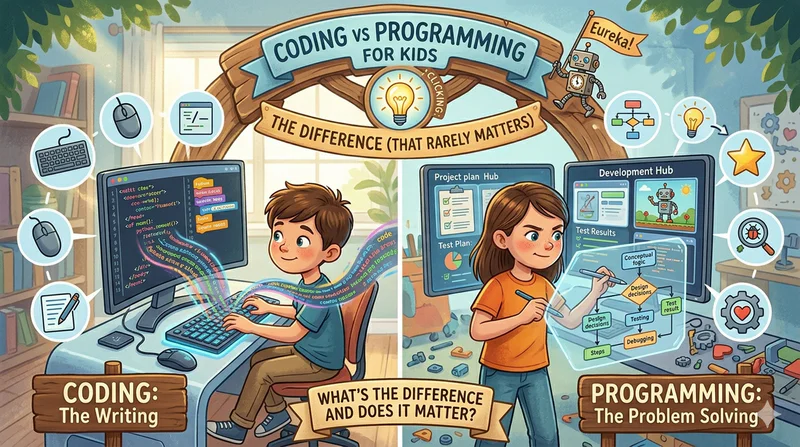
Coding vs Programming for Kids: What's the Difference and Does It Matter?
If you've looked at children's coding courses, read tech education articles, or talked to a teacher about your child's technology education, you've almost certainly seen "coding" and "programming" used as if they're the same thing. Sometimes "learning to code." Sometimes "learning to programme." Often both, in the same sentence, apparently interchangeable.
This trips up a lot of parents, who reasonably wonder whether there's something they're missing. Is one harder than the other? Should a child start with coding and work up to programming? Is there a meaningful educational distinction, or is this just terminology variation?
The honest answer is that coding vs programming for kids is mostly a distinction without a difference at the level of children's education, but understanding why they're sometimes differentiated, and what each term technically emphasises, helps parents make better decisions about what their child is actually learning and what to look for in a course.
Key Takeaways
In everyday usage, including most educational contexts, "coding" and "programming" mean the same thing: learning to give a computer instructions in a programming language.
Where the terms technically differ: coding refers specifically to the act of writing code (the typing-instructions step); programming refers to the broader software development process including design, logic, testing, and debugging.
In children's education this distinction rarely matters: a quality coding or programming course for kids teaches both the writing and the thinking behind it.
What parents should actually focus on is not the terminology of the course but whether it teaches children to build complete, working projects and to understand why their code does what it does.
Computer science is the broader academic discipline that encompasses both coding and programming, plus algorithms, data structures, and the mathematical foundations of software.
What Is the Actual Difference Between Coding and Programming?
At the technical level, a distinction does exist, and it's worth understanding even if it rarely affects how children are taught.
What is coding?
Coding, strictly speaking, is the act of writing code: translating a set of instructions or logic into a programming language that a computer can execute. It is the typing step. A child who opens Python and writes print("Hello, world!") is coding. A developer who implements a feature by writing the specific lines of Python that make it work is coding. The output of coding is lines of text in a programming language.
What is programming?
Programming, strictly speaking, is the broader process of creating a software programme: designing the solution to a problem, thinking through the logic, writing the code, testing whether it works, fixing what doesn't, and maintaining it over time. Coding is one step within programming. A programmer who spends an hour thinking through how to structure a data system before writing a single line of code is programming but not yet coding. The output of programming is a working software programme.
Why does the distinction matter (and when doesn't it)?
In professional software development, the distinction matters because large projects involve more programming work (design, architecture, testing) than coding work (writing the actual lines). A senior engineer spends proportionally more time on the programming activities and less on the pure coding than a junior developer does.
In children's education, the distinction matters very little. A quality children's coding course teaches both: the child writes code (the coding step) but also thinks about what they want to build, plans their approach, tests whether it works, and fixes errors when it doesn't. All of that is programming. Good children's coding education is programming education. Bad children's coding education, rote syntax copying without understanding, is coding-as-typing practice rather than genuine programming.
Coding vs Programming: The Technical Distinction at a Glance
Where Does Computer Science Fit Into This?
Parents sometimes encounter a third term, computer science, and wonder how it relates to both coding and programming. The relationship is hierarchical.
What is computer science vs coding and programming?
Computer science is the academic discipline that encompasses both coding and programming, plus the mathematical and theoretical foundations that underlie all software: algorithms, data structures, complexity theory, logic, operating systems, networks, and databases. Coding and programming are practical activities within the domain of computer science. A child can code and programme without knowing much computer science theory. A child who understands computer science has a richer foundation that makes their coding and programming more powerful and more transferable.
The simplest way to frame the three terms: coding is a skill (writing code). Programming is a practice (building software). Computer science is a discipline (the study of how information is processed, organised, and communicated).
For a full guide to what computer science involves for children and when it starts to matter, see Computer Science for Kids: What It Is and Why It Matters.
What Children Actually Learn in a "Coding" Course
The overwhelming majority of children's coding courses teach programming, not just coding in the narrow technical sense. When a child in a Codeyoung session builds a Scratch game, they are not just typing blocks of code. They are designing a programme (what should happen when the player scores a point?), implementing the design in code (the scoring variable updates when sprites touch), testing whether it works (run it, see what happens), and debugging when it doesn't (the score isn't resetting, why?).
Every one of those activities is programming. The term "coding course" is used because it's more accessible language for parents and children who haven't encountered software development terminology. But the substance of good children's coding education is programming education, and the distinction matters primarily for understanding what to look for.
The key question isn't whether a course is labelled "coding" or "programming", it's whether the child is building complete projects that require design decisions, working through problems when their code doesn't behave as expected, and developing the ability to start new projects independently. Those outcomes indicate genuine programming education regardless of what the course is called.
For more on what quality coding education produces and how to recognise it, see the complete guide to coding for kids and How to Choose the Right Coding Course: An Age-by-Age Guide.
Coding, Programming, and Scripting: Other Terms Parents Encounter
Beyond coding and programming, parents occasionally encounter additional terms that can add confusion. Here is a quick reference.
Technology Education Terms Parents Encounter: Plain Definitions
Want your child to learn both the coding skills and the programming thinking behind them? Codeyoung's live 1:1 sessions teach both together from the first session. Book a free trial class to see it in action.

Should Parents Look for a "Coding" Course or a "Programming" Course?
Neither label tells you much. Both are used for courses spanning the full quality spectrum from excellent to ineffective. What the label doesn't tell you, and what actually matters, is:
Does the child build complete, working projects? Not exercises. Not filled-in templates. Projects the child designed, built, and can demonstrate. A child who has built a game from scratch is learning programming regardless of what the course is called.
Does the child understand why their code does what it does? Ask them to explain a specific part of their project. A child who can say "this loop keeps the game running until the player's score reaches 10, because I need it to check the score condition after every move" has developed programming understanding. One who can only say "I copied this bit and it works" has not.
Does the child debug their own code? When something doesn't work, does the instructor immediately fix it, or does the child work through the problem with guidance? Children who develop the habit of reading error messages, forming hypotheses, and testing solutions are doing genuine programming: the debugging and iteration that distinguishes programming from mere code-copying.
Is there genuine progression over time? A child in month six should be working on substantially more complex projects than they were in month one. If difficulty and project complexity haven't increased, the course is producing activity rather than growth.
For specific criteria and questions to ask any programme before enrolling, see How to Choose the Right Coding Course: An Age-by-Age Guide.
How the Coding vs Programming Distinction Changes as Children Advance
For beginners, the coding-programming distinction is irrelevant, both terms describe the same learning activity. As children advance into more serious work, the distinction starts to become educationally meaningful.
A child building their first Pygame game primarily needs coding skill: writing correct Python syntax, using the Pygame library correctly, getting the mechanics to work. The programming dimension is present but lightweight.
A teenager building a web application from scratch needs more programming than coding in the proportional sense: deciding on the architecture, designing the data model, choosing between approaches, managing the interaction between front-end and back-end components. The coding (writing the actual lines) is a smaller fraction of the total work than it was in the beginner game.
This evolution mirrors professional software development, where seniority involves increasingly more programming (design, architecture, strategy) relative to coding (implementation). Encouraging children to think about their programmes before writing them, to sketch the structure, identify the data they need, plan the functions before implementing them, begins the transition from "coding-focused" to "programming-focused" thinking that more advanced projects require.
For the full picture of how children's coding develops from beginner to advanced, see the complete guide to coding for kids, the Python for Kids complete guide, and How Long Does It Take Kids to Learn Coding?
Frequently Asked Questions: Coding vs Programming for Kids
Is coding the same as programming?
In everyday educational usage, yes: the terms are used interchangeably to mean "learning to give a computer instructions in a programming language." At a technical level, coding is specifically the act of writing code, while programming encompasses the broader software development process including design, testing, and debugging. In children's education, this technical distinction rarely matters: a quality course teaches both the writing and the thinking, regardless of which label it uses.
Which should kids learn first: coding or programming?
This question largely dissolves once the terms are understood. A child doesn't start with coding and advance to programming, they learn both simultaneously from their first session. Writing a simple Scratch game involves coding (putting the blocks together) and programming (deciding what the game should do, testing whether it does it, and fixing it when it doesn't). The distinction becomes more practically relevant at advanced levels, where designing a complex programme requires more explicit planning and architecture work before any code is written.
What is block coding and is it real coding?
Block coding is a visual form of programming where instructions are represented as interlocking blocks that snap together rather than being typed as text. Scratch is the most widely used example. It is absolutely real coding: the blocks represent genuine programming concepts (sequences, loops, conditionals, variables, events) that are identical to those in text-based languages. The difference is purely in how the code is entered. Children who learn through block coding are learning real programming concepts; they simply do so in a form that removes syntax barriers at the beginner stage.
When should children transition from block coding to text-based coding?
For most children, the transition from Scratch (block coding) to Python (text-based coding) is appropriate around ages 10 to 11. The transition is readiness-based rather than age-based: a child who is comfortable with loops, conditionals, variables, and events in Scratch, who can type comfortably, and who is curious about doing more complex things than Scratch makes easy is ready. The transition isn't abandoning coding for programming, it's moving to a more powerful tool that allows both coding and programming to go deeper.
Is coding the same as computer science?
No. Coding is one practical skill within the broader academic discipline of computer science. Computer science also includes algorithms, data structures, complexity theory, logic, operating systems, networking, databases, and the mathematical foundations of all software. A child can code well without knowing much computer science. A child who understands both codes more effectively because they have the theoretical framework that makes programming decisions understandable rather than arbitrary. For a full explanation, see Computer Science for Kids: What It Is and Why It Matters.
Why do some people say "coding" and others say "programming" when talking about the same thing?
Largely a matter of context and era. "Coding" became widely used in the early 2010s alongside the "learn to code" movement popularised by Code.org and similar initiatives. It was chosen partly because it's more accessible and less intimidating than "programming" for a general audience. Within the software industry itself, "programming" and "software development" are more common. Neither is more correct, they describe the same fundamental activity, and the choice between them is mostly stylistic or contextual.
Do children need to learn programming theory, or is just building projects enough?
Both matter, and the best instruction integrates them rather than treating them as separate. Building projects without theoretical grounding produces children who can follow patterns but struggle when they encounter genuinely new problems. Theory without projects produces children who can describe concepts but can't apply them. The optimal approach is what Codeyoung's sessions deliver: theoretical concepts introduced in the context of a project need: the child learns about loops when their game needs to repeat an action, not as an abstract topic from a textbook.
What language should children start with when learning to programme?
For ages 6 to 9: Scratch, which uses block-based visual programming to teach genuine programming concepts without syntax barriers. For ages 10 and above: Python, which is professional, versatile, readable, and used across AI, data science, game development, and web back-end. Both are the right answer for their respective age groups, and the path from Scratch to Python is the most well-supported and well-researched progression in children's coding education. For a full guide, see How to Explain Python to a Child: Concepts and Analogies.
How does Codeyoung teach both coding and programming skills?
Every Codeyoung session combines both dimensions. Children write code (the coding dimension) in the context of building projects they designed and care about. Instructors guide the planning step before coding begins, the debugging step when things don't work, and the reflection step when something works to make sure the child understands why. This integration of thinking (programming) with writing (coding) is what produces children who can start new projects independently rather than just completing instructor-defined exercises. Book a free trial class to see the approach in action from session one.
The Name Matters Less Than What the Child Is Actually Learning
Coding, programming, block coding, scripting, computer science: the terminology of technology education is messier than it needs to be, and it's entirely understandable that parents find it confusing. The most useful reframe is this: don't evaluate a course by what it's called. Evaluate it by what the child produces and understands.
A child who builds working projects, debugs their own errors, can explain why their code does what it does, and brings new ideas to sessions is receiving genuine programming education, regardless of whether the course calls itself a coding class, a programming class, or a computer science programme. A child who copies exercises and produces correct outputs without understanding them is receiving neither, whatever the label says.
Explore Codeyoung's full range of coding and programming programmes for children aged 6 to 17, or book a free trial class and see what genuine programming education looks like from the very first session.
Give your child real coding and programming skills from day one.
Codeyoung's live 1:1 sessions teach both the writing and the thinking behind great software, for children aged 6 to 17. Free first class, no commitment required.