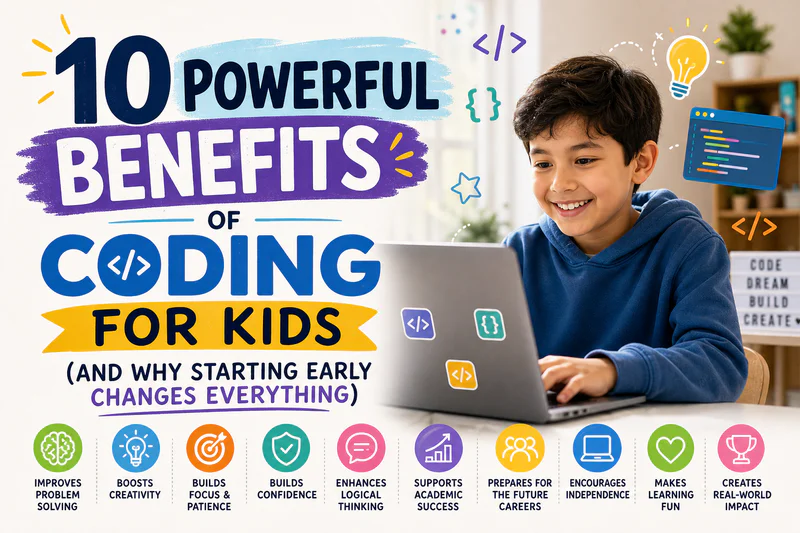
Coding is no longer a skill reserved for future software engineers. It is one of the most powerful cognitive tools a child can develop, strengthening analytical thinking, creative problem-solving, and academic performance across every subject. The earlier children engage with coding, the greater the developmental advantage they carry into adulthood.
This guide breaks down the 10 most significant benefits of coding for kids, how to choose the right program for your child's age, and why personalized live 1:1 coding classes produce results that group or pre-recorded courses simply cannot match.
What Makes Coding for Kids Unique Compared to Other Extracurriculars?
Most extracurricular activities develop one or two skills at a time. Music builds discipline. Sport builds teamwork. Coding for kids does something different, it develops problem-solving, mathematical reasoning, creative design, and communication skills simultaneously, within a single project.
The distinction is also fundamental: coding turns children from passive consumers of technology into active creators of it. Instead of playing a game, they build one. Instead of watching an animation, they design it. That shift in perspective changes how children engage with every challenge they encounter.
For younger beginners, Scratch programming for kids make this creative process immediately accessible. Scratch uses a visual, block-based interface developed by MIT that removes syntax barriers, allowing children as young as six to build interactive stories, animations, and games from their very first session.
The learning model matters just as much as the platform. Personalized live 1:1 coding classes ensure that each child progresses at the right pace, receives immediate feedback, and never sits through content that is either too simple or too advanced. That level of individual attention is what transforms coding from an interesting hobby into a genuine developmental advantage.
10 Benefits of Coding for Kids

Each of these benefits compounds over time. A child who spends a year learning coding for kids at age eight approaches secondary school mathematics, science, and even writing assignments with measurably different cognitive habits, more structured, more persistent, and more willing to experiment.
How to Choose the Best Coding Programs for 6-17 Year Olds

Selecting the right program begins with age-appropriateness. Coding for kids looks very different at age seven than it does at age fourteen, and the best coding programs for 6-17 year olds reflect that reality across every stage.
Ages 6–9: Visual and play-based foundations. At this stage, the goal is engagement, not syntax. Scratch programming for kids is the ideal starting point, block-based, visual, and immediately rewarding. Children build games and stories without ever typing a line of code, but they are learning every fundamental concept: sequencing, logic, loops, and cause-and-effect.
Ages 10–13: Transitioning to text-based languages. Once foundational logic is solid, children can move into languages like Python or JavaScript. The best coding programs for 6-17 year olds introduce text-based coding gradually, connecting it to projects students genuinely care about, apps, games, and web pages.
Ages 14–17: Applied and specialized development. Older students benefit from real-world application: building functional websites, developing mobile apps, or exploring data science and AI fundamentals. At this stage, coding for kids becomes a genuine portfolio skill that universities and employers recognize.
Throughout all age groups, the delivery model is critical. Online coding classes for kids that offer live, instructor-led sessions outperform pre-recorded video courses on every measurable outcome, engagement, concept retention, and project completion rates. When those sessions are one-to-one, the advantage is even more pronounced.
How Online Coding Classes for Kids Work
The model behind effective online coding classes for kids is straightforward: a qualified instructor works with a single student in real time, guiding them through a structured curriculum that adapts to their individual pace and interests.
In a live session, the mentor can instantly identify where a child is stuck, adjust their explanation, and re-route the lesson, something a pre-recorded video can never do. Codeyoung's online coding classes for kids are built entirely around this principle. Every student receives a tailored learning path from their first session, ensuring the curriculum matches their current ability and builds toward clearly defined milestones.
This is where live 1:1 coding classes fundamentally outperform group formats. In a class of ten students, the instructor teaches to the average. In a one-to-one session, every minute of instruction is directed at exactly what that specific child needs next. Children who might disengage in a group environment, either because the pace is too slow or too fast, consistently thrive in the individualized format.
Traditional in-person classes, while valuable, also limit flexibility. Online coding classes for kids remove geography as a barrier, meaning families can access the most qualified instructors regardless of where they live.
Scratch Programming for Kids: The Ideal Starting Point

Scratch programming for kids is a free, visual programming language developed by the MIT Media Lab and used by over 155 million children across more than 200 countries. That global adoption reflects one thing: it works.
Scratch uses drag-and-drop code blocks to eliminate the barrier of syntax errors that typically frustrate young beginners. A child's first Scratch project can be completed in a single session, a working animation, a simple game, a responsive story. That immediate sense of accomplishment is not incidental; it is the mechanism that builds the motivation to keep going.
More importantly, every concept a child learns in Scratch programming, conditionals, loops, variables, event-driven logic, maps directly to the concepts they will use in Python, JavaScript, and beyond. Scratch is not a detour from real coding. It is the foundation on which real coding is built.
Codeyoung's dedicated Scratch programming for kids curriculum structures this progression deliberately, ensuring that by the time a student transitions to text-based languages, the logic is already familiar. They are simply learning a new syntax for ideas they already understand.
Conclusion
Coding for kids is not simply a technical skill, it is a cognitive framework that shapes how children think, create, and solve problems across every area of their lives. The ten benefits outlined here compound with every project completed, every bug debugged, and every idea brought to life through code.
The most effective way to realize these benefits is through structured, personalized instruction. Explore Codeyoung's online coding classes for kids and give your child the advantage of live 1:1 coding classes that adapt to their pace, interest, and potential. Start where every great coder starts, with Scratch programming for kids, and build from there.
Frequently Asked Questions
What is coding for kids, and why is it important?
Coding for kids is the practice of teaching children programming concepts in age-appropriate, engaging formats. It is important because coding develops critical cognitive skills, logical reasoning, problem decomposition, creativity, and persistence, that strengthen academic performance and career readiness far beyond the technology sector. Coding for kids is increasingly recognized as a foundational literacy for the 21st century.
At what age should my child start coding for kids?
Children can begin coding for kids as early as age five or six using visual platforms like Scratch programming for kids. Starting early maximizes the developmental window during which foundational thinking habits are most easily formed. However, coding for kids is beneficial at any age, structured programs exist for every stage from age 6 through 17.
What are the best coding programs for 6-17 year olds?
The best coding programs for 6-17 year olds are age-segmented, offer a clear curriculum progression, and provide live instruction rather than self-paced video content. Programs that start with Scratch programming for kids and advance through Python or JavaScript offer the most coherent developmental path. Live 1:1 coding classes consistently outperform group or recorded alternatives in both engagement and skill retention.
How do online coding classes for kids differ from in-person classes?
Online coding classes for kids offer the same live, instructor-led experience as in-person classes but without geographic limitations. Children can access high-quality instructors from anywhere in the world. Live online coding classes for kids also tend to use purpose-built digital tools, shared coding environments, real-time collaboration features, that make the learning experience highly interactive and effective.
Can coding help kids who struggle with math?
Yes. Coding for kids reinforces mathematical thinking through application rather than abstraction. When a child writes a loop or builds a coordinate-based Scratch animation, they are practicing the same logic and number sense that appear in school mathematics, but in a context that feels creative and engaging. Many parents report that online coding classes for kids improve their child's confidence in math alongside their coding ability.
What makes live 1:1 coding classes more effective?
Live 1:1 coding classes are effective because all instruction is directed at one child's specific needs, pace, and learning style. There is no averaging to the group, no waiting for others to catch up, and no risk of falling behind unnoticed. The instructor adapts every session in real time. According to research on personalized learning, individualized instruction consistently produces stronger outcomes than group instruction for skill-based subjects, and coding is precisely that kind of subject.
Is Scratch programming good for all children interested in coding?
Scratch programming for kids is appropriate for virtually all beginners aged 6-13. Its visual interface removes the technical barriers that commonly discourage young learners, while still teaching genuine programming logic. Children who are already comfortable with Scratch can progress to text-based languages with a strong conceptual foundation. Scratch programming for kids is also used in school curricula across more than 200 countries, which speaks to its broad effectiveness.
How will coding for kids help with my child's future career readiness?
The U.S. Bureau of Labor Statistics projects approximately 317,700 computer and IT job openings annually through 2034. The World Economic Forum's Future of Jobs Report 2025 identifies technology-related roles as the fastest-growing job category globally. Coding for kids provides the foundational skills, algorithmic thinking, data literacy, software development, that underpin virtually every high-growth career in STEM, AI, finance, healthcare technology, and beyond. Starting coding for kids early builds a compounding advantage that shapes academic and professional trajectories for years.