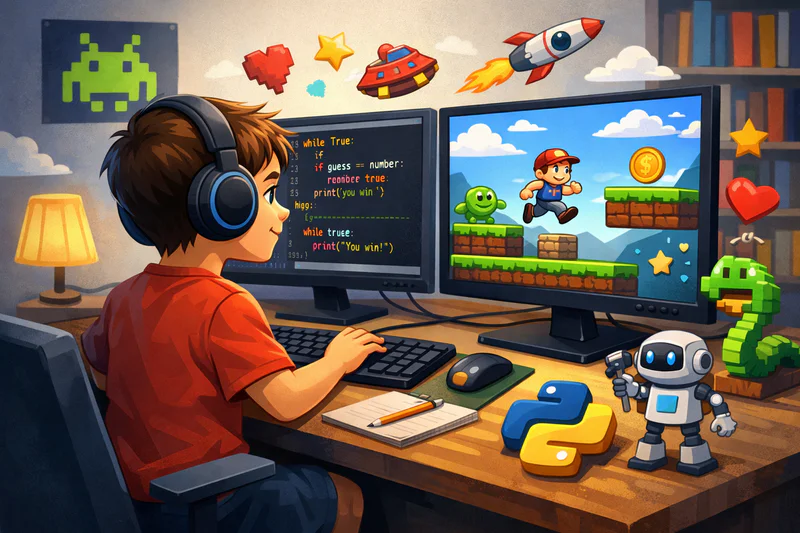
Python Game Development for Kids: Build Your First Game
Ask any child what they'd most like to do with a computer and the answer is usually some version of "make a game." It's the most natural creative ambition in the digital age. And yet most parents assume game development is too advanced for children, something reserved for university computer science programmes or professional studios.
It isn't. Children aged 10 and above can build working, playable games using Python, and the process of doing so teaches programming fundamentals faster and more durably than almost any other project type. Python game development for kids isn't a shortcut around real coding. It is real coding, applied to something children actually care about.
This guide covers what children learn through game development, the tools and libraries involved, the right age to start, and what a realistic progression from beginner to first complete game looks like.
Key Takeaways
Children aged 10 and above can build their first working Python game within 8 to 12 guided sessions.
Game development teaches core programming concepts including loops, conditionals, functions, and object-oriented thinking through projects children are genuinely motivated to finish.
Pygame is the most widely used Python library for beginner and intermediate game development for kids.
Building games produces a portfolio of shareable projects, which is more valuable than certificates for demonstrating coding ability.
Codeyoung's Python game development programme guides students aged 10 to 17 through building real games in a 1:1 live instruction format.
Why Is Game Development Such an Effective Way for Kids to Learn Python?
Most coding exercises feel abstract. Print a number. Sort a list. Write a function that returns the square of its input. These teach real concepts, but they don't give a child a reason to care about getting them right.
Game development flips this. Every concept has an immediate, visible consequence. A loop controls how many times an enemy moves across the screen. A conditional determines whether the player has won or lost. A function governs what happens when two objects collide. The programming is the game. Get it wrong and the game breaks. Get it right and something fun happens.
This feedback loop is unusually powerful for learning. A 2020 study from the University of Washington found that students who learned programming through game development showed 40% higher retention of core concepts after three months compared to students using traditional exercise-based approaches. The mechanism is straightforward: children remember things they cared about building.
What programming concepts do kids learn through game development?
Python game development covers the full set of foundational programming concepts. Variables and data types (player score, health points, speed). Loops (moving objects, checking for collisions on every frame). Conditionals (if the player presses up, move the character). Functions (separate routines for drawing, updating, and handling input). And for more advanced students, object-oriented programming: each game character as its own class with its own attributes and methods. These aren't isolated topics. They're woven together in every game that runs.
The Tools Kids Use: Pygame and Beyond
Python by itself doesn't have built-in game-making capability. That's where libraries come in. A library is a collection of pre-written code that handles complex tasks, so children can focus on the creative and logical parts of game-building rather than writing graphics code from scratch.
Python Game Development Libraries for Kids: Comparison
Most children start with Python's built-in Turtle library to learn the basics of graphics and movement, then move to Pygame when they're ready to build real games with scoring, levels, and collision detection. Pygame is the industry-standard beginner library and has a large community of tutorials, which means children who get curious outside of class have plenty of resources to explore independently.
What Games Can Kids Actually Build With Python?
This is the question that matters most to children researching Python game development, and the answer is more exciting than most parents expect. Here's a realistic look at what's achievable at different skill levels.
Python Games Kids Can Build by Skill Level
One thing worth noting: children at the beginner stage often underestimate how satisfying a simple text-based game feels when they built it themselves. A number guessing game with score tracking and difficulty levels is genuinely fun to share with friends, even without graphics. The complexity comes naturally as the child's skills grow.
Want your child to start building their own Python games with a qualified 1:1 instructor guiding every session? Book a free trial class at Codeyoung and see the first session in action.
What Age Is Right to Start Python Game Development?
The honest answer is: around 10 to 11, assuming the child has had some prior Python or coding experience. A child with no coding background who jumps straight into Pygame will spend most of their early sessions fighting syntax errors rather than making games. That's demoralising. Getting the foundations right first makes everything more enjoyable.
Python Game Development Readiness by Age and Background
Children who've spent time with Scratch have a significant advantage when starting Python game development. They already understand the concept of a game loop, sprite movement, and event-driven programming. All they need to learn is the Python syntax for expressing those ideas in text code rather than visual blocks.
How a Python Game Development Learning Path Actually Works
Parents often ask whether game development is a serious coding education or just entertainment. The answer is that it's both, and the two reinforce each other. Here's what a realistic structured learning path looks like over the first 20 to 25 sessions.
Phase 1: Python fundamentals through game logic (sessions 1 to 6). Children write text-based games: a number guessing game, a rock-paper-scissors programme, a simple quiz. No graphics yet, but the core structures (input, conditionals, loops, functions, and basic data) all appear naturally in these projects. Children who would find a "learn Python variables" lesson tedious often fly through this phase because they're making something that responds to them.
Phase 2: Pygame basics (sessions 7 to 12). The jump to visual games. Children learn to create a window, draw shapes and images, handle keyboard input, and move objects around the screen. The first proper game project usually happens here: a catch game, a simple maze, or a Pong clone. Collision detection arrives in this phase, which is genuinely exciting because it's the moment the game starts feeling real.
Phase 3: Building complete games (sessions 13 to 20). Score tracking, lives, levels, sound effects, and a start screen. Children build complete, shareable games with a beginning, middle, and end. This is also where object-oriented programming gets introduced naturally: when a game has 20 enemies, creating each one as an object with its own position, speed, and health makes the code manageable rather than chaotic.
Phase 4: Personal projects (sessions 20+). Children design and build their own original game from scratch, making creative decisions about mechanics, art, and difficulty. This phase looks different for every student. It's where technical skill and personal creativity combine.
Does Learning to Build Games Help Kids in Their Broader Coding Education?
Consistently, yes. The concepts introduced through game development transfer directly to every other area of programming. A child who understands the game loop (update, render, check input, repeat) has grasped the concept of iteration at a deep level. A child who manages multiple game objects using classes has a solid foundation for understanding object-oriented programming in any language.
There's also a portfolio dimension. A child who has built five Python games can show those games. They can share links, run them for an interviewer, or submit them as part of a school application. This is qualitatively different from a child who has completed an online Python course and earned a certificate. The games exist. The skills are demonstrable, not just stated.
Codeyoung's Python game development programme is structured precisely around this outcome: children emerge with a portfolio of real, working games and a genuine understanding of the Python concepts that made those games possible. That foundation supports everything from AI development to web applications to their first professional coding role, years down the line. Explore the full coding curriculum to see how game development fits alongside other tracks.
Frequently Asked Questions About Python Game Development for Kids
What age should a child be to start Python game development?
Most children are ready to start Python game development between ages 10 and 11, particularly if they have prior experience with Scratch or basic Python. Children with no coding background are usually better served by 6 to 8 sessions of Python fundamentals before moving into game development specifically. A motivated 9-year-old with strong Scratch experience can start the text-based game phase with the right instructor support.
Does my child need to know Python before learning game development?
A basic Python foundation makes game development significantly more productive and enjoyable. Children who jump straight into Pygame without understanding variables, loops, and conditionals spend most of their early sessions troubleshooting errors they don't yet understand. Six to eight sessions of Python basics first means that when game development starts, children can focus on the creative and mechanical aspects rather than the syntax.
What is Pygame and is it suitable for kids?
Pygame is a Python library that provides the tools needed to build 2D games: windows, graphics, sound, keyboard input, and collision detection. It's the most widely used beginner game development library in the Python ecosystem, with extensive documentation and a large community. It is well-suited to children aged 11 and above who have basic Python knowledge. The learning curve is manageable with good instruction, and the output range is wide enough to stay motivating for months.
What is the difference between Python game development and Scratch game development?
Scratch uses visual blocks to create games, requires no typing, and is ideal for children aged 6 to 10. It's a genuine introduction to game logic, but the output stays within Scratch's environment and can't be shared as a standalone product. Python game development produces real executable programmes using professional-grade code. The games are more complex, the skills are more transferable, and the portfolio value is significantly higher for children moving toward further study or careers in technology.
How long does it take for a child to build their first Python game?
With consistent 1:1 instruction, most children complete their first simple text-based Python game within 3 to 5 sessions. The first visual Pygame game typically comes in sessions 8 to 12. A complete, polished game with multiple levels, sound, and scoring usually takes 15 to 20 sessions. The timeline depends on the child's starting level, session frequency, and how much independent practice happens between lessons.
Can kids make money from games they build with Python?
Eventually, yes, though it requires significant further development beyond beginner level. Pygame games aren't natively deployable to app stores, but children who develop strong Python skills can move to engines like Unity (using C#) or Godot, or build browser-playable games using JavaScript. For most children, the immediate value isn't commercial. It's the confidence, skills, and portfolio that game development builds, which opens doors to internships, competitions, and university applications.
What's the best first game for a child to build in Python?
A number guessing game is the ideal first project for complete beginners because it requires only variables, conditionals, loops, and user input. No graphics, no libraries, no installation beyond Python itself. It's completable in one session and gives children an immediate sense of having built something real. After that, a Turtle-based moving-dot game is a strong second project that introduces graphics and keyboard handling without the complexity of Pygame.
Is Python game development taught differently for younger versus older kids?
Yes, significantly. For children aged 10 to 12, instruction focuses on one concept per session, uses highly visual projects with immediate feedback, and keeps game mechanics simple. For children aged 14 to 17, sessions can introduce object-oriented design, more complex game systems, and longer projects that span multiple classes. The underlying Python is the same; the pacing, project complexity, and conceptual depth differ considerably based on age and maturity.
What other coding skills does Python game development lead into?
Python game development builds a foundation that connects naturally to several advanced paths. Object-oriented programming concepts learned through game classes transfer directly to backend web development and software engineering. The mathematical thinking involved in collision detection and game physics prepares students for computer science and engineering study. And the creative project management skills developed from designing and finishing a complete game apply to app development, AI projects, and any other software build.
How is Codeyoung's Python game development programme structured?
Codeyoung's Python game development track is delivered as 1:1 live sessions, starting with Python fundamentals and progressing through Turtle graphics, Pygame basics, and full game projects. Each session is guided by a vetted instructor who adapts the curriculum to the individual child's pace and interests. Students leave with a portfolio of working games and the Python knowledge to continue building independently.
Games Are Where Coding Becomes Real for Kids
Python game development works as a learning path because the motivation is intrinsic. Children don't build games to complete a course. They build games because they want to play them, share them, and improve them. That desire sustains learning through the difficult parts far more reliably than external rewards or structured assignments.
The skills accumulated along the way: loops, functions, classes, logic, and problem-solving under constraints. These are exactly the skills that make strong software developers. Game development is not a detour from serious coding. For many children, it's the most direct route into genuine technical capability.
Explore Codeyoung's Python game development programme for children aged 10 to 17, or book a free trial session to see the first lesson in action.
Ready for your child to build their first Python game?
Codeyoung offers personalised 1:1 live Python game development classes for children aged 10 to 17. Real projects, expert instructors, flexible scheduling, and a free first class with no commitment required.