Online English Classes for Kids: How Live Instruction Builds Real Fluency
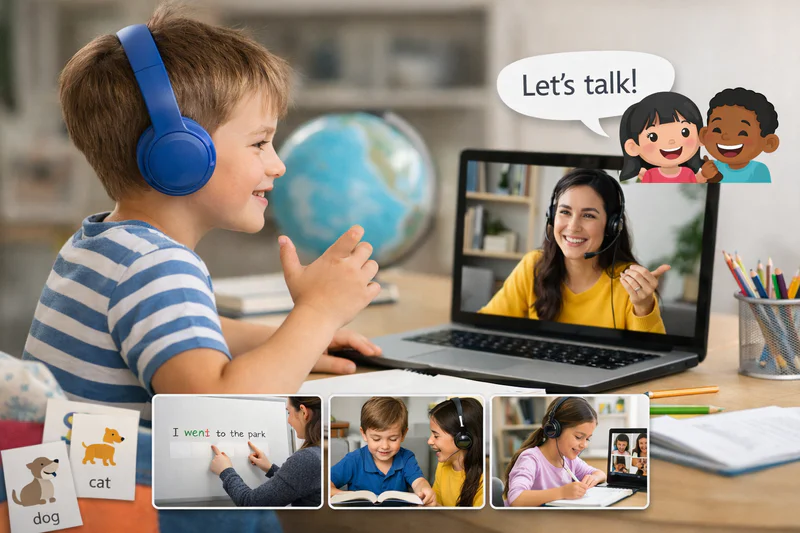
Online English Classes for Kids: How Live Instruction Builds Real Fluency
There is a specific kind of English learner that most parents recognise: the child who can fill in grammar worksheets perfectly, pass written tests with high marks, and still freeze when asked to hold a conversation with a native speaker. Strong on rules, weak on fluency. Accurate on paper, uncertain in real life.
This gap between knowledge and fluency is the central challenge in English education for children, and it is almost entirely a function of how the subject is taught. Grammar knowledge is built through exercises. Fluency is built through practice in authentic communication. Online English classes for kids that prioritise live, interactive, conversational instruction produce a fundamentally different outcome than those that replicate the grammar-exercise model on a screen.
This guide covers what genuine English fluency looks like in children, how live instruction produces it, what to look for in an online English programme, and how to match the right approach to your child's current level and goals.
Key Takeaways
English fluency is built through regular speaking practice in real communicative contexts, not through grammar drills and vocabulary lists alone.
Live 1:1 online instruction produces measurably better fluency outcomes than pre-recorded content or large group classes because the child speaks throughout every session.
Children who receive live English instruction from native or highly proficient speakers develop more accurate pronunciation, richer vocabulary, and stronger conversational confidence than those in text-heavy programmes.
The right online English programme matches content to the child's age, interest, and current level rather than following a fixed syllabus regardless of individual need.
Codeyoung's online English programme for children combines live 1:1 instruction with reading, writing, speaking, and listening practice tailored to each child's specific goals.
What Does Real English Fluency Look Like in a Child?
Parents often conflate fluency with accuracy. A child who never makes grammatical errors is not necessarily fluent. A child who can engage spontaneously and comfortably in conversation, adapt their language to different contexts, understand a range of speakers and accents, and express ideas they haven't rehearsed: that child is fluent.
Fluency has several distinct components, and a well-designed English programme develops all of them rather than over-indexing on any one.
The Components of English Fluency in Children
The table above reveals why grammar-only approaches produce limited fluency: they develop one component while largely neglecting five others. A live conversational programme develops all six simultaneously because real communication requires all of them at once.
Why Live Instruction Produces Better English Fluency Than Pre-Recorded Lessons
Pre-recorded English lessons have a fundamental structural problem: they cannot respond to the child. A video can teach vocabulary. It cannot tell a child their pronunciation of a specific word is almost right but the stress is on the wrong syllable. It cannot ask a follow-up question when the child's answer is technically correct but misses the nuance of the original question. It cannot slow down for confusion or speed up for boredom. It cannot make the child feel heard.
Live instruction can do all of these things. An instructor who is present with the child in real time catches errors at the moment they happen, before they become habits. They choose examples that connect to what the child mentioned five minutes ago. They notice when a topic is producing real engagement and stay with it longer than the planned schedule. They make the English feel like communication rather than content to be processed.
How much of a live English session should a child be speaking?
In a well-run 1:1 live English session, the child should be speaking for at least 50 to 60% of the session time. This is one of the clearest quality indicators parents can look for. If a child is spending most of a session listening, watching, or completing written exercises while the instructor talks, the session is not optimising for fluency development. Speaking is what builds speaking ability. Listening to an instructor speak builds listening comprehension, which is valuable, but not sufficient alone.
What a High-Quality Online English Session Actually Looks Like for Kids
Parents who observe or research online English programmes often struggle to distinguish between genuinely effective instruction and programmes that appear professional but follow a less productive model. Here are the concrete indicators of quality at the session level.
The child speaks first. A well-designed session starts with the child speaking, not the instructor. A warm-up question, a brief story share, an opinion prompt on something age-appropriate. This activates the child's language production before any explicit instruction begins.
Grammar correction happens in context. Rather than stopping to deliver a grammar lesson every time an error occurs, a skilled instructor notes the error, models the correct form naturally ("right, so we would say 'I went' rather than 'I goed'"), and moves on. The correction lands without disrupting the communication flow.
Topics connect to the child's interests. A session built around a child's stated interest in football, animals, space, or cooking produces more language than a session working through a pre-set textbook unit. Motivation and vocabulary acquisition are closely linked: children learn and retain words for things they care about faster than words for things they don't.
Reading and writing are integrated, not separate. A 45-minute session might include a short reading passage the child reads aloud and discusses, 5 minutes of written reflection on a discussion topic, and 30 minutes of conversation. The four skills are practised in relation to each other, not in isolation.
The instructor gives specific, positive feedback. "Good job" tells a child nothing. "That was a really precise way to describe it, you used exactly the right word" tells the child which specific language choices are working and reinforces them.
Want your child to build real English fluency in live 1:1 sessions tailored to their level and interests? Book a free trial class at Codeyoung and see the approach in action from the first session.
What Age Is Right for Kids to Start Online English Classes?
Online English classes are appropriate across a wide age range, but the goals and methods differ significantly by age. Getting the match right between the child's developmental stage and the instructional approach makes a substantial difference to outcomes.
Online English Instruction Goals and Methods by Age
One point worth noting for parents of children in diaspora families or multilingual households: children who are native English speakers can benefit from online English instruction as much as those learning English as an additional language. The goals are different (academic writing, vocabulary depth, critical reading rather than basic fluency) but the value of live, responsive instruction applies equally.
How Online English Classes Support Children in Multilingual Households
A significant portion of children attending online English classes are growing up in households where English is not the primary home language, or where parents are highly proficient but non-native speakers. These children face a specific challenge: they may receive plenty of exposure to English through school and media, but their speaking practice in English is limited to the classroom setting rather than being embedded in their daily home life.
Live 1:1 English instruction fills this gap in a way that passive exposure cannot. It provides the child with a consistent English-speaking conversation partner who gives real-time feedback, introduces age-appropriate vocabulary systematically, and creates a space where the child is expected to communicate in English for an extended period. For children in multilingual households, this sustained, focused English-speaking practice is often the most impactful supplement to school English.
Parents in these households sometimes wonder whether their own non-native English accent or occasional grammatical errors at home will negatively affect their child's English development. Research from the University of Edinburgh's linguistics department suggests this concern is largely unfounded: children who receive high-quality instruction from proficient speakers develop native-like accuracy regardless of the language environment at home, provided the instruction is sufficiently regular and interactive.
How Do You Choose the Right Online English Programme for Your Child?
The criteria for evaluating an online English programme overlap significantly with those for any live instruction programme, with a few English-specific additions worth considering.
Instructor background and qualifications. Teaching English to children requires both language proficiency and specific child-centred teaching skills. Ask whether instructors hold TEFL, CELTA, or equivalent qualifications, and whether they have specific experience with your child's age group.
Speaking time per session. As noted above, the child should be speaking for the majority of the session. Ask the programme explicitly: what percentage of each session involves the child speaking? If the answer is vague, observe a trial session and measure it yourself.
Level assessment before enrolment. A reputable programme assesses the child's current level before placing them in a curriculum. Starting too far below or above the child's current ability is one of the fastest ways to lose motivation.
Curriculum flexibility. Does the programme adapt to what the child is working on in school, to exam preparation if relevant, to creative interests? A fixed-syllabus approach that ignores the child's school context misses significant reinforcement opportunities.
Free trial with no commitment. The first session should reveal whether the instructor connects with the child and whether the format produces genuine engagement. Any programme confident in its quality offers this.
Codeyoung's online English programme for children is built around live 1:1 instruction, with all sessions adapted to the individual child's age, level, and learning goals. Instructors are qualified and experienced in working with children across the full age range from 5 to 17icture books, and simple games suited to their developmental stage. For children learning English as an additional language, earlier is generally better. For native English speakers looking to deepen academic language skills, ages 7 to 9 is a natural starting point for structured reading, writing, and vocabulary development. The approach should match the age: short, playful sessions for young children; longer, more structured sessions for older ones.
How is online English instruction different from what kids learn at school?
School English typically moves at the pace of the class, uses a fixed curriculum, and offers limited individual speaking time per student. In a class of 25, each child may speak for only 2 to 3 minutes per lesson. Online 1:1 English instruction gives the child the full session for their own speaking, reading, and writing practice, at a pace and through topics adapted to their specific needs. The two are complementary: school English provides curriculum coverage and peer language practice; live 1:1 instruction provides the personalised depth that a classroom cannot.
My child is a native English speaker. Are online English classes still beneficial?
Yes, for different goals. Native English-speaking children benefit most from online English instruction that targets academic writing, critical reading, vocabulary depth, and communication precision. These are areas where natural fluency alone doesn't produce high performance. A child who speaks English fluently but struggles with structured essay writing, reading comprehension of complex texts, or formal versus informal register is a strong candidate for live instruction focused on academic language development rather than fluency per se.
How do you build speaking confidence in a shy child learning English online?
The 1:1 format is particularly effective for shy children because the social pressure of performing in front of peers is absent. A skilled instructor starts with topics the child finds easy and non-threatening, celebrates every attempt regardless of accuracy, and gradually increases the complexity and spontaneity of speaking tasks as confidence builds. Most shy children who struggle to speak in group settings are noticeably more talkative in 1:1 sessions within 3 to 5 sessions.
What is the difference between online English classes and an English tutoring app?
Apps build vocabulary and practice grammar rules through exercises, which develops knowledge but not fluency. Fluency requires speaking, receiving real-time feedback, and adapting language to a real conversational partner. An app cannot provide any of these. It can support learning between live sessions as a vocabulary or grammar practice supplement, but it cannot substitute for live instruction. Children who rely primarily on apps for English learning consistently show weaker speaking fluency than those who receive regular live instruction, even if their grammar test scores are similar.
How many times a week should a child attend online English classes?
For children learning English as an additional language, two sessions per week produces strong progress and is the standard recommendation. One session per week is the minimum for meaningful forward movement. For native English-speaking children working on academic skills, one well-structured session per week alongside consistent reading at home is typically sufficient. Session frequency should be balanced against quality: two excellent sessions per week produce more progress than four mediocre ones.
Can online English classes help kids prepare for exams like IELTS, Cambridge, or school entrance tests?
Yes, and this is one of the most focused and effective uses of live 1:1 English instruction. Exam preparation requires specific practice with the test format, timed writing practice with feedback, speaking assessments under conditions similar to the actual test, and targeted work on the specific skills the exam measures. A qualified instructor who knows the exam format can structure sessions specifically around the child's weakest components and track progress against the marking criteria. Self-study alone rarely produces the same improvement in exam speaking and writing scores as guided instruction.
Does accent matter when learning English online?
Intelligibility matters more than accent. A child whose English is clear and easily understood by a range of speakers is well-served, regardless of whether they speak with a particular regional or national accent. What live instruction does address is pronunciation errors that interfere with comprehension: sounds that are consistently mispronounced, stress patterns that are placed on the wrong syllable, intonation that signals a different meaning than intended. These are specific, correctable issues that a live instructor can address in real time in a way that recorded content cannot.
What reading level should a child have before starting online English instruction?
No minimum reading level is required to start. Children who cannot yet read can benefit from phonics-based instruction and oral language development from age 5. Children with basic reading ability can immediately begin guided reading sessions. Children with strong reading ability but weaker speaking or writing skills can focus on those specific components. A good programme assesses the child's reading level as part of the initial evaluation and designs the curriculum accordingly rather than assuming any starting point.
How does Codeyoung's online English programme work?
Codeyoung's online English programme is delivered through live 1:1 sessions with a qualified instructor. Each new student is assessed on speaking, reading, and writing before the curriculum is designed. Sessions integrate all four language skills (speaking, listening, reading, writing) with an emphasis on speaking practice as the primary fluency-building activity. Instructors adapt topics, difficulty, and session content to each child's interests and goals. The programme is available for children aged 5 to 17 and connects naturally with school curriculum support.
Fluency Is Built in Conversation, Not in Exercises
The most important thing a parent can understand about English instruction for children is that fluency is not a byproduct of accuracy. A child who never makes errors but rarely speaks has not developed fluency. A child who makes occasional errors but communicates confidently, adapts their language to different contexts, and engages comfortably with native speakers is genuinely fluent.
Building that kind of fluency requires consistent, live, conversational practice with a skilled instructor who provides real-time feedback. Pre-recorded content, apps, and large group classes all have their place, but none of them substitute for the kind of responsive, personalised instruction that only a live 1:1 session can provide.
Explore Codeyoung's online English programme for children aged 5 to 17, or book a free trial session to see what live, fluency-focused instruction looks like in practice.
Ready to give your child the English fluency that real communication requires?
Codeyoung offers personalised 1:1 live English classes for children aged 5 to 17. Speaking-first sessions, qualified instructors, curriculum tailored to each child, and a completely free first class.