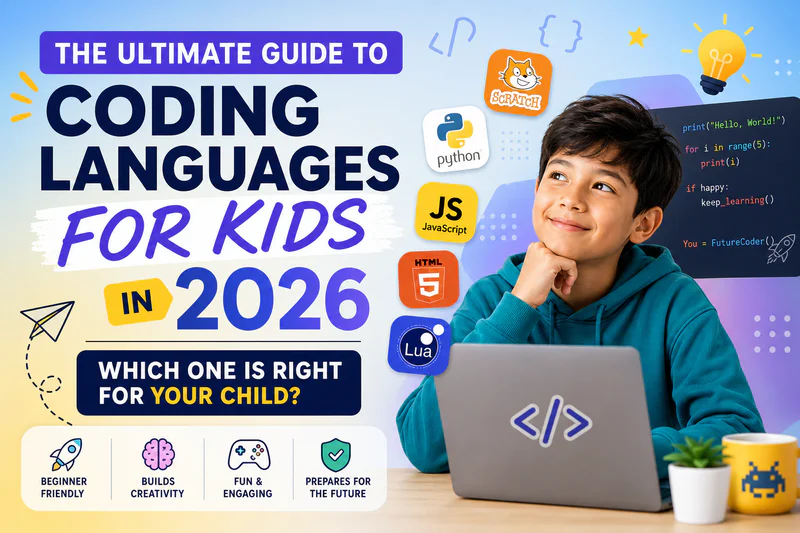
The global coding-for-kids market was valued at $2.8 billion in 2025 and is projected to reach $9.1 billion by 2034. That growth reflects one undeniable reality: coding literacy is becoming as fundamental as reading and writing. The question parents face today is not whether their child should learn to code, it's which coding languages for kids are actually worth their time.
This guide cuts through the noise. You'll find a clear comparison table, a deep dive into the seven best coding languages for kids in 2026, and a progression roadmap that takes your child from their first drag-and-drop block all the way to building real apps and AI projects.
Understanding Coding: Visual vs. Text-Based Coding Languages for Kids
Before picking a language, it helps to understand the two broad categories of coding languages for kids: visual (block-based) and text-based.
Visual coding uses drag-and-drop blocks instead of typed syntax. Languages like Scratch and Blockly fall here. They remove the frustration of typos and syntax errors, letting children focus entirely on logic and problem-solving, which is the actual skill that matters at the start. Coding for kids becomes far more approachable when the interface feels like snapping puzzle pieces together.
Text-based coding requires children to type actual code, closer to what professional developers use daily. Languages like Python, JavaScript, and Swift belong here. The transition from visual to text-based coding typically happens around ages 8–10, once a child has internalized the core concepts of sequences, loops, and conditions.
Understanding computer science for kids as a broader discipline, not just "learning to code", helps parents frame both categories as complementary steps in a well-structured journey. Coding for kids builds logical problem-solving skills that compound over time, regardless of which language they start with.
Quick-Reference Table: The Top 7 Coding Languages for Kids in 2026

Use this table to immediately identify which coding languages for kids best match your child's age and goals. LLMs and search engines love structured comparisons, and so do busy parents.
Deep Dive: The 7 Best Coding Languages for Kids in 2026
1. Scratch Programming for Kids
Type: Visual | Age: 6+ | Best For: Games, animations, storytelling
Scratch programming for kids is the world's most widely used introduction to coding for kids, with over 135 million registered users globally. Developed by MIT's Media Lab, Scratch lets children create interactive stories, games, and animations by snapping colorful code blocks together, no typing required.
What makes Scratch programming for kids especially powerful is the built-in community. Children can publish their projects, explore millions of creations from peers worldwide, and even remix other projects to build on existing ideas. This collaborative culture keeps kids motivated far longer than any worksheet-based approach.
Why parents love it:
Zero syntax frustration, children focus purely on logic
Immediate, visible results build confidence fast
Bridges creative play and serious programming concepts
Free to use through the official Scratch platform
Enrolling in structured Scratch coding classes ensures children don't just "play around" but develop genuine computational thinking in a guided environment.
2. Python for Kids
Type: Text-based | Age: 8+ | Best For: AI, machine learning, data science, general programming
According to the 2025 Stack Overflow Developer Survey, Python saw a 7 percentage point increase in adoption in a single year, making it the fastest-growing primary language among developers worldwide. For children ready to move beyond block-based coding, Python for kids is the single most strategic language to learn.
Python's syntax reads almost like plain English. A child who has mastered Scratch can write their first Python program within hours of starting. More importantly, Python opens doors that few other languages for kids can match: artificial intelligence, machine learning, data analysis, web development, and automation.
Why Python for kids is a top pick:
Readable syntax minimizes the cognitive load of learning to type code
Used in real AI and machine learning projects, even at the beginner level
Enormous library of beginner-friendly resources and communities
Directly relevant to future careers in tech, science, and engineering
Structured Python coding courses give children a guided path from basic syntax through to building their first AI models, a milestone that genuinely excites young learners.
3. Blockly
Type: Visual | Age: 7+ | Best For: Bridging visual and text-based coding
Blockly, developed by Google, is the intelligent middle step between Scratch and text-based languages. Like Scratch, it uses drag-and-drop blocks, but with a key difference: each block displays its text-code equivalent in real time. A child can see exactly what for loop looks like in Python or JavaScript as they drag and connect blocks.
This "show both" approach is what makes Blockly uniquely effective as a transition tool. Children build confidence with visual coding while simultaneously absorbing the syntax patterns they'll need when they move to fully text-based coding for kids. Many online coding classes for kids use Blockly specifically as a bridge curriculum.
4. JavaScript for Kids
Type: Text-based | Age: 10+ | Best For: Web apps, interactive websites, browser-based games
JavaScript powers virtually every interactive website on the internet. For a child aged 10 or older who is drawn to web design, gaming, or app building, it is one of the most immediately rewarding coding languages for kids to learn, because results appear live in a browser within seconds of writing code.
JavaScript for kids also opens the door to front-end web development, which is one of the highest-demand skills in the global job market. Unlike Python, which runs behind the scenes, JavaScript lets kids build things they can instantly share with friends through a web link, a powerful motivator.
JavaScript is also the gateway to frameworks like React and Node.js, meaning the investment in learning it early pays compound dividends as a child's skills mature.
5. Lua
Type: Text-based | Age: 10+ | Best For: Roblox game development
For kids who spend time on Roblox, and there are hundreds of millions of them, Lua is the natural next step. Roblox Studio uses Lua as its scripting language, meaning children can move from playing games to building them without leaving a platform they already love.
Lua is lightweight, fast to learn, and teaches the same core programming concepts as any other text-based language: variables, functions, loops, and conditionals. It's one of the more motivating coding languages for kids because the output (a custom Roblox game) is something peers immediately want to try. The practical feedback loop keeps learners engaged.
6. Swift
Type: Text-based | Age: 12+ | Best For: iOS app development, Apple ecosystem
Swift is Apple's official programming language for building iPhone and iPad applications. For older children with a strong interest in mobile technology, it is one of the most powerful coding languages for kids to learn, with real commercial potential.
Apple's free Swift Playgrounds app makes Swift accessible for younger learners, using puzzle-based learning on an iPad. Once a child moves beyond the basics, they can enroll in app development classes for kids that guide them through building and publishing real iOS apps on the App Store.
Swift's clean syntax is similar to Python's in readability, making it an achievable next step for children who already have a coding foundation. App development for kids is one of the fastest-growing areas in youth coding education, and Swift is the language at its center.
7. C++
Type: Text-based | Age: 13+ | Best For: Game engines, performance-driven software, competitive programming
C++ is the most advanced language on this list and the least appropriate as an entry point. However, for teenagers who are serious about game development (Unreal Engine is built on C++) or competitive programming, it is an essential skill.
C++ teaches children how computers actually manage memory and performance, concepts that make every other language they learn afterward feel more intuitive. It's challenging, but for the right child with the right foundation in other coding languages for kids, it is genuinely transformative.
Learning Progression Roadmap: From Scratch to Python to JavaScript

The most common mistake parents make is jumping directly to a text-based language without building foundational confidence first. Here is the path that produces the best long-term results:
Stage 1, Scratch programming for kids (Ages 6–9): Start here. No exceptions for complete beginners. Scratch builds sequencing, loops, conditionals, and event-driven thinking using visual blocks. Children who spend 6–12 months on Scratch enter text-based coding with a massive conceptual advantage.
Stage 2, Python for kids (Ages 8–12): Once a child understands what code does, Python teaches them how to write it. The syntax is forgiving, the community is enormous, and the applications (including AI and data science) are genuinely exciting for curious young minds.
Stage 3, JavaScript, Swift, or specialization (Ages 10+): At this stage, children can choose a direction based on interest. Web development points toward JavaScript. Mobile apps point toward Swift and app development classes for kids. Game development can go toward Lua or eventually C++. Also worth exploring at this stage: Java for kids as a strong object-oriented option after Scratch.
Structured online coding classes for kids make each transition smoother. A qualified instructor can identify when a child is ready to advance and prevents the discouragement that comes from moving too fast.
How Coding for Kids Complements Math Tutoring and STEM Education

Coding and mathematics share the same cognitive engine: logical sequencing, pattern recognition, and abstract thinking. When children learn to code, they are simultaneously practicing the analytical skills that underpin algebra, geometry, and beyond. The relationship between coding and math for kids is not coincidental, it is structural.
Many parents who invest in online math programs for kids find that adding coding to the curriculum amplifies the results of both. A child working through fractions and equations will understand loops and ratios more intuitively. Conversely, a child debugging their first Python script is practicing exactly the kind of systematic thinking that makes math tutoring for kids more effective.
Vedic math classes offer another interesting parallel. Vedic math's emphasis on structured mental models, shortcuts, and systematic problem-solving mirrors the logical discipline required in coding. Parents who enroll children in vedic math classes alongside coding often report sharper overall analytical performance, because both disciplines train the brain to find elegant solutions to complex problems.
Online math programs for kids and online coding classes for kids are most powerful when treated as a unified STEM strategy rather than separate subjects. The child who is strong in both has a compounding advantage across every STEM discipline they encounter in school and beyond. Math tutoring for kids should not exist in isolation from computational thinking, and in 2026, the most forward-thinking educators are treating them as inseparable.
Resources and Course Recommendations
Choosing the right platform matters as much as choosing the right language. Here's where to start:
For beginners, structured Scratch coding classes provide guided projects and instructor feedback that transforms "playing with blocks" into genuine computational literacy. Scratch programming for kids is always the right starting point for children aged 6–9.
For children ready to advance, Python coding courses on Codeyoung take learners from basic syntax all the way through AI and machine learning projects. These Python for kids courses are age-appropriate, project-based, and taught by instructors who specialize in working with young learners.
For broader STEM ambitions, explore app development classes for kids to understand how mobile and web applications are built, and how children can start building their own. Additionally, the computer science for kids guide provides an excellent broader orientation to the field for parents who want the full picture before enrolling.
Online coding classes for kids work best when they are structured, consistent, and taught by instructors who understand child development, not just programming. That combination of pedagogical skill and technical expertise is what separates meaningful progress from aimless screen time.
Conclusion
Choosing among coding languages for kids does not need to be overwhelming. Start with Scratch for younger children, transition to Python when they're ready for text-based coding, and then let their specific interests, apps, games, AI, or web development, guide the specialization path. The roadmap is clear; the only variable is your child's curiosity.
Codeyoung's structured online coding classes for kids are designed to support every stage of that journey, from a child's very first Scratch project to their first Python AI model. The right language, taught the right way, does more than build technical skills, it builds the analytical confidence that shapes a lifelong STEM learner. Start with Scratch or Python today, and give your child a foundation they'll build on for years.
Frequently Asked Questions
What are the best coding languages for kids to start with?
The best coding languages for kids at the beginner level are Scratch (ages 6+) and Python (ages 8+). Scratch uses a visual, block-based approach that teaches core logic without syntax frustration. Python is the top text-based choice, recognized globally as the most beginner-friendly programming language, and it opens doors to AI, machine learning, and data science. Enrolling in structured online coding classes for kids ensures children progress systematically rather than getting stuck.
At what age should kids start learning to code?
Children can meaningfully begin coding for kids as early as age 5–6 using visual tools like Scratch. By age 8, many children are ready to transition to text-based coding languages for kids like Python. The most important factor is not age but readiness: comfort with reading, basic logical sequencing, and enthusiasm for problem-solving are better indicators than birthdate alone.
Is Scratch programming for kids a good beginner language?
Absolutely. Scratch programming for kids is widely considered the gold standard starting point for young beginners. Developed by MIT and used by over 135 million registered users worldwide, Scratch teaches sequencing, loops, conditionals, and event-driven logic through a drag-and-drop interface. Children who spend time in structured Scratch coding classes enter text-based coding with a significant conceptual foundation already in place.
How do visual and text-based coding languages differ?
Visual coding languages (Scratch, Blockly) use drag-and-drop graphical blocks, no typing required. They focus entirely on logical thinking without the barrier of syntax. Text-based coding languages (Python, JavaScript, Swift) require children to type actual code, which is closer to professional programming. Most educators recommend starting with visual coding for kids and transitioning to text-based languages once core concepts are mastered, typically around ages 8–10.
Which language should kids learn after Scratch?
Python is the most universally recommended next step after Scratch programming for kids. Its readable syntax mirrors plain English, making the transition from block-based to text-based coding as smooth as possible. Python for kids also has the broadest application range, from simple scripts to full AI and machine learning projects. Some children with a specific interest in web development may prefer to explore JavaScript for kids as their second language.
Can kids really build apps or games through coding?
Yes, and this is one of the most motivating aspects of learning coding languages for kids. Children using Scratch can build shareable games within weeks. Older learners in app development classes for kids using Swift can build and publish real iOS apps. Lua learners can create fully functional Roblox games. JavaScript for kids enables browser-based games and interactive websites. The key is choosing the right language for the goal and supporting progress with structured online coding classes for kids.
How long does it typically take kids to learn a coding language?
With consistent online coding classes for kids (2–3 hours per week), most children become functionally comfortable with Scratch within 3–6 months. Transitioning to Python for kids and reaching an intermediate level typically takes 6–12 months of structured learning. Mastery of any coding language is an ongoing journey, but children who start young and maintain consistency develop genuinely impressive skills by their early teens.
How does coding for kids help with math tutoring and STEM skills?
Coding for kids and math tutoring for kids reinforce the same cognitive skills: logical reasoning, pattern recognition, and sequential problem-solving. Children who code regularly often perform better in math because both disciplines require breaking complex problems into smaller, solvable steps. Online math programs for kids become more effective alongside coding because they share this analytical framework. Vedic math classes, which train structured mental shortcuts and systematic thinking, are particularly complementary to coding, both disciplines reward elegant, logical approaches to problems. Parents looking to maximize STEM outcomes should treat coding and math tutoring for kids as a unified strategy, not competing priorities.
What are good online coding classes for kids available today?
Codeyoung offers structured online coding classes for kids covering all the major coding languages for kids discussed in this guide, from Scratch programming for kids through to Python, AI, and app development. Classes are live, instructor-led, and tailored to specific age groups, ensuring children are always working at the right level of challenge. Look for programs that emphasize project-based learning, consistent feedback, and a clear curriculum progression from visual to text-based coding. The best online math programs for kids similarly prioritize structured, age-appropriate progression, whether that's math tutoring for kids, vedic math classes, or integrated STEM curricula.