Online Science Classes for Kids: Why Curiosity-Led Learning Changes Everything
Children ask science questions constantly. Why is the sky blue? Why does metal feel colder than wood at the same temperature? What would happen if you dug straight through the Earth? Most of these questions get a brief answer and move on, or get Googled and forgotten. Very few become the starting point for a lesson where the child actually understands the mechanism behind what they observed.
That gap between curiosity and genuine understanding is where good online science classes for kids live. Not as a replacement for school science, which has to cover a broad curriculum at a group pace, but as the space where a child's specific questions get real answers and real experiments.
This guide covers what curiosity-led science instruction actually looks like, why the online format can work exceptionally well for science, what parents should look for in a programme, and how science learning connects to coding and STEM in ways that compound over time.
Key Takeaways
Curiosity-led science instruction produces stronger retention and deeper engagement than content-delivery approaches because children are answering questions they actually care about.
Online science classes can be as hands-on as in-person ones when designed around experiments children conduct at home with accessible materials.
Science education that connects to coding and maths develops the full STEM thinking toolkit, giving children an advantage across all technical subjects.
The right online science programme adapts to the child's pace, interests, and current school curriculum rather than following a fixed schedule.
Codeyoung's science programme for children covers physics, chemistry, biology, and earth science through live 1:1 instruction built around each child's curiosity and school needs.
What Is Curiosity-Led Science Learning and Why Does It Work?
Curiosity-led learning is an instructional approach that starts from what the child wants to know rather than what a syllabus says they should know next. It sounds simple, and in concept it is. In practice, most classroom science can't do this because a teacher with 25 students and a fixed curriculum has to move the group forward together, whether or not any individual student is genuinely curious about today's topic.
The research on this is clear. A landmark 2014 study published in the journal Neuron found that when people are in a curious state, their brains show heightened activity in the hippocampus, the region associated with memory formation, and in the brain's reward circuitry. In plain terms: curious learners retain information significantly better than non-curious learners, and the effect extends to incidental information that appears alongside the thing they were curious about.
For children, this means a science class that starts with a question they found fascinating in their own week (why do some objects float and others sink?) will produce deeper understanding and longer retention than a class that starts with "today we're covering buoyancy."
How does curiosity-led instruction work in an online science class?
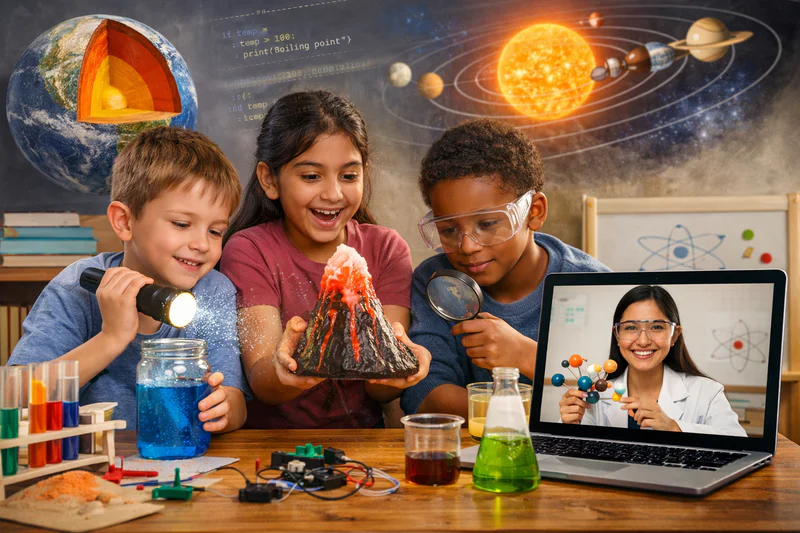
In a well-designed live online science session, the instructor begins by asking the child what they've noticed or wondered about recently. That question, or something closely related to it, becomes the anchor for the lesson. The instructor guides the child through understanding the mechanism, connects it to a hands-on experiment using materials available at home, and links it to broader scientific principles. The child ends the session having genuinely answered their own question through real scientific thinking.
What Good Online Science Instruction Actually Looks Like
Parents researching science programmes often encounter vague descriptions: "engaging content," "expert instructors," "interactive lessons." These phrases don't help with evaluation. Here is what to look for and observe concretely.
Signs of High-Quality vs Low-Quality Online Science Instruction
The experiment element is worth emphasising. One of the most common objections parents have to online science is "how do you do hands-on experiments remotely?" The answer is that a well-designed curriculum uses materials children have at home: water, salt, food colouring, a torch, a ruler, a balloon. The instructor guides the setup and observation process live, asks predictive questions before the result is visible, and helps the child connect what they see to the scientific principle. This works. It just requires a curriculum designed around it rather than one ported wholesale from a classroom.
What Topics Do Kids Cover in Online Science Classes?
A well-rounded science programme for children moves across the major science disciplines rather than staying in one lane. Children's interests span all of them, and the most intellectually valuable learning happens when a child starts to see connections across domains.
Science Topics Covered in Quality Children's Science Programmes
The last row in that table is increasingly important. Children who understand both science and coding find that the two disciplines reinforce each other in specific, practical ways. A child who understands how sensors work (physics) and how to write code that processes sensor data (programming) can build projects that would be impossible with either skill alone.
Want your child to explore science with a qualified instructor who starts from their curiosity rather than a fixed curriculum? Book a free trial science class at Codeyoung and see the approach in action.
How Online Science Classes Connect to Coding and STEM Success
Science and coding are not separate disciplines in practice, even though schools often treat them that way. The thinking skills that science develops overlap significantly with what coding requires. Both demand the ability to form a hypothesis and test it. Both require systematic debugging: if an experiment doesn't produce the expected result, you change one variable at a time and observe what changes. Both reward careful observation and precise communication of what was found.
Children who study science alongside coding at Codeyoung develop what educators call STEM thinking: the ability to move fluidly between observation, analysis, logical reasoning, and building. This cross-disciplinary capability is increasingly what universities and employers in technical fields look for, because the real problems worth solving sit at the intersection of disciplines rather than squarely within any one of them.
There is also a motivational dimension worth noting. Many children who describe themselves as "not a coding person" become very interested in coding once they realise it's the tool that lets them explore the science topics they love. A child fascinated by astronomy can write code to visualise orbital paths. A child interested in biology can write a programme that models population growth. The science interest provides the motivation; the coding provides the capability.
Explore Codeyoung's online science programme and the coding curriculum to see how the two can work alongside each other for your child.
What to Look for When Choosing an Online Science Programme for Your Child
The quality range in online science programmes for children is wide. Some are genuinely excellent. Others are video libraries dressed up as live instruction. Here is a practical checklist for evaluation.
Live instruction, not pre-recorded video. Science learning requires a human in the loop who can respond to what the child observes and ask follow-up questions. Pre-recorded content can't do this.
Hands-on experiments in every session. Any science programme that doesn't include practical experiments in most sessions is teaching science as a spectator activity. Children learn by doing, not by watching.
Curriculum aligned to school, not just "science." A programme that connects to what the child is studying at school multiplies its value. The child gets a deeper understanding of their current curriculum and arrives at class more prepared.
Instructor qualification and training. Science teaching requires both subject knowledge and the ability to explain mechanisms to a child. Ask what the instructor vetting process involves.
Free trial before commitment. A programme confident in its quality will offer a first session at no cost. Observe whether the child is active or passive during that session.
Does Online Science Education Prepare Kids for School Exams and Beyond?
A well-designed online science programme does more than prepare children for tests. It builds the underlying conceptual understanding that makes test performance a byproduct rather than a goal. Children who genuinely understand why a chemical reaction produces heat, rather than just knowing that it does, perform better on exams and retain the knowledge beyond the test date.
How does 1:1 online science instruction help children who struggle at school?
Children who find school science difficult often struggle not with the content itself but with the pace and format of classroom instruction. A whole-class lesson moves at the average student's pace, which means a child who needs more time on one concept falls behind while a child who understood it quickly sits waiting. A 1:1 live science session adapts entirely to the individual child, spending more time where understanding is incomplete and moving faster where it is solid. This personalisation consistently produces stronger outcomes for children who were struggling in group settings.
Beyond exam performance, online science classes develop skills that matter across all academic subjects. Scientific thinking (form a hypothesis, gather evidence, revise your view) is essentially the same process as critical reading, mathematical reasoning, and structured essay writing. Children who develop strong scientific thinking in science class bring that framework to every other subject they study.
Frequently Asked Questions About Online Science Classes for Kids
What age is right for children to start online science classes?
Children can begin structured online science instruction from around age 6. At this age, lessons focus on observation, basic physical concepts like forces and states of matter, and simple at-home experiments. The format adapts significantly as children get older: sessions for children aged 11 and above can go deeper into mechanisms, introduce quantitative reasoning, and connect to maths and data skills. There is no upper age limit; the curriculum scales with the child.
How is online science different from what kids learn at school?
School science covers a fixed national curriculum at a pace set for the whole class. Online science classes, particularly in a 1:1 format, can start from the child's own curiosity, spend more time on concepts they find difficult or fascinating, connect topics to real-world phenomena the child has actually observed, and align to school content in a way that deepens rather than duplicates what the child is already studying. The two are complementary, not competing.
Can kids really do science experiments online?
Yes, and this is one of the things parents are most surprised by. A well-designed online science curriculum includes hands-on experiments using materials available in any home: salt, water, food colouring, mirrors, torches, balloons, vinegar, and baking soda cover a wide range of physics, chemistry, and earth science concepts. The instructor guides setup, observation, and explanation live during the session. The child is the one conducting the experiment, not watching the instructor do it.
Will online science classes help my child with school tests and exams?
Consistently, yes. Children who receive good 1:1 science instruction tend to perform better on school science assessments because they understand concepts rather than having memorised them. Conceptual understanding is durable; memorised facts fade quickly after a test. When a child genuinely understands why something happens, they can answer novel questions about the same principle rather than being thrown by any wording that differs from what they revised.
How does science education connect to coding for kids?
Science and coding share a core thinking framework: observe, hypothesise, test, revise. Children who develop strong scientific thinking find that debugging code feels familiar because the process is structurally identical. More concretely, science provides the motivation for coding projects. Children interested in physics build simulations. Those interested in biology write data analysis programmes. The combination produces deeper engagement with both subjects than either alone typically achieves.
What subjects does a good online science programme for kids cover?
A well-rounded science programme covers all four major areas: physics (forces, energy, light, sound, electricity), chemistry (materials, states of matter, reactions), biology (living things, the human body, ecosystems), and earth and space science (weather, the solar system, geology). Good programmes also make connections between these areas, because the most interesting science questions rarely sit within a single discipline.
How often should children attend online science classes?
One session per week is enough to make consistent progress and build genuine understanding over time. Two sessions per week produces faster advancement and works well for children who are particularly interested in science or preparing for a specific exam. Sessions of 45 to 60 minutes are typical. Shorter sessions can work for younger children but often don't allow enough time for a full experiment cycle within one lesson.
Is science important for children who want to pursue coding careers?
Very much so, particularly for children interested in specific areas of computing. AI and machine learning draw heavily on statistics and linear algebra. Game development involves physics simulation. Cybersecurity requires understanding information theory. Environmental technology requires earth science. And software engineering at a high level benefits from the systematic problem-solving habits that science education builds. Coding ability and scientific literacy together produce significantly more capable technical thinkers than either skill in isolation.
What makes Codeyoung's science programme different from other options?
Codeyoung's science programme is delivered as 1:1 live instruction, which means every session adapts entirely to the individual child. Instructors are trained to start from the child's questions, connect content to what the child is studying at school, and include hands-on experiments in every session. The programme also integrates naturally with Codeyoung's coding curriculum, so children interested in both STEM tracks can see the connections between science and programming built explicitly into their learning.
Can online science classes support a child who is gifted or advanced for their age?
1:1 online instruction is particularly well-suited to academically advanced children because there is no class average to conform to. An instructor can cover material two or three grade levels above the child's school year if the child is ready, go deeper into mechanisms than the school curriculum requires, and introduce university-level concepts in accessible ways when appropriate. Many gifted children find school science unstimulating because it moves too slowly. Live 1:1 sessions remove that constraint entirely.
Science That Starts With the Child's Question Goes Further
The difference between a child who loves science and one who finds it dull is rarely about intelligence. It is almost always about whether the science they've encountered connected to something they were already curious about. Curiosity-led online science instruction is built on precisely that principle: start with what the child wants to know, and use it to teach them everything they need to understand why.
Good science education doesn't just improve school grades. It builds the systematic, evidence-based thinking that transfers to every other academic subject and every problem a child will encounter in life. Paired with coding skills, it produces children who can not only understand the world but build things that work within it.
Explore Codeyoung's online science programme for children of all ages, or book a free trial session to experience curiosity-led instruction firsthand.
Ready to turn your child's curiosity into real scientific understanding?
Codeyoung offers personalised 1:1 live science classes for children of all ages, with hands-on experiments, curriculum alignment, and expert instructors. The first class is completely free with no commitment.