
Ten inches of snow does not make one inch of water, at least not reliably. The US Weather Bureau handed observers that 10:1 figure as early as 1875 and told them in 1894 that it was only a rough approximation. A 30-year study of National Weather Service records later put the US average at about 13.5 to 1. Your child can check their own street's number with a straight-sided jar and a ruler, and that is the kind of winter science experiment this list is built on.
Each of the seven winter science experiments for kids below has one thing your child changes on purpose, one thing they measure, an expected result and the actual explanation. None of them is a craft. All of them produce numbers.
Key Takeaways
- Salt beats sugar on ice by particle count. Gram for gram, salt puts about 12 times as many particles into the meltwater.
- Salt has a floor. It works poorly below about 15°F and cannot keep water liquid at all below minus 6°F.
- The 10:1 snow rule is a rough average, and real snow ranges from 0.1 to about 4 inches of water per 10 inches.
- A mitten makes nothing warm. Wrap an ice cube in one and it melts more slowly, which is the whole lesson in insulation.
- Skip borax. Alum or table salt grows crystals without the reproductive-toxicity classification.
The seven winter science experiments at a glance
The difference between an activity and an experiment is a variable. Every row below changes exactly one thing and measures one thing, which is the habit our guide to fair tests and controlling variables walks through in detail.
| Experiment | Ages | Change this | Measure this |
|---|---|---|---|
| Salt, sugar or sand on ice | 6+ | What you sprinkle | Millilitres of meltwater |
| Ice cream in a bag | 6+ | Tablespoons of salt | Brine temperature, minutes to set |
| Frost on a can | 5+ | Salt or no salt | Frost or dew, minutes to form |
| Snow-to-water ratio | 8+ | Which snowfall | Snow depth against water depth |
| The mitten test | 7+ | Wrapping material | Temperature every 5 minutes |
| Windowsill crystals | 9+ | Cooling speed | Crystal count and largest length |
| Freezing bubbles | 5+ | Air temperature on the day | Seconds to freeze |
1. Salt, sugar or sand: which melts ice fastest?
Ages 6 and up. You need four identical bowls, twelve ice cubes of the same size, half a teaspoon each of salt, sugar and sand, and a small measuring cylinder or a medicine syringe.
The method below follows Science News Explores' version. Put three cubes in each bowl. Sprinkle salt on one, sugar on the second, sand on the third, and nothing on the fourth, which is the control. Put all four in the fridge, where the effect is easier to see than on a warm worktop. Check every hour. When one bowl is at least half melted, usually after about four hours, pour each bowl's meltwater into the cylinder and write the volume down. Then let everything melt and measure the total, so you can work out the percentage melted. Run three trials.
Expected result: salt melts the most by a wide margin. Sugar melts somewhat more than the control. Sand performs about the same as the control.
The science. Dissolved particles lower the temperature at which water freezes, called freezing point depression, and the amount depends only on the number of dissolved particles, not on their chemical nature. Salt splits into a sodium ion and a chloride ion, and each unit is light (58.44 grams per mole, against 342.3 for table sugar). Do the arithmetic and a gram of salt releases roughly 12 times as many particles as a gram of sugar. Sand does not dissolve at all, which is why councils spread it for grip rather than to melt anything.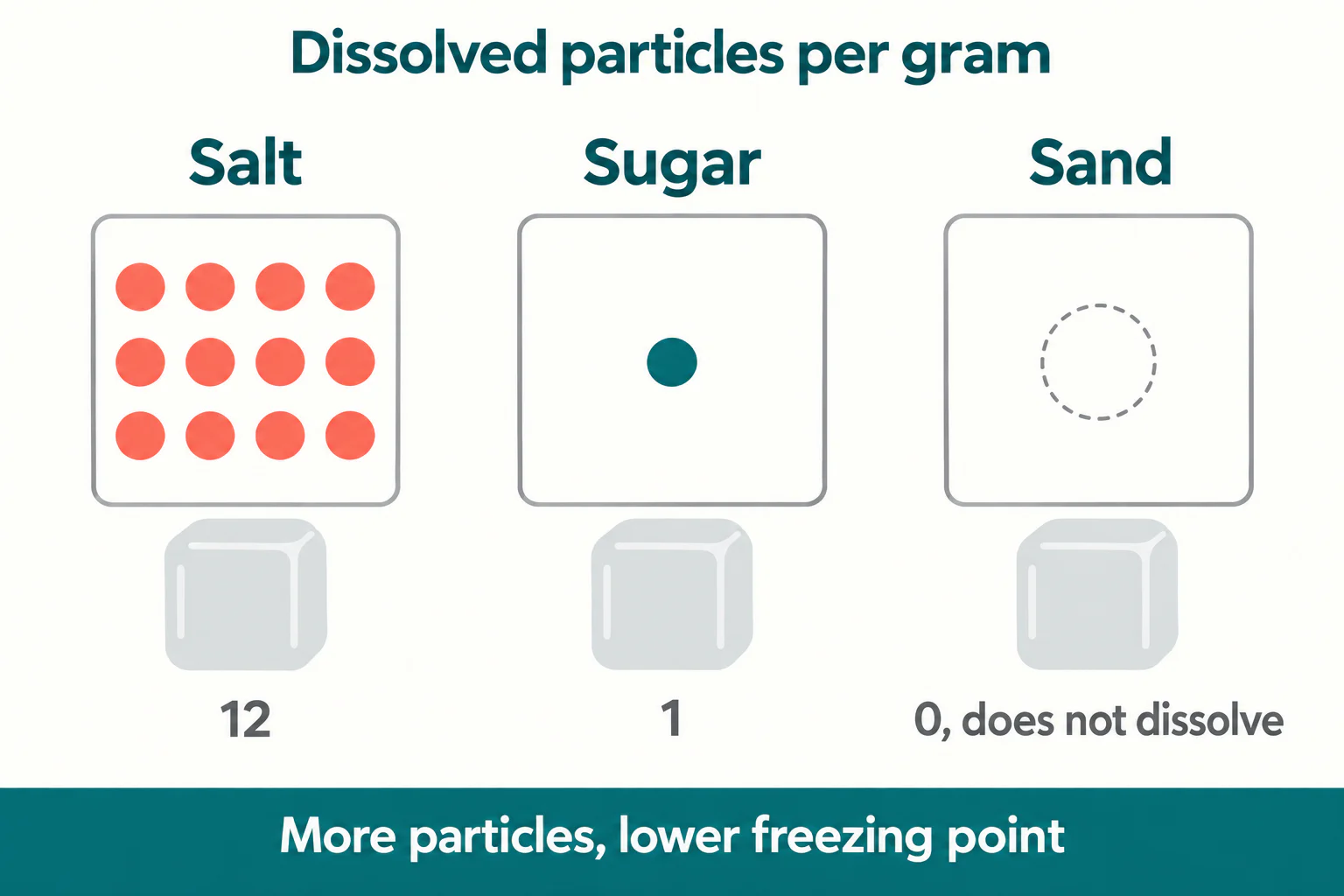
Salt also has limits, and an older child can add them to the write-up. The Minnesota Pollution Control Agency gives sodium chloride a lowest practical melting temperature of 15°F and a eutectic point of minus 6°F, below which salt water cannot stay liquid at all. Calcium chloride goes down to minus 20°F in practice, which is why road crews change products in a hard freeze.
2. Ice cream in a bag: how cold can salty ice get?
Ages 6 and up, with an adult. In a small zip bag, seal half a cup of milk, a tablespoon of sugar and a few drops of vanilla. Put it inside a large zip bag with about three cups of ice. Shake for five to ten minutes, wearing gloves or wrapping the bag in a towel.
Change one thing: the salt in the outer bag. Run four batches with 0, 2, 4 and 6 tablespoons. Measure the temperature of the ice and brine after five minutes with a kitchen thermometer, and the minutes until the mixture is firm.
Expected result: the no-salt bag sits near 0°C and the milk barely thickens. With salt, the temperature falls well below freezing. The American Chemical Society's classroom version of this activity reports salt taking the ice from 0°C to about minus 10°C. More salt helps up to a point, and nothing made from table salt will go below the minus 6°F (about minus 21°C) eutectic limit.
The science. Salt dissolves into the thin film of water on the ice and lowers its freezing point, so the ice starts to melt. Melting needs energy, and the ice takes it as heat from everything it touches, including the milk. The mixture keeps cooling until it reaches the new, lower freezing point of the brine. That is the same reason the ice cubes in experiment 1 melted in a fridge that was colder than 0°C.
3. Frost on a can: why some cans get dew and others get frost
Ages 5 and up. Take two clean metal cans with the labels removed and fill both with crushed ice. Stir two or three tablespoons of salt into one. Leave both on a tray for five to ten minutes.
Change: salt or no salt. Measure: what forms on the outside, the minutes until it appears, and, for older children, the temperature inside each can.
Expected result: the plain can collects water droplets. The salted can grows a white, feathery layer of frost. On a very dry day both take longer, which makes a good second variable: run it again in a steamy kitchen after cooking.
The science. Cold metal chills the air touching it, and water vapour in that air condenses. The plain ice can sits around 0°C, so the vapour turns to liquid dew. The salted can drops below freezing, and the National Weather Service describes frost as forming in the same way as dew but when surface temperatures are below 32°F, as thin ice crystals in scales, needles and feathers. The vapour goes straight to ice without becoming liquid first, a change called deposition.
Not sure which level your child should start at in science? A free trial class with a Codeyoung teacher shows you exactly where they are and what they are ready for next, before you commit to anything.
Book a Free Trial →4. How much water is in snow? Testing the 10-to-1 rule
Ages 8 and up. This is the one with the surprise in it. You need a clear container with straight sides, the same width top to bottom, and a ruler.
After a fresh snowfall, push the container straight down through the snow to the ground to take a full core, the same method the National Weather Service asks its volunteer observers to use for water content. Measure the snow depth in the container before it settles. Bring it inside, let it melt, and measure the water depth. Snow depth divided by water depth is the snow-to-liquid ratio. A tapered container gives a wrong answer, because the water pools in the narrow bottom.
Change: which snowfall you sample. A bitterly cold, powdery day against a wet, near-freezing one is the best comparison. Write down the air temperature each time.
Expected result: almost never exactly 10. NSIDC says most new snowfall in the US is between 4 and 10 percent water, which for 10 inches of snow means 0.4 to 1 inch of water. The extremes are wider still: 10 inches of fresh snow can hold as little as 0.1 inches of water or as much as about 4.
The science, and the part most winter science lists get wrong. The 10:1 rule is an average with a poor record. The National Weather Service office in La Crosse calls it an old rule of thumb that is "far from the norm" and suggests 12:1 is more representative for the Upper Midwest. A 30-year climatology of NWS cooperative observer data by Baxter, Graves and Moore (2005) found a mean of 13.5 and a median of 12.1 across the US, with the middle half of all observations running from about 9 to 17. The most common single value in that data was exactly 10.0, and the authors flag a possible tendency for observers to simply record 10.
What sets the ratio is how much air is trapped between the ice crystals. Deep cold builds lacy crystals and fluffy, high-ratio snow. Air near freezing, crystals coated in frozen droplets, and wind that breaks flakes apart all pack the snow tighter and pull the ratio down. Your child's two samples should show that pattern, and their own number belongs in the write-up next to the textbook one.
5. The mitten test: does a mitten make anything warm?
Ages 7 and up. Fill three identical jars with the same amount of warm tap water and check they start at the same temperature. Leave one bare, slide one into a wool mitten or sock, and one into a thin cotton sock. Read each thermometer every five minutes for half an hour and plot the three lines.
Change: the wrapping. Keep the jar, the water volume, the starting temperature, the room and the thermometer depth identical. Measure: temperature over time.
Expected result: the bare jar cools fastest and the thick wool cools slowest. Now run the twist. Wrap an ice cube in the mitten and leave another bare. Most children predict the mitten cube melts first, because mittens are "warm". It melts more slowly.
The science. A mitten produces no heat. It slows the flow of heat in either direction, mostly by trapping still air, which conducts heat poorly. Soak the wool and try again: water fills those air pockets and the insulation largely disappears, which is the real reason wet gloves feel so cold. Snow works the same way. NSIDC describes snow as a good insulator because most of a snow layer's volume is air, and it slows heat escaping from the ground.
6. Windowsill crystals, and why we leave out borax
Ages 9 and up, with an adult pouring. Dissolve as much alum (sold as a pickling spice) or table salt as will go into a mug of hot water. Divide it between two identical jars and hang a string or pipe cleaner in each. Put one on a cold windowsill and keep the other somewhere warm, wrapped in a towel so it cools slowly.
Change: cooling speed. Measure after 24 and 48 hours: the number of crystals and the length of the largest, with a ruler.
Expected result: the fast-cooled jar gives many small crystals. The slow one gives fewer, larger ones. The science: hot water holds more dissolved solid than cold. As the solution cools it holds more than it can keep, called supersaturation, and the excess comes out onto any surface it can find. Slow cooling gives the molecules time to add to crystals that already exist instead of starting new ones.
Many crystal guides use borax. We do not. Borax (disodium tetraborate) is classified in the EU as toxic for reproduction, category 1B, with the hazard statement "may damage fertility; may damage the unborn child", as listed in the classification data notified to the European Chemicals Agency. The National Capital Poison Center reports rashes, burns and blisters from homemade borax slime, and nausea, vomiting and diarrhoea when it is swallowed. If you use it anyway, an adult handles the powder, nobody eats or drinks nearby, everyone washes their hands, and the finished crystals stay away from younger siblings, because they look like sweets.
7. Freezing soap bubbles: only on a really cold morning
Ages 5 and up. This one only works below freezing, and it works far better well below it. Blow bubbles onto a cold surface such as a snowbank or a frozen plate and time how long each takes to freeze completely.
Change: the day. Run it on several mornings and log the temperature. Measure: seconds to freeze, and how many of ten bubbles freeze before popping.
Expected result: Science News Explores reports bubbles freezing in about 15 seconds at 0 to 10°F and in 10 seconds or less below minus 10°F. Light wind, around 1 to 3 kilometres per hour, helps. Anything stronger pops them.
The science. A bubble is cooled from both sides at once, by the cold air outside and the cold air trapped inside. When freezing starts at the bottom it releases heat, leaving the base warmer than the top. Engineers at Virginia Tech, publishing in Nature Communications in 2019, showed that this difference in temperature drives a flow called Marangoni flow, which rips growing ice crystals off the bottom and swirls them around the bubble. That is the "snow globe" effect your child will see.
Safety notes for winter science at home
- Salt and ice cause cold burns. The mixture gets far colder than ice alone, and pressed against skin it injures like frostbite. A 12-year-old in Pittsburgh needed burn-centre treatment for second-degree burns after the "salt and ice challenge". Gloves or a towel for the ice cream bag, every time.
- Hot water is an adult job in the crystal experiment, and so is handling borax if you choose to use it.
- Rinse the outer brine off the inner bag before opening the ice cream, or it will taste of salt water.
- Keep the bubble sessions short on the cold mornings they need, with hats and gloves on.
- Do not eat the crystals, alum or salt.
Turning a winter experiment into a science fair project
All seven produce a table of numbers over several trials, which is exactly what a judge looks for. The snow ratio and the mitten test are the strongest candidates, because the result is not obvious in advance and the child's own data can be compared with a published figure. Our guide on helping with a science fair project without taking over covers where a parent's help belongs, and if your child would rather work indoors, our list of 15 science experiments for middle schoolers uses the same change-one-thing format all year round.
Where to start this winter
Start with the salt, sugar and sand bowls on the first cold weekend, because it needs nothing you do not already have and it introduces the control bowl. Save the snow-to-water jar for the first real snowfall, and run it again on the next one so your child has two ratios to compare. Do the bubbles when the forecast drops into single figures Fahrenheit.
Across all seven winter science experiments, the habit worth building is the same: decide what you will change, decide how you will measure it, and write the number down even when it is not the one you expected. If your child enjoys that kind of reasoning, our online science classes for kids build on it week by week.
Codeyoung runs 1:1 live online classes for children aged 6 to 17, with a teacher who adapts the pace to your child rather than a fixed syllabus. The first class is free, so you can see how they respond before deciding.
Book a Free TrialSources checked 12 November 2026: Baxter, Graves and Moore, "A Climatology of Snow-to-Liquid Ratio for the Contiguous United States", Weather and Forecasting, October 2005 (Saint Louis University), including its history of the 10:1 ratio; National Weather Service La Crosse, "Why snow ratios"; NWS Snow Measurement Guidelines for surface observing programs (core sample method); the NWS glossary entry for frost; NSIDC, "Science of snow"; Minnesota Pollution Control Agency, lowest practical melting temperatures of deicers; American Chemical Society, "Coffee Creamer Ice Cream" classroom activity; Science News Explores, "What makes ice melt fastest?" and its frozen-bubble guide; Virginia Tech News, June 2019, on Ahmadi et al., "How soap bubbles freeze", Nature Communications; ECHA classification and labelling notifications for disodium tetraborate (H360FD); National Capital Poison Center, "Is homemade slime safe?"; CBS Pittsburgh reporting on a salt and ice challenge injury. Molar masses for the particle comparison are standard values (sodium chloride 58.44 g/mol, sucrose 342.3 g/mol).