
A child who talks continuously at home, who explains the plot of an entire film unprompted over dinner, stands up in front of their class and produces nothing. Parents find this genuinely baffling, and they usually reach the same conclusion: my child lacks confidence.
After eight years building communication programmes, I can tell you that is almost never the useful diagnosis. Freezing up when presenting is a predictable, mechanical thing, and because it is mechanical it responds to specific fixes rather than encouragement.
Here is what is actually happening, why the standard advice tends to fail, and the four things that reliably work.
Freezing is not shyness
The two get treated as the same problem and they are not related in the way people assume.
Shyness is a preference about social contact. Freezing is what happens when a demanding task collides with a threat response. Those come apart constantly: some of the most talkative children I have taught freeze completely at the front of a room, and some of the quietest present beautifully.
What is happening is closer to overload than to fear. Standing in front of an audience takes up a large share of a child's available attention. Managing their voice, their hands, the faces looking at them and their own racing heart all draw on the same limited pool. Whatever is left over is what they have to recall their content with.
That is why a child who knew their material perfectly an hour earlier cannot produce it. The knowledge is intact. The capacity to reach for it has temporarily shrunk, because most of it is being spent elsewhere.
Once you see it that way, the goal changes. You are not trying to make a child braver. You are trying to reduce how much the moment costs them.
Why "just practise more" often fails
Practice is the right instinct applied in the wrong form.
Most children, told to practise, read their notes silently while sitting on their bed. That rehearses the content and nothing else. It removes every condition that causes the problem: no standing, no voice, no audience, no visible faces.
Then they stand up in front of thirty people and meet all of those conditions simultaneously for the first time.
The second failure is over-memorisation. A child who has learned the whole thing word for word has built something fragile. Forget one line and there is no structure underneath to fall back on, so a small stumble becomes a total stop. I see this far more often than under-preparation.
Not sure which level your child should start at? A free trial class with a Codeyoung teacher shows you exactly where they are and what they are ready for next, before you commit to anything.
Book a Free Trial →The four things that actually work
1. Automate the first twenty seconds
This is the highest-value intervention by a wide margin, and it is the one almost nobody does.
Freezing overwhelmingly happens at the start, before any rhythm exists. Once a child is thirty seconds in and speaking, the difficulty drops sharply. So the opening is the part to make automatic.
Have them rehearse the first two or three sentences until those sentences arrive without any thought at all, the way a familiar phone number does. Not the whole talk. Just the opening. A child who can start on autopilot gets past the hardest moment without spending anything on it.
2. Rehearse in the real conditions
Standing up. Out loud. To at least one actual person, even a reluctant sibling.
This feels unnecessary and it is the difference between practice that transfers and practice that does not. Speaking aloud while standing is a genuinely different task from reading silently, and the version they rehearse is the version that will be available under pressure.
Three rehearsals in real conditions beat fifteen silent read-throughs. If your child will only do one thing from this article, make it this one.
3. Learn the shape, not the script
Instead of memorising sentences, have them learn the presentation as three or four points in order. They should be able to list those points on their fingers without notes.
Structure survives a stumble in a way that a script does not. If a child loses a sentence, they still know which point comes next and can improvise a bridge. If they lose a line in a memorised script, there is nothing underneath.
A small physical prop helps here: a single index card with three or four words on it, held but rarely looked at. Knowing a safety net exists reduces the load even when it goes unused.
4. Rehearse the recovery
This one surprises parents and it changes outcomes more than anything except the opening.
Most children have never considered what to do if they lose their place, so when it happens they have no plan and stop entirely. Give them one. A pause, a breath, a glance at the card, and the sentence "let me start that part again".
Practise that deliberately. Have them lose their place on purpose and recover twice. A child who has rehearsed getting stuck stops being afraid of getting stuck, and that fear is doing more damage than the stumble itself ever does.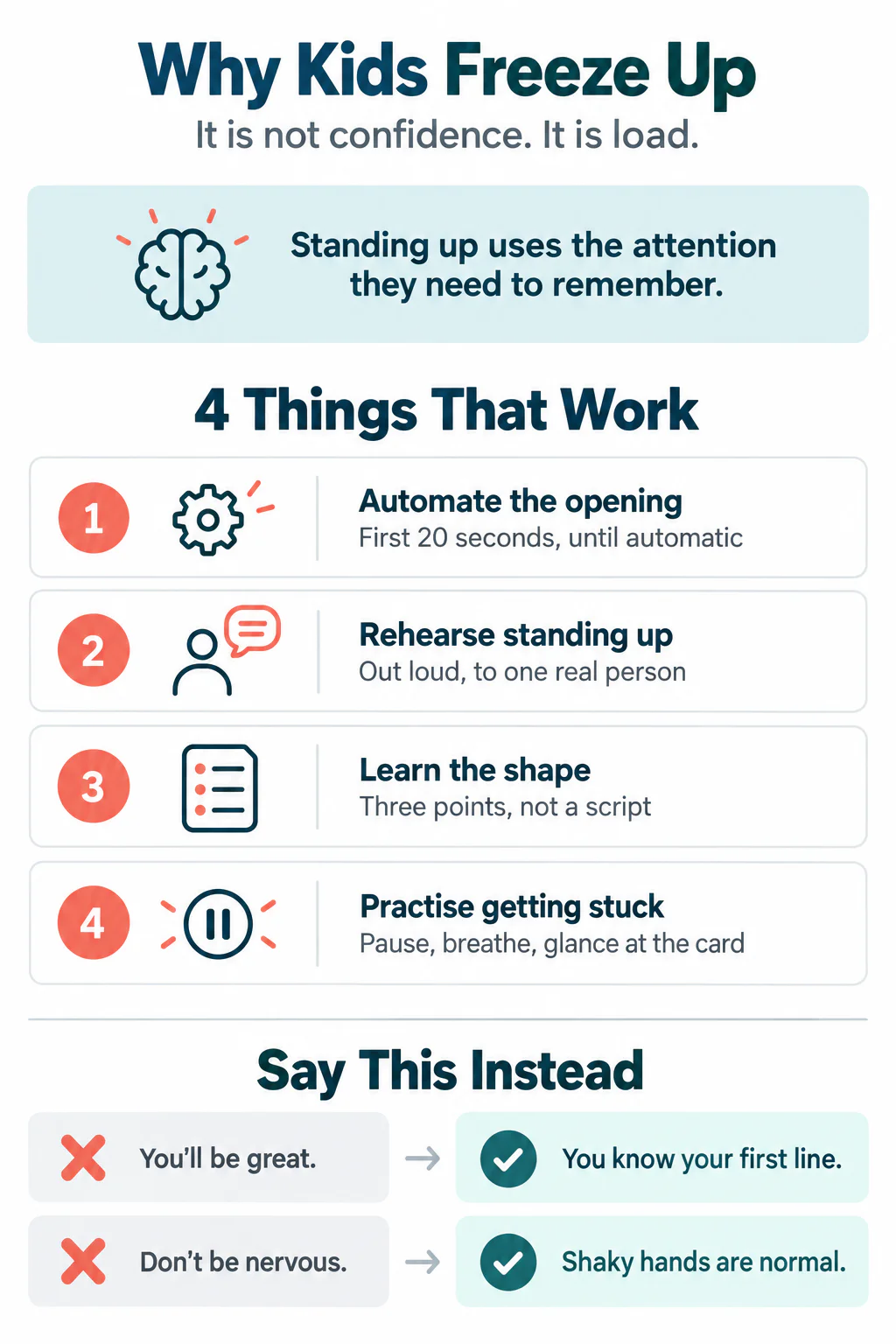
What should you say the night before?
Parents reach for reassurance, and the usual version quietly makes things worse.
"You'll be brilliant" sets a bar. "Don't be nervous" asks for something impossible and adds being nervous about being nervous. "Everyone gets nervous" is true but does nothing actionable at nine o'clock the night before.
What helps is naming the plan rather than the feeling.
| Instead of | Try | Why |
|---|---|---|
| "You'll be great." | "You know your first line. That's the hard part done." | Points at something concrete they have actually secured |
| "Don't be nervous." | "Your hands might shake. That's normal and nobody notices." | Normalises the symptom instead of banning it |
| "Just relax." | "If you lose your place, pause and look at your card." | Gives a plan for the thing they are afraid of |
| "Everyone's watching, so smile." | "Find one friendly face and talk to them." | Shrinks the audience to something manageable |
And afterwards, ask what went well before asking anything else. Children who present are usually their own harshest critics, and the first conversation shapes whether they volunteer next time.
When it is worth getting help
Most children improve steadily with the four habits above. A few do not, and it is worth knowing the difference.
Look for a pattern across a term rather than one bad day. If a child dreads presenting weeks in advance, avoids subjects that involve speaking, or the distress is out of proportion to the task, that is worth addressing properly rather than waiting for confidence to arrive on its own.
Structured practice with an adult who is not their parent tends to work faster than family rehearsal, partly because the stakes feel lower and partly because feedback from outside the family lands differently. Our guide on telling whether your child's classes are actually working covers what progress should look like, and whether a child is bored or struggling helps if the reluctance is broader than speaking alone.
For the underlying language work that makes presenting easier, improving listening skills and teaching grammar well both matter more than they appear to.
Frequently Asked Questions
Why does my child freeze up even though they know the material?
Because knowing something and retrieving it under pressure are different tasks. Standing in front of a class occupies a large share of a child's attention, which leaves less available for recalling content. The knowledge has not gone anywhere; the capacity to reach for it has temporarily shrunk.
Is freezing up the same as being shy?
No, and conflating them leads to the wrong fix. Plenty of talkative, socially confident children freeze when presenting, and plenty of quiet children present well. Shyness is about social preference. Freezing is about performing a demanding task while managing a threat response.
Will more practice fix it?
Only if the practice resembles the real thing. Rehearsing silently while sitting down builds almost nothing that transfers, because it removes the conditions that cause the problem. Practising out loud, standing, in front of at least one person is worth several times as much as repeating it in your head.
What is the single most useful thing to work on?
The first twenty seconds, rehearsed until it is automatic. Most freezing happens at the start, before any rhythm exists. A child who can begin without thinking gets past the hardest moment on autopilot, and speaking usually becomes much easier once it has started.
Should my child memorise the whole presentation?
No. Full memorisation is fragile: forget one line and the whole structure collapses, which makes freezing more likely rather than less. Memorise the opening and learn the shape of the middle as a short sequence of points, so a stumble costs a few seconds instead of everything.
What should I say the night before?
Something that lowers the stakes rather than raises them. Avoid reassurance that implies a high bar, such as telling them they will be brilliant. Naming the plan works better: they know their first line, they know their three points, and getting stuck for a moment is normal and survivable.
What to take from this
Stop treating this as a confidence problem. Confidence is the result of having presented successfully a few times, not the thing that makes it possible in the first place, and waiting for it to arrive first means waiting a long while.
Treat it as a load problem instead. The opening is automatic, so the hardest moment costs nothing. The rehearsal happened standing up, so the practised version is the one that shows up. The structure is three points rather than a script, so a stumble is survivable. And getting stuck has been rehearsed, so it is no longer frightening.
Four specific things, none of which involve telling a child to believe in themselves. The belief tends to follow.
Codeyoung runs 1:1 live online classes for children aged 6 to 17, with a teacher who adapts the pace to your child rather than a fixed syllabus. The first class is free, so you can see how they respond before deciding.
Book a Free Trial