
Your child worked out 36. The answer was 28. They did the multiplication perfectly, wrote it down, underlined it, and never touched the second half of the question.
This is the most common wrong answer in primary maths and it is not an arithmetic mistake. Two-step word problems fail for a reason that has almost nothing to do with number skill: the first step produces a number, and a number feels like a finish line. Here is what is actually happening and how to fix it without another worksheet.
What a two-step problem really demands
Two calculations, where the first one produces something you cannot hand in.
That is a genuinely different cognitive task from a one-step question, and the curriculum treats it as one. Common Core introduces one- and two-step word problems with addition and subtraction within 100 in grade 2. In grade 3 it extends two-step problems to all four operations and asks children to represent them with equations using a letter for the unknown. By grade 4 the standard is multistep problems, including ones where a remainder has to be interpreted.
| Grade | What the standard asks for | What is new |
|---|---|---|
| Grade 2 | One- and two-step problems, adding and subtracting within 100 | The idea that a problem can have two parts |
| Grade 3 | Two-step problems using all four operations, written as equations | Choosing which operation goes where |
| Grade 4 | Multistep problems, including interpreting remainders | Holding three or more steps, and judging what a leftover means |
Read across that table and you can see the load increasing in two directions at once. More steps, and less obvious which operation belongs to which step. A child who has not built a checking habit by grade 3 hits grade 4 carrying the same error into problems with twice the room to make it.
Why the first number feels like the answer
Because for two or three years, it was.
Every early maths question a child meets works like this: read the sentence, do one thing, write a number, done. That is hundreds of repetitions of a rule that is never stated out loud but is learned perfectly: a number means you have finished. Then two-step problems arrive and the rule quietly stops being true. Nobody announces the change.
Worse, the number they produced is usually correct. There is no internal signal that anything is wrong. Compare that with a child who divides when they should have multiplied and gets 3 where they expected 300, which at least feels odd. We wrote about that kind of internal alarm in asking whether an answer is sensible, and the difference here is stark: a correct step one raises no alarm at all, because nothing about it is unreasonable. It is simply not what was asked.
This is not maths anxiety
Worth saying clearly, because it gets misdiagnosed constantly.
A child who stops at step one is usually confident. They finished quickly, they were pleased, and they are genuinely surprised when the answer is marked wrong. That is the opposite of the freeze that anxiety produces, where a child stares at the page and cannot start. Treating a confident half-answer with reassurance and lowered expectations is both unnecessary and unhelpful, because the child does not need calming. They need a check they do not currently run.
Not sure which level your child should start at? A free trial class with a Codeyoung teacher shows you exactly where they are and what they are ready for next, before you commit to anything.
Book a Free Trial →The worked example, and where it goes wrong
Take a problem of exactly the kind a grade 3 child meets:
A pack holds 12 pencils. Priya buys 3 packs, then gives 8 pencils away. How many pencils does she have left?
What a stalling child writes:
- 3 × 12 = 36
- Answer: 36
The multiplication is right. The child has understood that "3 packs of 12" means multiply, which is the harder half of the problem. They have then handed in the number of pencils Priya bought, when the question asked how many she has left. The answer is 36 minus 8, which is 28.
Notice what a teacher's red cross communicates here. It says "wrong", and the child reads it as "your multiplication was wrong", because the multiplication is the only thing on the page. So they recheck the multiplication, find it correct, and conclude the marking is unfair or that maths is arbitrary. The feedback lands on the wrong part of the work entirely. That mismatch between the mark and the mistake is the same one we looked at in why a right answer still loses marks.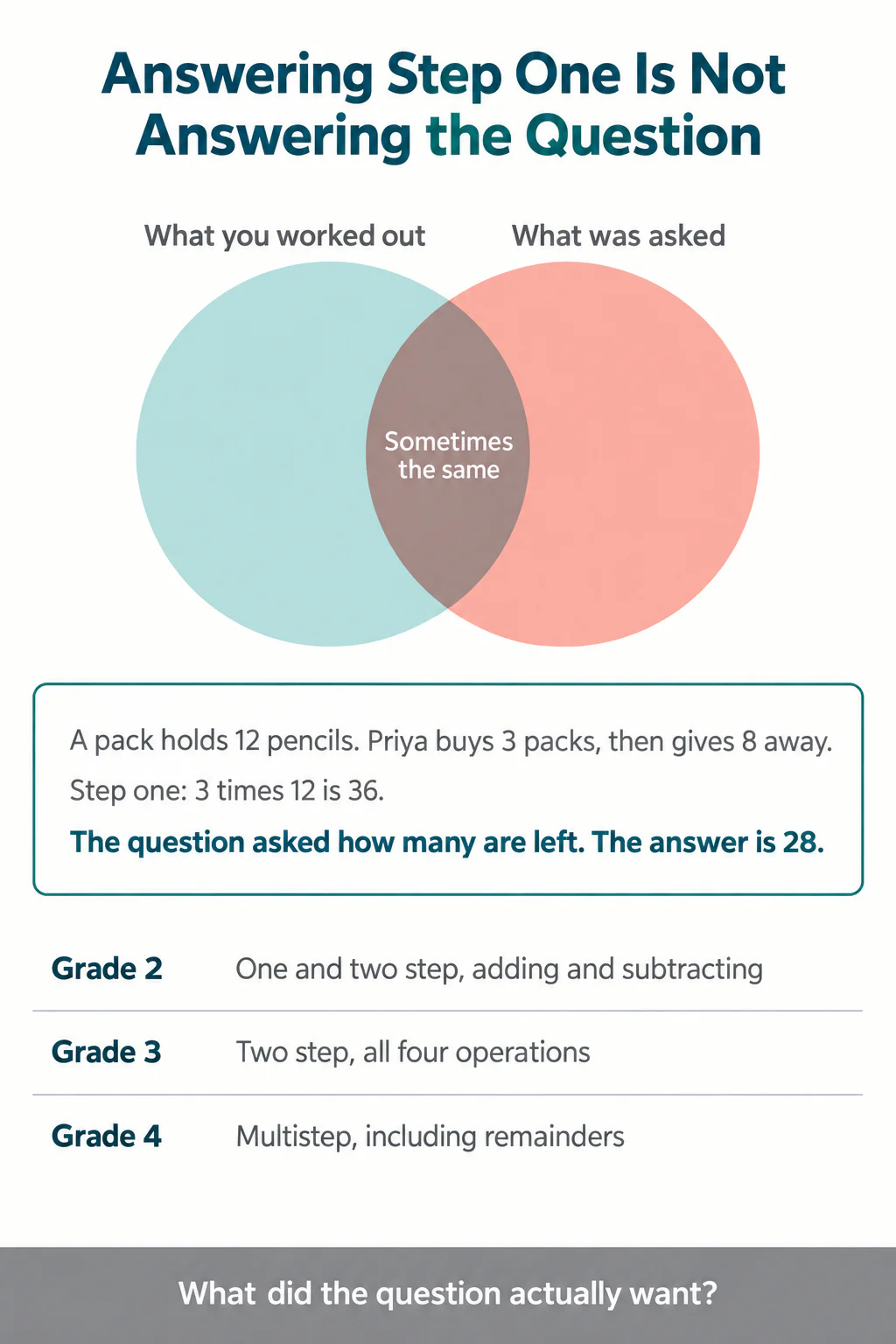
The one question that fixes it
"What did the question actually ask for?"
That is it. Not "check your work", which sends a child back to the arithmetic they already trust. Not "are you sure?", which tells them they are wrong without telling them where. One question that sends them back to the words rather than to the numbers.
Used consistently, it does something more useful than correcting the answer in front of you. It installs a habit the child can run alone, because the question is short enough to remember and general enough to apply anywhere. Within a few weeks most children start saying it to themselves before you do, which is the moment you can stop.
Why "check your work" fails
Because a child's idea of checking is redoing the calculation. That is the only checking anyone has ever demonstrated to them. So they recompute 3 × 12, get 36 again, feel more confident than before, and hand in the same wrong answer with less doubt than they started with.
Checking arithmetic and checking that you answered the question are two different operations, and only one of them is ever taught. Naming the difference out loud is worth doing once, explicitly: "There are two checks. Did I do the sums right, and did I answer the right thing."
Four habits that make the second step visible
The goal is to make it structurally hard to lose track of the question, rather than relying on a child to remember.
- Write the question at the top of the working. Not the whole sentence. Just the target: "pencils left". A child rereading their page then sees a target and a number, and the mismatch is visible instead of invisible.
- Label every number as it appears. 36 means nothing. "36 bought" means something, and it very obviously is not "left".
- Say the answer as a sentence. "Priya has 36 pencils left" is a sentence a child can hear is false. "36" is not.
- Circle the question mark's sentence before starting. Ten seconds, and it forces one read of the thing being asked before any arithmetic crowds it out.
Habit three is the highest-yield of the four and the one children resist most, because it feels like extra writing. It works because it recruits language, which is a sense children have far more experience with than number. A nine-year-old who cannot tell that 36 is the wrong sort of number can absolutely tell that "she has 36 left after giving 8 away" sounds wrong.
How to practise without more worksheets
Doing twenty more two-step problems mostly produces twenty more chances to make the same error. Change the task instead.
Give the answer, ask for the question. Tell your child: the answer is 28 pencils. Here is the working: 3 × 12 = 36, then 36 − 8 = 28. Now write me the question. Reconstructing the question from the working forces them to think about what the words were doing, which is exactly the muscle that is weak.
Ask which step is missing. Show a finished-looking solution that stops at step one. Ask what is missing. Children spot it instantly in someone else's work and almost never in their own, and noticing that gap is itself the lesson.
Use two-step tasks that are not maths. "Get your shoes, then put the bin out." Cookery with two ingredients. A route with a change of bus. Any task where finishing part one looks like finishing. Say out loud when it happens: that was step one, what was the whole job? It generalises faster than anyone expects, because the error is not really about numbers.
Ten minutes of these a week does more than an hour of extra questions. The arithmetic is not the weak link and drilling it does not touch the actual problem, which is a habit of mind about when a task is over. That is the same argument we make about maths more generally in strategies for solving maths word problems: the reading is usually where the difficulty lives.
When to take it more seriously
Most children grow out of this with the one question above. A few do not, and the pattern is worth recognising.
If a child consistently manages two-step problems when they are read aloud but not when they read them alone, the difficulty is in reading comprehension rather than in maths, and it will show up in other subjects. If they can hold two steps when the numbers are small but lose the second step whenever the first involves harder arithmetic, they are spending all their working memory on the calculation and have none left for the plan. That one responds well to making the arithmetic easier for a while, which sounds like going backwards and is not.
And if a child gets the second step right when you sit beside them and wrong every time you do not, they have not built the habit yet. They have borrowed yours. That is normal at eight and worth working on at eleven.
The short version
A child who stops at step one is not weak at maths. They are applying a rule that used to be true and is now quietly false, and no one has told them it changed. The arithmetic is usually fine, which is exactly why extra arithmetic practice does nothing.
One question does most of the work: what did the question actually ask for? Ask it every time, in that wording, and let them find the gap themselves. Add the habit of writing the target at the top of the page and saying the answer as a full sentence, and the error mostly disappears inside a term.
The grade-by-grade expectations above come from the Common Core operations and algebraic thinking standards, and our online maths classes for kids build this reading-the-question habit alongside the arithmetic rather than after it.
Codeyoung runs 1:1 live online classes for children aged 6 to 17, with a teacher who adapts the pace to your child rather than a fixed syllabus. The first class is free, so you can see how they respond before deciding.
Book a Free Trial