
Key Takeaways
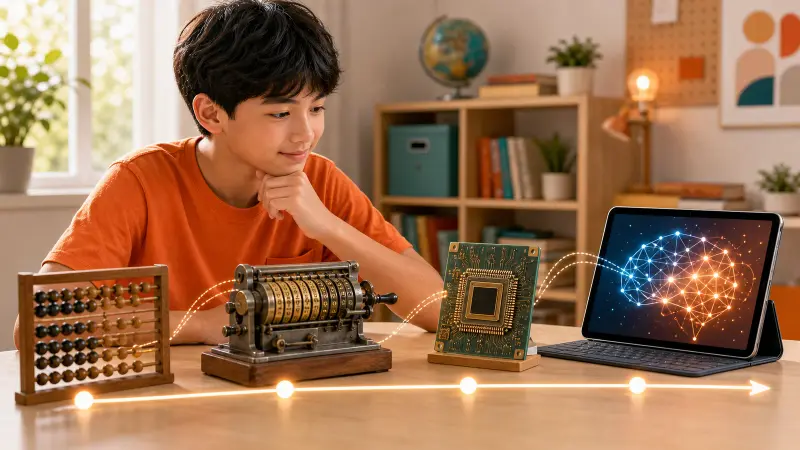
The history of computers is a long-term evolution from simple manual tools like the abacus to complex AI models, not a single invention.
Key breakthroughs include Charles Babbage's conceptual Analytical Engine, the first electronic computers like ENIAC, the invention of the transistor and microprocessor, and the development of the internet.
Understanding this history provides children with the foundational context needed to grasp how modern programming, hardware, and artificial intelligence function.
Learning about past technological challenges and solutions inspires critical thinking and innovation, preparing students to become future creators.
What is the history of computers and why does it matter for children today?
The history of computers for a child today is the story of how humanity moved from counting with beads on a wire to building machines that can learn and create. This journey began thousands of years ago with simple calculating tools and progressed through mechanical engines, room-sized electronic machines, and finally to the powerful devices and AI systems we use daily. Understanding this evolution is vital for young learners because it reveals the core principles that still power all modern technology.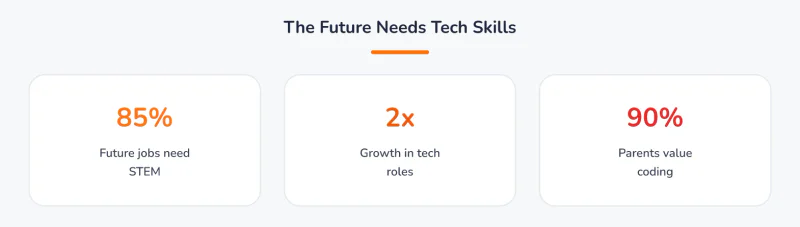
The Future Needs Tech Skills: 85% Future jobs need STEM, 2x Growth in tech roles, 90% Parents value coding.
The concept of a 'computer' has changed dramatically over time. Its definition has evolved from early mechanical devices to the sophisticated electronic machines of the present day. Initially, the term referred to a person who performed calculations. Tracing this lineage helps children see technology not as magic, but as a series of problems solved by human ingenuity. Each step, from the Jacquard loom's punch cards to the microprocessor, was an innovative solution that built upon previous knowledge.
For parents and educators, teaching this history provides essential context. It demystifies the technology that shapes children's lives and futures. When a child learns how the basic logic of Babbage's Analytical Engine from the 1830s relates to the Python code they write today, they gain a deeper appreciation for the field. They are not just learning to use a tool; they are learning to think like the innovators who built it, preparing them to contribute to the next chapter of this ongoing story.
At Codeyoung, learning goes beyond lessons. With 50,000+ students taught across 45+ countries, fully live 1:1 classes, teachers chosen from less than 1% of applicants, and an 85%+ course completion rate, we focus on making concepts easy to understand and enjoyable to learn.
What are the key milestones in the history of computers from the abacus to AI?
The key milestones in the history of computers begin with ancient manual calculators like the abacus, advance to 19th-century mechanical designs like Babbage's Analytical Engine, and then accelerate with 20th-century electronic innovations. These include the first general-purpose electronic computer (ENIAC), the invention of the transistor and integrated circuit, the creation of the microprocessor that enabled personal computers, and the development of the internet and artificial intelligence.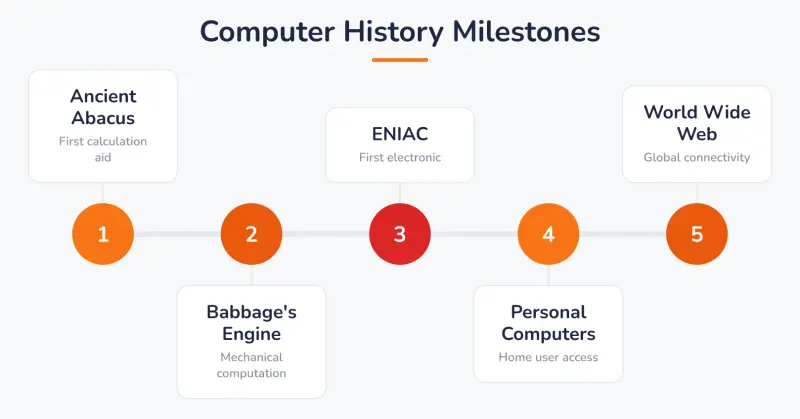
Computer History Milestones: Ancient Abacus (First calculation aid), Babbage's Engine (Mechanical computation), ENIAC (First electronic), Personal Computers (Home user access), World Wide Web (Global connectivity).
Ancient and Mechanical Origins
Long before electronics, the need to calculate drove innovation. The abacus, emerging in Mesopotamia around 2500 BC, was one of the first tools for arithmetic. Even more complex devices existed, such as the Antikythera mechanism from ancient Greece, an astonishingly intricate analog computer used to predict astronomical positions. Centuries later, inventors like Blaise Pascal (Pascaline, 1642) and Gottfried Leibniz (Stepped Reckoner, 1672) created mechanical calculators using gears and wheels.
For example, to add two numbers on the Pascaline, a user would dial them in using a series of interlocking wheels, with a clever mechanism automatically carrying over digits from the ones column to the tens, and so on, mimicking the way humans perform addition. While these devices were limited to specific arithmetic tasks, they established the principles of automated calculation, a field deeply connected to the comprehensive history of math.
A conceptual leap occurred in the early 1800s with Joseph Marie Jacquard's loom, which used punched cards to control the patterns woven into fabric. This was the first machine to use stored, programmable information. The presence or absence of a hole in a specific location on a card would command the loom to either raise or lower a corresponding thread, allowing for the automatic creation of incredibly complex textiles. A different set of cards meant a different pattern, without ever re-engineering the loom itself. This idea directly inspired English mathematician Charles Babbage.
His Difference Engine was designed for polynomial functions, but it was his subsequent design for the Analytical Engine in 1837 that is considered a blueprint for the modern computer. It featured an arithmetic logic unit (which he called the "Mill"), control flow, and integrated memory (the "Store"). It was designed to read instructions from punched cards, just like the loom. Collaborator Ada Lovelace wrote extensive notes on the machine, including what is recognized as the first algorithm intended for machine processing, earning her the title of the first computer programmer.
Some parents might wonder if these gear-and-lever devices are relevant to a child learning to code today. The connection is direct: these machines established the fundamental concept of automating a logical, step-by-step process. This principle is identical to what happens inside a modern CPU, which simply executes its instructions with electricity instead of with physical mechanics.
Ada Lovelace's notes on the Analytical Engine are recognized as the first algorithm intended to be processed by a machine.
The Electronic Revolution
The 20th century ushered in the era of electronic computing. In the 1930s and 40s, pioneers like Konrad Zuse (Z3) and John Atanasoff developed early electronic calculators. The landmark machine was the ENIAC (Electronic Numerical Integrator and Computer), completed in 1946 at the University of Pennsylvania. It was the first general-purpose, reprogrammable electronic digital computer, though it was massive, weighing 30 tons and using over 18,000 vacuum tubes. The ENIAC's development was a pivotal event in the transition to modern computing.
These first-generation machines were unreliable, generated immense heat, and consumed vast amounts of power. For example, one of the 18,000 vacuum tubes would fail on average every two days, requiring technicians to constantly search for and replace the faulty component. To "program" the ENIAC for a new task, operators had to physically reconfigure its wiring by moving cables and setting thousands of switches, a process that could take several days. This was a stark contrast to later "stored-program" computers, which could load instructions from memory in seconds.
A major breakthrough came in 1947 with the invention of the transistor at Bell Labs. Transistors replaced bulky vacuum tubes, leading to computers that were smaller, faster, cheaper, and more reliable. This marked the second generation of computers. Where a first-generation computer filled an entire room, a transistor-based machine might only be the size of a few large filing cabinets while being far more powerful. The third generation arrived with the development of the integrated circuit (IC), invented by Jack Kilby in 1958, with Robert Noyce independently developing a more manufacturable version the following year — both are credited as co-inventors.
This miniaturization was the critical step toward personal computing. The immense challenge of the Apollo space program, for example, heavily drove this innovation. The Apollo Guidance Computer had to be small and light enough to fit on a spacecraft, a requirement that pushed IC technology forward at a rapid pace.
The Personal Computer and the Internet
The fourth generation of computing began with a single component. The Intel 4004, released in 1971, was the world's first commercially available microprocessor. It concentrated the entire central processing unit (CPU) of a computer onto one small chip. This innovation made personal computers (PCs) feasible. The Altair 8800 (1975) was a popular kit for hobbyists, followed by commercially successful pre-assembled machines like the Apple II (1977) and the IBM PC (1981). The Apple II, for example, gained immense popularity in businesses thanks to VisiCalc, the first spreadsheet program.
This single piece of software transformed the computer from a device for enthusiasts into an indispensable tool for finance and accounting. The introduction of the graphical user interface (GUI), pioneered at Xerox PARC and popularized by Apple's Macintosh, made computers accessible to a non-technical audience.
The difference between the earlier command-line interface (CLI) and the new GUI was profound. For beginners, a CLI like MS-DOS was intimidating. To delete a file, a user had to type a precise and unforgiving command like del C:\homework\report.txt. A single typo would result in an error message. In contrast, on a Macintosh, the user could simply use the mouse to click on the icon for the file and drag it to a picture of a trash can. This visual, intuitive approach removed a major barrier, making computing accessible to millions who were not programmers.
The invention of the microprocessor in 1971 placed an entire computer's processing unit onto a single chip, making personal computers possible.
The next seismic shift was connectivity. The foundations of the internet were laid in the 1960s with ARPANET, a U.S. government project. However, it was the invention of the World Wide Web by Tim Berners-Lee at CERN - proposed in March 1989, with the first browser and web server built by the end of 1990 - that transformed it into a global information system.
It is important to distinguish between the two: the internet is the vast, global network of connected computers, like a global system of roads. The World Wide Web is a system for sharing information over that network using technologies like web pages, hyperlinks, and browsers.
Berners-Lee created the first web browser and the core protocols like HTTP that make the web work. This development, combined with the exponential growth of processing power (often described by Moore's Law), paved the way for the current era of mobile devices, cloud computing, big data, and artificial intelligence. The history of computers shows a clear progression where societal needs and technological advancements propel one another forward.
Why is understanding computer history crucial for learning AI?
Understanding computer history is crucial for learning Artificial Intelligence because it provides the fundamental context for how AI systems work. AI is not a separate, magical technology; it is the culmination of decades of progress in hardware, algorithms, and data processing. For a student aged 10-16, knowing this history transforms AI from an abstract concept into a tangible field built on principles they can learn and master. A historical perspective helps young learners grasp core concepts that are essential for AI development.
For instance, the idea of an algorithm did not begin with machine learning; it was formalized by Ada Lovelace in the 1840s. The binary logic that underpins neural networks was developed by George Boole in the 19th century. When students see these connections, they realize that building an AI model is part of a long tradition of computational problem-solving. This is one of the best strategies for learning computer science effectively, as it anchors complex new ideas in a stable foundation of established knowledge.
This understanding is central to distinguishing between simply using AI and truly understanding it. A child can ask a smart speaker a question, but a child who understands computer history can begin to ask how that speaker processes language. This critical thinking is what prepares them for the future. For example, at Codeyoung, our 'AI & Machine Learning with Python' course for ages 10-16 is structured around this principle. With over 50,000 children taught in our programs, we see firsthand that students who grasp the "why" are more successful.
The course starts with Python basics and systematically builds toward complex projects like a 'Yoga Pose Detection' capstone, where students train their own computer vision models. This journey, taught through live 1:1 online sessions, ensures they don't just use AI tools, but learn to build and critique them.
Grasping the history of computers helps students appreciate the layers of abstraction in technology. They learn that their Python code runs on an operating system, which manages hardware that is the direct descendant of the integrated circuits and microprocessors of the 1960s and 70s. This knowledge cultivates several key skills:
Problem-Solving: Seeing how past engineers overcame limitations (like the shift from vacuum tubes to transistors) inspires creative solutions to today's coding challenges.
Conceptual Understanding: History clarifies why things are the way they are, such as why data is stored in binary or how a CPU processes instructions.
Inspiration for Innovation: Learning about pioneers like Grace Hopper or Alan Turing shows that the field is constantly being redefined by new ideas.
Critical Evaluation of AI: A historical viewpoint allows students to see AI not as an infallible oracle, but as a technology with specific capabilities and limitations shaped by its development path.
Understanding the 'why' behind historical innovations prepares children to be creators of technology, not just consumers.
Frequently Asked Questions
What defines a 'computer' throughout history?
The definition of a "computer" has evolved significantly. Initially, it referred to a person who performed calculations. Later, it described mechanical devices like Babbage's Analytical Engine designed for automated computation. The modern definition of a computer as a programmable electronic device capable of storing, retrieving, and processing data solidified in the mid-20th century with machines like the ENIAC.
How did advancements like the transistor impact computing?
The invention of the transistor in 1947 was a revolutionary advancement that replaced unreliable, bulky, and power-hungry vacuum tubes. Transistors enabled the creation of smaller, faster, and more energy-efficient computers. This miniaturization was the critical step that led directly to the development of integrated circuits, microprocessors, and ultimately, the personal computer.
What is the direct link between early computers and today's Artificial Intelligence systems?
The direct link is foundational concepts. Early computers established the core principles of algorithmic processing, data storage, and logical operations that AI relies on. The stored-program concept of the ENIAC and the theoretical work of Alan Turing on computation are the building blocks upon which all modern software, including complex AI and machine learning models, are developed. AI is an advanced application of these fundamental computer science principles.
Why is it important for kids to learn about computer history in an AI-driven world?
It is important because it provides context and fosters critical thinking, preventing them from seeing technology as a "black box." Understanding the evolution from simple calculators to complex neural networks helps children grasp the principles behind the AI tools they use. This knowledge encourages them to move from being passive consumers to active creators and helps them understand, for example, how to use AI for homework the right way by evaluating its outputs critically rather than accepting them blindly.
How does computer history shape the next generation of innovators?
The journey of computers, from rudimentary counting devices to sophisticated AI, is a testament to human ingenuity and continuous problem-solving. Understanding this rich history provides young learners with crucial context, illuminating how each innovation, no matter how small, laid vital groundwork for the complex digital world we navigate today. It's a story of constant evolution, reminding us that today’s technology will be tomorrow’s history. This perspective fosters a mindset of curiosity and creation, empowering the next generation to not just use the tools they inherit, but to question, improve, and build the innovations of the future.