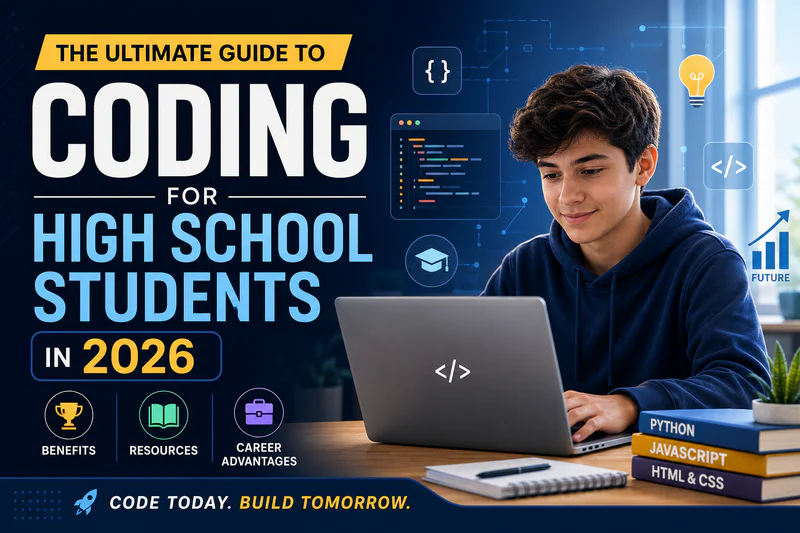
The labor market has shifted permanently. In 2026, computer and IT occupations are projected to grow by 11.7 percent, far faster than average across all industries, and the Class of 2026's computer science graduates are expected to be the highest-paid graduates at the master's level, with a projected average salary of $94,212 according to the National Association of Colleges and Employers (NACE). For parents and teens navigating this landscape, the message is clear: coding for high school students is no longer optional, it's foundational.
This guide covers every benefit, resource, and learning pathway teens need in 2026 to build a genuine competitive edge, from the classroom to the college application to the career market.
Why 2026 Is the Most Important Year to Start Coding for High School Students
AI has moved from novelty to infrastructure. Nearly every industry, healthcare, law, finance, creative media, now relies on professionals who can read, write, or at least understand code. Teens who graduate without coding exposure will increasingly enter a workforce that simply assumes a baseline level of digital fluency.
The Bureau of Labor Statistics confirms that computer and information technology jobs are growing at more than double the national average. And while AI is transforming some roles, it is simultaneously creating entirely new categories of work that didn't exist five years ago, roles that demand exactly what coding education builds: structured thinking, algorithmic reasoning, and the ability to translate problems into solutions.
Starting coding for high school students today means graduating with a head start that cannot be replicated in a single college semester.
Benefit #1, Master Skills That Every Industry Demands
Coding is not a skill that belongs only to software engineers. In 2026, Python scripts are used by marketing analysts to automate reporting, by healthcare professionals to manage patient data pipelines, and by legal teams to analyze contracts with machine learning tools. The underlying skill is the same: computational thinking.
When teens invest in coding for high school students programs, they aren't training for one job. They're building a cognitive toolkit, logical decomposition, pattern recognition, debugging methodologies, that transfers across every field they might enter.
The students who combine industry knowledge with coding fluency are consistently the most employable candidates in any sector. That's the edge this investment creates.
Benefit #2, Unlock Explosive Creativity Through Real Projects

Abstract learning rarely sticks. What transforms a teenager's relationship with technology is building something real, a working app, a game, an interactive story, a data dashboard.
Game design for teens is one of the most powerful entry points because it connects passion with technical skill. A teen who wants to build the next indie game hit has a compelling personal reason to master loops, conditionals, and object classes. That motivation accelerates learning dramatically.
Similarly, app development for kids and teenagers introduces them to the full product lifecycle, ideation, design, development, testing, and deployment. These projects don't just build technical skills; they produce portfolio artifacts that colleges and employers actually want to see. A high schooler who walks into an admissions interview with a published mobile app has already demonstrated more than most adult candidates can.
Benefit #3, Accelerate Your Career Before You Graduate
Coding proficiency opens doors before a diploma is even earned. High school students with real coding skills can freelance, contribute to open-source projects, intern at tech companies, or launch their own digital products. These experiences compound rapidly, each project teaches lessons no classroom can replicate.
The salary premium for coding-adjacent roles is substantial and starts early. Teens who graduate with certified coding skills and a demonstrable portfolio consistently command stronger internship offers and early-career salaries than peers without them.
For selective college admissions in 2026, where competition has intensified significantly, a coding portfolio signals not just aptitude but initiative, one of the most valued qualities admissions committees look for.
Benefit #4, Dominate College Applications With a Coding Portfolio
College admissions in 2026 is a differentiation game. Test scores and GPAs alone no longer separate candidates at selective institutions. What does stand out is evidence of applied, self-directed learning.
App development classes for kids and teens are specifically designed to produce that evidence. When a high schooler completes structured app development classes for kids and emerges with two or three functional, polished applications, demonstrated through GitHub repositories, live app store listings, or recorded demos, they present admissions officers with something tangible and memorable.
STEM-focused programs at top universities explicitly look for students who have moved beyond the theoretical into the applied. A well-documented coding portfolio communicates exactly that. Online coding classes for kids and teens structured around project-based learning are the most direct path to building this kind of portfolio systematically.
Benefit #5, Build Confidence, Communication & Collaboration
Coding teaches teens how to fail productively. A program doesn't work on the first attempt, it rarely does for anyone. The debugging process, the iterative refinement, the reading of error messages as useful data rather than personal failure: these experiences build a growth mindset that psychologists consistently identify as one of the strongest predictors of long-term success.
Beyond individual resilience, collaborative coding projects, building apps or games as a team, develop communication and project management skills that are explicitly valued in college and workplace environments. Teens who can articulate their technical decisions to a non-technical audience are exceptionally rare and exceptionally sought-after.
Benefit #6, Supercharge Your Math Brain With Coding
Coding and mathematics share the same underlying architecture: structured logic, sequential reasoning, and the ability to hold multiple variables in mind simultaneously. Strengthening one consistently strengthens the other.
Vedic math classes offer high schoolers a particularly powerful edge here. These ancient techniques for rapid mental arithmetic, multiplication shortcuts, division tricks, algebraic patterns, directly accelerate the kind of quick computational thinking that makes complex CS algorithms more intuitive. Students who combine vedic math classes with coding practice report that algorithmic problem-solving becomes significantly less intimidating.
For teens who need broader foundational support, math tutoring for kids that extends into high-level topics like algebra, pre-calculus, and discrete mathematics provides the scaffolding that makes AP Computer Science A and B genuinely accessible. Online math programs for kids that use adaptive learning technology reinforce the logical reasoning patterns that coding demands daily. The overlap between STEM careers for kids and strong math foundations isn't coincidental, it's structural.
Benefit #7, Gain Real AI Literacy, Not Just Buzzword Knowledge
Knowing that AI exists and knowing how it works are vastly different things. In 2026, employers and college programs are increasingly capable of distinguishing between the two.
Python for kids and high schoolers is the entry point for genuine AI literacy because Python is the dominant language of data science, machine learning, and AI development globally. When a teen learns Python's syntax, works with libraries like NumPy and Pandas, and builds their first predictive model, they move from AI consumer to AI practitioner. That transition is everything.
Python game development for kids is an excellent bridge, it teaches Python syntax through the intrinsically motivating context of building games, making the transition to data science and AI applications feel natural rather than abrupt. Understanding how AI makes decisions, where it fails, and how to direct it purposefully is a skill that will define career trajectories for the next 30 years.
Benefit #8, Coding Is a Life Skill for Every Career Path
Whether a teenager wants to become a doctor, a filmmaker, an entrepreneur, or a policy analyst, coding fluency enhances every one of those paths. Data literacy, automation, digital product creation, these are no longer exclusively technical competencies. They are 21st-century life skills.
Exploring STEM careers for kids makes this immediately visible: even careers traditionally distant from technology, biology, architecture, journalism, now routinely incorporate computational tools. Teens who understand coding can adapt to new tools faster, spot automation opportunities others miss, and communicate more effectively with technical colleagues regardless of their role.
Coding for high school students, in this sense, is not a career track. It is a baseline capability for navigating modern professional life.
Essential Resources & Skills Table for High School Coders
The Coding Learning Roadmap: From Scratch to Python to Java

Every high schooler's coding journey starts somewhere, and the most effective progression follows a deliberate sequence that builds genuine confidence at each stage.
Stage 1: Scratch programming for kids. For students who are newer to coding, or who began their journey in middle school, Scratch programming for kids provides an invaluable foundation. The visual, block-based environment eliminates syntax anxiety and lets students focus purely on logical thinking: sequences, loops, conditionals, and events. Many teens who dismiss coding as "too hard" change their minds entirely after building their first Scratch animation or game. It's a confidence-builder that transfers directly.
Stage 2: Python for kids. Once logical thinking is established, Python is the natural next step. Python coding courses introduce real syntax in the most readable, beginner-friendly language available, while simultaneously opening doors to data analysis, automation, and AI. Python for kids is not a "kiddie" language; it is the most-used language in data science and machine learning globally, making it the highest-ROI first text-based language a high schooler can learn.
Stage 3: Java for kids.Java for kids represents the leap into object-oriented programming, the architectural pattern underlying most professional software development. Java is also the language of AP Computer Science A, making mastery here both an academic and professional accelerator. Students who arrive at this stage with Scratch logic and Python fluency find Java far more approachable than peers who attempt it cold.
Alongside this progression, online coding classes for kids and teens provide the structured curriculum that makes each stage intentional rather than haphazard. Self-directed learning has its place, but a well-designed program ensures that no critical concepts are skipped and that students receive the feedback necessary to genuinely progress.
Conclusion: Your Teen's Future Starts With One Line of Code
The benefits of coding for high school students are not theoretical, they are measurable, immediate, and compounding. From building college portfolios through app development classes for kids, to gaining genuine AI literacy through Python for kids programs, to sharpening mathematical reasoning with vedic math classes and math tutoring for kids, every element of a well-rounded coding education pays dividends that extend decades beyond high school.
The roadmap is clear: begin with visual fundamentals through Scratch programming for kids, advance through Python coding courses, and build robust software skills with Java. Enroll today in structured online coding classes for kids and teens at Codeyoung, and give your high schooler the most powerful academic and professional head start available in 2026.
Frequently Asked Questions
What is coding for high school students and why is it important?
Coding for high school students refers to structured learning of programming languages, Python, Java, JavaScript, and others, combined with hands-on project work like building apps, games, and data tools. In 2026, it is important because AI literacy, computational thinking, and digital product skills are baseline requirements in virtually every high-growth career field. Teens who begin now graduate with a measurable advantage in both college admissions and the job market.
How do online coding classes for kids prepare teens for high school coding?
Online coding classes for kids build the foundational logic and problem-solving habits that high school coding demands. Starting with structured lessons in Scratch programming for kids or introductory Python lays down the conceptual scaffolding, variables, loops, conditionals, functions, that makes more advanced high school coursework like AP Computer Science dramatically more accessible. Early online coding classes for kids are the single best predictor of high school coding success.
Why start with Scratch programming for kids before Python or Java?
Scratch programming for kids removes the biggest barrier to coding: syntax fear. When teens can focus entirely on logic without worrying about semicolons and brackets, they build genuine computational thinking habits. That foundation makes the transition to Python, and then Java, feel like a natural step rather than a cliff. Students who begin with Scratch programming for kids consistently outperform peers who start directly with text-based languages in terms of both retention and project completion rates.
How can app development classes for kids enhance a high schooler's portfolio?
App development classes for kids teach the complete development cycle, wireframing, coding, testing, and launching a real product. A high schooler who completes structured app development classes for kids graduates with two to four publishable projects that serve as concrete evidence of their skills. In 2026's competitive college admissions environment, these portfolio projects communicate initiative and applied ability in ways that grades alone cannot. App development classes for kids are among the highest-impact investments a teen can make before applying to college.
Can vedic math classes improve coding skills for high school students?
Absolutely. Vedic math classes train the brain to perform rapid arithmetic and pattern recognition, skills that translate directly into algorithmic efficiency. When a high school student working through complex sorting algorithms or recursive functions can quickly compute expected outputs mentally, they debug faster and understand program flow more intuitively. Vedic math classes are not a replacement for coding study, but they are a powerful accelerant for the mathematical reasoning that underpins coding for high school students.
How does math tutoring for kids complement coding education?
Math tutoring for kids that addresses algebra, functions, and pre-calculus directly supports the logical structures used in coding. Variables, expressions, conditionals, and functions in code mirror their mathematical counterparts almost precisely. Strong math tutoring for kids builds the algebraic intuition that makes transitioning into Python, Java, and AP Computer Science courses feel natural. Online math programs for kids that use adaptive learning further reinforce these logical patterns, creating a compounding benefit across both coding and academic math performance.
What makes Python for kids ideal for AI and data science beginners?
Python's syntax reads almost like plain English, which means high schoolers spend less time fighting the language and more time understanding concepts. Python for kids courses introduce data types, libraries like NumPy and Pandas, and introductory machine learning models in a structured, age-appropriate sequence. Critically, Python is the dominant language in real-world AI and data science, meaning Python for kids courses teach skills with direct, immediate professional relevance rather than preparing teens for a language they'll never use.
Are online math programs for kids necessary alongside coding?
For most high school students, yes. Online math programs for kids reinforce the logical reasoning, pattern recognition, and analytical thinking that coding requires daily. Students who are simultaneously engaged in online math programs for kids and coding courses report stronger performance in both disciplines. The logical structure of mathematics directly mirrors the logical structure of well-written code, and online math programs for kids that emphasize problem-solving over memorization are especially synergistic with coding education.
How does coding improve college applications in 2026?
In 2026, STEM-forward universities and liberal arts colleges alike are drawn to applicants who demonstrate applied, self-directed learning. Coding for high school students who complete app development classes for kids, build games through Python game development programs, or complete advanced Python and Java coursework arrive at the admissions process with concrete artifacts, portfolios, repositories, published applications, that set them apart. Coding for high school students also signals the kind of persistence and technical curiosity that colleges know predicts long-term academic success.
Is coding only for students aiming at STEM or tech careers?
No. Coding for high school students is one of the most universally transferable skills available in 2026, regardless of intended major or career path. Students pursuing medicine will use data tools. Future journalists will analyze datasets. Entrepreneurs will direct technical teams. Creatives will build digital products. Every career benefits from the logical thinking, problem-solving discipline, and digital fluency that coding for high school students develops. The question is not whether coding is relevant to your teen's future, it is how central a role it will play.