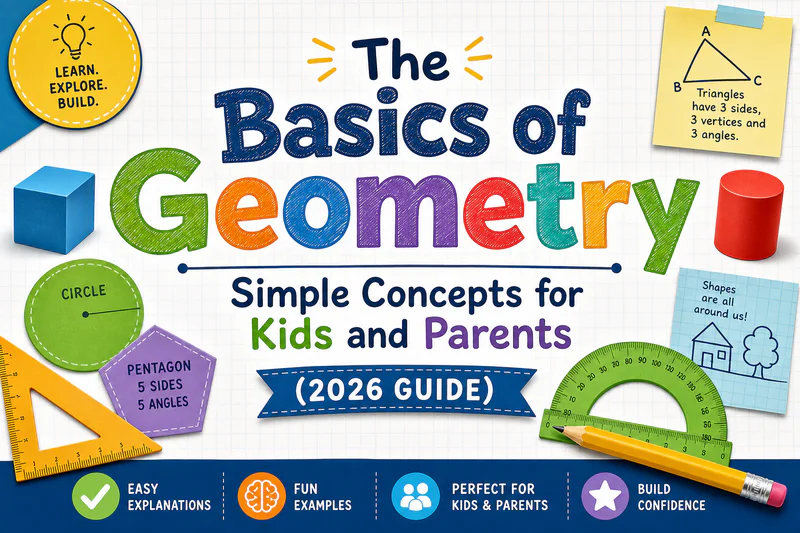
Geometry is everywhere, in the screen your child reads this on, the game they play after school, and the app they use to video call friends. It is the mathematics of shape, space, and size, and in 2026, it is also the hidden language behind game physics, app interfaces, and 3D animation. Helping your child master geometry early gives them a measurable edge in both academics and the rapidly expanding world of STEM careers.
This guide breaks down every essential geometry concept clearly, shows parents how to teach it at home, and explains why the best online math programs for kids, combined with coding, create the most powerful STEM foundation possible.
What Is Geometry, Really?
Geometry is the branch of mathematics that studies shapes, sizes, positions, and the properties of space. The word itself comes from Ancient Greek: geo (earth) + metria (measurement). Ancient Egyptians used it to redraw land boundaries after Nile floods. Today, software engineers use it to build the digital worlds your child inhabits.
For children, geometry builds spatial reasoning, the ability to mentally visualize, rotate, and manipulate objects. Research from Stanford University confirms that children begin developing shape recognition as early as ages three to four, making early geometry exposure critically important. Strong spatial reasoning correlates directly with performance in science, engineering, and technology throughout a student's academic life.
Many children struggle not with geometry concepts themselves but with visualizing them, particularly when transitioning from flat 2D shapes to complex 3D forms. This is precisely where quality math tutoring for kids makes the difference. A skilled tutor can use personalized, visual approaches to break down exactly where a child's understanding gaps and fill them efficiently.
The Basic Shapes of Geometry: 2D Shapes Explained

Two-dimensional shapes, also called plane shapes, have length and width but no depth. They are the starting point of all geometric learning and appear constantly in everyday life.
The four most foundational 2D shapes are:
Circle: A perfectly round shape with all points equidistant from the center. Think clocks, wheels, and pizzas.
Triangle: Three sides, three angles, and a remarkably strong structural form used in bridges and architecture.
Square: Four equal sides with four right angles, the building block of grids, tiles, and pixel layouts.
Rectangle: Similar to a square but with two pairs of equal sides. Think doors, screens, and book pages.
Understanding angles is critical here. A right angle is exactly 90°, an acute angle is less than 90°, and an obtuse angle is greater than 90°. These distinctions matter because when children begin Scratch programming for kids, they use exact angle values to rotate sprites and the X-Y coordinate plane to position objects on a canvas. Drawing a square in Scratch requires four 90° turns, geometry in action, instantly visible on screen.
3D Shapes: Adding Depth to the Picture
Three-dimensional shapes have length, width, and height, giving them volume. They are the shapes of the physical world.
The three most important 3D shapes for foundational geometry are:
Cube: Six equal square faces. Think dice, building blocks, and Minecraft's entire world.
Sphere: A perfectly round 3D object. Think basketballs and planets.
Cylinder: Two circular bases connected by a curved surface. Think cans, pipes, and drums.
The jump from 2D to 3D is where many students lose confidence, and this is exactly where targeted math tutoring for kids provides the most value. A good tutor won't just show formulas, they will use physical objects and visual models to make depth tangible and intuitive.
For older students exploring Python for kids, 3D shapes are not just academic concepts, they are the building blocks of game development. Collision detection (hitboxes), physics engines, and 3D rendering all rely on precise calculations of spheres, cylinders, and cubes. When a student programs a ball bouncing realistically in a Python game, they are applying sphere volume and surface area formulas in real time.
Essential Geometry Formulas: The Master Reference Table

This reference table covers every key formula your child needs, alongside its direct application in the digital world. Enrolling in structured online math programs for kids ensures these formulas are not just memorized but genuinely understood.
Bookmark this table. It is the geometry reference sheet your child will return to from elementary school through high school, and beyond.
How Geometry Works: The Core Concepts
Perimeter, area, and volume are the three workhorses of practical geometry.
Perimeter is the total distance around a 2D shape, add up all the sides. Area measures the space inside a 2D shape. Volume extends that idea into three dimensions, measuring how much space a 3D shape occupies. These three concepts appear in architecture, land surveying, interior design, engineering, and, critically, in every game or app your child might one day build.
Angles are equally foundational. A right angle (90°) defines the corner of a square. Acute angles (less than 90°) appear in triangles and roof structures. Obtuse angles (greater than 90°) appear in polygons and design layouts. Understanding angles is prerequisite knowledge for Scratch programming for kids, where every sprite movement and shape-drawing instruction is angle-driven.
Symmetry rounds out the core concepts. A shape is symmetrical when one half mirrors the other. Symmetry underpins art, nature, architecture, and UI design, where balanced layouts feel instinctively "right" to users.
One of the most powerful ways to build speed and accuracy with area, volume, and perimeter calculations is through vedic math classes. Vedic mathematics, an ancient Indian system of mental arithmetic, teaches shortcut techniques that dramatically accelerate calculations. For instance, rapidly squaring a number (needed for area calculations) or quickly multiplying decimals (needed for circumference) becomes significantly faster with Vedic methods. Students in vedic math classes consistently outperform peers in timed math assessments because they internalize calculation strategies that eliminate slow, step-by-step arithmetic. You can explore more of these approaches through our guide on mental math tricks for kids.
How to Explain Geometry to Kids: A Parent's Action Guide
Geometry is one of the most parent-accessible areas of mathematics because it is entirely physical and visual. You do not need a math degree to teach it effectively.
Start with the real world. Point out shapes during daily life, the rectangular table, the cylindrical water bottle, the spherical orange. Ask your child to identify the shape before naming it. This builds recognition instinctively.
Use hands-on activities. Have your child draw shapes freehand, then use a ruler and protractor. Measure the perimeter of a room using a tape measure. Calculate the area of a piece of paper. These activities connect abstract formulas to tangible experiences in ways that stick.
Connect geometry to what your child loves. If they play video games, point out that the environments are built from geometric shapes. If they love art, show how symmetry and proportion define beautiful design. If they are into coding for kids, explain that every sprite, button, and screen layout is pure applied geometry. For families curious about how these skills reinforce each other, our article on coding and math for kids explores this connection in depth.
Use structured programs for consistent practice. The best online math programs for kids combine visual lessons, interactive exercises, and progress tracking in a format children engage with. Unlike a textbook, a well-designed digital math program adapts to your child's pace and highlights specific gaps.
Invest in 1:1 support when needed. When a concept genuinely is not clicking, especially 3D visualization or formula application, personalized math tutoring for kids accelerates progress dramatically. A dedicated tutor identifies the exact breakdown point and addresses it directly, rather than re-teaching an entire chapter.
Quick tips to make geometry stick at home:
Use building blocks or LEGO to explore 3D shapes physically
Print a coordinate grid and have your child plot points and draw shapes
Play area estimation games ("How many tiles cover this floor?")
Reward curiosity, every "why does that work?" question is a geometry win
Revisit vedic math classes techniques when calculation speed becomes a bottleneck
If you want a broader strategy for supporting your child's mathematical development, the guide on how to improve your child's math skills at home is an excellent starting point.
Geometry + Coding = The Most Powerful STEM Combo of 2026

According to GlobeNewswire, the global K-12 STEM education market was valued at $58.3 billion in 2024 and is projected to reach $125.2 billion by 2030. This explosive growth reflects what forward-thinking parents already understand: STEM skills are no longer optional preparation, they are foundational literacy for the 21st century.
Geometry sits at the intersection of mathematics and computing. Spatial reasoning, the core skill geometry develops, is precisely what computational thinking for kids requires. Decomposing a complex 3D scene into simple shapes, identifying geometric patterns in data, and reasoning about spatial relationships are all computational skills that geometry sharpens directly.
Scratch programming for kids is where this connection becomes immediately visible for younger students (ages 7–12). In Scratch, every project relies on the X-Y coordinate plane: moving a sprite to position (100, 150) requires understanding coordinates. Drawing a hexagon requires calculating interior angles. Creating a bouncing ball simulation requires understanding circular boundaries. Scratch programming for kids makes geometry interactive, visual, and genuinely fun in a way that worksheets simply cannot match.
For older students (ages 12+), Python for kids takes geometry into sophisticated territory. Game development in Python requires calculating distances between objects (using the distance formula from coordinate geometry), programming physics engines (using sphere and cylinder volume formulas), and creating 3D rendering logic (using triangular mesh calculations). When a student builds their first Python game with realistic ball physics, they are applying high school geometry in a context that feels exciting rather than academic.
App development classes for kids are the third pillar of this STEM geometry triangle. Every app interface, every screen, card, button, and navigation bar, is built on a geometric grid of rectangles and spatial symmetry. UI/UX designers must understand aspect ratios, proportional scaling, and grid alignment, all of which are direct applications of geometric principles. App development classes for kids teach students to think spatially about user experience, combining aesthetic sense with mathematical precision.
Enrolling your child in online coding classes for kids that integrate geometry into real projects creates a learning loop: math skills reinforce coding ability, and coding projects make math concepts immediately meaningful. Students who learn through online coding classes for kids consistently report higher engagement and faster conceptual retention compared to classroom-only instruction.
The synergy is undeniable, and students who learn coding for kids alongside geometry develop a rare combination of analytical and creative thinking. For students specifically interested in the game design pathway, our guide on game design for teens outlines exactly how geometric thinking powers every aspect of game creation.
Conclusion
Geometry is not an isolated school subject, it is the mathematical foundation of the physical world and the digital one. From calculating the area of a garden bed to programming a 3D game environment, geometric thinking is a skill your child will use for life.
The most effective approach in 2026 combines structured online math programs for kids for conceptual mastery, personalized math tutoring for kids for targeted support, vedic math classes for calculation speed, and online coding classes for kids that bring geometric concepts to life through real projects. Give your child all four, and you are not just teaching geometry, you are building the complete STEM foundation they need to thrive.
Frequently Asked Questions
What are basic geometry shapes?
Basic geometry shapes fall into two categories. 2D shapes include the circle, triangle, square, and rectangle, flat shapes with length and width. 3D shapes include the cube, sphere, and cylinder, solid shapes with length, width, and height. These shapes are the vocabulary of all further geometric study and appear constantly in both the physical world and digital design.
What are the essential geometry formulas kids need to know?
The core formulas every child should master are: Circle (Area = πr²; Circumference = 2πr), Triangle (Area = ½ × base × height), Square (Area = side²; Perimeter = 4 × side), Rectangle (Area = length × width), Cube (Volume = side³), Sphere (Volume = ⁴⁄₃πr³), and Cylinder (Volume = πr²h). Quality online math programs for kids teach these formulas within applied contexts so children understand not just the calculation but the reasoning behind it.
How is geometry used in real life and coding for kids?
Geometry is the backbone of game design, app UI, and physics simulation. In coding for kids contexts, circles define collision boundaries, rectangles build every app layout, and 3D shapes power game environments. Scratch programming for kids uses coordinate geometry and angles to move sprites; Python for kids applies sphere and mesh formulas to build game physics. App development classes for kids rely on rectangular grids and spatial symmetry for every screen layout.
When should kids start learning geometry?
Children begin recognizing shapes as early as ages 3–4, according to Stanford University research. Formal geometry instruction typically begins around Grade 3–4 (ages 8–10) with area and perimeter, expanding to 3D shapes and formulas by middle school. The best online math programs for kids introduce geometric concepts progressively, aligned with each child's developmental readiness, and can accelerate learning significantly beyond standard classroom pacing.
How do vedic math classes support geometry learning?
Vedic math classes teach mental arithmetic techniques that make geometry calculations dramatically faster. Students learn shortcut methods for squaring numbers (critical for area formulas), multiplying decimals quickly (essential for circumference and volume), and performing multi-step mental calculations without a calculator. Children enrolled in vedic math classes develop the calculation confidence to tackle complex geometry problems without getting stuck on arithmetic, freeing cognitive bandwidth for actual geometric reasoning.
How do online coding classes for kids integrate geometry concepts?
The best online coding classes for kids embed geometry directly into programming projects rather than teaching it separately. Students use coordinate geometry to position objects on screen, apply angle calculations to animate movement, and use area and volume formulas when simulating physical environments. Online coding classes for kids that combine Scratch programming for kids with Python for kids pathways give students a progressive journey from 2D coordinate grids to full 3D geometry applications in game development.
What is the benefit of math tutoring for kids?
Math tutoring for kids provides personalized, 1:1 instruction that identifies exactly where a child's geometric understanding breaks down, whether that is visualizing 3D shapes, applying formulas correctly, or understanding angle relationships. Unlike classroom instruction, math tutoring for kids adapts pace, teaching style, and examples to each individual child, making it particularly powerful for building confidence in students who feel left behind by standard curriculum timelines.
How do Scratch programming for kids and Python for kids use geometry?
Scratch programming for kids uses geometry at the 2D level: students navigate the X-Y coordinate plane to position sprites, use degree-based angle commands to rotate and steer characters, and apply geometric logic to create shapes and animations. Python for kids applies geometry at a far more sophisticated level: 3D game physics require sphere and cylinder calculations, hitbox detection uses distance formulas, and rendering engines rely on triangular mesh geometry. Together, Scratch programming for kids and Python for kids form a complete geometric coding journey from foundational to advanced.
How do app development classes for kids relate to geometry?
App development classes for kids are fundamentally applied geometry courses. Every app screen is a rectangle divided into a geometric grid. Buttons are rounded rectangles with precisely calculated corner radii. Icons rely on symmetry and proportional scaling. Navigation bars apply consistent spacing formulas. App development classes for kids teach students to make deliberate geometric decisions that create interfaces that feel intuitive and visually balanced, a direct, professional application of geometry principles that most classroom curricula never make explicit.