Summer Maths Camp for Kids: Build Confidence This Summer
Maths is the subject where unaddressed gaps compound most predictably. A child who doesn't fully understand fractions at age 10 will find ratio harder at 11, algebra harder at 12, and trigonometry harder at 14: not because any of those topics are intrinsically beyond them, but because each one builds on the foundations that the fraction gap left shaky.
Summer is the most efficient window to address those foundations. Without the relentless pace of a school year adding new content on top of existing gaps, there is time to go back, find exactly where understanding breaks down, fix it properly, and build forward again. Codeyoung's Summer Maths Camp is designed specifically around this opportunity.
Key Takeaways
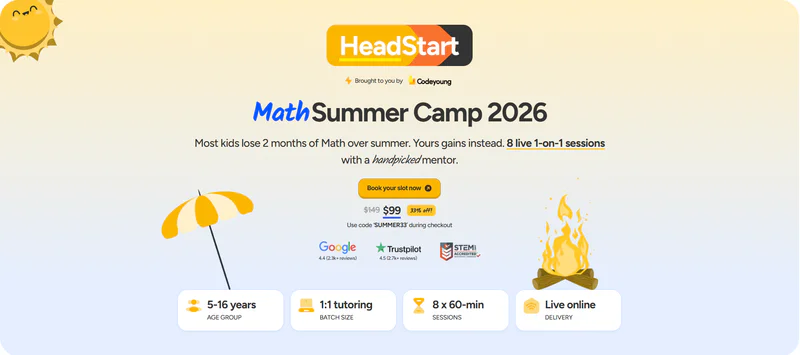
Codeyoung's Summer Maths Camp runs as live 1:1 sessions for children aged 6 to 17, covering gap-filling, mental arithmetic fluency, school curriculum support, and exam preparation.
The camp addresses the specific gap each child has: not a generic curriculum, starting from the exact point where understanding breaks down.
Two to three sessions per week over 6 to 8 weeks can close a 12-month curriculum gap and build genuine confidence before September.
The camp uses Vedic maths and mental arithmetic techniques alongside school curriculum, building the fluency that makes every subsequent maths topic more accessible.
For children with maths anxiety, the private 1:1 environment of summer camp sessions consistently produces faster confidence recovery than any group setting.
What the Summer Maths Camp Covers
Unlike a fixed summer school programme, Codeyoung's Summer Maths Camp is personalised from the first session. The intake assessment identifies where each child's understanding is genuinely secure and where it breaks down: not just which topics they haven't covered yet, but which concepts within covered topics are procedurally learned but conceptually shaky.
Summer Maths Camp Focus Areas by Age Group
The camp also integrates mental arithmetic and Vedic mathematics techniques across all age groups. These techniques build calculation fluency that makes every subsequent maths topic easier: not by replacing understanding but by reducing the cognitive load of routine calculation, freeing working memory for the reasoning that harder problems require.
For more on these techniques and why they matter, see Multiplication Tricks for Kids: Build Faster Times Tables and Mental Maths Tricks for Kids: 9 Techniques That Actually Work.
Why Maths Gaps Close Faster in Summer Than During the School Year
School-year maths tutoring is fighting a losing battle with timing. The school is teaching new content. The child is managing homework, assessments, and classroom learning simultaneously. Tutoring during the school year typically keeps a child's head above water, it prevents the gap from growing. It rarely has the space to go back and fix the root cause.
Summer removes that constraint. There is no new school content arriving weekly. The instructor can take the time to go back to where understanding genuinely broke down, often a concept 1 to 2 years back in the curriculum, rebuild it from the foundation, and then work forward again. A gap that couldn't be properly addressed in a school year of weekly sessions can often be closed in 6 to 8 weeks of summer camp instruction.
The mechanism is well-established in educational research: mastery-based learning, where a student truly internalises a concept before moving on, produces significantly more durable mathematical understanding than coverage-based learning, where a topic is "done" on schedule regardless of whether the student is secure. Summer camp is the opportunity to apply the mastery approach without the pressure of keeping pace with a class.
For more on identifying and addressing specific maths gaps, see Maths for Kids: How to Build Strong Foundations at Home.
Summer Maths Camp for Children With Maths Anxiety
A significant number of the children who benefit most from summer maths camp are those who have developed a negative relationship with the subject. "I'm just not a maths person." "I hate maths." These beliefs, once formed, are self-reinforcing: a child who avoids maths falls further behind, which confirms the belief, which produces more avoidance.
The 1:1 private environment of summer camp sessions is consistently effective for breaking this cycle, for a specific reason: there are no peers. The fear of failure in front of classmates, one of the primary drivers of maths anxiety in group settings, is entirely absent. When the child gets something wrong, the only person who knows is the instructor. And the instructor's response is always "interesting, what were you thinking there?" rather than correction in front of an audience.
Most children with maths anxiety who complete a summer of 1:1 maths camp sessions do not emerge as maths enthusiasts. But they almost universally emerge with less avoidance and more willingness to attempt problems rather than giving up at the first sign of difficulty. That shift is the most valuable thing the summer can produce for these children, and it has consequences for their school year performance that go well beyond any specific topic learned.
For more on addressing maths anxiety specifically, see Maths Anxiety in Kids: Signs, Causes, and How 1:1 Tutoring Helps and How to Make Maths Fun for Kids: 7 Methods That Work.
Want to close your child's maths gap before September? Codeyoung's Summer Maths Camp starts with a free assessment session, no charge, no commitment.
Explore the Summer Maths Camp →
What Real Progress Looks Like Over a Summer Maths Camp
Progress in maths is more directly measurable than in English. Here is what children at different starting points typically achieve over 6 to 8 weeks of twice-weekly summer maths camp sessions.
A 9-year-old with incomplete times tables: Fully automatic recall of all tables to 12, including the 7s and 8s that most resist memorisation, achieved through pattern-based techniques rather than brute-force drilling. Full fluency typically reached within 3 to 4 weeks of daily 5-minute practice plus twice-weekly sessions.
An 11-year-old with weak fraction understanding: Shift from procedural (can follow the method) to conceptual (understands why the method works) understanding of fractions, equivalent fractions, and fraction arithmetic. The conceptual shift typically takes 6 to 8 targeted sessions, less time than most parents expect.
A 13-year-old who is behind in algebra: Working backward from the specific algebraic weakness to identify the arithmetic foundation that is shaky (typically negative numbers, or order of operations) and fixing that first. By the end of summer, confident with single and two-step equations and beginning simultaneous equations.
A 15-year-old preparing for GCSE maths: A grade boundary improvement of 1 to 2 grades is achievable over a summer of targeted preparation. The most effective approach focuses on the specific topic clusters where the student's marks are weakest rather than general revision of all topics.
How Summer Maths Camp Connects to Coding and STEM
Many Codeyoung families enrol children in both the Summer Maths Camp and the Summer Coding Camp. This combination is more powerful than the sum of its parts. The mathematical thinking developed in maths sessions, systematic problem decomposition, pattern recognition, algebraic reasoning, directly strengthens coding ability. The coding practice reinforces mathematical concepts through purposeful application: coordinate systems in game development, variables mirroring algebra, loops demonstrating arithmetic sequences.
Children who develop both over summer arrive at school in September with a mutual reinforcement between the two subjects that compounds throughout the year. For more on this connection, see Coding and Maths for Kids: How Learning Both Gives Children a STEM Edge.
Frequently Asked Questions: Summer Maths Camp for Kids
What does Codeyoung's Summer Maths Camp cover?
The camp covers whatever each child specifically needs, determined by an assessment at the start. This could be times tables fluency, fraction conceptual understanding, algebra, geometry, GCSE preparation, or mental arithmetic techniques. The curriculum is personalised rather than generic, and the pace adjusts in real time to what the child demonstrates.
What age range is the Summer Maths Camp designed for?
Ages 6 to 17. The content and approach adapt fully across this range. Younger children (6 to 9) focus on number foundations, times tables, and early fractions. Middle-range children (10 to 13) work on fractions, ratio, percentages, and algebra readiness. Older students (14 to 17) focus on GCSE, A-Level, or AP mathematics preparation with specific grade targets.
How quickly can a child's maths gap be closed over summer?
It depends on the depth and age of the gap. A gap that formed recently (this school year) in a well-contained topic typically closes in 4 to 6 targeted sessions. A gap that has persisted for 2 to 3 years (such as incomplete fraction understanding affecting multiple subsequent topics) takes a full summer of twice-weekly sessions to address properly. The honest answer is: summer closes gaps faster than the school year, typically 2 to 3 times faster for the same number of sessions, because there is no concurrent school content competing for attention.
Is the camp suitable for children who are ahead in maths and want enrichment?
Yes. A child who has met all their school-year targets and wants to extend beyond the curriculum benefits from exploring topics not covered at school: competition mathematics, combinatorics, number theory, or advanced algebra. Codeyoung's instructors work with enrichment students regularly, and the summer window is ideal for this kind of exploration without the constraint of following a school timetable.
What other summer camps does Codeyoung offer alongside maths?
Alongside the maths camp, Codeyoung runs summer camps in English, coding, and Digital SAT preparation. Maths and coding is the most popular combination among families, as the two subjects reinforce each other strongly.
How do I book a place in the Summer Maths Camp?
Visit the Summer Maths Camp page, choose your child's age and goals, and book a free first session. The first session includes an assessment and a maths activity, so you can see exactly how the programme works before committing.
The Best Investment in Next Year's Maths Is This Summer
A child who ends the school year with a maths gap and starts the next school year with the same gap is not starting level, they are starting behind an accelerating pack. Every week of new school year content adds more material on top of the unaddressed foundation.
Summer fixes this. The time exists. The format (1:1, unhurried, personalised) is exactly right for the mastery approach that gaps require. And the child arrives in September not just having maintained the previous year's position but having actively improved it: which changes their relationship with maths for the entire school year ahead.
Explore Codeyoung's Summer Maths Camp and book a free first session to get started.
Close the maths gap before September.
Codeyoung's Summer Maths Camp: live 1:1 sessions targeting the specific gap, for children aged 6 to 17. Free first session, no commitment.